saveasteading
-
Posts
10075 -
Joined
-
Last visited
-
Days Won
82
Everything posted by saveasteading
-

Any YIMBYs on here? Keir Starmer is.......
saveasteading replied to ToughButterCup's topic in Planning Permission
Chemistry at school was less well explained. -
Any YIMBYs on here? Keir Starmer is.......
saveasteading replied to ToughButterCup's topic in Planning Permission
I was in one. Ford escort, first company car. On M1. Something central under rhe bonnet. The mechanics told me it would have been easier for them to have let it burn. -
Any YIMBYs on here? Keir Starmer is.......
saveasteading replied to ToughButterCup's topic in Planning Permission
Can the manufacturer wrap them or have them enclosed tightly? I did some prep work on a car park tender and got the impression that fire safety and stability was an optional extra....the steel was designed to minimise tonnage (good in principle) but the minimum for fire. That may now change. Eg after each fire disaster I have had enquiries from clients' insurers about completed buildings. Way back it was about eps underlay in warehouses (should never have been allowed), next was pu foam in cladding, then pir. (Had arson against one our metal buildings once. It was a rated fire wall and performed really well. ) The science is all in place, and enough Engineers can apply it if engaged to, but perhaps only the insurance industry can insist on it being applied. -
Any YIMBYs on here? Keir Starmer is.......
saveasteading replied to ToughButterCup's topic in Planning Permission
I read that. But I'd think also quite easy to encase. Fires need oxygen So on balance good? If only car parks (and tunnels and basements) allow for this. Sprinklers can act very locally and that is the enc of the small iniyial fire. I know a lot of car parks have sprinklers, because they are designed by small people and I hit my head on them. -
Good information makes this easier than sometimes. The pan shows a 300mm underground pipe. If that is already there then the job seems to be done.
-
Speculating... By Cala's builders Hardcore Blinding Dpm Screed Insulation board Screed By the flooring contractor. Another dpm for some reason Plywood for some reason Floor cover. This suggests that the concrete floor was rough and damp. Normally a floor contractor would use latex to level, but this one has put plastic then plywood. Unfortunately most developers resist all claims as they have lots uf funds. But perhaps if thd LA got involved on your side...
-
Any YIMBYs on here? Keir Starmer is.......
saveasteading replied to ToughButterCup's topic in Planning Permission
The developers build what makes money. Detached, perhaps by only 1m. Tiny gardens. Because it comes down to land cost and these sell. Councils have policies of avoiding suburban sprawl, preferring terraces and spaces. Developers and landowners are in charge though. -
Any YIMBYs on here? Keir Starmer is.......
saveasteading replied to ToughButterCup's topic in Planning Permission
Equivalent English and British and UK murmurs have been jumped on by the establishment. They were very nervous during and after the French Revolution. Beginning with the Levellers? It's shocking how much of Scotland is owned by so few. The industrialist ownerships change hands occasionally. The aristocracy hold tight. -
Any YIMBYs on here? Keir Starmer is.......
saveasteading replied to ToughButterCup's topic in Planning Permission
I've got a certificate. On the Fire Engineering course 20+ years ago,it was clearly stated that serial explosions only happen in Hollywood. Mostly because fuel tanks, made of steel, don't catch fire. Plus open sides allow heat to vent and keep the temperature down. Since then, fuel tanks have changed to plastic. If the rules haven't changed then that is not clever. Another fundamental is that big open spaces are good design. Very heavy steel beams last longer, unprotected, before failure. The Luton design appears to have lots of small sections for economy before convenience. Neither do they appear to be boxed in. Why the floors collapsed is another issue. Not concrete, I'm guessing. Twitter seemed to jump on it being an electric car. Rumours supported by big oil, behind the scenes? -
Yes and not about to reduce. Those with lots of land don't usually need the money so can negotiate hard/ sit tight. S106 contributions are too low, again I suspect because it basically comes off the land value.
-
How much of this is your own choice? I can't think what SAB means. You have rw attenuation 3 times in that list. Can that be simplified? A green roof is the first to go for cost and maintenance. I've done one reluctantly on someone elses planning, but subsequently argued against them successfully. £100/m2 is a lot of saving (after including structure and edge detail).
-
Can you measure the height difference between the gravel and internal floor? It's easiest to do this at an opening window.
-
Any YIMBYs on here? Keir Starmer is.......
saveasteading replied to ToughButterCup's topic in Planning Permission
A car park at ground level can be built over. Sprinklers to be included, unlike at Luton. -
They will need to be fixed down top and bottom or they'll disappear in a strong wind. The excellent principle of old slates and tiles was that they had big overlaps, so one break exposed another layer. Also any rain blown upslope had a long way and a steep slope to overcome. That doesn't happen with modern designs. Beware trying any new product. Or try it and keep us informed.
-
That seems evasive. If someone has dug a hole it isn't much trouble to measure the depth. Ask politely? Ahh but I now see they haven't dug a hold, just looked at a general statement in a book on the area. Till is glacial deposits. It can be very good to build on. Also it can be tend of m deep. Really I would want to dig a hole on your site because it might be topsoil on fill or disturbed till. Farmers bury stuff in corners of fields too.
-
It seems excessive. However, it is essential to do these to show up any issues, potentially huge. A cable or sewer. A right of way. Mines beneath. An infilled tip. Scottish lawyers are very, very much better value than English, esp in SE.England. does it say how thick the 'till' is? Sandstone at about 1m would be good news.
-
But if the bottom is flat, then why not lay it as one big tile?
-
@ProDave suggestions are the most likely. But my gut feeling here is that lots is wrong. Sorry. If you can give more details then we can all help more. 5 years warranty may be irrelevant if the whole thing isn't done to normal standards. You say new build, but was this a one off, or a development? You say builder, but is this a local builder or a major developer?
-
45° will always run more smoothly if you can. A pair of 45s will also allow more tweaking. It's probably more to do with your geometry. 90s are easier though.
-
Once it is plonked down, any prising up to get levels perfect would lift it away from sand and cement, but tile adhesive will cling and there won't be voids.
-
Round to rectangular are stocked at TS and SF.
-
These bixings are usually taken up to the ceiling. Then you use plastic ducts, either round or rectangular, through the wall or through the ceiling, to outside. Angles or battens fixed to the ceiling will give you something solid and rectangular to fix to. The main fan section will usually have a round spigot that takes a standard flexible duct. If not, the vented air will find its way through whatever outlet. you provide.
-
Struggling to change flush mechanism
saveasteading replied to saveasteading's topic in General Plumbing
Cistern came off easily. Flush mechanism unscrewed with a nudge. So now, for interest, I have managed to unclip the flush part. It was clipped on and just needed a screwdriver. In situ it would have needed a wide, stubby screwdriver. Photo for completeness. Loads of lime on the seal and everywhere. It can't be worth cleaning and refitting the think so I'll get a new generic one. I found the same Roca model on Amazon but no point in waiting for it. So it's still available. How can that cost £25?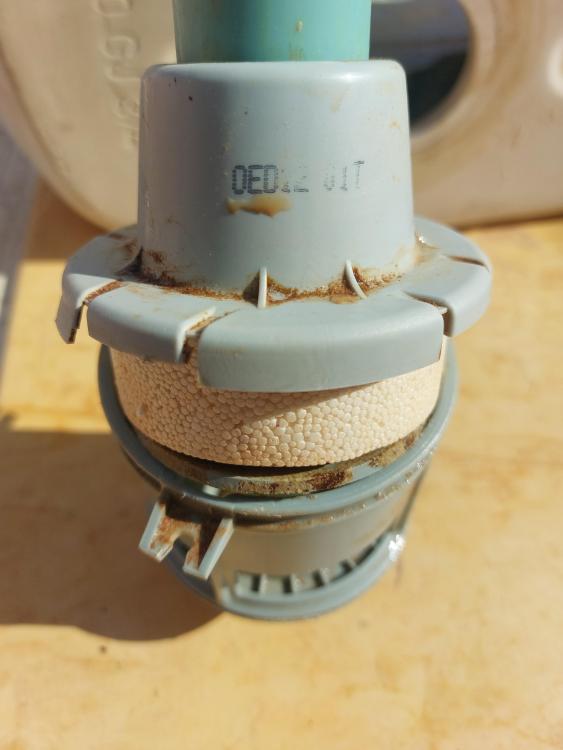
-
Self build funding - what would you do differently!
saveasteading replied to Harmony's topic in Self Build Mortgages
@Harmonyseems to have gone away without any reaction since the first post. Odd. Have we wasted our collective time? I'll turn this subject off. -
I've got 6 runs in operation. 3 are on mains with timers and 3 are solar pumps from barrels. All are tube and dripper systems. All very fallible due to variously. Tubes popping off droppers and connectors. Cats or other creatures pulling them apart. Muck in the droppers. Increased water pressure breaking the connections. Reduced water pressure so drippers not functioning. Battery failure. Valve failure. An underground pipe would add to these problems, or simply hide them. I leave my plants in their care when away, but wouldn't assume all will be well. The watering can is still very well used. My grass never gets watered. Doesn't need it, as I don't play croquet. Roses and most garden plants, rven vegetables only need watering about twice p/a.