


saveasteading
-
Posts
11094 -
Joined
-
Last visited
-
Days Won
97
Everything posted by saveasteading
-
I've done a few buildings ( schools and factories) on steep slopes. My principle has been to build a platform at the higher level, then a conventional framed building on top. That keeps it simple and vastly more economical. No basement as you get into a different level of complexity and risk.( digging into the ground, waterproofing, stability, access) So that is conventional strip footings ans walls up to level . Then beam and block or precast planks make the surface. You are then out of the ground and on a solid surface. With a raft you have a big hole to dig then work in. If the slope is steep there is potential differential movement of the ground. If the slope is extreme then you can perhaps have a natural extra storey or part of one. Worth mentioning perhaps that in a couple of those jobs the original designers had assumed the dig and raft technique or retaining walls and mass fill to make a platform. I met one during negotiation and discussed the principles, and he was simply surprised at the cost difference, not being a contractor. Beam and block then a conventional kit above is my suggestion.
-

This puts any of our challenges into perspective
saveasteading replied to saveasteading's topic in Boffin's Corner
The same rules apply. In efficient structural design concrete beams and slabs would be completely integrated, but these appear to have been designed for speed and tying in has been for location and nothing more. The NY building probably has concrete floors too, tied to the steel with studs. -
Scotland has differing values and goals to a large extent. Hence a left wing government for a long period , despite the voting system being designed to prevent it. So lots is different And lots was not devolved. In summary? More collectivist and egalitarian. Eg social services. Less of a class system Naturally against privatisation.
-
Thats perhaps intended as a distraction. No, but they could get a reduced rate for using non- peak times. It's also common sense, as a no Investment solution. People are entitled to not turn on the cooker any time they choose.
-
I don't think they can except at aonb / heritage sites or where local need is vastly oversupplied. Certainly they cannot on major power lines which is a UK thing, and could go over the Chilterns.... but don't.
-
Wind seems not to be even considered. Solar expanses are going ahead though, on farms and marshes but not large-scale on roofs where it will be more difficult. Can't do that. Farm sheds are designed for about 40% less loading than peopled buildings as the factors of safety are low to nil. And the quality can be lacking. Adding another 20kg/m2 would be unwise. That's what they say in planning applications. Removing all direct sun from a field will obv affect photosynthesis. So I say it's unlikely in a temperate climate.
-
The big detour would cost more. ICs are plastic and about £150, plus concrete, gravel and labour. Needed whatever you do. Another matter is the gradient. Assuming that the drain was designed efficiently, by taking it a longer route you are flattening the slope and it might not work. Say £1,000 diy. Double or Treble that for a good contractor. Add fees for the licence but building control will cover that with the building work. I'd still be digging to find that pipe. But first feasibility on budget and permissions.
-
Agreed, and lots onto industrial roofs: vast areas of metal just sitting there. Just look on Google Earth at a commercial estate near you, and the amount of roof as seen from above can be shocking. Plus they are usually in or near the towns that can take that amount of power into existing cables. They aren't designed for the extra loading but most will have enough if we look at whether snow load allowance is excessive. However if required at planning then the cost of the extra steel and suitable detailing is relatively small. When you and I are asked to sort the world out will you agree that price structuring can also help for both power and water.? Reduced rates for less than the reasonable need per head. Then it increases for anything above that, by enough to subsidise the lower use. And then a curve to make excessive use (car washing, swimming pools, hose use) an expensive matter. This rate can change at times of shortage, so right now we would be charged a lot for uneconomic use of water. The rich will simply pay but that's normal and at least it can be used for infrastructure. The middle ground is where habits can be changed, and I think that is fundamental. The formula will alter according to region and water resources. Sorted.
-
Help with Twinwall Flue Detail Through Timber Frame
saveasteading replied to Stratman's topic in Timber Frame
As often by those from the South, Scotland is up there and is wet and cold. The reality is of a very varied and large place. 3°C colder on average, in the populated areas. Nobody lives on the mountain tops. The west is generally wet. The east is generally quite dry, except last winter when it reversed. The saved Steading area has rainfall much the same as Kent. But if up high then of course it gets colder. Proper winters with snow. We put a woodburner in. It is in a very large open space, including stair well. There is a lot of outside wall, including lots of glass and exposed, uninsulated walls. And yet the one log at a time principle applies. So for there it was the right decision as it is: 1. Expected, esp for rentals.* 2. Very pleasing. 3. A backup in the highly likely occurrence of power cuts due to trees v cables. * paying guests include the wbs in their incredibly positive reviews, so it is also economically justified. This discusson is very helpul and timely for us. We are (were?) currently planning to fit a wbs in our current family project in the scorching SE. I think we may leave it out for now, but the air intake and flue routes are ready if we change our minds. It can be very cold here... I liken it to Dutch winters of a damp cold that eats at your being.... not so much in recent years though. Question. What is a sensible backup if there are long term power cuts? I'm thinking that winter solar might run the basics and a little ufh. Thick socks and jumpers and buy a gas stove or 2? -
I think you may be choosing to reject it. I won't go further into that. What do you favour then as our source of energy? Now and in say 20 years or whenever you consider that carbon fuels will be too diminished, esp if the burning regimes succeeded in banning renewables.
-
Sticking Aerogel to steel
saveasteading replied to Great_scot_selfbuild's topic in General Construction Issues
That's another issue than the fire protection, but a chunky beam that is inefficient in normal use can then use that extra stiffness. Next time you're in a big warehouse , reasonably modern, if you look up at the rafters, they are likely to have diagonal struts. They're not for fire but show how stiffness can be provided. Likewise if a floor is built in line with a beam, or a wall into a column it won't distort. -
Sticking Aerogel to steel
saveasteading replied to Great_scot_selfbuild's topic in General Construction Issues
Without referring to documents.. It takes a huge temperature rise for steel to soften and fail. If it was all exposed to fire the heat would rise more quickly than if some is protected. A skinny section of steel conducts the heat more quickly. So a typical example of partial protection is being partly enclosed by a wall or having a concrete plank floor sitting on it. The steel is not being protected in the long term. Continued heat will make it fail. But it is being designed to remain structural for a period of time. Thus we could find that an exposed light column needs lots of intumescent paint while a heavy section needs nothing or a thinner coat. I've dealt with 3 fire damaged steel buildings. An agricultural one was a write-off. One we had built a few years earlier only needed cleaning and painting. The third was within an external fire wall (steel cladding and fibreglass insulaion) .. no damage other than to the paint on cladding and column (fire officer amazed).(the fibreglass was converted back to sand). I don't know if that's a complete or logical answer, so keep asking. -
This puts any of our challenges into perspective
saveasteading replied to saveasteading's topic in Boffin's Corner
This happened in my uni year one. Tiny portal frames tested to destruction, and thus stuck in my mind thereafter that a frame needs 3 'pins' to form. (You can see that in the photo... top, middle bottom have all rotated.) If it had simply been 10 minutes of a lecture it wouldn't have had the same effect. Dead load becomes dynamic load. Also that the loading of the remaining structure becomes out of balance, and in the RP example the floor collapses are accumulating to be ever increasing loads. -
Does an island need to be fixed to the floor?
saveasteading replied to saveasteading's topic in Kitchen Units & Worktops
Not a pretty sight. And then there is getting out again. How did I know it would be CT1? Or Snibbo as it used to be called. -
This puts any of our challenges into perspective
saveasteading replied to saveasteading's topic in Boffin's Corner
" it’s a steel frame building, so it would not be a total collapse. It would be more of a localised collapse. " Wishful thinking perhaps, or some words to keep the shareholders and banks happy? Steel buildings can collapse. There is an inherent ability for them to crumple and come to some sort of stability if there is a localised failure. But I don't think this was designed for back in 1960. in Europe we have to design to prevent "disproportionate collapse" ie one failed element, eg from a gas explosion, would cause only local damage. see Ronan Point 1968 That's a fire officer...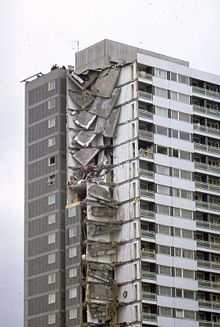
-
Sticking Aerogel to steel
saveasteading replied to Great_scot_selfbuild's topic in General Construction Issues
It's one of these area over perimeter things. So a chunky steel possibly needs no protection, an certainly less... I've had lots of cases, and knowing the principle can save money and also be easier to build. (To the extent of using a structurally inefficient steel because of the fire and geometry benefit... this seldom happens in a linear design process. ) It's the exposed area, so with a fire on the inner face, only that area counts, divided by the whole cross section. Thus a column in a wall is less exposed than one in an open area. The info is provided by manufacturers of protection products. -
This puts any of our challenges into perspective
saveasteading replied to saveasteading's topic in Boffin's Corner
Understand or know how to use them? I was never very close but have since drifted further away. A few seem obvious statements of fact, but the others? Smoke and mirrors. But if I don't believe them to be true then the world will surely end. Anyway, numbers don't exist. -
Does an island need to be fixed to the floor?
saveasteading replied to saveasteading's topic in Kitchen Units & Worktops
Thanks all. The feet look better on this (Howdens) than the moving one* (benchmarx) and it is much bigger. I'm just thinking... one chance / shouldn't stress or rely on the plumbing. *It slides when leant on, then the legs snap or break off the base, then the kickboards have no support. I'll add some sticky stuff and have another look at it overall. -
Kitchen island going in now, using a fitter. I would like to screw the feet down, as we have one that moves if leant against. But the new one is bigger, heavier and has plumbing so probably won't move. The ufh pipes are omitted at the area. Screw into 40mm screed? Or maybe stick it down with silicon or tape?
-
Raising build height and planning permission
saveasteading replied to PSC88's topic in Planning Permission
I probably wouldn't. You are proposing to lift it 200mm above what you previously thought. But is there anything on the drawings that could be used as a height reference? It sounds as if you can only use a scale rule. Is the height going to be referenced to adjacent buildings, the original (gone) or ground level? You will probably raise ground level to match the higher building. If height was considered sensitive then there would be a condition. Can you flatten the drains by using bigger pipes, or finding a shorter route? -
This puts any of our challenges into perspective
saveasteading replied to saveasteading's topic in Boffin's Corner
Fortunately for me, the pure maths can be tertiary or whatever comes after that. Of course I did maths up into uni but there is a big gap between what I could ever fully comprehend and what dedicated mathematicians do. Ie I could repeat a formula with new input but not create that formula. Another difference seems to me to be a grasp of what is happening by way of load transfer in real life, which some of the best theoreticians can't. There is room for all, and it is important to have both, but numeracy has to be on a high level ( people who can't do it think it's a trick / smoke and mirrors). Back to the building failure. It will all have been manufactured offsite. Sometimes a building intended to be raised later might have columns cantilevering above the roof. Another cynical thought is corruption. I've seen a few reports over the years of criminals in develoment who threaten supervisors. Big time threats. We will probably never see the detail as this drops out of UK news interest. -
they become brick slips or hardcore easily. I agree it is wasteful.
-
Sticking Aerogel to steel
saveasteading replied to Great_scot_selfbuild's topic in General Construction Issues
Been reading without comment as I don't know aerogel. But my inclination is to keep it simple and ensure a good, solid and permanent connection. What area of steel are we talking about, relative to the wall area? i.e. is it the biggest deal to get maximum insulation? And what depth is available? There are several makes, too and its available at my local BM (and yours) , Topps and at Wickes, so about £30/m2 and no transport cost. Depending on detail and access, I'd probably stuff the void of the steel to stop that cavity being cold, and also reducing overall heat loss. -
This puts any of our challenges into perspective
saveasteading replied to saveasteading's topic in Boffin's Corner
It looks to me as if the column is not continuous but has a butt joint at mid height, then spliced ( very badly) and all concealed by sprayed concrete or similar. As such buildings are normally designed in great detail, and fabricated offsite, to slot together I'm guessing there has been damage and a bodged repair. -
This puts any of our challenges into perspective
saveasteading replied to saveasteading's topic in Boffin's Corner
These temporary props will be supported on a beam, as the one above, which is supported by a column..... as the failed one. Walk gently. And these are empty spaces with previous internal loads removed.


