
ProDave
-
Posts
30681 -
Joined
-
Last visited
-
Days Won
424
Everything posted by ProDave
-
All our external doors are 1M wide. You will be thankful when trying to get furniture in if you make it wider like that.
-
Not quite. It won't start de icing until 50% of it is iced over. Not much help if the 49% that is iced over is on the drivers side.
-

Hello everyone. 4 years in and two architects later...exasperation
ProDave replied to Stu-UK's topic in Introduce Yourself
I lost faith in architects 15 years ago when building our first house. We had 2 architects come and talk to us. Both wanted in the order of £25K to act on our behalf, and these fees were based on a percentage of their estimated build cost. And they would not negotiate on the fees or scope of work that we wanted. We ended up getting a local building firm to build the shell and they did the drawings for £2K and the total build cost was roughly half what both architects had estimated. We did project manage ourselves and did a lot of the internal work ourselves. I get the impression if you just hand it to an architect and say "build me a house" you will end up paying substantially more than if you manage it yourself appointing trades as you need them. -
Okay the PATH is yours, not adopted. So the Kerb stones are yours. When i was preparing my site entrance, I queried the rules, and was told you only need a street work permit for work on the highway. It gets a bit grey on an unfenced highway edge as they can claim the first 3 metres was part of the highway. I was advised if there was a FENCE between where you are working and the highway, even if the fence is right at the edge of the highway, then you don't need a permit. So I erected a very temporary fence (some steel stakes and some tape) and did the work. So if you do the same, drive a couple of steel stakes in to form a fence, replace your kerbstones on your path, and re surface your path, then remove your temporary fence. Job done.
-
Given the diabolical state of the road, I would do nothing just yet, and make a weekly "road defect" report to your local council. (up here you can fill in a road defect report on line) There is a road defect in our road that has not been repaired and some of the local residents are trying to drum up support for us all en-mass withholding our council tax payments until it is repaired. The neighbour believes that if we instead lodge our council tax payments with a solicitor, he will be able to argue we are not refusing to pay, and the money is there for them to be released when they agree to spend it fixing the problem.
-
Probably a broken flex where it enters the handle. Pretty standard for me to chuck away the orrible short pvc cables on power tools and put a much longer rubber cable on them.
-
I think, like me, you have a Telford unvented cylinder? I have to say I am impressed with the as supplied thermal insulation, and I have take care to well lag all the connecting pipework. I don't "feel" any heat loss and certainly not enough to cause problems. I am pretty sure the foam lagged copper tanks on common sale are a lot worse from an insulation point of view, and a thermal store more so because of the higher temperature of the stored water.
-
As I see it: Yes the sun amp is "smaller" but it takes up just about the same amount of floor space as a hot water cylinder, it's just that the HW cylinder is taller. So a Sun Amp may have an advantage if you are tucking it down down in the eaves where a taller tank might not fit, but otherwise I see little advantage. The main selling point of the Sun Amp is the much lower standing heat losses than a HW tank. That is indisputable. So it comes down to does this advantage outweigh the extra costs and the extra "difficulties"? The big question is how are you going to heat the tank? And the fly in the ointment there is the PCM temperature is too high for heating with an ASHP. Now you might only get a COP of say 2 from your ASHP when heating hot water temperatures but that is still better than a resistance heating element. If you have a lot of PV (and I am not sure 4KW is really "a lot") and can be sure that a lot of the time you have excess PV to heat the water then that swings it in favour of a SA, but don't forget your HW tank also has an immersion heater, so it can do that as well. Oddly enough, to me a Sun Amp makes a lot more sense as a companion to a gas system boiler instead of a HW tank, where you can reliably heat it from the boiler, or (when it is playing ball) from surplus PV. For a "heat pump house" I saw too many disadvantages.
-
I am guessing the planning is to turn it into 5 flats? I can't otherwise think of why you would want to extend what is already a large house So work out from the floor plans if they would be 1 or 2 bed flats, look up what they might sell for, then see if there is enough difference from the purchase price to actually pay for the work and make a profit. Don't forget little extras like getting the DNO to install 4 new supplies as they don't do shared supples any more.
-
Devil's advocate. Bypass the contactor. You can almost guarantee your excess PV diversion will start up at a low power as the sun comes up / goes round so the heat input will be gentle at first rising throughout the day, so the fear of an initial high power input into a solid mass of cold PCM would not be there. Of course anyone doing such, would never admit to it on a public forum....
-
Reading this continuing saga makes me glad I fitted a conventional unvented cylinder. SWMBO does not take well to cold showers and if I had spent lots of money on a new high tech piece of kit and it was not working, there would be calls to "get rid of that POS"
- 186 replies
-
- 2
-

-
- sunamp
- energy efficiency
- (and 1 more)
-
Close to the pump chamber where it passes over a culvert it's only about half a metre down. At the field margin just before entering the soakaway it's about 0.8 metre down. In between it's anyone's guess as 3 trenches over 1 metre deep have failed to find it. I might consider the idea of a tee and a "sample point" capped with a stop end, but better would be to engineer the equivalent of a rodding eye. But if I do re lay it with a new pipe I will be avoiding making a sump.
-
Very much more complicated. That would mean digging up a lot of the top bit to cut it, fit a 50mm mdpe to something a lot smaller adaptor.
-
Converting towel radiator to electric
ProDave replied to oranjeboom's topic in Bathrooms, Ensuites & Wetrooms
Just buy the element and fit it. you can even use it stand alone, i,e just as an electric towel rail not connected to the central heating. Just remember if the pump is running your little element will be trying to heat the whole house,. -
I have just bought this pair https://www.ebay.co.uk/itm/254026764133 a slip and a normal for £10 I hope they are the right thing, just described as "50mm black poly"
-
So far we have only found the pipe in 2 places, one just a few metres from the pump chamber, and one just a couple of metres from the soakaway where it goes into the field. Attempts to find the pipe at intermediate points have just resulted in very deep trenches. This highlights the importance of keeping photographs and notes. I didn't do much of either when we installed this. But I do recall the ground levels were quite different. From the pump chamber, the pipe crosses a culvert over the burn and in essence then goes up a hill to the field. But the reality is the original ground level went down before going up. the ground later gout built up to use up surplus soil and level the garden. This is why I think it is so deep, because it goes down then up. Now thinking about it, that is not good. without thinking about it or considering it, I created a "sump" and any sludge will naturally collect there and my theory is that is where it is blocked. If rodding it won't clear it, then I will be fitting a new section of pipe from the known good point near the bottom, to the known good point at the edge of the field, but any such new pipe won't be as deep and definitely won't have a "sump"
-
The joint I will have to make where I am cutting the pipe, will have to be able to withstand the full pump pressure of about 7 metres head, without bursting, I am not sure that can do it.
-
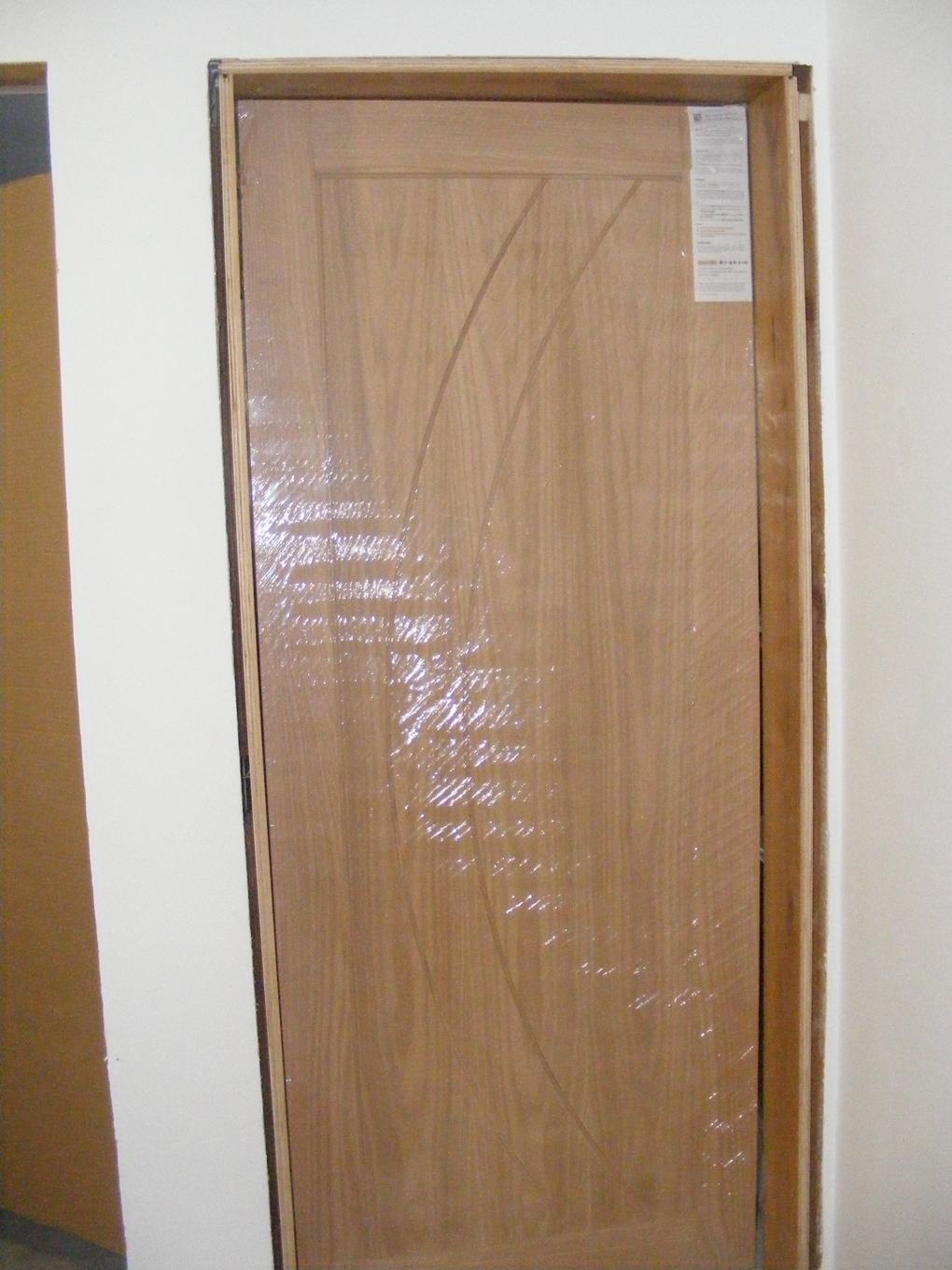
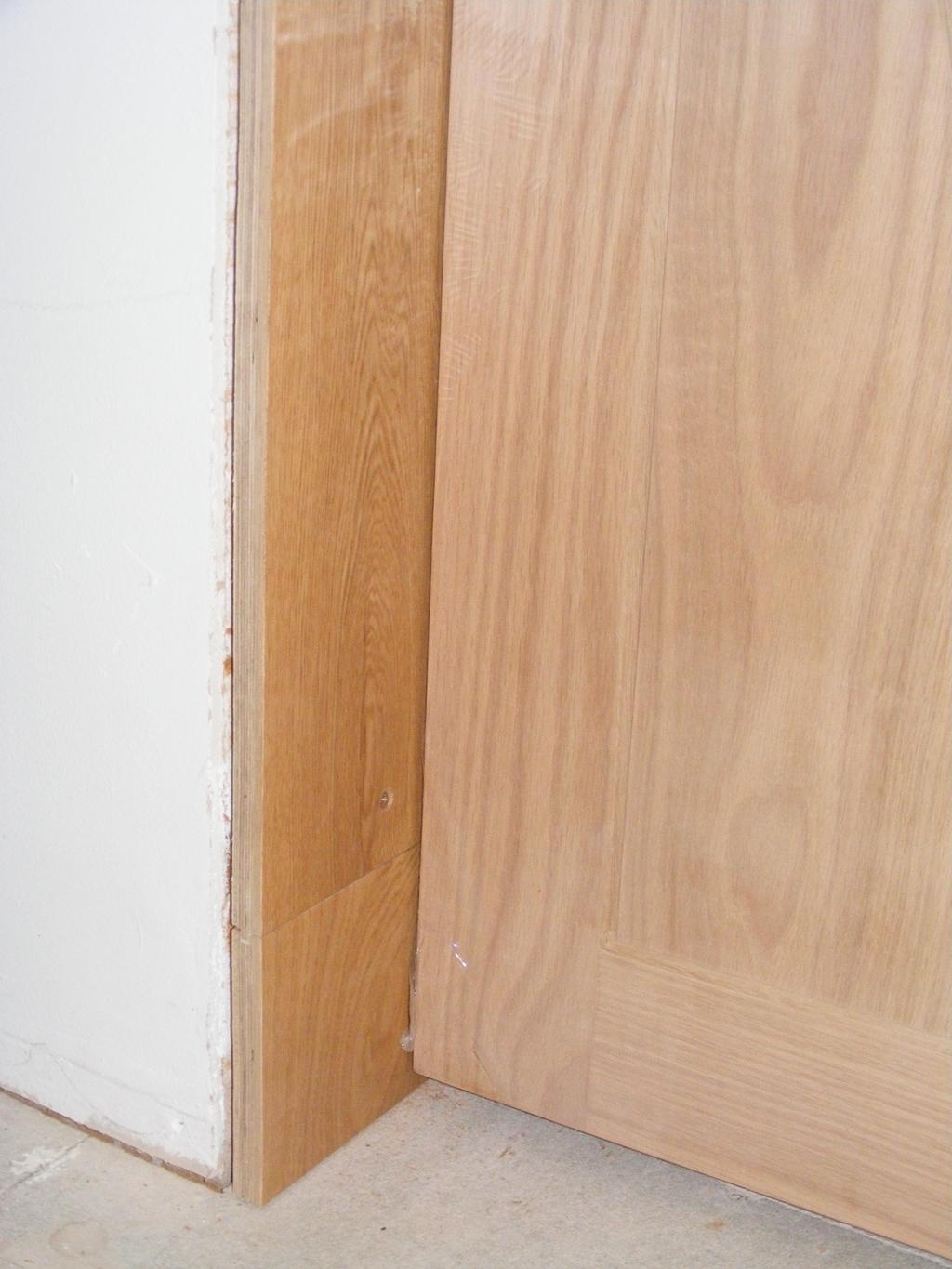
So I had some spare time this morning and did the bare bones of a "floorboard" oak door frame Here is the detail of "that join" near the bottom: We are now "evaluating" it before deciding whether to continue, and waiting for the joiner to visit and see if he ha any better ideas.
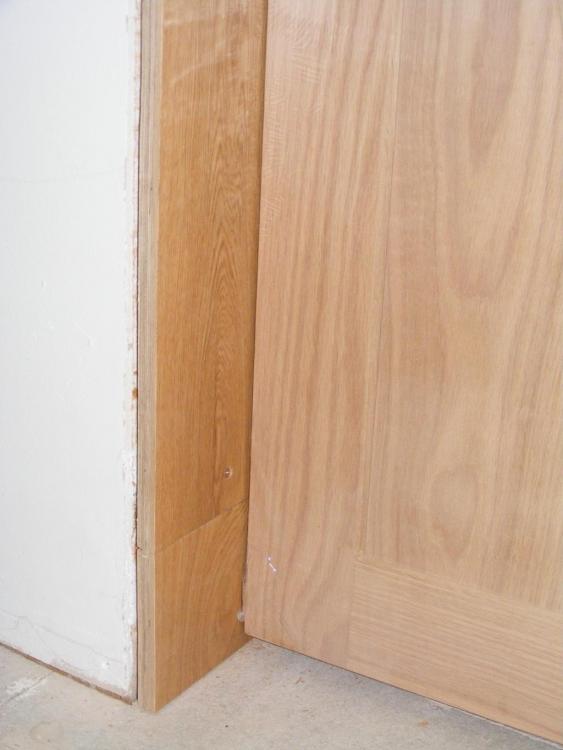
-
Okay an update. The Italian pump arrived today, the only difference for saving well over £100 by buying from Italy direct, was it came with a Schuko plug on the end. The bad news is the pump runs but nothing pumps away and I still just get a dribble from the top "test hole" Next plan, expose more of the pipe at the bottom pit so I can cut it, and then try rodding it from there. Anyone know if you can get a 50mm mdpe slip coupling?
-
Looking for electric system/combi boiler advice please
ProDave replied to MrM's topic in Boilers & Hot Water Tanks
5KW ASHP is heating my whole house and DHW I have an unvented cylinder, with a high capacity heat input coil designed for a heat pump. I heat the HW to 48 degrees with the heat pump. I have a 300L cylinder which is just enough, but there have been a couple of ran out of hot water incidents, so I now have a modulating in line 10KW electric heater that will take over if the tank runs out as a backup for such events. The way most heat pumps work, they heat hot water or space heating, never both together, and they usually run at a lower temperature when doing space heating. -
Noggin ', nogging, dwang, nog: be gentle with me....
ProDave replied to ToughButterCup's topic in General Flooring
Well that depends. It would go on the "might come in useful" stack. you might find you can use it as the first or last bit of the next run. Or like me you will have lots of bits left to make shelves in a shed or garage. -
Noggin ', nogging, dwang, nog: be gentle with me....
ProDave replied to ToughButterCup's topic in General Flooring
You are talking about the first run of boards yes? Boards are 2400mm long and joists are on 400 centres yes? Why do any of the joints of the first run have to miss a joist? Cut one end where it abuts a wall so the joint lands on a joist. Job done. -
Looking for electric system/combi boiler advice please
ProDave replied to MrM's topic in Boilers & Hot Water Tanks
Suspended timber floor, 300mm Frsmetherm 35 between joists (JJI I beam) then UFH then engineered oak floor. Walls, 200mm Frametherm 34 between frame studs, and 100mm wood fibre cladding then render. Same for the roof but tiles not render. U values all around 0.14, just about passable for a Passive House perhaps. 3G windows and good airtightness and mvhr. We are in a valley, the ones they mention in the weather forecast "could be colder in some sheltered Highland Glens" That is us. In winter with no wind it gets cold, record low this year was -14, and not above zero in the day, but the cold spell only lasted 3 weeks this year. The winter has been mild this year, nothing compared to last year. As they pointed out on the weather yesterday, this time last year we were dealing with the "beast from the East" and struggling to stay warm in the caravan. This year I am wondering how long before we need the lawnmower. I hope those heating costs will go down. Once the sun room is done, that should be a good heat collector on sunny winter days. With it just boarded up at the moment the kitchen / diner does not get any solar gain until very late in the day. -
Looking for electric system/combi boiler advice please
ProDave replied to MrM's topic in Boilers & Hot Water Tanks
When the weather is right for sitting in the garden, I doubt the heat pump will be on? The noise might bother you but so will the blast of cold air coming from it. -
Looking for electric system/combi boiler advice please
ProDave replied to MrM's topic in Boilers & Hot Water Tanks
That depends on insulation and air tightness. It has cost less than £200 to keep my entire house at 20 degrees all winter., As long as you get a modern inverter driven ASHP noise will not be an issue. Ours is behind the garage but a small window in the lounge looks out towards it, and we never hear it indoors.