

ProDave
-
Posts
30678 -
Joined
-
Last visited
-
Days Won
424
Everything posted by ProDave
-
There is no other choice if the OP wants the UFH to work without the radiators on.
-
That is looking likely why it was disconnected, but that does not help the OP, he wants the UFH to work on it's own. When he gets it working then if there is a lot of short cycling then we can discuss options to make the UFH work as one big zone all on or all off.
-
Yes, but the point I was making as there are other grey wires with other functions, make absolutely certain these ARE the grey wires from the motorised valves before you connect your UFH grey wire to them.
-
 Crucial question. Is there a difference in ground level between the 2 sides? i.e. is it a retaining wall? If it is a retaining wall it is the ground on the higher side pushing the wall over. If not then it is inadequate foundations that are subsiding. If the plan is to take the wall down in a few years I would do nothing, and if it starts to lean a lot more take the top half off earlier than planned.
 -
Treat it as a space heater. Keep it simple. We have a stove, only 5kW and it is decorative, fun and simple. The main reason for having it is the ample availability of free wood that would otherwise be "waste" that we would have to deal with somehow. I have said many times, if I had to buy wood, I would not have a stove. Trying to heat water with it adds considerable cost and complicates your normal heating system.
-
Clearly that grey going nowhere is why the call for heat from the UFH does not work. You say the black from the UFH box goes to the same connector block as all the orange wires from the 2 port valves. That is good. (it is not clear in your photo which one that is , i think the orange wires are looking more like brown in that photo) So the grey wire from the UFH box needs to connect to the same terminal block as all the grey wires from the 2 port valves. Make absolutely sure you are connecting to the correct set of grey wires before connecting the wire from the UFH into them. and make sure power is off, depending on the boiler this might be switching a low voltage or might be 230V
-
This terminal block. The right hand pair should power the manifold circulating pump. The manifold circulating pump should turn on when any UFH circuit calls for heat. Does that happen? The left hand pair of contacts is a relay contact that should close at the same time. This pair or relay contacts would normally be connected in your case in parallel with the switch contacts from the radiator motorised valves and that would give the call for heat to the boiler when UFH requests heat. Do you have anything like a multimeter to make any measurements? Can you follow the cable that contains those black and grey cables and see where it goes and photograph whatever junction box etc it connects into?
-
That's a good point. My ASHP has switched outputs for heating and DHW so I wired normal motorised valves from that. I could have applied that logic and used NO and NC valves and powered them both from the DHW output. Or I could have used a 3 port 2 position valve, and achieved the same result. But logically from a plumbing point it is exactly the same thing, it would just have saved having the DHW valve energised for a large chunk of the day. I think my point however is, as long as you avoid the dreaded 3 port mid position valve, then the plumbing for S plan or PDHW is the same. PDHW is just bringing gas boilers into the 20th century and doing what ASHP's have done for ages, allowing different flow temperatures to heating and DWH.
-
The problem with heating water with a WBS is that it is an uncontrolled heating source. That adds lots of complications and regulation issues. You don't want the stove kettling and you must make provision for some always on dump load. And any controls must fail safe in the event of a power cut. I would just keep the stove as a source of heat only, as a stove.
-
Surely the plumbing for a PDHW system is still S plan, a mototised valve for each of heating and hot water, but only one is open at a time, and you can have different flow temperatures. That is exactly how my ASHP works but I still think of the plumbing side of it as S plan.
-
Post some close up pictures of the wiring inside the Wunda box with it's cover off.
-
But you mentioned the Humax box, If all you want to watch is available from that (live or recorded) then put it in a cupboard where an aerial connection is available and use the 2 gadgets I linked to to connect it. Most of my "set top boxes" are in the under stairs cupboard.
-
You have proved at 0 degrees outside, 4kW of heat is only just enough when running 24/7 It will sometimes be colder than 0 for several days. Your heat pump can't do heating 24/7 or else it will not have time to heat your hot water. And do you really want it on 24/7 (we prefer a quiet house at night) So i would say a minimum of 10kW ASHP. MCS don't work on real figures so just their own way of calculating, and the last thing they want is to have to rectify an under specified system so they probably take a cautions approach.
-
You can get a wireless "video sender" and then put your Humax in cupboard something like this picked as a random example https://www.ebay.co.uk/itm/296798670157 Then to enable you to control your Humax, now hidden away in a cupboard an IR remote contol extender https://www.ebay.co.uk/itm/235946596471
-
I would not do that. The 10mm straight to the EV charger and only to there. Feed the other 13A outside socket from a different source, even a spur from a nearby ring final, in 2.5mm
-
Undersink terrible plumbing and water damage?
ProDave replied to puntloos's topic in General Plumbing
When you say "water damage" are you referring to the brown stain on the shelf? That looks more like the waste fitting dripping, which should be easy to trace and fix. Agreed it could be neater, but unless any pipes are actually leaking I would adopt the "it ain't broke, don't fix it" approach. Some more pipe lagging would not go amiss -
Ah yes I forgot that quirk of that type of valve. So you need probably a second person looking / listening to the boiler to see if it briefly tries to start as you push the manual lever on the 2 port valve as hard and as fast as you can to make it momentarily turn the switch on.
-
In your second picture, you can see the three 2 port motorised valves all connected to what I believe is the wiring centre above the 2 switches. First test. With everything OFF, go and turn on the UFH. Observe the 2 port valve for the UFH. Does that open? Second test, with everything OFF, manually opening the override lever on each valve should cause the boiler to fire up. Does it?
-
No mains cables should be at least 450mm deep IF it's steel wire armoured cable and properly terminated with proper glands you could get away with it but the point of burying it deep is so no future owner cuts through it when digging the garden. I strongly suspect that cable is just PVC or rubber non armoured if so rip it all out and start again with the correct cable.
-
DIY repair job to chimney removal concerns
ProDave replied to Luke232's topic in Roofing, Tiling & Slating
See this diagonal support on the good side of the roof: You need to replicate that as near as you can on the side where the chimney used to be, then discard the inadequate prop. If you don't feel up to doing that yourself it would be a simple job for a joiner.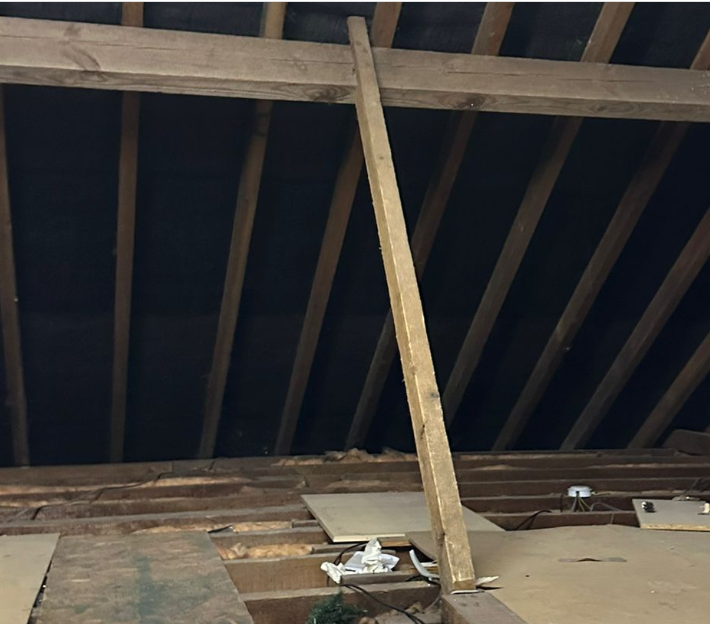
-
DIY repair job to chimney removal concerns
ProDave replied to Luke232's topic in Roofing, Tiling & Slating
Leaving out the tiling of the hole created in the roof for now, I am more concerned at that pile of brickwork on the left, and that rather inadequate timber "prop" sitting on top of it. Can we see more detail of what that brickwork is and what state it has been left in? The actual roof tiling bit apart from the felt does not look too bad, what does it look like from outside? -
Contesting final invoice - please help!
ProDave replied to Tom's topic in General Self Build & DIY Discussion
While you have a substantial payment due, you hold a lot of cards. Get the negotiation done now about the snags. Once you only have a small payment due, then they have less incentive to dome back. List all the snags, like the oustanding plumbing work, kitchen doors and ANY other aspect of the job that is still pending or substandard. Ask for a site meeting to discuss this. -
Contesting final invoice - please help!
ProDave replied to Tom's topic in General Self Build & DIY Discussion
Contact them NOW and raise the kitchen door issue. Make it clear you are happy to pay the bulk of the invoice but you think this part is unfair. If they don't even know about the issue, then how do you expect them to deal with it? -
I bet the instructions said use pea gravel only if not prone to high water table? Lets reset the conversation, apart from the occasional blockage between the final IC and the input to the TP, what is the actual "issue" you are trying to solve?
-
So you exposed the pipe between the final inspection chamber and the inlet of the TP and confirmed it was not kinked. Did you put a spirit level on that pipe when exposed? It must run downhill from the IC to the TP. We need to know if that is the case. If it does run downhill and the IC is not emptying completely, then the TP is filling too full. That could be because it is not level, or it could be an internal baffle has distorted. The baffles usually form a weir between the dirty and clean side of the TP. As for backfilling with pea gravel. That might be okay it might not. At a previous house the installer badly advised me and set a septic tank in pea gravel. The site has a high water table in winter, so if the tank was desludged (emptied) in winter there would be a very real chance the tank could float out. I dealt with the situation by only ever getting the tank desludged in the middle of summer. Even if it did not float out, it could possibly move if emptied at the wrong time.

