


Tom
-
Posts
857 -
Joined
-
Last visited
Everything posted by Tom
-
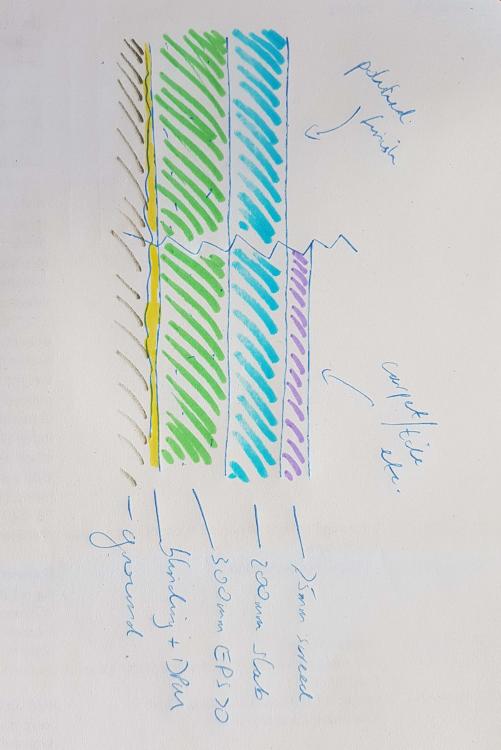
Massive thanks for the replies, all is very much appreciated. Sorry for the delay in getting back, bit of a crazy day yesterday. Haven't finalised other floor finishes but some rooms will be tiled, others wood and bedrooms carpets - so 20-30mm I guess. I just figured pouring the slab in these areas to take in to account these differences would be too big an ask - easier to do it with a screed at the end. We're not pwerfloating the screed Peter, we'll be doing this to the slab in the other half of the build. OK, have done the best I can with the children's felt tip pens! And also a diagram of what I think would be better than everything in the insulation: the 110mm passing through the DPM into the ground. The wastes from showers can T in to the vertical 110mm and travel through the insulation. The toilets can T in above floor level and be boxed in. Does this look reasonable?
.thumb.jpg.682b71622eb523fbf60b916eb466d6c9.jpg)
-
It's' a long story.... well not that long actually. We have a suspended slab over the whole build and in the main living area are having this powerfloated and polished as the finished floor surface. In the rest of the build we have the slab but will be having other floor coverings but it was too much of as ask to get the builders to sort the levels out for different floor finishes, shower tray formers etc, figured it would be just simpler to add a screed. I don't have a section drawing unfortunately!
-
Thanks mate. Is it an experiment? I got the impression from the builder that it would be normal to do. The pipes would be in the insulation, at worst resting on the DPM/oversite and the concrete slab above is suspended rather than ground bearing, so the weight would not be taken by the insulation/pipes.
-
Bueller?
-
My (proposed) floor make up is: ground - blinding-DPM/radon-300mm EPS70-200mm concrete- 75mm screed and my builder wants to run the 110mm drainage runs through the EPS layer rather punching through the DPM and running through the ground. Is this acceptable? I guess I'm worried about the loss of insulation in these areas (albeit less than half of the 300mm thickness). He is also saying we need to do the same for the narrower drainage pipes from showers and basins and T in to the 110mm in the insulation layer. Again, is this what's done? Seems to me too many joins with potential leaks somewhere I will be able to do naff all about once the slab in poured. I'm rapidly losing faith in my builder - not least as we have yet to get above floor level and he has already managed to pour one ICF wall in the wrong place. Not a good week this week ?
-
?thanks Moonshine
-
If it's in an AONB then Class Q PD rights don't exist - any application will fail. It'll be one of the first things the planning officer will look at!
-
?thanks. Ours is coming direct from the factory I believe, so guess no stock issues. Reassuring to hear you got your money back.
-
Hmmm, kinda. Tried to call just now but apparently it's a religious holiday today and tomorrow - was hoping for delivery end of this week. Seems legit website, trustpilot, checked companies house etc.
-
Has anyone got any experience of Tzur steel? Paid them a lot of money for mesh rebar last week...
-
I was just thinking that if tied to the bottom mesh we can bolt braces down anywhere without worrying. I can see this would affect responsiveness, but is that too much of a concern? For the main living area we are having the powerfloat as the final finish (albeit polished a bit and sealed etc), and one of the contractors said having the UFH pipes attached to the upper mesh would be a nightmare with moving the hose around, damage from boots etc etc. He recommended having it on the lower mesh. This slab would be going in after the ICF walls so no issues with bracing or anything though.
-
Thanks Russell, will send him a PM. So, hypothetically speaking, if you were given a choice between: 200mm slab with two layers of mesh with UFH tied to LOWER mesh (i.e 150mm from surface) + 20mm for tiles or carpet etc OR 200mm slab, UFH on the top covered with 75mm screed + 20mm for tiles or carpet etc which would you go for? Both would have 300mm EPS below the slab. I'm thinking relative cost, floor heating responsiveness (big deal in a near passive house?), ability to "store" heat etc
-
...though would we still need a screed for a final/level finish, even if we plan tiles/carpet/wood flooring in various areas?
-
Thanks Nick. The issue is we need something to brace our ICF walls off while they're poured, and would need to bolt in to the slab for these, so having the UFH pipes in there would cause problems. Our slab is 200mm thick with two layers of mesh. It was initially spec'd as having the UFH pipes attached to the top layer of mesh, hence the issues with the ICF braces and thinking we could just take the pipes out and put in a screed over the top bwhen the walls are done. Tbh can see no reason why they can't be tied to the lower layer of mesh in the first place which would keep them out of the way of any bolts/screws.
-
Yep, clip rails or the castellated panels, either way UFH pipes on the slab then screed over the top.
-
I'm not bothered about response times tbh, I quite like the idea of having essentially a big storage heater! I'm sure I can't be the only one looking to put pipes directly on to a slab and screed over the top? Would the pipes fail due to differential movement or something?
-
I've approached Wunda to give me a quote, but they are saying my proposed floor make up isn't possible. We plan to have an insulated slab, UFH pipes fixed directly to the top of the slab, then 75mm screed over the top of this. From what I've read this doesn't seem completely nuts, but they are saying they can't recommend fixing the pipes diectly to the slab. Is there any reason why we can't do what we plan?
-
mortar "waterproofer" for structural concrete
Tom replied to Tom's topic in General Self Build & DIY Discussion
I guess because the ICF forms are not waterproof, and the poured concrete in the middle is continuous with the foundations, no damp proof membrane? -
mortar "waterproofer" for structural concrete
Tom replied to Tom's topic in General Self Build & DIY Discussion
We're mixing the first few courses by hand (albeit in a tub mixer) because of various things. -
We've started to pour our below-ground ICF (Nudura) and the builder is using a martar waterproofer, on the container it says not to use in structural concrete or concrete containing rebar - both of which ours is. Builder says "everyone does it, mate" - but, as ever, I'm worrying. Should I be?
-
Not enough glue in 22mm Egger Chipboard installation?
Tom replied to Adsibob's topic in Floor Structures
This sort of thing really gets my hackles up - and you know for sure the builders will be shaking their heads and raising their eyebrows at each other, simply because you are insisting on getting it done correctly. You can also be equally sure they won't be seen for dust after the build when your floor starts creaking... OP, get it redone properly - yes, perhaps they might cut corners elsewhere to recoup the cost, but equally they will pay more attention when you next explain how you want something done. -
Thanks Gus, some good things to look in to there. The only thing that has changed recently is we had to replace the pump, might have a chat with the people who did this and see if they have any ideas.
-
Yep, it's being tested tomorrow ?
-
Thanks both. It tastes metallic, like rust, but is clear - hence I'm guessing (from my web research) that it's ferrous iron. It goes rust coloured when allowed to oxidise eg - leave a glass of it overnight. I remember reading JSH's blog about his water treatment shenanigans a few years ago, and praying at the time I wouldn't have to go through the same faff! I guess I'm just wondering what experience people might have of boreholes over time - do they change like this - then go back to how they were? Could I be right in thinking the rainfall a few months ago would have affected it like this?
-
So as far as I'm aware there have been no problems with the water from the borehole since it was put in years ago, and certainly when we moved to site in February and started drinking it with gay abandon it was fine (we also had it tested - all good without any treatment needed). In the last few weeks however it has started to taste of iron and has started to leave rust stains in the shower, basin etc. Cosmic. It comes out of the tap clear but goes red when oxidises, so I guess it's dissolved/ferrous iron. I'm not bothered about the rust staining while we're in the caravan, and have switched to bottled water for drinking, but does anyone have experience of this? Can we expect it to go back to normal at some stage? I guess this might be due to the ridiculous wet weather we had in April/May-ish. If it has changed to this I guess there is every chance it will change back?

.jpg.3d1a23ed30582ee057aeb494a4358e6f.jpg)
