garrymartin
-
Posts
553 -
Joined
-
Last visited
-
Days Won
7
Everything posted by garrymartin
-
 Possibly another good example of how things change. Probably thinking about terrestrial TV, Satellite, and UHF radio at the time. Then you could buy adapters for either end of one cable that multiplexed all three into a single cable at one end and broke them back out again at the other meaning that you only needed one cable, but when the multiplexors first came out they would cost more than running three cables! But they were valuable if you only had one cable because the cost of ripping stuff out, running new cable, and redecorating was higher.
 -
Always possible. The proposed site has access to Ultrafast 1Gbit FTTP... Need is such a strong word... 😉 My experience tells me that if I put the minimum amount of cabling into key locations and then *in the future* need to do something else, it will be far, far more costly and difficult rather than paying a small price premium for cables I may not need at the point where access is easy. You only have the think about the various interactions of technology and the choices you might make. The first streaming sticks were capable of just plugging into your HDMI port and working over wireless. Then you started needing to add USB power to them as the power requirements for additional features increased, and some TVs didn't have USB ports that could provide the power. Then TVs started having powered USB ports. Then it was suggested you might not be able to stream at high-def at high frame rates. Then the sticks started using quicker wireless standards and wireless network speed caught up. I have USB extension cables from my media hub to two current TVs in the lounge and playroom (though the kids are too old to call it a playroom now). I put them in because it allowed me to do some clever things with the Wii and Playstation at the time. Since we don't use the old Playstation any longer and the Wii will work quite happily on radio frequencies, they are no longer required, but they are also not doing any harm stuck behind a wall. Of course, if your personal circumstances or the design of your house make routing cables difficult or expensive, then you can make a personal decision about what you want to do. But for me, when it's easy and the cost is low, I'd over-engineer the solution every day of the week.
-
MBC Timber Frame Open Day and Factory Tour 13th July 2024
garrymartin replied to garrymartin's topic in Timber Frame
Gotcha. For timber/materials questions I currently have... Materials and sources - what type of wood? where from? is it sustainably harvested? what treatments are applied? how do you ensure supply? how do you manage fluctuating costs of timber and materials? -
MBC Timber Frame Open Day and Factory Tour 13th July 2024
garrymartin replied to garrymartin's topic in Timber Frame
I am still planning to be there tomorrow if anyone has any questions for MBC or, indeed, about timberframe in general. I've asked, and they are happy for me to take photos and post any questions and answers on the Buildhub forum so I'll update this thread sometime over the next few days. -
Never happened to me... Nothing to see here... Move on... 😉 🤣
-
I'd rather have one and not need it than need one and not have it! Of course, it all depends on the economics and ease of doing something. If the route is particularly tricky or long or would require runs parallel to mains cables, then maybe I wouldn't bother. But if I had easy access, and bearing in mind HDMI cables are relatively cheap (unless you've been conned into the high-end super cables), then I'd do it just in case.
-
As the forum search isn't the best, here's the link
-
If anyone needs to go further for any reason, best to look into HDMI repeaters rather than longer cables.
-
I was going to suggest that if no part of the development was going to be in the area that had been added in the second red line plan, you could use the original red line plan, and use a blue line to show the additional land that is within your ownership now. However, you noted above that the proposed development overlaps the (incorrect) red line. I honestly can't see any way forward other than a new application. It isn't just about the planners, it's a material change that would need to provide for other people and other departments/organisations to comment on your application.
-
It's not a *bad* idea per se, depending on the distance from any TV to the source devices. Although you can do HDMI over CAT5/6 etc., it's often more expensive and can sometimes come with issues of compatibility. In my current house, every TV has one HDMI cable that runs back to a matrix HDMI switch where various source devices are connected, a coax that provides Digital TV and Satellite connections, and two CAT5 cables, one of which provides wired Internet to the TVs and the other allowing "expansion" with various devices. These CAT5 cables route back to the same location as the matrix HDMI switch. The HDMI matrix switch allows any TV to select from two BT HDTV boxes, a Wii, and a NAS. If I ever get to self-build, each TV location will have an HDMI cable (possibly two), two coax, four CAT6 cables, and some single-mode fibre for future-proofing.
-
As of 2023, approximately 8.4% of new homes in the UK are bought with cash. https://eyeonhousing.org/2024/01/all-cash-share-of-new-home-sales-remains-elevated-in-2023/
-
I'm sure those that have gone through this will be along with some real-life examples, but for reference, take a look at https://app.croneri.co.uk/feature-articles/health-and-safety-file-key-document-site-safety
-
Great news. Glad you got it sorted.
-
The below is a good article that covers the mechanisms to effect change and the likely timescales. It also directly references reverting the changes implemented to the NPPF in December 2023. https://www.farrer.co.uk/news-and-insights/whats-labours-plan-for-planning-what-we-know-and-what-the-new-government-could-consider/#:~:text=We expect the NPPF changes,six months to a year.
-
And don't get me started on Affordable Housing contributions. My LPA want £12,797 from me in Affordable Housing contributions despite the fact I'm proposing a *single* self-build development! They are using the vague wording of the NPPF and the PPG because they are a 'Designated Rural Area' to set a requirement that should be a *threshold* of "5 units or less" to actually set the requirement effectively at "1 or more" as 1 is *less* than 5! Now there should be an evidence base and local justifications to support any lower threshold but there are none and even the financial viability report does not mention self-build, only "developer profit margins" concerning viability, and there are no developer profit margins in self-build! I tried to challenge it through my appeal but the Inspector declined to comment due to it not being necessary until the Technical Details Consent stage, so I've gone full FOI request on the LPA today! 😉 https://www.whatdotheyknow.com/request/evidence_base_and_local_circumst?nocache=incoming-2696710#outgoing-1686147
-
There are some notable of examples of where Local Authorities have got this *so* right though, so there are models for success (although that doesn't necessarily direct address the competence question...) https://www.mikhailriches.com/project/goldsmith-street/ Of course, there are issues related to Right to Buy that will inevitably mean not all will remain as social housing, so that's potentially another area that needs some sort of reform.
-
There's also the New Homes Bonus. My LA picked up a £620,123 bonus for the last year. https://www.gov.uk/government/publications/new-homes-bonus-final-allocations-2023-to-2024
-
Given my personal circumstances, I'm very much looking forward to that one!
-
It's not so important that they are A or B (but they should really be B), only that both ends follow the same standard. If you've wired one end as 568A and the other as 568B then I think (been a while and this is from memory) that you'd get PoE but data pins would be reversed and would not work. Of course, you'd have to plug the cables into the wrong ports on a tester too, but that's my best guess at this point.
-
What sort of tester are you using Mark? Are you using the correct "port" in the connector for the standard you have wired to? What connection standard are you using (568A,568B) and is it matched to all the other cabling in use?
-
Bricks with holes in them. Continental style.
garrymartin replied to saveasteading's topic in Brick & Block
Depends on the blocks. Generally lighter than the concrete equivalent in size. There's a growing number of UK houses being built using Porotherm blocks which are very similar https://www.wienerberger.co.uk/tips-and-advice/blockwork/what-is-porotherm-and-why-should-you-use-it.html -
No Idea on price - Does this sound weird?
garrymartin replied to GEO-PAR's topic in Bricklaying, Blockwork & Mortar
Never work on the basis of trust. If they're reluctant to give you an estimate, how can you possibly budget or plan? Set expectations for them if need be. Research what a reasonable m2 rate for the type of bricks/blocks you are using and the design and conditions they'll be working in and use that as your benchmark if they won't commit to a number they come up with. Get it in writing. If they're not prepared to do that, move on. Do you think a professional employer would continue to pay them a wage if their performance did not meet expectations? It sounds like you may be a little inexperienced in some areas and that might leave you exposed if you are project managing this yourself. Can I suggest you at least get hold of the following two books to arm yourself with some knowledge and expectations when discussing tasks with sub-contractors? https://www.amazon.co.uk/Housebuilders-Bible-15-Mark-Brinkley/dp/1916016839/ https://www.amazon.co.uk/Chudley-Greenos-Building-Construction-Handbook/dp/1032492880/ -
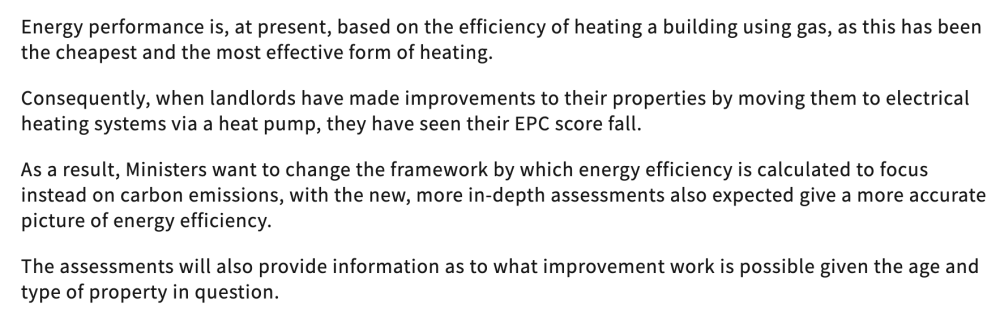
No idea. To be honest though, I thought it was recognised that EPC was flawed. At least before the changes this week, the government was consulting on a new Home Energy Model...
-
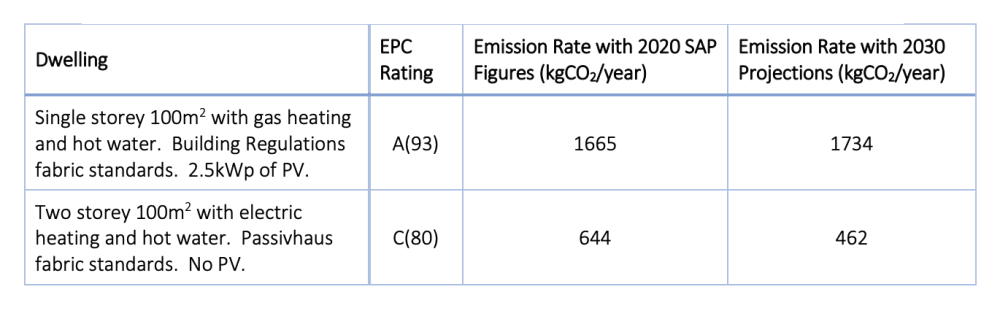
EPC is severely flawed and can be "gamed" very easily. See the below for just one example from https://www.passivhaustrust.org.uk/UserFiles/File/research papers/EPCs/2020.04.17-EPCs as efficiency targets-v9.pdf
-
I inadvertently answered your question while you were writing it! See my post above 😉