
Stones
-
Posts
3761 -
Joined
-
Last visited
-
Days Won
23
Everything posted by Stones
-
 Superbly summarised!
 -
How much weight can the steps take before flex becomes an issue? Can't wait to see the finished article!
-
I've got to seal around some electric cables where they go from insulated to uninsulated space. IIRC the PVC sheathing around electric cables doesn't react well with XPS, or it may be EPS (can't remember). It may also suffer when in contact with other materials / products. Can somebody refresh my memory as to what products I need to avoid using to seal around cables - expanding foam, silicone, caulk? If I wrap the cable at the relevant point with electrical tape, can I avoid the PVC degradation problem?
-
I would agree with that 100%. Perfectly possible to have your own water supply but a quick read of this and previous entries will give a flavour of the work you would be letting yourself in for. Electricity - if you are talking about reducing dependance on the grid using the likes of Solar PV, then yes, it may be worth doing (depends how much it would cost to install, whether you want to make provision for storage), or do you want to be off grid? If the latter you really have to ask yourself do you really want to be at the mercy of an intermittent supply (Solar PV, wind etc) or have to rely on a back up generator. Sewage - I would far rather be connected to mains sewage than have a treatment plant. The novelty of having to inspect and service a treatment plant soon wears off!
-
All very helpful. We've been out visiting a couple of self builds today, one helpfully had varnished oak, the other oiled. We certainly prefer the oiled finish, so it will really come down to test patches to see whether its Osmo or Danish. Interesting point about cleaning the floor, and TBH something I hadn't considered. We had been veering to a brushed and oiled finish, but I can certainly see the benefit of a lacquer finish in this regard. What product do you use to clean your floor?
-
My Options on mvhr
Stones replied to janedevon's topic in Mechanical Ventilation with Heat Recovery (MVHR)
The filters in our last unit were simply cut from large sheets of filter media which you could buy per metre online (rather than pre-cut from the manufacturer at 10 times the price). http://www.justfans.co.uk/synthetic-air-filter-media-1000mm-1000mm-p-642.html?gclid=CJr1ha7yqMACFRDItAodxz0AHQ&osCsid=5tri9fcf5dksj8l7uc5gfddt84 The unit we have bought for the new house (Vent Axia) has the filter media enclosing a metal frame, but my good lady has already indicated she'll be able to sew a piece of filter media to fit round the frame as and when it requires replacement. This company came up as a source for reasonably priced filters on ebuild http://www.jfilters.com/ -
Scottish parliament Committee 'expert' opinion
Stones replied to jamiehamy's topic in Environmental Building Politics
I thought I had posted last night, but obviously didn't submit. My initial thought had been a significant amount of dumbing down for the audience in question, and that I wouldn't want to live in a house she had had a hand in designing. However, there are some useful discussion points raised. Insulation levels - we have previously discussed the cost / benefit of meeting or exceeding passive levels of insulation. When framed in terms of fuel poverty, and how much it will cost future owners to heat a property, pushing for ever higher levels of insulation and air tightness seems like a positive thing to do, but as many of us have found out, spending an extra £2K on insulation to achieve £20 or £30 a year saving in running costs doesn't make much financial sense. Where should the burden fall - house builder or successive future owners? The same applies to Heat Pumps, SAP penalises the use of direct electric as a fuel source, yet in many low energy homes, it could very well be the most practical and cost effective solution. The only way to get around SAP is to install a heat pump, but in a house that only requires a couple of thousand kWh a year for heating does this make sense, especially when you live in an area that already produces over 100% equivalent of its electricity requirement from renewables? I actually think this is one of the biggest issues we face, but how can politicians deal with problem without being critical of the majority of the population (never a good thing when you need their support for re-election)? -
It's a very important point you've made. The restrictions applied are there to protect the character and appearance of the area, and you've bought into that, presumably with full knowledge of what you were doing. The same applies to Conservation Areas, and Listed Buildings. The restrictions may be frustrating, and yes there may be an argument that the restrictions are too tight, but a line has to be drawn somewhere. Relax the rules too much and the area might lose that special character that makes it what it is.
-
My own preference would be getting someone in to do all the work you have described. You have to weigh up both the time it would take you to do it and the hire / fuel cost, vs the cost of getting someone in (with a bigger machine?) who could do the job in half the time. If you really want to have a go operating a machine, remember you will have landscaping to do.
-
+1 on investigating the treatment plant / soakaway option
-
That's the method I used on our kitchen worktop, albeit I had to rub that down with fine grade wire wool first as the kitchen suppliers had initially applied oil with a brush and it looked awful.
-
BT Openreach have an obligation to provide you with a connection free of charge up to a value of around £3400. I believe that if the work is going to cost more they can charge you the entire amount rather than just the excess, so I think Dave is spot on. Get a suitably approved contractor to put in a duct and then get back to Openreach. Always amazed by the experiences posted on here about Openreach. They have (so far) been great on my build (an indeed on all my previous builds). I filled out the form via Openreach New Sites, had my acknowledgement within a day giving the local guy's contact number. The local chap told me where my connection would be made and asked me to call back a week or so before the digger was due on site. I did so, he came out the following day, and marked the position of the cable I would be connecting to. He came back out the day the digger started with some split ducts to put around the cable that runs across my driveway entrance, and left me a roll of SWA cable to run into the house.
-
We used danish oil in a previous house for an Oak worktop in the kitchen, and have to say it did look nice. Is there a huge difference in terms of finished appearance between danish and osmo oil? I don't have any of the facings / doors yet although that time is fast approaching. Testing is certainly on the cards, but it would be good to narrow things down, and so far everything is poiting to an oil of some kind. Assuming we do go for oil, how onerous is preparation and anything required between coats?
-
A great deal of conflicting advice out there, and I'm sure there will be a range of views here. We are fitting oak skirtings and facings, will have oak veneered doors, and plan to fit a oak flooring (still not decided on whether it will be solid or engineered) over 2/3 of our floor. What I want to avoid is the orange look you sometimes see in finished oak, and have the deeper colour you more often associate with an oak worktop. My inclination therefore is oil, which would mean going for an oiled finish to the floor (rather than lacquer) and unfinished doors so we can oil them to match. Of course the inverse could apply, lacquered floor, pre-finished doors and varnished woodwork. Any suggestions thoughts? Danish or Osmo oil? Varnish - type/suggestions for particular product?
-
We rarely use ceiling lights in our main living rooms and bedrooms, favouring table and floor standing lamps. Consequently we are going for a 5amp circuit in the main living area, as this seems a great (and cheap) way to facilitate an interesting lighting scheme. Kitchen will have LED downlights. Still undecided about what to do in the bathrooms...
-
Of the 6 houses we have built, the current one is the only one that has used rafters in certain areas (engineered trusses elsewhere). These came as uncut lengths to be finished on site. With our wall plate and ridge beam both fitted and leveled off by a site laser, the joiners were able to cut all rafters to the same length, I suspect saving a great deal of time. Our previous builds have all been engineered trusses, this being the standard offering of by most (if not all) Scottish TF suppliers.
-
Have you been calling insurers direct or have you gone through a broker? I would suggest that for anything non standard your easiest (and most cost effective ) route will be using an insurance broker.
-
When we built our last house, we went into a lighting shop that had an in=house design team. After explaining what we were thinking of, we were taken through to meet the design team. On the way through, the lady casually asked what we were thinking in terms of budget. We never made it into the design teams office, being gently steered away into the showroom (it being made obvious we didn't have enough money for a 'designed' solution!). Despite this, we did actually try and order a light fitting from them, only to be told it had been discontinued. I didn't go back...
-
My builder uses Soudal Fix All High Tack as his weapon of choice - won't touch anything else.
-
Yes, really pleased with how it looks so far. Can't wait for the scaffold to come down to get a proper view. As far as I understand it, it's a four stage system. Base coat with fibre glass mesh, skim, prime then top coat. Hoping it will be this coming week so should be able to update soon. No eggs sadly... Yes, if you have a look back through the blog I've posted our plans. The house is basically two interlinked buildings set out parallel to each other, one section with bedrooms, the other living accommodation. Large dining / lounge 9 x 5 m, full height vault. A mezzanine of around 14 m2 looks out over this room and is located above the kitchen, utility and a small snug / reading room. I put my MVHR ductwork in before they put the plasterboard on, as I found it easier working from floor level. I was in the loft space to fit and secure the ceiling valves in place but no real hardship provided you use some boards to work off ( rather than balancing off trusses). Certainly worth doing whatever work you need to do before the electrician and plumber gets there. I have a fairly easy route into the now loft space through what will be a wall hatch off our mezzanine, so getting in isn't a problem. We're not planning recessed downlighters, but do have our eye on some surface mounted LEDs for the ensuite, shower room and hall and pendants to the bedrooms, so no real problems for us in terms of lighting. I have a cunning plan to deal with wire penetrations through the ceiling plasterboard which I'll elaborate on further down the line (assuming it works!).
-
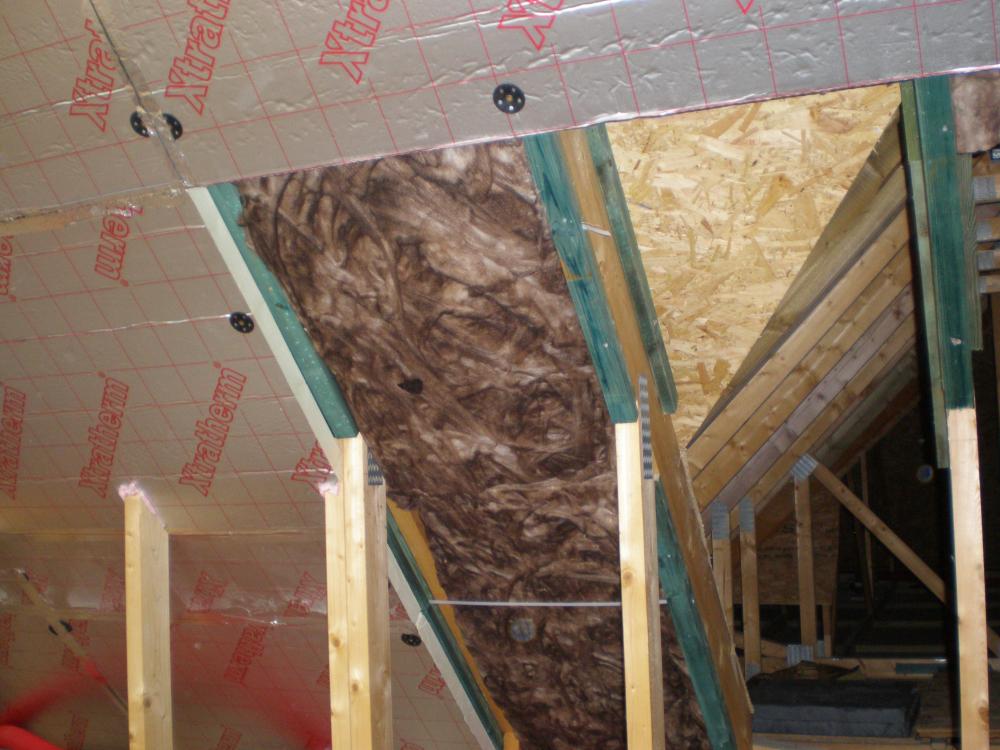
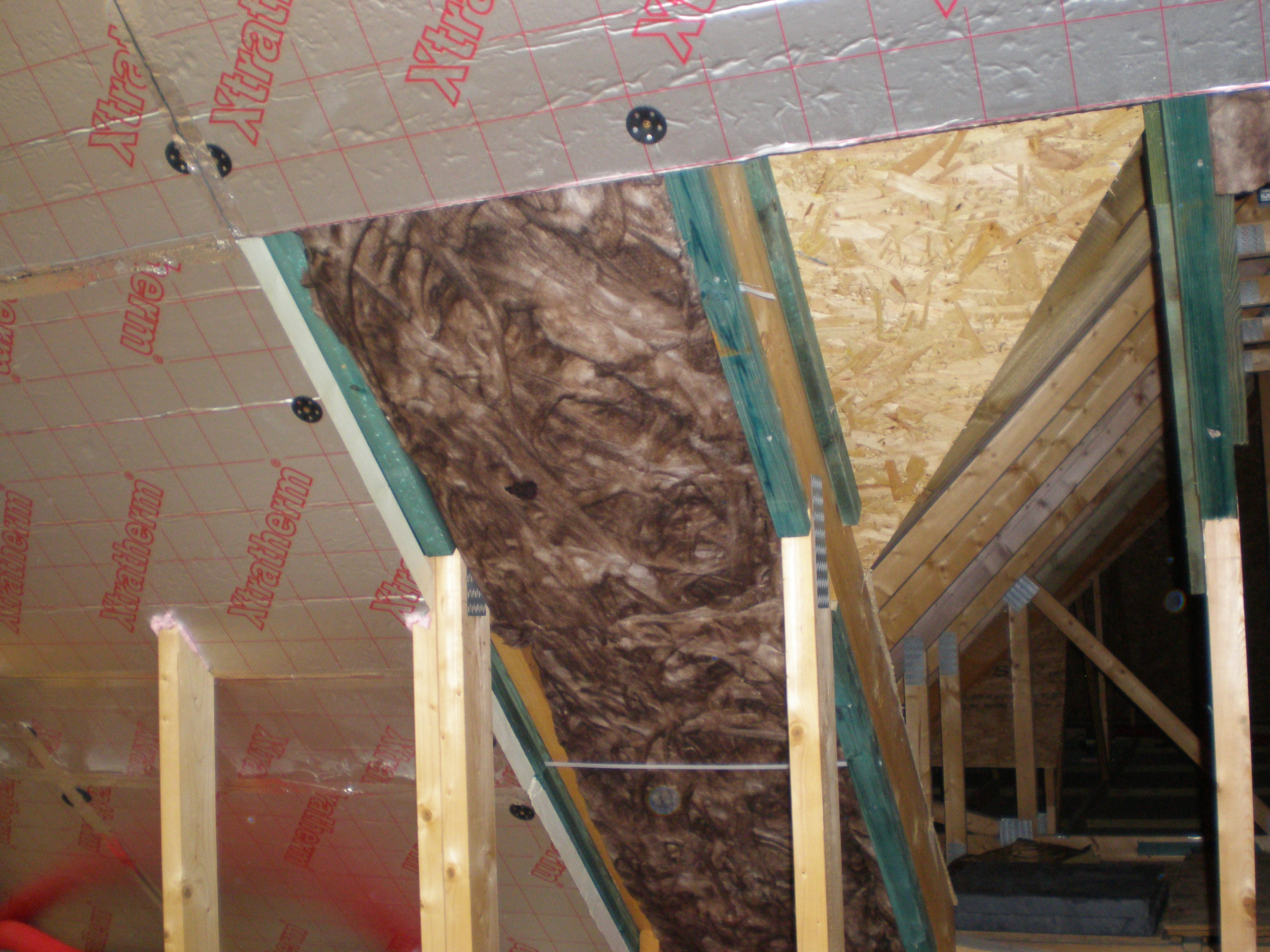
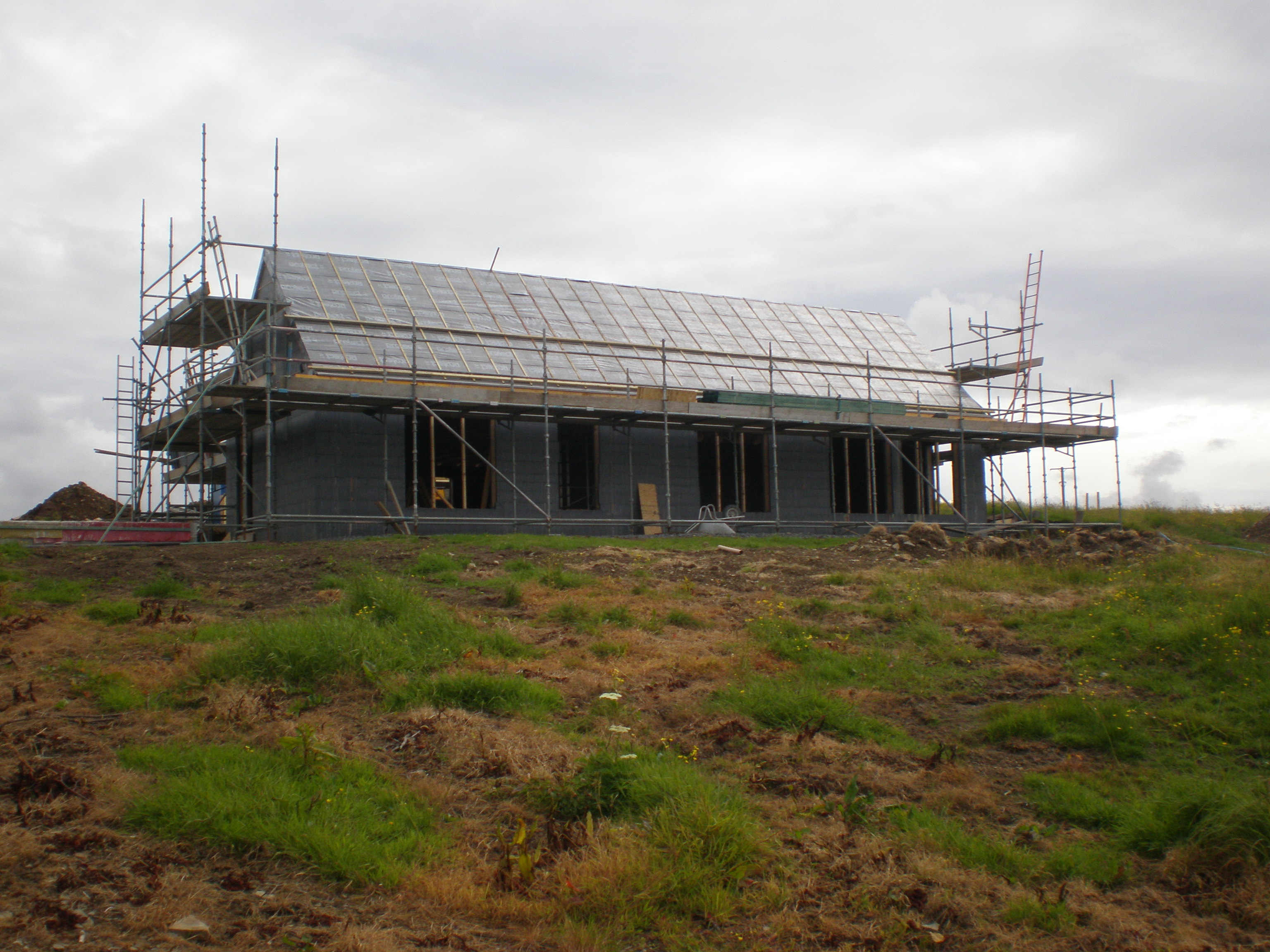
There has been progress on all fronts over the last couple of weeks, inside and out. Taking advantage of some good weather, the joiners pushed on with the larch cladding. We still have one wall to finish off and around the entrance door, but due to a shortage of cladding (a slight under ordering) we will not get this finished for another week or so. It looks very crisp at the moment, but we still have various cover pieces at the corners, to the underside of skews, window reveals etc to finish off before the cladding is complete. I do have a fantastic joinery team on site, who are very particular in making sure the cladding is being well fitted, produce nice straight lines of stainless steel nail fixings and ensure board end joints are flush. On the other part of the house, the windows have all been masked off and the EWI buffed with a giant orbital sander to make sure the surface is level prior to the application of render. In the picture you can see a base coat of render has been applied for the bellcast. We have most of our beading fitted now, but encountered another unfortunate shortage - the local building merchants all being out of 6mm beading used for the render system we are applying. Fresh supplies are en-route, so only delaying things by a few days. Our treatment plant also arrived, which meant a 'crash' course in loader driving for me! Fortunately it came on a large pallet which meant unloading was straightforward. Inside, battens have been fitted to create a service void, plasterboard ceilings are up, partition work started and insulation work to the vaulted ceiling started: Over the flat ceilings we have 450mm of earthwool to go in, albeit this won't be laid until after first fix. On the vaulted ceiling, tile battens are fitted to the underside of the OSB sarking to create a ventilated cavity. An additional tile batten was then fixed onto the underside of the rafter to give us the required depth to fit 2 x 90 mm frametherm 35 earthwool batts. 50mm board insulation across the rafters follows, then further battens for a service void and finally plasterboard. A large part of our roof is vaulted, so no truss uprights to worry about, but where we have them they will have nothing more than plasterboard as they are within the insulated envelope. This gives us the option of having a warm storage space if we so desire. The gap through you can see in the last photo leads to section of the house with flat ceilings. I have taken the opportunity to lay all my MVHR ductwork from a central point above our entrance hall, and to install ceiling valves. Using a radial system has been far easier than previous installations I have DIY'ed, where I had main duct runs with branches off. The crushproof radial ductwork is just far more user friendly and dare I say forgiving. My MVHR unit will eventually be positioned next to the plenums. Being a cold roof space, my intention is to insulate it with a simple box made from board insulation. Any ductwork not covered by loft insulation will be wrapped in foil backed insulation. All being well the insulation work to the vaulted ceilings and the remaining partition work should be completed by the middle of next week, ready for the plumber and electrician - first fix. Last but not least, a couple of visitors have taken up residence on the pile of quarry dust we have on site...
-
But isn't what you are saying your interpretation of a guidance document? You refer to: Paragraph 37(2): "In dealing with such an application the authority shall have regard to the provisions of the development plan, so far as material to the application, and to any other material considerations." If the local development plan, which of course will have been through an examination process by the (Scottish) government before it is adopted, has as one of it's policies that redundant or derelict buildings can be replaced, because they are detrimental to the overall amenity of an area, I'm struggling to see how it is unreasonable to condition their removal prior to development commencing. I doubt we are going to agree on what is reasonable and unreasonable in this case, but does that not go to show that it is about interpretation?
-
New topic following on from information here: Copies of relevant posts This very much depends where you live. Up here, when planning consent is granted for the replacement of an existing dwelling / redundant building, there is usually a condition requiring the removal of the original dwelling before any construction work on site. An anecdotal about house prices, when we sold our last house, 130 m2, we were in direct competition with a more recently built house of nearly 200 m2. Our house sold quicker and for the same money. Why - our house was a one off design, had interesting features and spaces and a good quality finish and nicely landscaped gardens. The other house, although newer was a basic off the shelf kit design from a TF manufacturer and had little in the way of landscaped grounds outside. It is certainly not just about floor area. Quote Edit Sensus Member Members 22 30 posts Posted 21 hours ago · Report post It depends... all Planning Conditions should meet the 'six tests' as set out in the NPPF, amongst which they have to benecessary and reasonable. Demolition prior to commencement is neither. You can just about argue that demolition prior to first occupation would meet the test, but 'prior to commencement' would be an appeal every time, if they tried to apply it to one of my consents.If your authority is routinely applying such a condition, someone needs to take them to task over it, as they're acting improperly and, indeed, illegally. In the OP's case, the existing dwelling would have to come down before you could physically build the second plot, so such a condition would arguably fail a third of the six tests, by not being relevant either. Like this Quote Shah Newbie Members 1 8 posts Posted 21 hours ago · Report post Very good points by all of you (PeterW, Redoctober, Sensus, Stones). Thank you Redoctober: I've been looking for plot for sometime and have read as much as I could in the last couple of years (still not enough!). I can understand your frustration Sensus. I can give more details about the plot. The house will have 150m2 each on ground and first floor and about 60m2 for the second floor. The height is about 10 meters to the ridge. So basically the 60m2 is built into the roof space with one dormer window at the back. The ground floor also has a builtin garage. So the house has 5 bedrooms in total (5th on the second floor). I am still getting information regarding this. The current house is on one side of the entire site so it maybe that it won't be affected by partitioning the site into two. The new house is meant to be built on a different patch of land so it maybe possible to build while the old house is still standing (waiting for estate agent to come back with more information on this). Like this Quote Stones Advanced Member Members 78 1,547 posts Posted 19 hours ago · Report post The NPPF doesn't apply up here (Scotland) and I couldn't see the six tests you refer to in the Scottish NPF (albeit I just had a quick glance so they may well be there). The Town and Country Planning (Scotland) 1997 has the following provision Conditional grant of planning permission. (1)Without prejudice to the generality of section 37(1) to (3), conditions may be imposed on the grant of planning permission under that section— (a)for regulating the development or use of any land under the control of the applicant (whether or not it is land in respect of which the application was made) or requiring the carrying out of works on any such land, so far as appears to the planning authority to be expedient for the purposes of or in connection with the development authorised by the permission; (b)for requiring the removal of any buildings or works authorised by the permission, or the discontinuance of any use of land so authorised, at the end of a specified period, and the carrying out of any works required for the reinstatement of land at the end of that period. Local authorities may well consider such a condition reasonable and necessary to comply with local policies or adopted local development plans. You've asserted your interpretation of the terms reasonable and necessary and that you would appeal any such condition. Have you had to appeal such a condition and if so what was the result? You also suggest that my local authority is acting illegally imposing such a condition. Can't say I agree with you on that point. Interesting debate! Quote Edit Sensus Member Members 22 30 posts Posted 9 hours ago (edited) · Report post I didn't appreciate you were in Scotland: different country, with different law, obviously (and hence irrelevant to the OP). But the underlying principles of the law do remain the same. The actual written law perhaps isn't so explicit to the layman as the interpretive guidance in the NPPF (which is written in plain English), but the bit of the Town and Country Planning (Scotland) Act that makes such conditions illegal is Paragraph 37(2): "In dealing with such an application the authority shall have regard to the provisions of the development plan, so far as material to the application, and to any other material considerations." ...the 'without prejudice to the generality' bit of the provision you quoted makes it clear that this principle is carried forward to Conditions. The equivalent wording of the English law (Section 29 paragraph 1 of the Town and Country Planning Act 1971), isidentical. The key word is 'material'. The 'six tests' in the NPPF are merely a way of testing what is 'material'. And, incidentally,ALL Planning decisions, not just conditions, must be based on 'material' factors... this is Planning law at its most basic and fundamental level. But yes, I've appealed conditions before. I've also made many applications to vary or remove conditions (which, of course, is the stage before going to appeal). You don't always get the chance on minor applications (Planners have a habit of approving them without sufficient warning or dialogue), but the other thing I regularly do is to negotiate the Planning Conditions before the consent is granted, to ensure that they don't find their way through onto the approval notice in the first place. So far as I can recall, I've enjoyed 100% success rate on these issues. I've only ever gone to appeal on much more complex and subtle issues than this one: any competent LPA would acknowledge immediately that it is unreasonable and irrelevant to make such a condition precedent to commencementon a replacement dwelling, and simply accept an application to vary it: precedent to occupation gives them amplepowers to control the development. Such a condition is just sloppy Planning, quite frankly. (Apologies to Shah, we're derailing your thread with meaningless technicalities, aren't we... do we have moderators who could perhaps split this off into a separate topic on a more relevant section of the forum?) Edited 7 hours ago by Sensus
-
Nearing build completion - key steps?
Stones replied to ragg987's topic in General Self Build & DIY Discussion
Very much depends where you live, our council certainly doesn't charge. -
We have a cold roof - this is how we are doing it: Battens fixed to roof trusses / rafters immediately underneath OSB sarking. This is to prevent the insulation pushing up against or being in contact with OSB and the condensation issues that could arise. The battens ensure a 45mm ventilation gap between insulation and sarking. Another batten fitted to the underside of the truss / rafter so that there is enough depth left between rafters (180 mm) to take 2 x 90 mm frametherm 35 batts. 50 mm board insualtion across the rafters, joints taped and foamed. We have taken our insulation right down to the wall plate (it actually extends out over all the EWI we have) There will be further battens on top of the insulation boards to create a small service cavity then plasterboard. A large part of our roof is vaulted, so no truss uprights to worry about, but where we have them they will have nothing more than plasterboard as they are within the insulated envelope. The gap through you can see leads to a section of the house with normal ceilings. This area will have 450mm earthwool, which will simply be brought up to the back of the frametherm batts. Just to clarify, the area you are asking about is cold roof?