


WWilts
-
Posts
782 -
Joined
-
Last visited
Everything posted by WWilts
-
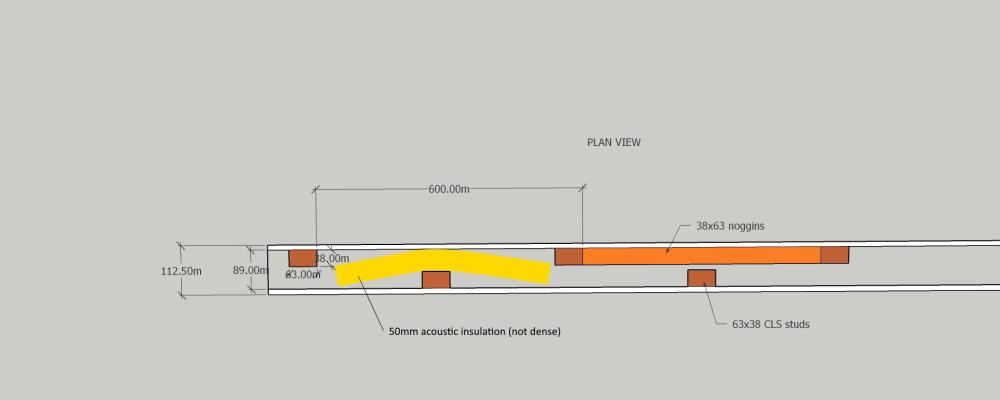
Built upstairs stud walls with the design shown earlier. With plasterboard on both sides (and floppy acoustic insulation between) the walls seem surprisingly strong. Noggins at mid height. Ground floor will have addition of OSB 11mm on at least the central part of one face. The studs have been moved in to accommodate the 11mm OSB. Noggins again at mid height as before. Banking on the OSB for fixings, and for added strength.
-
Great going, well done.
-
Will 9mm OSB do for allowing fixings to a stud wall? Or is 11mm OSB needed? Any particular kind of OSB?
-
In stud walls, what height to put in noggins for a) Towel rails (central heated) b) Basins c) Hand towel rails d) Mirror cabinets e) Loo roll holders Is there a better approach (short of cement board or OSB or ply)
-
New build in progress. Cost is a serious consideration. First floor ceiling spec: 12.5mm foil backed plasterboard 150mm Crown wool tight between ceiling joists & spilling over wall plate 250mm Crown wool above ceiling joists Low pitch hipped roof. For various reasons, masonry outer leaf about 150mm shorter than inner leaf. 75mm PIR insulation fixed externally to outer face of inner leaf. Roofshield membrane (completely air permeable) below Cambrian tiles. No eaves to ridge ventilation needed. Ceiling plasterboard starting to go on. BUT a) Not foil backed pb b) Only 150 + 150mm loft roll (Knauf loft insulation) c) Loft roll not spilling over wall plate Which of a) b) and c) is worth insisting on? Need to pick my battles wisely.
-
What and where to use air tight tapes on block built house
WWilts replied to JamieM's topic in Ventilation
What is the name of the special glue please? -
Tyvek housewrap used as airtight membrane around first floor joists For various reasons wd like to fix it to inner face of plasterboard. 3mm skim to go over plasterboard How to fix membrane to plasterboard so that skim can be put over n no cracks later
-
How to make an expansion joint work with liquid screed? Without any of the screed going down under the insulation? Buildup: Concrete slab Blinding DPM 100mm PIR insulation Polythene UFH pipes 50mm liquid screed Expansion joints separating UFH zones (door thresholds).
-
New build in progress. Two rigid ducts buried in trench with drawstring, going from public footway to near new house. The ducts were put in to help future proof for a) telecoms b) fibre to the premises No cable in them. What cable(s) to pull through before the end of the trench is backfilled? Nobody knows less than I do about these things. Further, within the house want data points in each habitable room plus TV points. What wiring/cabling to use for c) data points (previously someone suggested 3 Cat 6a cables per data point) d) TV points
-
New build in progress. One section has warm roof. Roof covering details being planned. Fully air permeable roofing membrane. Certificate states: "For roofs with an insulated ceiling, ventilation above or below the underlay will not be required provided that the passage of moisture by diffusion and by convection is controlled, eg by a continuous envelope of insulation with a high vapour resistance" Roof covering layers: Cambrian slate Battens Completely air permeable roofing underlay (Roofshield) Rafters with 100mm Celotex or similar insulation between 50mm Celotex or similar taped across ceiling Foil backed plasterboard 3mm skim coat Qu: Would it be too unwise to do away with the traditional 50mm ventilation gap below the underlay?
-
External oak, to treat or not to treat, that is the question?
WWilts replied to joe90's topic in Decorating
This seems just right for oak soffits -
Any opinions on leaving external oak as it is? Presumably finishing external oak is a relatively recent practice
-
tks, Any suggestions for what oil to use for oak externally (relatively sheltered soffits, relatively exposed door frame jambs)
-
Character oak T&G obtained for soffits. Some boards have visible knots etc incl. some holes going all the way through. What oil to use? Linseed or osmo? What filler to use? Resin / other?
-
Softwood door linings. Some on stud walls, some on concrete block walls. Knot, prime, seal? Or is that wasted effort? If sealing, all of it before installation or just the exposed parts after installation?
-
Stud walls Over screed (Cemfloor liquid) or on concrete slab or on insulation (Celotex 100mm)?
-
PME, according to a label in the kiosk
-
No ASHP. Gas boiler. Electric double oven, induction hob EV charger will be located not far from kiosk
-
Not sure what earthing arrangement. Observed that at the boundary with public footway, where there is a hard black sausage marked "live" with a thick black cable going into and out of it, there is also an apparently copper rod about 1m long partly buried in the earth. Open to any suggestions about cost-effective earthing. Electrical loads: 4 bedrooms, normal lighting & usual kitchen appliances. Occasional power tools usage. Kiosk about 20m from house CU location The kiosk is W1130, H1490, D320. Potentially can take more than the cutouts and smart meter. Open to any suggestions
-
Roughly how big are these inverters? Assuming space on roof for 8kW worth of panels
-
sorry, 22 kW All Greek to me
-
Additionally, if solar PV panels to be added in future, what can be done now with cabling for some degree of future proofing?
-
New build in progress. Three phase supply installed up to our kiosk. Kiosk is about 15m from dwelling. Smart meter will be installed in kiosk. Intention is to have 1 phase in dwelling. But have 3 phase available to dwelling for future proofing. Plus for 22V EV charger near kiosk. Question: Is that a sensible plan? If so, what SWA to run from kiosk to house? (5 core? how thick? etc. Novice here)
-
New build in progress. External soffit, thinking of matchboard. Possibly solid oak. Is that a pain to maintain? Or to finish nicely?
-
Protecting rainwater drains under drive
WWilts replied to WWilts's topic in Rainwater, Guttering & SuDS
Less than 400mm cover from pipe to surface. Perforated pipe. Leaning towards twinwall. Lean mix backfill over seems a good idea


