


WWilts
-
Posts
782 -
Joined
-
Last visited
Everything posted by WWilts
-
New build in progress Rainwater downpipe -> bottle gulley -> ~6m land drain (occasional cars or light vans driving over) with ballast bench & cover What material for land drain? What to use over that to protect from weight of vehicles? (details welcome, novice here)
-
foil wrapped, with sealing flap. But point well taken that at 500mm below ground level insulation probably not needed.
-
New build in progress 32mm MDPE about 7m runs externally on footings (about 500mm below eventual ground level) How to protect vs freezing? Would 25mm rockwool insulation suffice? Within 100mm rigid duct
-
How do people make it work with hard floor (over electric UFH mat) on one side & carpet on the other side of threshold?
-
New build in progress. Carpenter asking how much gap to leave off floor for door frame (if I understood correctly). Plan is to use underlay & carpets. He suggested 20mm. Is that good advice?
-
Builder schedule is stud walls first (already begun) & later ceiling, for better or worse
-
New build in progress. Stud wall under attic truss. Fix to truss? Are cracks in plaster likely to develop when truss deflects with loads? If so, is there a trick to reduce the risk of cracked plaster? Perhaps some kind of movement joint material between head plate and truss tie beam?
-
Comforting re water table, which stays several m below ground through the year. Why won't the waterproof paint work? Can have a conversation with builder.
-
from the web: About 25% of the heat produced by your boiler will escape through the roof of your home. About 35% of the heat will escape through the walls and through gaps, in and around windows and doors, and about 10% of heat will disappear through the floor. Invested the limited funds in expanding cavity insulation from 100 to 125 average. Only 100mm available for insulation from highest slab surface to bottom of 50mm screed.
-
Builder proposes to use damp proof paint. He doesn't want call backs for rising damp & mould.
-
New build in progress. Ground floor: Hardcore Blinding DPM taken up to lap DPC at finished floor level 100mm concrete To be followed by 100mm Celotex (with perimeter insulation), polythene, UFH in 50mm liquid screed (Cemfloor) Problems: 1) DPM torn in at least 30 places over a ~75m length of DPM. Some large enough to put a fist in. Most large enough to insert a pinkie or pencil. A couple of places where DPM is loose from DPC, no lapping. 2) DPM & DPC cut or mutilated where internal block walls were knocked through in preparation for insulation/screed. So far the only attempted repair has been some duct tape which has mostly come off. Question: Is this a problem? If so, what is a pragmatic solution?
-
Did not realise a drain is needed for the hot water cylinder. Constant drainage required?
-
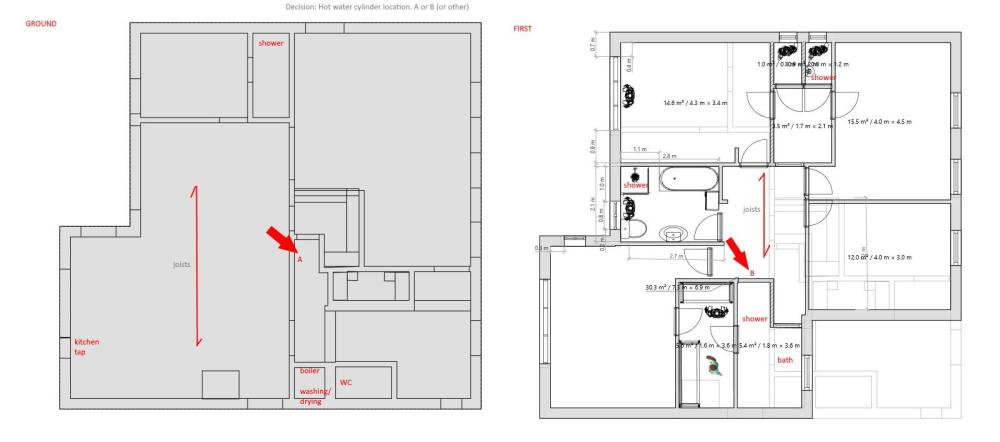
Unvented hot water cylinder, location to be chosen. Options: Either under the stairs (central) or off the upstairs landing (reasonably central) Which might you choose and why? (A, downstairs, was originally intended. B would involve some fiddling with the upstairs floor plan)
-
found this at designing buildings wiki A range of U-values are indicated below for the purposes of comparison only: Solid brick wall: 2 W/(m²K) Cavity wall with no insulation: 1.5 W/(m²K). Insulated wall: 0.18 W/(m²K). Single glazing: 4.8 to 5.8 W/(m²K). Double glazing: 1.2 to 3.7 W/(m²K) depending on type. Triple glazing below: 1 W/(m²K). Solid timber door: 3 W/(m²K).
-
What thickness of residual cavity is assumed for that?
-
Air at 20degr C has low thermal conductivity. (lambda 0.026 W/mK) Better than blown-in EPS beads. For small extensions exempt from Building Regs, 75 mm cavity, what value would be added by including cavity insulation? Zone 1 for wind-driven rain.
-
Small amount of C25 concrete to be mixed for foundations. (2800mm double skin masonry wall, side of lean to). Is the following correct? Ratio of C25 concrete grade is 1:1:2, in which one part is Portland cement mixed with 1 part of fine aggregate/ sand and 2 part of coarse aggregate with required quantity of water to reach compressive strength 25 Newton per square millimetre (N/mm2) or 25MPa at 28 days curing
-
Would a plastic soffit vent mesh do the job? (folded and inserted into the tiny gap) Or is multipurpose silicone better?
-
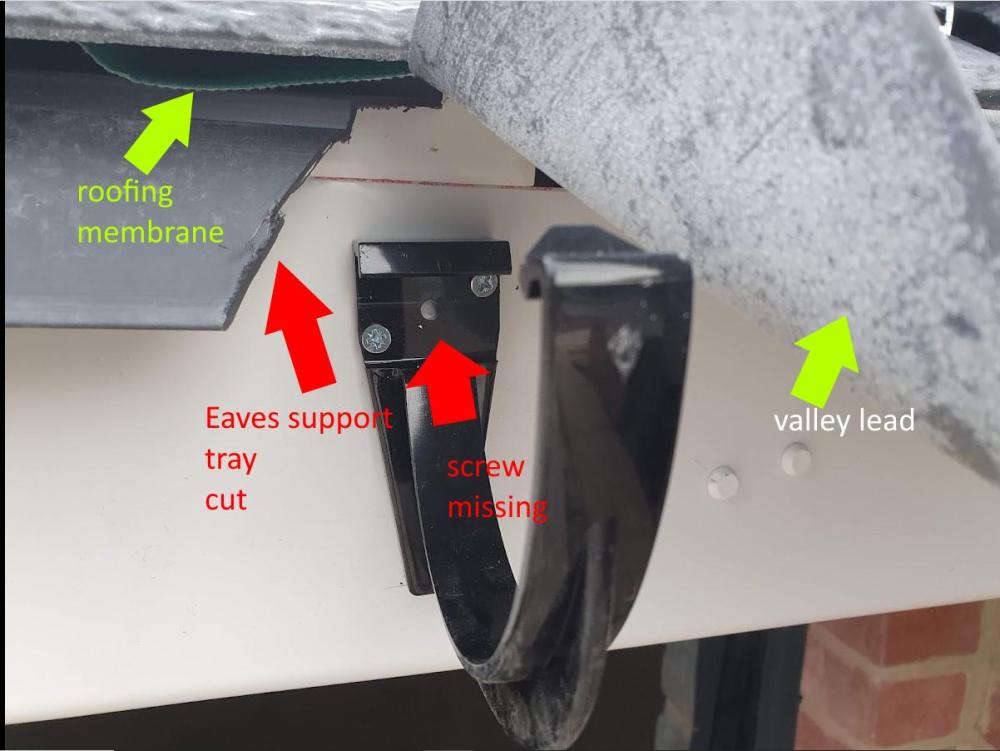
What happens to rain water when a section of eaves support tray is cut out?
-
What poly sheet would you use, to allow plasterer to see where roof trusses are? (avoiding battens under roof trusses if possible, to preserve limited floor to ceiling height) When stud wall top plates are attached to roof trusses, could the poly sheet still go on after stud walls put up? (stud walls not yet begun) If so, how to get airtight seal above stud wall?
-
No need for ventilation with this air permeable roof membrane
-
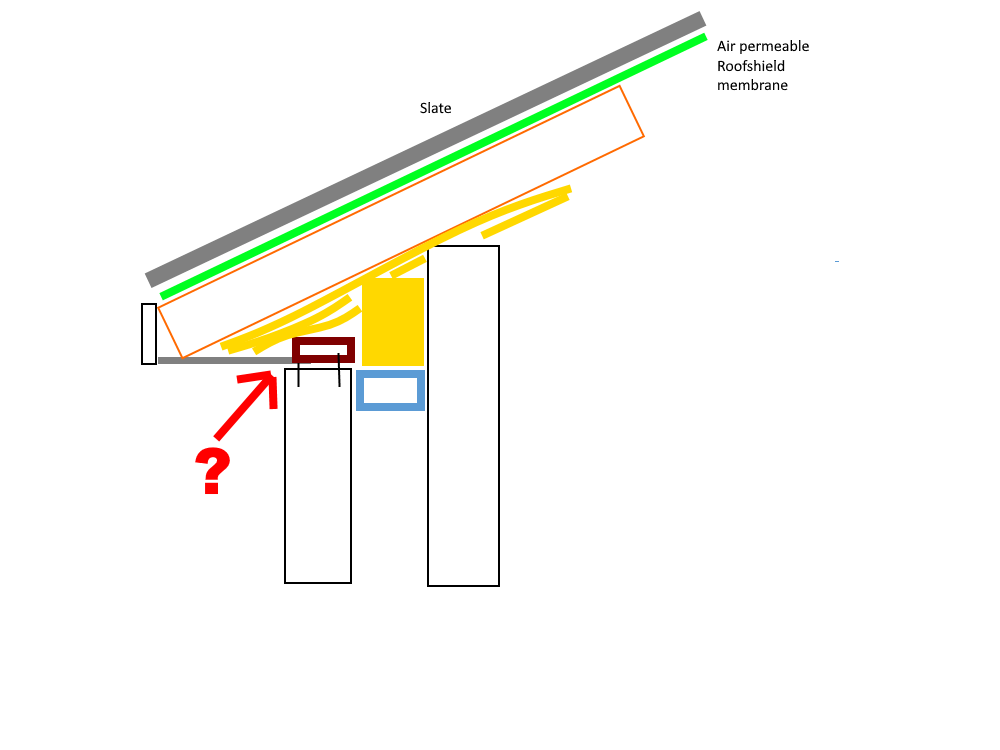
New build in progress. Roof covering: Roofshield air permeable membrane with Cambrian slate on top. Soffits well pinned down to outer leaf by wood/screws. Eaves have PIR insulation against inner leaf, crown wool insulation to spill out from loft into remaining eaves space. Is there any real reason to be siliconing the soffit/wall junction? (red arrow)
-
Virtually same ingredients. Minor differences.
-
New build in progress. Ground floor: Hardcore / Blinding / DPM turned up at walls, lapped to DPC at finished floor level / concrete slab / 160 to 180mm from concrete slab to original DPC/finished floor level. To be added - 100mm Celotex / polythene / liquid screed / floor covering Internal block walls go down to foundations. Unfortunately builder did not leave out any blocks at internal door thresholds. Later, a layer of internal blocks was knocked out at door thresholds, destroying the DPM/DPC. Qu: How to restore the integrity of the DPM/DPC? How to seal any solution to the concrete slab, so that moisture remains below the solution? Builder says just lay down a meter wide strip of polythene DPM at thresholds, nothing else needed. No sealing or lapping of the polythene to anything. We fear damp might track across to the skirting boards and rise up the walls.
-
Everbuild Everflex ac50 seems suited to this situation. 100% to 200% elongation at break.



