


SimonD
-
Posts
2215 -
Joined
-
Last visited
-
Days Won
13
Everything posted by SimonD
-
If you point him to Section 3, page 24 & 25 for diagrams and dimensions of Building Regulations Approved Document G, that should at least cover some of it - the plumber should know this as he should have an Unvented ticket, and so should the boiler installer re PRV if he's gas safe registered (if they're different people) - you could ask to see the tickets thet hold. Download it here: https://assets.publishing.service.gov.uk/government/uploads/system/uploads/attachment_data/file/504207/BR_PDF_AD_G_2015_with_2016_amendments.pdf
-
Yes, I think it is CSST rather than mdpe, but worth double checking if it's used as a continuous run from boiler to gas meter or if mdpe is visible somewhere along the run because the yellow coils in the other extension look more like MDPE. As mentioned, the PRV arangement is questionable and the tundish looks undersized for potentially 2 discharges, but not as bad as a recent job where the builders were about to plasterboard over the existing open end prv discharge in the new extension. The owner was surprised when I mentioned it, saying nobody had said anything about it, not even the gas safe engineer who capped off the boiler during the works...
-
Ever the diplomat! 😁 Looks bloody awful if you ask me...
-
Anyone with experience of. Honeywell evohome system
SimonD replied to magunn's topic in Central Heating (Radiators)
I'll take the blessings when I get them 😇 And I'll have to take that as a compliment of my self-building skills 😊 For modulating multi-zone control, especially mixed ufh & rads, what products do you usually opt for instead? EPH? (whom I notice now do a PDHW pack but I've not used the controls). -
How much did your green coat roof cost
SimonD replied to gavztheouch's topic in Roofing, Tiling & Slating
I don't think that's too bad given recent inflation. I installed my standing seam roof myself, but before I did we got an installation quote of £8k plus the roof materials that I'd already bought at about £8k (inc Lindab rainwater goods), so that worked out to about £126m2 just as Covid hit. Our highest quote was just under £34k. Our roof has two different curves mind you but no penetrations. -
Anyone with experience of. Honeywell evohome system
SimonD replied to magunn's topic in Central Heating (Radiators)
Perhaps there is but that isn't the point. The point, and long running complaint, is the poor and inaccurate communication and technical advice from the company about modulation where they simply removed this function in the UK without telling anyone and have since then reintroduced it with poor communication in a rather haphazard way. If they made it all clear to begin with, this discussion would not have arisen. There are many boilers on the market, heat only too, that do provide this. Needless to say, with proper opentherm communication, you can achieve significant savings through modulation even with a flow temperature set at 70C on the boiler to facilitate the heating of your hot water. The moral of the story is to choose a boiler than can run at 2 distinct temperatures and then select compatible controls, many of which may actually be the boiler manufacturer's own controls, or if you're inclined like @Radian, hack the system yourself 😁 (PS I'd recommended my customer use the Vaillant controls but he insisted on Tado) Yes, and when I last looked at using a Drayton Wiser system it was very clear in the technical specifications that hot water support wasn't there. To re-iterate, I telephoned the Tado installer technical helpline to configure the system, which then didn't work at all. That's a very different case. -
Anyone with experience of. Honeywell evohome system
SimonD replied to magunn's topic in Central Heating (Radiators)
Which do you mean by it? The Evohome? Simply that you have a lot of configuration choice, Opentherm, it's compatible with traditional fossil fuel heating as well as heat pumps, it supports priority hot water etc. It's also very easy to use through the main controller - access to configuring each zone schedule for heating and hot water is a doddle, so is any over-ride. If connected to the internet, you also get a mixture of both weather compensation based on downloaded weather data (not quite as accurate as weather comp component) and load compensation. -
Anyone with experience of. Honeywell evohome system
SimonD replied to magunn's topic in Central Heating (Radiators)
Yup, so I wrote to Tado when having a moment. I wrote: Granted I received a very quick response, but: What I find particularly underwhelming is the claim that because s-plan operates using zone valves and relays it is not capable of modulation - a claim that is of course nonsense. Not even worth continuing the conversation with them, unfortunately. -
This is the one I think is referenced about the rebound effect: https://www.newscientist.com/article/2269315-climate-targets-at-risk-as-green-tech-triggers-higher-energy-demands/ Yes, I have this discussion on a fairly regular basis with some profs and researchers I know working in this area - it becomes a closed club, a little like The Conversation website that closes down the discussion to academics only, even some academics that write about topics where they have zero implementation or real world knowledge and just a research background, always risky when dealing with complex real world problems.
-
Is this sub-standard. Sanity check needed!
SimonD replied to devondumpling's topic in Heat Insulation
Yes, absolutely. It's sadly so common to see this. I've done work at two extensions in the last couple of weeks where there are clear gaps in the insulation. It must be ignorance on the part of the trades, mustn't it? -
Good article. I'm still bemused how the political and economic narrative around growth has failed to change and embrace a model of energy reduction. And as alluded to in this article, it's not an individual process or act, but one of whole systems and markets, but it's still shrouded by some incorrect assumptions like: When you scratch below the surface, the picture is more complex. I don't think it's the rebound effect that is actually guilty here (e.g. simplistically if people install LED lighting, they don't rebound by saying, 'oh, I can now turn up the heating a few degrees because most people really don't understand the concept of energy and its use); it is clear, for example, that car manufacturer's wilfully design their cars to grow between each version, so the consumer is given less choice, or even unaware of the shift. I was driving down the motorway the other day and passed by an old Saab 900 Turbo once considered a large car (I used to load up motorbikes into the boot of mine for transport) and was surprised by how tiny it looked even compared to a couple of new Minis and then a Model X Tesla. Then there's the psychological manipulation that plays on people's fear and some social desire to keep up, that then drives them to buy an SUV because they feel safer, for example. When you look at energy reduction figures in countries like Sweden, for example, that have benefitted massively from the rollout of heat pumps given that it is a country dependent upon direct electric heating and cooking, their entire grid has seen huge reductions in demand, which hasn't rebounded at all. So in essence, I think we have to question what technology implementation relates to the rebound effect and how does that arise. But maybe the linked article explains that but it's behind a paywall?
-
I don't think there's ever a plumber around when you need one, let alone a heating engineer. And they all run a mile when it comes to those pesky trvs
-
Anyone with experience of. Honeywell evohome system
SimonD replied to magunn's topic in Central Heating (Radiators)
Well, to pick up on this topic, I've now had enough of Tado and I gave the product a chance. Here's why: A customer contacted me to ask if would install a Tado on their s-plan system. I said I'd be happy to help. Boiler was a Vaillant and I recommended they use Vaillant's own system but they insisted on Tado. So, I called Tado installer technical department and told them what i wanted to do. Yes the technical support said, all you need to do is: 1. buy the wired thermostat 2. buy the add-on receiver from the professional store. Big caveat was that despite saying their system supports digital control, they told me they do not guarantee that it will work with Vaillant's ebus. Okay, customer still happy to have a go. So, on this advice customer orders all the kit and today I go to install it all only to find out that the add-on receiver does NOT support low voltage digital control but 230v relay only. I call the installer technical department to ask WTF only to be told that no, it is not possible to have a wireless modulating control with an s-plan using Tado reciever to control ch and dhw valves, not even Opentherm. I kind of went through what I'd been told and received a rather unhelpful re-assertion that the product I'm after doesn't exist. So what is the real story?????? Of course I can't phone their installer technical helpline to check now can I??? All I can say is a total load of (expletive deleted) rubbish. And then don't even get me started on the smart trvs with plastic adapters trying to get them to properly attach to existing 'heritage' trv threads and not fall off.... Clearly Tado and I have not got off to a good start. Meanwhile my Honeywell evohome ticks away, modulating my boiler nicely and reliably and provides easily accessible control to each zone doing everything it said on the box. -
I'm just here for the entertainment 😁
-
Only some of it. There's good reason to question the origin of some hardwood ply from Asia and Brazil, but plenty of other choices such as spruce or pine either from Scandinavia or even Chile. I can't link to the products as they're local suppliers to me who are a bit old school as it's mostly dog & bone or the odd email (see below), but at the end of the day, class 2 will suffice as it's under cover. Sometimes you've just got to go with what you can get, I had to do a lot of that as I was trying to build right through Covid19. I disagree. Granted, you've got to make your selection but I recently made my son a desk using B/BB pine plywood from B & Q and being a B face it has come out really nice. I wouldn't buy bulk as I'd do that with a trusted local timber merchant instead. My choice supplier for my build has been Robbins timber in Bristol.
-
If using 18mm plywood, then 50mm galvanised ring shanks are fine. I'd nail at 150mm along edges and 300mm otherwise. If you want more reassurance then 150mm all over wil do the job. Not necessarily, there are several suppliers where I can get class 3 plywood at the same price as class 2 as it tends to depend on the origin and species of the timber. I think that even B&Q and Wickes, for example, sell class 3 ply for about £45/sheet. I'd be surprised if sarking boards were cheaper per m2. However, the most important thing here is what you're using it for and putting it all into perspective. We're talking about probably a few hundred quid and a few hours of labour on a roof that costs thousands and thousands and products like Greencoat PLX come with a 50 year guarantee with a lileky life of 70+ years. This is the substrate for this wonderful covering material.
-
Yes, sarking boards are the preferred method according to the Federation of Traditional Metal Roofing Contractors UK Guide to Good Practice. However, plywood is extremely common as it's much easier, quicker and cheaper to install so contractors naturally tend to go for this. It's also okay to use OSB but screw pull out is much reduced and therefore care should be taken especially in exposed areas where uplift could pose a problem. If using plywood, I'd suggest definitely using a membrane between plywood and metal roof - some installers are known to omit this.
-
Not necessarily, a 15 kW output boiler will still deliver a flow temp of 80 for your dhw and it'll be better for recharge time and probably efficiency. Just like you, as I've experience with my own installation, the problem is when there's a small differential temp between flow and store and the boiler just runs forever. Increasing this differential has made a big difference for me especially as I have a thermal store. Then as per probably the main point of your OP, focus on the efficiencies of the heating system as that's where you gain the most . Personally, I'd start with a brief calculation to estimate the output of your radiators at various Delta Ts compared to your calculated heat losses at a variety of exterior temperatures, then do some calcs to look at the mass flow rates required at various temperature points to assess feasability compared to your current pipe sizing and circulating pump (is your pump single speed or does it have some modulation tied to flow/pressure and/or boiler modulation?). A bit onerous but possible to derive some clunky initial theoretical values to develop a curve. But as you've indicated, ideally you'd want some measure of temperature rise over time so that you can then begin to throttle back boiler output as the room approaches setpoint, with feedback to learn how quickly the measured space responds to a range of heat inputs. Rather you than me...and a process you've probably already thought through 😁 I'd also have a good look at balancing the system to minimise return temps, a process so often overlooked and somewhere you can experiement with different Delta Ts too.
-
"Modern" radiator design and controls?
SimonD replied to mjsx's topic in Central Heating (Radiators)
I come from the opposite end of the spectrum of experience compared to @Nickfromwales in that I've only recently achieved my badge of heating engineer with about 1 years worth of experience and in that time I've already learned enough to go with what he's said. Keep it simple. I've designed and installed my own heating system using manifolds, but I've gone low tech. I made my own manifolds that simply have full bore lever valves, trvs on each radiator and uses basic push-fit fittings with polybutylene barrier pipe (great stuff if you make a mistake). However, my house was a bare shell so easy to do all the pipework like a spiders web emanating from a fairly central position. In your situation I'd be inclined to go the traditional route. I'm also of the view that trvs are not a problem. Fairly recent research suggests with heat pumps that trvs are fine (e.g. don't dramatically affect the cop) as long as the cycling time of the boiler isn't too short and if it is, you can re-position the main controlling thermostat, add volume to the heating system or even increase the system delta T to reduce the effects of this. -
I've just noticed a white Magnaclean Micro in my recycling box that I took out while installing a boiler not long ago. I can have a look inside it to make sure it's okay and then if you want it, you can have it.
-
If you're so inclined, Urban Plumbers takes a decent but not too laborious look at these things. They all use the same principles. I'm not a mega fan of Magnaclean as they're plastic and the seals can cause a problem when servicing them. The replacement seal packs are expensive for some o-rings. I personally prefer the metal ones. The Spirotech with magnet you can pick up for about £70:
-
When is a cold bridge a cold bridge?
SimonD replied to SimonD's topic in Energy Efficient & Sustainable Design Concepts
And some more: Upstairs rad with Opentherm doing its job: Flow temp: Return temp: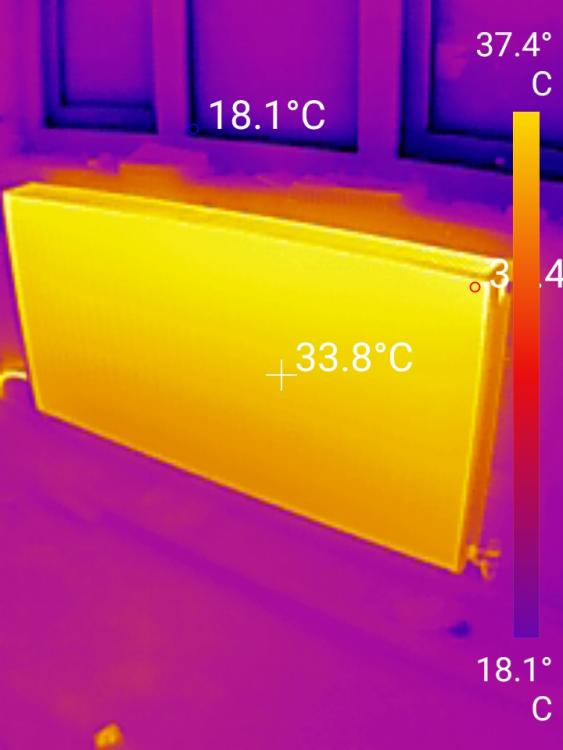
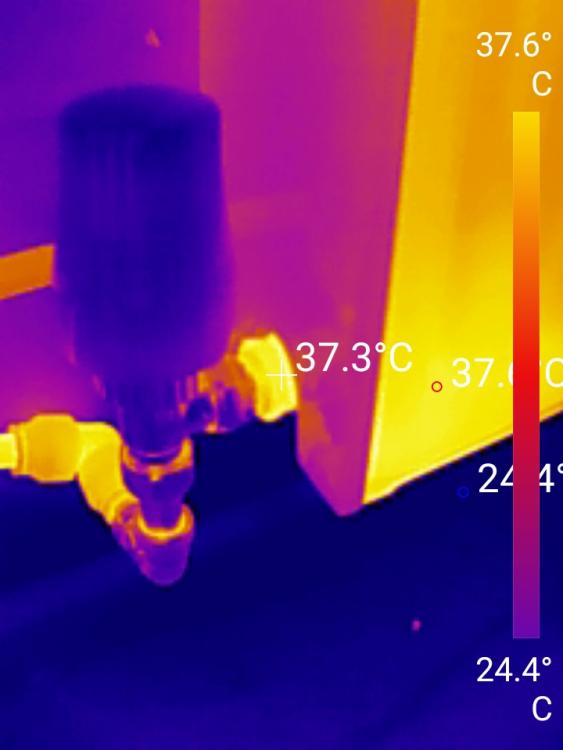
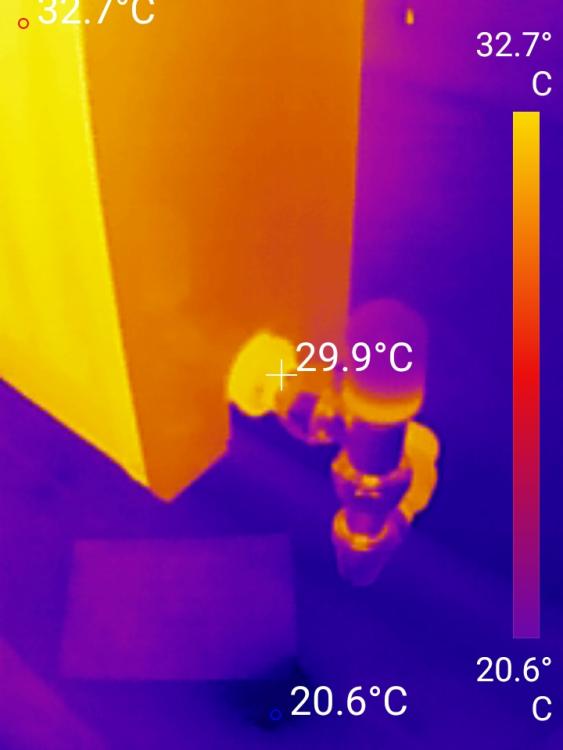
-
When is a cold bridge a cold bridge?
SimonD replied to SimonD's topic in Energy Efficient & Sustainable Design Concepts
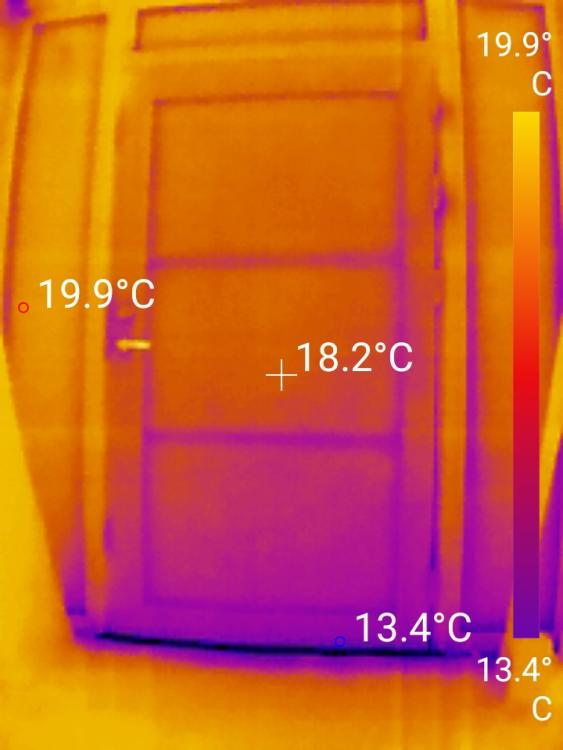
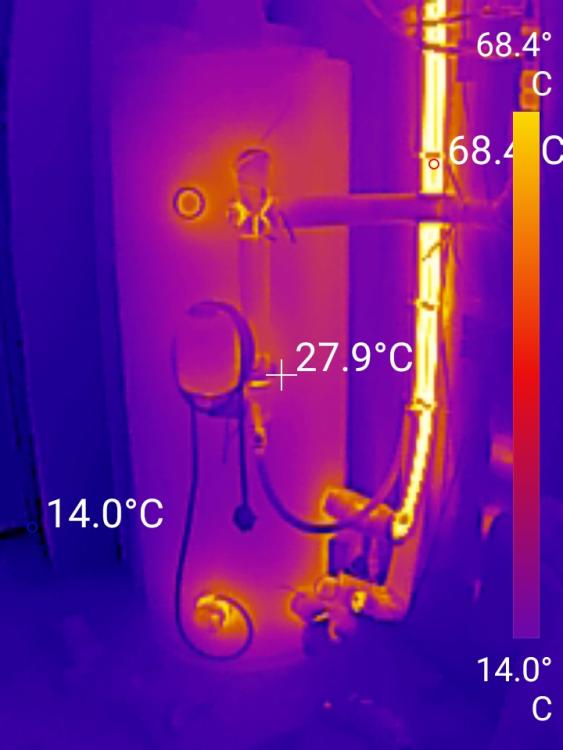
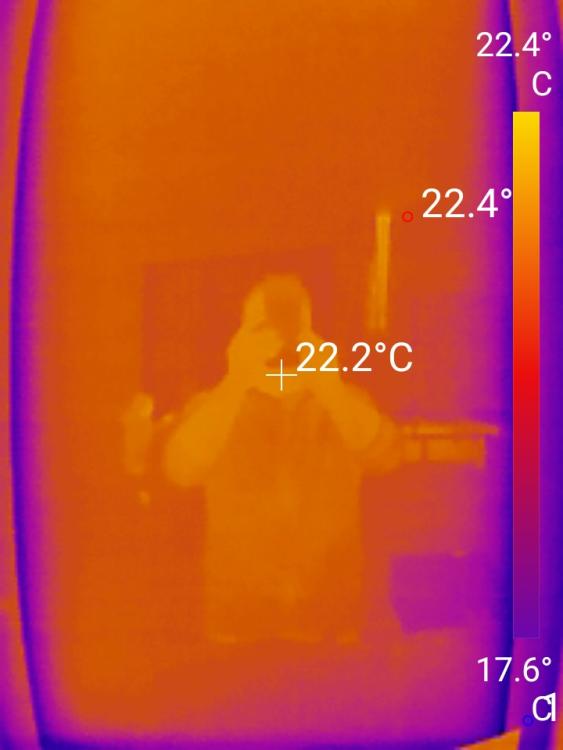
Yes, I'm finding this to be a bit of a process. Mine auto tunes the temperature range, which means that it can transform the image from what looks really cold to what looks really warm, until I then reference the temperature range, so I need to play around with the settings a bit as I can create profiles to use for specific jobs, including add the emissivity value of the materials in question - e.g copper doesn't show very well at all on the standard. As you say, windows are interesting as I get a 'hot' image of me reflected in the window, but the temperature shown in the display is the temp of the glass??? Pic added below. I'm also getting what seems like some kind of bleed around the edge of the image at certain angles and distances. Oh, alright then 😁 Random take along back wall. It's interesting how it shows the warmer line along the bottom of my ewi which is the stainless steel bottom rail, then a cooler section which is the plinth insulation and then warmer ground. Front bay ewi showing much warmer plinth where I haven't installed the plinth insulation yet, but also that to the left, the boundary wall and bushes are are much warmer: The front door. It's insulated accoya but as it's 1.2m wide, it required a steel reinforcement frame. That's clearly what's visible within the door. The dark area at the bottom is aluminium threshold and the shadowing down to the right, looks just like a pocket of cold air I assume as it's the uneated part of the house. Who knows?? We have a bridge using steel columns coming out the back of the house. These columns pass through the insulation layer. Even though they've been wrapped with eps and expanding foam within the thermal envelope I want to see if there's anything bad there. I can still add some insulation inside if there's a problem. The bridge bit is the one showing 5.7C: The thermal store and pipework (yes, pipework still to be insulated). I think I am going to add some extra insulation around the cylinder : Thermal selfie in window showing my body heat but also showing the glazing temp: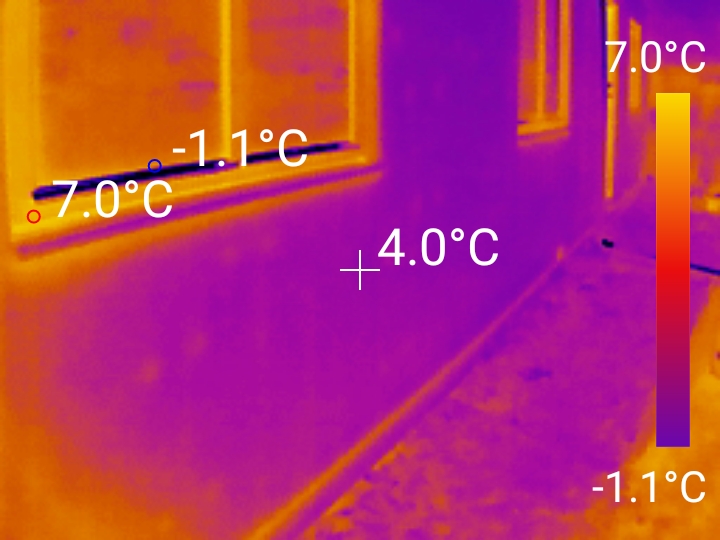
.jpg.02f2945245aa1be414810422cb567f9c.jpg)
.jpg.192e91372cf83906e7d7f1462430f189.jpg)
-
When is a cold bridge a cold bridge?
SimonD replied to SimonD's topic in Energy Efficient & Sustainable Design Concepts
You have now hit on the ultimate authority 😁 -
When is a cold bridge a cold bridge?
SimonD replied to SimonD's topic in Energy Efficient & Sustainable Design Concepts
Well, my architect designed this beam to be essentially sat in a stud wall that was the thermal envelope ! I changed the design, moving the wall outside so the beam's now fully inside the thermal envelope.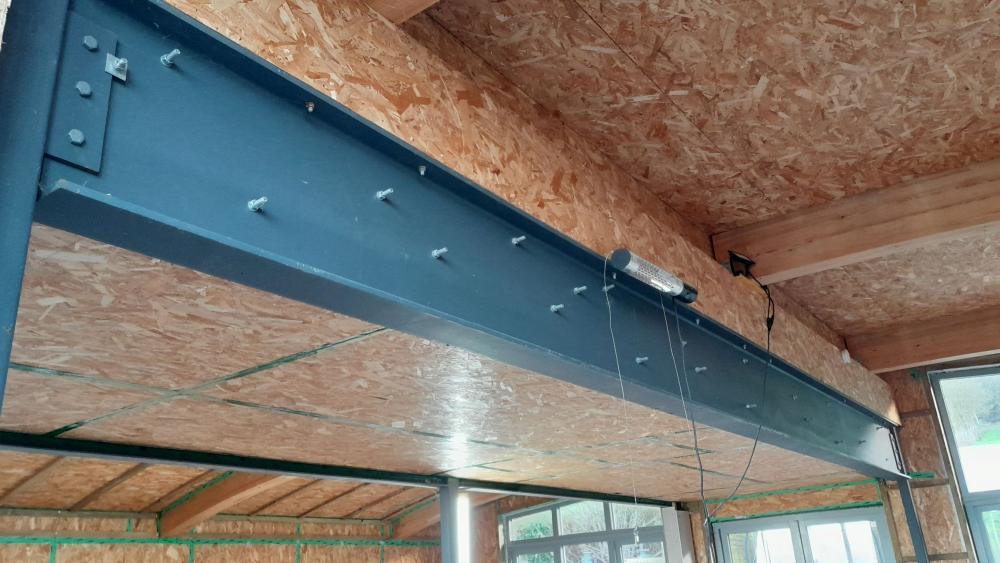




.jpg.02f2945245aa1be414810422cb567f9c.jpg)

.jpg.192e91372cf83906e7d7f1462430f189.jpg)


