


SimonD
-
Posts
2215 -
Joined
-
Last visited
-
Days Won
13
Everything posted by SimonD
-
My little Hanix H08b is in need of some serious tlc. I was doing some hard landscaping the other day and nearly rolled over the back of the digger because the tubes on the seat both broke and I now don't have a back to my seat. So I need to find a new one of those - generic would be fine. I also need a pin set, partitularly the kingpin. Anywhere you'd recommend, or is it just a case of a google and ebay maybe? Ta!
-
Soil stack and underground drain advice please!
SimonD replied to SimonD's topic in Waste & Sewerage
Thanks, it's always a good reminder to speak to BCO before embarking on a plan. Given how long it's been, I think I recall sensibly installing eps ewi at about 300mm all along the bottom of the woodfibre for splash protection so would just need to make sure I've got something like 150mm wide strip of pea gravel between hard surface and the ewi. I can alway put pavers over and concrete to make it look nice. At least this bit of the house is rarely accessed so it doesn't matter a whole load if it looks a bit weird. -
Soil stack and underground drain advice please!
SimonD replied to SimonD's topic in Waste & Sewerage
Ah, yes. I could then connect the drain to go to the bathroom at the inspection chamber That's what I feared! Thanks all, that's given me a plan! -
Soil stack and underground drain advice please!
SimonD replied to SimonD's topic in Waste & Sewerage
That was my original thought, but maybe incorrectly, I had this nagging idea that soil stacks are supposed to be connected using a rest bend and wanted to confirm if it's okay to use a tee for the very reason you say. The old drain was literally full of shit and I had to rod it and use my pressure washer drain attachment on a regular basis until we started the project - I really don't want that risk again. -
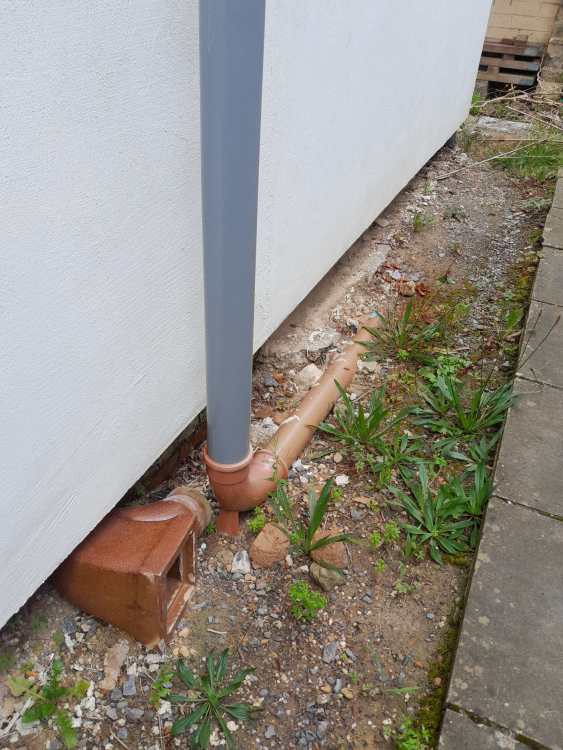
I've been putting this last bit of drainage off for quite some time, but I can't ignore it any longer and need to find a solution (because I want to install our heatpump along this wall during August!). In the image below you'll see what is a temporary plastic drain pipe with connected soil pipe which serves 110mm drain from a bathroom upstairs. This was a clay installation but we found it to be cracked and damaged, so I just riped it out and put this temporary stuff in there. The clay gully lying on the ground was previously at the end of the run which goes approximately 3m along the wall behind the camera. Now I need to extend the drain for the first fix of the final bathroom to go in and heatpump. My problem is that as you can see, the drain is very shallow and previously the clay pipe was only about 20mm below ground level with the gully raised up a bit (I don't think I can get away with that now with BC?) and I don't want to increase the ground level too much due to the wood fibre ewi. The current plastic drain is at a steeper gradient than the remaining clay pipe it's connected to so I do have so wiggle room. I've considered whether I just run a 110mm waste from the bathroom along the wall to the soil stack but by the time I've got suitable fall, it's very unlikely to be over the min 450mm to invert. But this would be ugly and I also want to keep this wall free so I can get the heatpump as close to the wall as possible (whether this is the best place for the heatpump is another question as I can put it at the front of the house instead but that has complications too!) So main question is whether it's possible to get a soil stack to drain tee that allows me to extend the drain as needed where I would put in a direct connection to wc and a gully maybe just 1.5-2m beyond this soild stack, or is this a stupid design idea? And yes I know this should have all been considered at the design stage but I was totally wet behind the ears then and trusted our architect to consider these things only to find he put almost all rooms needing drainage in stupid places compared to the existing drains! We have no options to dig out any of the drainage is the drain travels under the retaining wall you can see in the photo and then 8m further into the hill to meet the mains sewer that serves the whole row of houses. Any ideas and suggestions please?
-
Fine tuning my IWI Solid wall (Warm Batten) design
SimonD replied to Annker's topic in Heat Insulation
I've used mainly Auro clay paint as it's ultra breathable, but there is also Earthborn clay and I've recently found a new company that does clay pain called Coat (not tried them). Auro clay paint is sprayable so very helpful in that. The normal Auro paints are also breathable but nowhere near as much as the clay versions. -
Multipipe Maxima FM 16-port manifold (..and 13, 14, & 15)
SimonD replied to mikeysoft's topic in Underfloor Heating
I put that one in there thinking of you 😜 I know how it grates, but I have succumbed to the laziness of using the term because everyone in the industry does - I've sat through numerous lectures, and even hydronics course lately where it's bandied around like it means something, and if we were really serious about it, we'd be building houses with water and wood in preference of conrete and stone because they actually have better thermal mass, at least in one measure, IYKWIM 😊 -
Multipipe Maxima FM 16-port manifold (..and 13, 14, & 15)
SimonD replied to mikeysoft's topic in Underfloor Heating
UFH is perfectly valid in retrofits but it's only efficient and effective with minimised down losses, which means lots of insulation and flooring covering with good heat transfer. E.g. not long ago I had a call from a new customer who had just bought a very large property nearby. He and his wife wanted me to come and have a look at the underfloor heating that was on but not producing any heat. I went and had a look and quite correctly there was no heat, especially in the kitchen but the UFH was on. I asked to go and have a look in the basement and found the unility down there very nice a toasty. I touched the ceiling to find out it was lovely and warm. The UFH was working wonderfully as a radiant ceiling due to poor floor insulation. You've just got to be very careful with tog values of any carpets laid on top of ufh see here from one of my renewables catalogues: There are many strategies for room based control, the most common of which is to use on/off switching with room by room stats, through to designing the system with proper room by room heat loss, varying pipe spacing like @SteamyTea says and then varying the flow rates as @marshian suggested. @JohnMo is at the more extreme end using self regulation and thermal mass with low flow temps. What you'll find though is that regulating individual room temps successfully is quite difficult and in well insulated houses you might as well just treat the whole thing as one room and forget about it, just as @Nickfromwales says. I've been there and tried, tying myself in circles with it all and now find myself having arguments with desk based heat pump system designers who don't seem to understand the basics of thermodynamics and why you'd want one room at 22C next to another at 18C and making sure it theoretically stays that way with the doors always shut... Now different temperatures can be achieved across different floors, but that's another story.
-
Multipipe Maxima FM 16-port manifold (..and 13, 14, & 15)
SimonD replied to mikeysoft's topic in Underfloor Heating
Get the optional diverter valve assembly installed, if it isn't already and then run priority hot water. You'll probably have to modify your heating & hot water pipework. Then, you need a proper modulating control. The problem is that last I dealt with this with WB, they couldn't provide a modulating control that also did multiple zones (this requires 240v relay control), so you'd be required to have one heating zone throughout the house. One of the reasons I don't touch WB boilers. You can have weather comp with this setup though, which would be a sensible choice. On the good side, it'll modulate down to about 3kW. -
Yes, like when they ask you to ensure hall width permits necessary turning circle into the doorway too so you have to adapt both the hallway and door! However, from a aesthetic perspective, I do prefer the 826mm doors and 926 between the large spaces.
-
I would just caveat this one with that a self builder is someone who turns the dream into a reality through their own best means, and does it independently. However they do it is up to them, but in IMHO turnkey, full design & build stuff doesn't quite cut it for me, even if the self-builder sources the land and does some of the preliminaries. I wanted to go down the route of having a contractor to do all the work but was so appalled by my experiences through the quote phase and through some intial building experience that I decided to do it all myself. During this time I've just had some labour help with family and friends to assist with heavy stuff, like installing <200kg windows etc. My wife insisted at one point that while I was away with my son, that I get in a chippy and a plasterer in. She didn't supervise them (as she didn't know what to look for and just paid them) and it was a tragedy, so they got fired and I had to re-do a load of their work. Other than the disaster above, the only people I've had in are the steel framing crew with crane for the steel frame. I've had an electrician in to start doing 1st fix but let him and his mate go as this was a mess too. I met a retired electrical engineer who then tought me the electrical side so I can do this all now myself and have a friendly electrician to sign of and install the EV charger. Heat and plumbing all completed by me. My sense of this is that sometimes I totally regret going down this route and sometimes I don't know how I would have felt if I didn't go down this route and how much debt I'd be in if I'd paid someone else to do it. The other side to this is that I've ended up training and getting certified as a heating engineer and have my own business doing this. So far I've got about 5 years doing gas systems and now I've gained a lot of experience, I'm moving across to heat pumps, probably exclusively in the near future. I'm still not finished either.......but feel like I'm in good company with @Russell griffiths as I'm 6 years in and actually not that far off, although next month I've told the family to leave me alone so I can swap out my gas boiler for a heatpump, so who knows. Now my wife has the common worry that she'll never feel warm with a 35C flow temp and need it hotter 😁
-
What to do with an old softwood floor?
SimonD replied to Racheljane's topic in Wood & Laminate Flooring
We had redwood (which is a pine) floorboards in a previous cottage. You often see whitewood, which is spruce, used too. Both are fine for flooring use. When we moved into the cottage they were either covered up with old carpet or an old flaky stain. We sanded them all back an varnished with a high quality varnish and they stood the test of time for over 12 years through 2 young boys too. They actually lasted better than an oak engineered floor we had in the living room. I'm a great fan of Bona floor products which are called a "Bona floor" in Sweden and are so easy to lay as you can re-coat in about 2 hours and have the floor complete within 1.5 days with 3 coats although it does take up to 7 days to fully cure so no covering with rugs etc. until then. We've also used varnish from Lakeland Paints which we were also happy with. -
Yes, check this first. I don't work on enough Vaillants and their controls to know this off the top of my head, but the last time I saw a problem like this was the compensation curve set too low and the room stat/controller apparently still calling for heat but boiler only running at low flow temp so never reaching target - this was in the middle of winter with new house owners scratching their heads. A quick change to the curve and it all worked okay - but Vaillant controls are so dense and inaccessible, it doesn't help at all.
-
Yes, indeed. There is a company in our area who design systems so that when calling for dhw, there is flow not only the cylinder coil but also to a low loss header and straight back to return on the heatpump...who thought this was a good idea, I really don't know.
-
Sizing ASHP according to heat loss calcs
SimonD replied to flanagaj's topic in Air Source Heat Pumps (ASHP)
Generally, the design outdoor temperature for places between 51-52 degree north is -2 at 50m above sea level. If you're up higher and in a exposed location this would be slightly different, but -2 - -3 is absolutely fine for most of Wiltshire. Most domestic single phase EV chargers are 7kW I believe and any decent one will have load management to regulate charging according to whole house load, which our does very well. Calculations for this are a bit of a bogs dinner and highly inaccurate (e.g. using an industry standard method puts ours way over 100amps but is a load of nonsense). I would just ask an electrician to have a look and give you their opinion. If you have both EV charger and Heatpump you will need a DNO application anyway, whereas if it's just one, there are some conditions where notification is all that is required and some where application must be made. -
I've just taken another look at this thread with a bit more focus and clearly seems that regardless of the Heamiser control issues, you have a fundamentally poorly designed and installed system. The heatmiser stuff really shouldn't have been installed and they should have installed the manufacturers controls with weather compensation. Next they shouldn't have installed a buffer as it's a dark art to balance the primary circuit (flow return loop from the heatpump) with the secondary loop (the side feeding the ufh and rads) across a buffer and you'll loose efficiency. At most you'd want a volumiser, preferrably (although some would disagree) on the return side. The the system should have been installed as an open loop without zoning. Depending on the rads installed (I've seen huge ones in nearly new build that are so oversized they allow the same flow temp as ufh) you could just run a set flow temp from the heatpump to your whole heating circuit. You can use trvs and something like and esbe mixer for small amounts of room control and different flow temps if absolutely necessary. Now you have a simple system that is far more efficient. Instead of investing more time in the heatmiser, I'd try to find a competent installer locally who can look at your system - I know you've had some in already, but asking any potential installer about their view on open-loop and buffers will tell you all you need to know about their knowledge.
-
Don't worry, you're not the only one. My fingers don't always have a great connection with the brain and sometimes my brain doesn't work to begin with 😁 Finally....... took them long enough to catch up, didn't it.
-
Class G 3 as of May 2025: (aa)the air source heat pump is not solely used for the purpose of cooling;
-
Intelligent go smarlty controls ev charging 24 hours a day but gives you a window of cheap rate leccy every night to use at your own pleasure - the window is actually slightly longer at night than with the dumb version go.
-
Yes, absolutely. And this will change a bit now with the r290 heatpumps working 'fairly' well up to 75C, so on an Octupus intelligent go rate, it becomes cheap as chips to batch charge on a reduced cop and then top up a few degrees with immersion. I think the cylinders should have a low level pocket for a thermostat so the call for heat to the heatpump is optimised according the stored temp around the coil. I've currently got a 200l thermal store knocking around and wondering how I can keep this in parallel to a heatpump unvented, potentially using the thermal store as a heat bank for the heatpump as we don't have a massive slab. But like with all these things, just got to get the calculator out and crunch the figures! + 1 I've been ordering from here for the past few months for all my installation jobs.
-
Viessmann 100-W Boiler, Wet UFH, 2 Port Valve and Opentherm
SimonD replied to Antec123's topic in Central Heating (Radiators)
Yes -
Yup, been there seen it and done it. I've lost a lot of hair in the process. I had a customer's house where the neostats would repeatedly pair fine up until the 10th stat and the last ones would refuse to pair, or would pair and then not work correctly. This was after replacing the wireless hub. I doubt it's the UH8, but more a tendency of the neoair stats. Why they can be problematic, I don't know. When you reset everything, did you proceed to repair from the closest stat to the furthest stat and do this methodically? It's worth calling Heatmiser tech support as they will help you through the process while to try to repair and get everything up and running again.
-
Viessmann 100-W Boiler, Wet UFH, 2 Port Valve and Opentherm
SimonD replied to Antec123's topic in Central Heating (Radiators)
Heatmiser sell an opentherm mini hub that will control 2 zones with 240v relay to zone valve. The opentherm is done by output from the mini hub to boiler. So you could buy another neoair to replace the t6r and then wire up the minihub. The other alternative is to use EPH CP4 combination if you're not using a heatmiser wiring centre - with the cp4 you just have 2 stats with receivers with one receiver set up at the hub unit which is is wired to the boiler with opentherm. Oh, and especially if you're running a low temperature heating system (i.e. 55C or below), make sure the installer has actually installed the UFH with hydraulic separation, otherwise you'll probably end up with balancing problems between the radiator system and ufh. HTH -
I've got a retired electrical engineer doing the 2nd fix electrics with me but passed me on to another guy to install an ev charger in our remote garage. Unfortunately, this one has disappeared into one of those trades black holes and just doesn't get back to me. I have a problem because I've got open trenches partly used for national grid to install my permanent supply, but also to take the cabling down to the garage. So, my plan is to just install this with the retired electrical engineer and then get it covered with the part p inspection. question is, what stuff do I need to install the infrastructure now and for the future? I'm putting in 25mm cable and the sparky who was supposed to do the job mentioned its useful to have a control cable, but I don't know what this is? Can someone here list everything I need from my meter tails to the ev charger, so I can get these trenches filled in and stop getting hassled by my wife about getting a proper charger instead of the wall plug? Thanks!
-
No connection on boiler to receive wiring centre - what to do?
SimonD replied to sb1202's topic in Underfloor Heating
Yup, this drives me mental. I did an instal (natural gas) a while back where the owner was doing a deep refurbishment. I put in the boiler with modulating controls etc. and said she should call me when it's time for the ufh. However, the guy doing the floors, ripping them out and properly insulating them etc. never called me and did it himself with some other plumbing/heating muppet. Then winter came and the customer called me to say house wouldn't get hot. its a tiny cottage and they'd zoned it all up, then thrown away the brand new modulating controls for cheap shite relay ones and the system constantly short cycled. The circle completed with me tearing all their crap out and putting back modulation. Hey presto no short cycling. Makes my blood boil...




