


SimonD
-
Posts
2215 -
Joined
-
Last visited
-
Days Won
13
Everything posted by SimonD
-
Temporary power to the building from our existing supply.
SimonD replied to saveasteading's topic in Barn Conversions
If it's trailling across site, make sure it's HO7RN-F as that will stand up to mechanical stress and weathering. -
If you get something like this, get a bigger box! The spacer on this one has to be trimmed down as it won't fit when you have your stuffing glands and cabling installed and the mcb & relay shouldn't be installed next to each other due to heat! It's a very tight fit with all cables installed.
-
Sudden pressure loss in ASHP system
SimonD replied to kandgmitchell's topic in Air Source Heat Pumps (ASHP)
Have you checked the anti-freeze valves? Big puddle of water around them? -
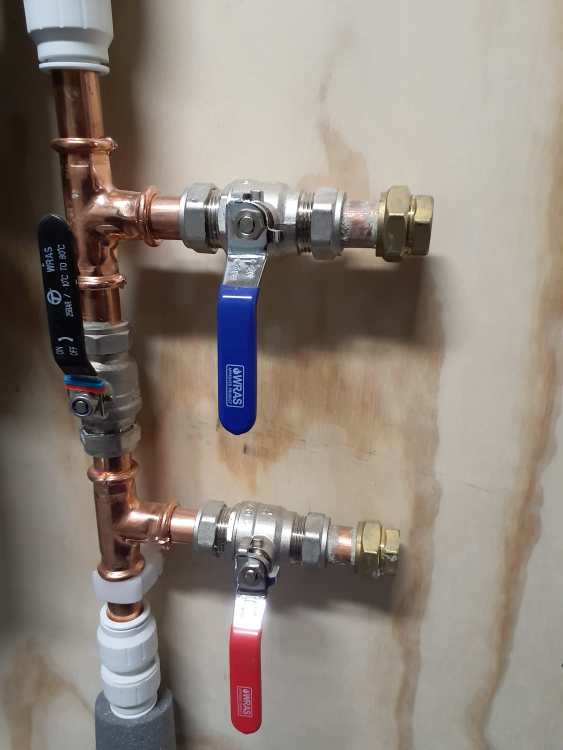
When needs must..😉 This one is on 22mm but works just as well on 28mm with full bore lever valve on the primary pipework.
-
Advice please: cutting metal down pipe.... without
SimonD replied to ToughButterCup's topic in Rainwater, Guttering & SuDS
I've used two methods. One was with a really old work bench where the surfaces could be angled to 45degrees and the tube would just rest in the pocket. The other was just to screw some 4 x 2 together at right angles and gently hold the pipe against those. Eventually you'll get the feel of very light strokes with the hacksaw and you can hold both the gutter and down pipes by hand on any bench and it works fine. For the holes in the gutter, you need to get yourself some tin snipps and a decent dead blow hammer for the edges. Installation instructions attached. Have fun. It's lovely material to work with. Rainline-Assembly-Guide.pdf -
Ah, well. A picture says a thousand words! As @Nickfromwales suggests, you have no need for a fill and flush valve as you can use the filling ports on the ufh. I'd just suggest you add a valve on your mains for future filling and flushing maintenance of the primary circuit - you'll need to do this once you get the ashp in and running anyway. I know you say you're going with 2 filters as there isn't the space where the return goes through the wall. The only other suggestion I might give is to consider running the return from the cylinder back to the vertical return near the ufh manifold and then tee the return back to the HP from there, which would give you a longer horizontal run you fit just one filter. Not brilliant, but could work.
-
That was exactly what I was thinking 🙂 And/or photos with sketches ?
-
Yes it is. I'm not sure I'd recommend it though 😉 I do wake up some mornings and wonder what on earth I was thinking, especially making the move to MCS accreditation. However I also decided to build my house myself, so not sure how good my decision making is for making my life easy. But from my experience there are two sides to the coin. Knowing what and knowing how. A lot of those in the plumbing and heating industry seem to have missed much of both those sides. A reflection of this is how many times people who have heard a bit about about heat geek training have remarked about how clever it is because they tell you to install complete runs joint free using flexible pipe and minimal joints. Something that has been the mantra on BH forever I think. And then there's the other one about pipe diameters. I just did an unvented installation where the bathroom plumbers insisted to the customer the supply pipes had to be 22mm. I said to the customer that this will mean lots of wasted hot water and long wait times when washing hands at the basin. I suggested running 10mm plastic to the basin while everything was exposed and 15mm to the bath as it gets used mostly for showering, but the plumbers wouldn't have it. Again something you see suggested here on BH all the time. So really BH has to be probably the best source of best practice you can find on all this. I often wish there was a similar resource I could use to help me with questions about paid jobs that is so forward thinking. I've found some useful resources, but nothing even close to here.
-
All of these tapes come in different thicknesses each of which has a specified compression measurement for water tightness, air tightness, wind tight etc. - e.g. thickness of 25mm, watertight to 12mm, air tight to 20mm. This means that even after expansion into the gap it should be fairly compressed to be water tight. I don't suppose you have any way of knowing what the installers used?
-
As per @JohnMo, not outside. I do however always install them on a new installation, just next to the cylinder on thd return before the mag filter/strainer close to the filling loop. That way I can connect my thorough flush kit within a moment as you ideally need to flush the system twice, once with old heating system in place (if you have one) and then after installation and the system has run warm for a while. You can get them here https://naturalgreenheat.co.uk/product/bastion-28mm-fill-and-flush-valve/ at under 20 quid. I used to always install a couple of ball valves on tails in an accessible position on flow and returns until I recently found that some idiot plumber had used them to pipe in a new radiator in a bathroom and used the one on the mains to supply cold to the same bathroom!
-
Looks like the party is over....
SimonD replied to Beelbeebub's topic in Air Source Heat Pumps (ASHP)
I think we're mostly on a par with Germany in terms of highest costs. It's no surprise given both rely so much on gas. But there are so many inconsistencies that make little sense from the perspective of an environmental policy. We still subsidise fossils fuels to the tune of £17.5 billion per year. The greatest increase in electricity costs are relating to wholesale costs and social/environmental costs on the average bill since 2021. It seems strange given the profits made by producers and that Gas has not been significantly levied from a social and environmental perspective, but is privy to significant subsidies beyond the subsidies available for renewables. Yes, the government has announced some reductions for electricity in the budget, but we'll have to see how that pans out in reality. -
Looks like the party is over....
SimonD replied to Beelbeebub's topic in Air Source Heat Pumps (ASHP)
Somewhere recently I saw some data showing that heat pump uptake follows a curve of parity between fossil fuel prices and electricity - the closer the parity the higher the uptake. something which largely disproves the capital cost argument. Interestingly the figures show that heat pumps provide the biggest bang for the buck when it comes carbon savings, even over insulation measures. I still cannot fathom why our electricity prices are the way they are and how this can in any way be justified other than in terms of profits for energy companies and their shareholders. -
Looks like the party is over....
SimonD replied to Beelbeebub's topic in Air Source Heat Pumps (ASHP)
Yep, maybe it's just my age, but it seems to be getting worse by the parliament. -
Looks like the party is over....
SimonD replied to Beelbeebub's topic in Air Source Heat Pumps (ASHP)
As is appearing quite typical of this government, they've realised the problem after the fact and are now trying to reassure pensioners that if their sole income is from pension, they won't pay any tax even if it is above the threshold. It's not too dissimilar to the 3p/mile tax on EVs which is another, we're going to do this but haven't got a clue how. Then some clever bean will think we'll just roll out a kind of start meter to be installed, and just like smart meters or fibre broadband it'll be privatised and roll out will maybe happen by 2080....or some other century in the future and use shite technology that doesn't work properly because the infratructure it needs hasn't been installed either. And they wonder why there's a productivity problem in the UK. -
I know you're in the Wiser ecosystem now, but for future reference the EPH controls can do multiple zones via Opentherm as each additional zone is paired to a master hub controller. I've always argued that it's not the heat source that's important but the control strategy and mechanism. With gas systems I always seem to have struggled with getting the system control as I like it, even in my own house where I ended up with a pragmatic solution that was okay, it was efficient, but not amazing. I think this is down to the split between heat source and controller manufacturer and how they decide to implement their control ideology and this causes problems. This is particularly the case with in the gas market. I've now completed 2 full system designs and installations of heat pumps where I'm fully responsible for the systems and have to say that with using the manufacturers control packs of course, the control element is just fantastic. Both have required very little time and only small adjustments to WC and room influence, including a tweak to a couple of normal trvs. From this, I have so become a convert to heat pump systems, I really don't want to work with gas any more. Integrated manufacturer controls are a big player, but I also suspect there are a few other fundamentals in the systems that improve things on this front. Anyway, just an aside, while I'm on the topic. I'll get my coat ☺️
-
I don't recall what boiler you have but I seriously doubt they'll check the wiring. For tests they'll usually use the check programs and might ask you to turn your heating on so there's flow through the system.
-
Yes, that's what I meant to write. You caught me before I edited 😊
-
I doubt they'll notice on a service. It's likely only on repair or warranty work they might find out.
-
I've lost count of the number of houses where I've been showered by the things. I reckon loads of the installers skimped on the adhesive as it cost them, especially during the grant funded years.
-
Yes, there are a few that do. On some, like Ideal, it's used with weather compensation and the manufacturers get a bit sniffy about it if you use it without weather comp. Don't ask me how I know, but they don't always like those who experiment 😏 If you're using something like this with an s plan you'll ideally need a normally open 2 port valve on the ch side to close when you send your 240v call for dhw to boiler. No such thing as a free lunch unfortunately. I used to do this stuff regularly until I saw the light and just moved to installing Viessmanns on 4 pipe. Life got a lot easier from then on - I'd regularly save myself a day.
-
With eph controls you can run priority hot water using opentherm on an s-plan system. You can also get an additional receiver to install right next to boiler for necessary opentherm communication so no new cabling required. Use the cp4i together with cp4-hw-ot for this. No subscription fees for the app. I wouldn't touch tado controls ever again after my experiences installing them for a few customers, even the ones I ordered from Europe with opentherm. Hth
-
Worst day for us was Wednesday at about 65kWh including EV charging. Best day was yesterday with 30kWh which is total consumption, so about £8.5. On gas just heating would have been about £6.5 with no dhw.
-
Looks like the party is over....
SimonD replied to Beelbeebub's topic in Air Source Heat Pumps (ASHP)
https://www.gov.uk/government/news/discounts-for-families-to-keep-warm-in-winter-and-cool-in-summer -
As @Onoff says, the system should be flushed as part of a boiler installation. Many boiler slingers will just do a chemical flush or nothing at all. Whilst I always complete a flush when installing new boilers if someone I haven't done an install for asks me, I usually send them to British Gas as they used to have a lifetime guarantee for their flushing jobs.
-
Looks like the party is over....
SimonD replied to Beelbeebub's topic in Air Source Heat Pumps (ASHP)
Exhaust air heat pumps. First made by Nibe in the 1970s who are probably still the market leaders.


