


Alan Ambrose
-
Posts
3129 -
Joined
-
Last visited
-
Days Won
13
Everything posted by Alan Ambrose
-
How to measure the remaining HW in an unvented cylinder
Alan Ambrose replied to Adsibob's topic in Boilers & Hot Water Tanks
>>> Normally an UVC will start off full of hot water heated to the set temperature. As it is used, a hot / cold transition moves up the tank. If no more heat was added, you would get almost the same temperature of water coming out of the taps right up to the point where the hot / cold transition reaches the top of the tank and the water would suddenly go very cold. If the cylinder thermostat was say half way up, then at the point the transition reaches the thermostat the boiler would fire up. At that point the heat input to the tank would stir up convection within the tank and continue to do so while it is heating. With the heat source being a big boiler, it can probably re heat the tank as fast as you can empty it. <<< Yeah, the behaviour of DW cylinders is quite a complicated business if you think about it - stratification / mixing / heat loss / statistical usage patterns etc. The simpler way would be no storage tank and use a heat source powerful enough to heat the water to the required temperature instantaneously at the required flow rate. @SteamyTea will be along shortly to tell us what instantaneous heat power is required for a typical shower . That system would be much more efficient because you would only heat the water you need / there would be no 'waste' heat when the cylinder cools while it's waiting for your next shower / there would be no need to heat up more water than you need not knowing how long your shower was going to be. However, the instantaneous power requirement is more than most heat sources can provide - hence the tank. The storage tank lets a lower power heat source heat over a longer period and then the heated water is delivered in a much shorter period. Sort of heat-based impedance matching if you get my drift. Given that the tank thing is all a bit of a fudge anyway, why not just heat a bit longer until you don't run out of hot water ever. Yeah, there's going to be some waste, but using a cylinder in the usual way implies some waste anyway. The other system nobody uses would be to have one or more vented tanks which didn't refill with cold water until the start of a new heating cycle had been determined, say 3 am? The control / safety system might be more complicated though. A bit like a more modern - 'heat the kettle on the stove and fill the bath in the parlour system' -
There's a bunch of discussion here on 't 'ub if you look for it.
-
When’s a good time to self build
Alan Ambrose replied to nod's topic in General Self Build & DIY Discussion
Before the town & country planning act of 1947? -
Regulations for landing balustrade (banister)
Alan Ambrose replied to MortarThePoint's topic in General Construction Issues
Gus gave some calculated examples about a month ago. I guess enough there that you would figure you need an SE to checkover a custom design. -
What do you make of this?
Alan Ambrose replied to CalvinHobbes's topic in Air Source Heat Pumps (ASHP)
Ah -
How do I set these thermostats?
Alan Ambrose replied to recoveringbuilder's topic in Underfloor Heating
Well you could RTFM and it's only a 10 pages or so. Should work fine remotely btw. Congrats on getting connected up. Auto - runs the time/temperature profile as set/shown below in that screen. Hold - is a temporary change to the profile - e.g. heat the hot water for a couple of hours to take an unscheduled shower. Standby - a sort of off/holiday setting - don't heat unless it gets below the 'frost temperature' (set with the little menu under the 3-sliders icon). I have mine all set to 12C although I guess you could risk lower. -
How do I set these thermostats?
Alan Ambrose replied to recoveringbuilder's topic in Underfloor Heating
That’s odd, the connect-to-hub step takes just a few secs, no? Then you can configure nearly everything from your phone. I give the app say 8/10 and they don’t update it every 5 mins - which is good. -
3 phase connection question asked by SSE
Alan Ambrose replied to BigBuilder's topic in Electrics - Other
It's at this point I usually remind people that the point is to use less energy rather than more energy. Maybe add the max power of your car chargers and the heat pump and add 20%. It could be that the DNO doesn't care much anyway and there's no change in cost. Or you could ask for 100A and see what they'll give you. They won't change the size of the cable their planning to use, so it'll just be up to the marketing department. It's a bit like deciding between a 3L engine and a 5L. Yeah, more is better right? All your single phase mates will be on 25kW or less anyway. At 63A per phase you'll have twice that. -
How do I set these thermostats?
Alan Ambrose replied to recoveringbuilder's topic in Underfloor Heating
You could buy the hub and set them with their phone app - you also get remote control that way. -
This web-connected auto-update thing is super-annoying. My CAD set-up exploded on Monday and it's not obvious how I get it back - the error messages are, of course, complete nonsense. Meanwhile our Sony TV is taking longer and longer to start as they add more cruft to it. Roll me back to the nineties when you bought a bit of software and it stayed the same unless you decided to update it.
-
Wow, very stylish. I would never have guessed that outside Venetians would cope with the wind?
-
@Bramco - can I ask what kind of blinds you chose? I'm imagining shop awning style as they're tiltable rather than the external vertical roller ones I was considering myself? Or are they tiltable in the venetian sense?
-
>>> mixing the colour match by yourself can work That's interesting, especially as I am already quite close with a few of the tester pots.
-
What do you make of this?
Alan Ambrose replied to CalvinHobbes's topic in Air Source Heat Pumps (ASHP)
They could look at their smart meter graphs and get an idea what's using all the power. -
3 phase connection question asked by SSE
Alan Ambrose replied to BigBuilder's topic in Electrics - Other
The DNOs seem to delight in asking these questions in a stupid way ... or maybe they ask the same question whether you have a 3 bed house or are putting in a new blast furnace. The options in the real world (for residential) are likely 63A or 100A fuses (or maybe 80A as ProDave says). Which means 63A x 230V ~= 15 kW or 80A x 230V = 18 kW or 100A x 230V ~= 25 kW per phase. The smaller is probably fine - that's a lot of power. I have 63A 3-phase. -
Bathroom extractor: self install?
Alan Ambrose replied to Post and beam's topic in Electrics - Kitchen & Bathroom
I think that if you don't already know the regs that apply e.g. 'special location / SELV / RCDs / notifiable to BC under Part P' etc - then you probably do. -
Fun and joy with a thermal camera, part I: Attic
Alan Ambrose replied to Garald's topic in Heat Insulation
Sort of 'suck it and see'? -
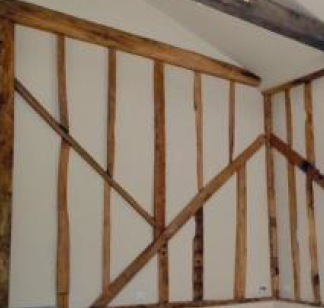
>>> Have you any idea of the original paint name / manufacturer.# No, the backstory is that it was a new barn conversion we bought 5 years ago and I need some touch-up paint. I guess that's a harder job than just 'get me somewhat close to this F&B colour'. I'm a bit closer with matching the Valspar swatches by eye and their sample pots - actually I have a much better match than the custom-spectro-matching-mix thing. That suggests their matching service is a bit of a waste of time - at least from that B&Q with that operator. I couldn't understand why they didn't have a second matching step to take their first guess and improve it - but they were properly stroppy by that time. I'll try Johnstones and Tikkurila and see if they're better and report back. Someone has done a very skilled job plastering and painting between all the old oak sticks so it's not an easy job to just re-paint a single 'wall' - it would need loads of masking. This kind of thing:
-
I'm not particularly prone to worrying, but now I have another thing to avoid worrying about.
-
Weights of Different Construction Methods
Alan Ambrose replied to Paul K's topic in General Construction Issues
I would say timber frame with wood rain screen and tiled roof should be ~5 kN/m^2 area loading including live load allowance. -
Suggest unplug internet connection then ping & portscan camera to verify onvif port is there / connect with a local camera app. That’s what e.g. blueiris would be using locally.
-
My view is that these builds are a huge amount of time and energy and that we might just as well do as good a job as we can of them. Hopefully they’ll be around in 100 years time.
-
Goodness, the level of expertise on the ‘ub never ceases to amaze me. I can just about see it’s brushed but very flat and matt.
-
>>> so 10 Germans emit the same amount of effluent as 12 Brits - must be all the currywurs I just had to explain to the other half why I was laughing so much…
-
>>> Ignoring all other sources of heat loss, floor, roof, windows and doors, MVHR ventilation, air tightness etc. Is that the problem? Heat loss through the walls is probably 20% of the total for a well insulated house. Windows are critical. You could use Mr Harris’s spreadsheet for a more accurate feel. And ubakus for to check the supplier’s U-value calcs.


