Adsibob
-
Posts
3604 -
Joined
-
Last visited
-
Days Won
10
Everything posted by Adsibob
-
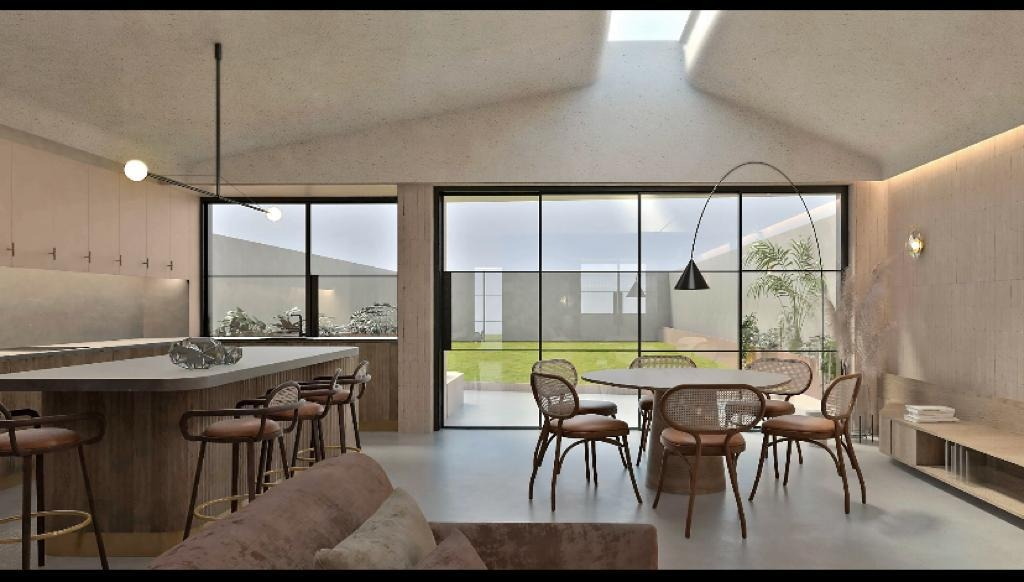
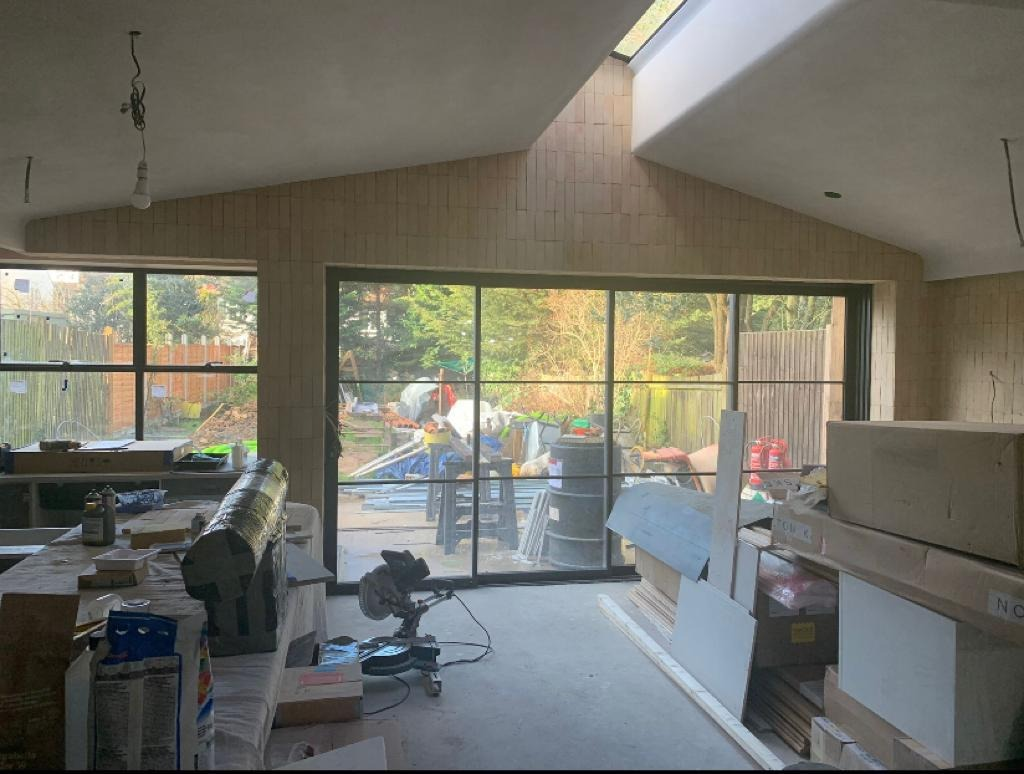
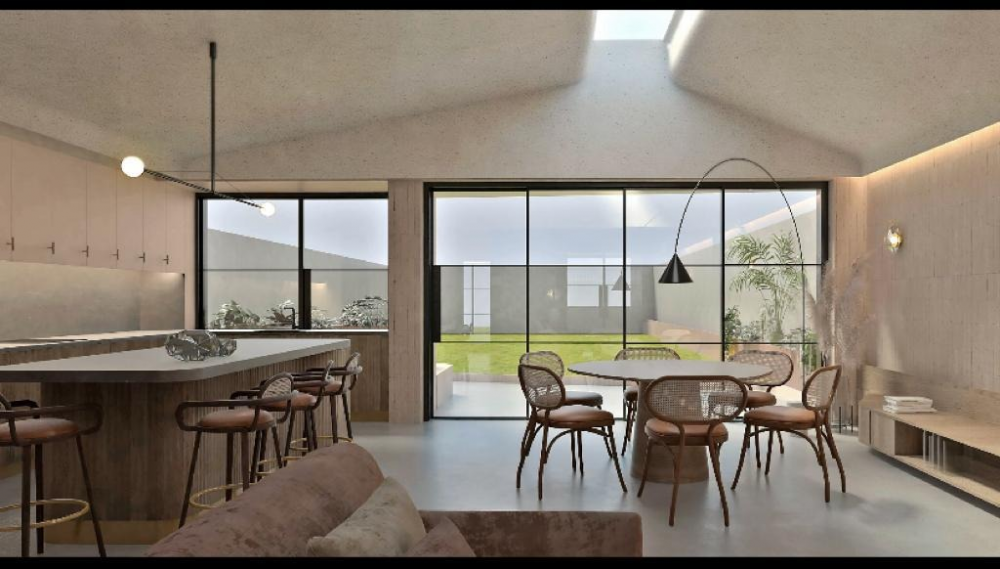
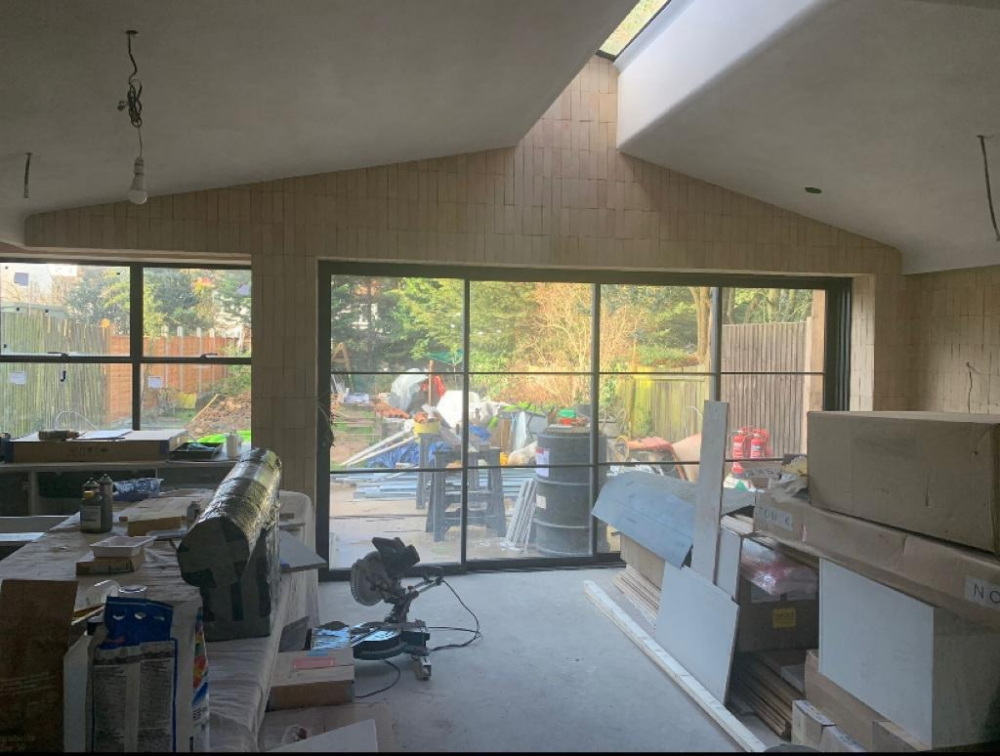
In the render there is no tile above the sliding doors (that triangle shaped gable bit of wall). That is decorative plaster as is the sloped ceiling either side of the skylight. In reality we took the tile up to the skylight on that wall. So quite dramatically different I guess. It's a rustic clay tile made in morocco and has come out a little more rustic than we were expecting, so she is annoyed there is more of it than we had originally planned.
-
there are no curtains. Let me give some more details for context: Version in digital render: What we did (without consulting SWMBO):
-
I'm trying to persuade her that she will learn to like it... It's not going well.
-
The house will pay too. It won't look as good in my opinion.
-
We had some digital renders done of our interior, not the whole house, but a few of the key spaces. SWMBO approved all of them (after quite a bit of debate about floor finishes and colour schemes). A few months into the project, my architect (who has also been responsible for assisting with interior design and project management) mentioned to me that he had a second thought and he thought something would be improved if we made what, at the time, I thought was a relatively minor and inconsequential change (didn't impact floor finish or colour scheme, so I didn't think to trouble SWMBO with it). Fast forward a few months, SWMBO sees it, notes it's not the same as the digital render and says she hates it. I took it back to the architect and told him and he explained the design philosophy underpinning the change, refreshing my memory of the conversation we had about the change at the time. It makes perfect sense to me, which is why I approved the change in the first place. But now I'm stuck as SWMBO really wants to reverse about £1200 worth or work and materials, with the result that £1200 goes down the drain and then we spend another £300 or so changing it to how she was expecting it to be.
-
 The best experience i had with an architect was when he would sketch in front of me (or on zoom) using a digital sketching tool so that lines could be undone really easily. He would start sketching and get our initial impressions and then undo and redo whilst in the meeting with us so that his sketch was a somewhat iterative process. He could also mark-up existing drawings to show us the different ways of amending them, again being able to very quickly undo and redo anything we weren't too keen on. In this way he could take on board our feedback almost instantaneously, making the process much more collaborative. It would stop him going on what we perceived as a massive tangent to the original design brief or what we had in mind, thereby avoiding big wastes of time on said tangents.
 -
i guess you could try focusing on "show don't tell". It's tricky though. People are often set in their ways and many aspects of design might be thought of as subjective, even though once people's own biases and experiences are filtered out, there is often an objectively better design when one compares two.
-
I disagree. Great design is about achieving both function and form. We spent a lot of time with an architect explaining to him the gripes we had about our living space and taking him though our aspirations for our future home, and he designed something beautiful that ticks all of our functional requirements. We’ve also managed to use lots of almost artesanal, at times rustic, materials in our finishes which in combination with the modern aesthetic of our house, look really good. Gives it a wabi-sabi quality. To design beautiful houses that people actually want, you need to understand what it is they want from their house, and what type of interiors they like before you even start sketching. You may think interiors are very separate to the design of the overall house, but I think they are fairly closely linked.
-
"Luxury" bath/showeroom planning
Adsibob replied to markharro's topic in Bathrooms, Ensuites & Wetrooms
Are you sure you want jets in your bath. They are never as good as a proper jacuzzi and the novelty will soon wear off. By all means, get a nice spacious bath, but this doesn’t have to be expensive. It is quite a bit of work ripping out sanitary ware, so I would choose wisely and choose once. Put the jacuzzi in the garden. -
So having boasted about my screed not having any cracks in it (somewhere else on this forum), I spotted a long, but thankfully thin, crack in my screed. It is about 2.5m to 3m long, but less than a mm wide. Slightly jagged with no real explanation as there is nothing different either side of the crack, it is more or less in the middle of the room. My architect thinks it’s just the building settling. Screed was poured 125 days ago and I only spotted this crack a couple of days ago. UFH went on about 8 weeks ago (around day 70 after the pour). Hopefully there aren’t any more cracks and that this crack doesn’t get any bigger, but I guess it must be fairly common. We are planning on laying a microcement topping which is 3.5mm thick. Not sure whether I need to fill this tiny crack with anything beforehand.
-
I’m confused about ubiquiti
Adsibob replied to Adsibob's topic in Networks, AV, Security & Automation
I had seen this a couple of days ago, and I’m very tempted by it. The thing that confused me is that being a ubiquiti product, won’t I either need a dream machine or a pc to run the software mentioned further up (I think by @Dan F)? Or is this just plug and play? And what about doing away with my Virgin router - what is the solution to that? -
I’m confused about ubiquiti
Adsibob replied to Adsibob's topic in Networks, AV, Security & Automation
I agree with this. I’m basically looking for the best hassle free and reliable way to have relatively fast wifi throughout my house. I have Ethernet points for the TV and two computers, but want good wifi for music and general purpose iPads, phones etc. We will have 200mb Virgin, as that is the fastest affordable option in our neighbourhood. I don’t need 200mb download on the wifi, 90mb will be plenty. But the upload speeds do need to stay close to the Max offered by Virgin, which is only 10mb to 15mb. I don’t really care about being able to have networked vídeo cameras or sophisticated options to allow guests to use the network. A way of blocking pornography for when the kids are old enough to find it would be good, but presumably that can be done on the local devices or within the Virgin settings. So I think it is a toss up between a ubiquiti DM with two to three access points, or a mesh wifi system like the Deco with three units. Though I see ubiquiti also do mesh so that’s even more to think about. -
I’m confused about ubiquiti
Adsibob replied to Adsibob's topic in Networks, AV, Security & Automation
Thanks @Rob99 and @Dan F. For a three storey house, do you think one dream machine pro and two APs will be enough? Does the dream machine pro also act as a wireless access point itself (like the Virgin superhub does) ? And I was a bit confused by @Dan F’s comment about needing a pc to run the software. Why is that necessary when ubiquiti’s website talks about controlling everything from their app? -
I get that ubiquiti is very well rated on this forum. I’m not entirely sure for what it is rated well, as it seems to do a lot of things that I really don’t understand. I went into their website to try to learn about what they sell and what it could do for me and I got even more confused. I have a three story house, cross section below. I want good wifi coverage everywhere, and I also don’t want to have to use any aspects of the Virgin Media “superhub” router that I can avoid. I hate that thing. Whenever there is an issue with the network it can only ever be resolved by a reboot and then it literally can take anywhere between 15 and 20 minutes (and sometimes another reboot) to get the thing working again. My electrician put a couple of extra Ethernet cables into the house when he was re-wiring in case I wanted to have some wifi access points. I didn’t ask him to do this, but it was a pleasant surprise when I found out. I told him I was just going to install a mesh system but he said he thinks wireless access points are better and that he has a ubiquiti system at home that he is really happy with and offered to install one for me. But I’m confused as to what exactly I need to achieve my goals. The ubiquiti website is just written in a language I don’t understand. R shows the location of my Router (or the location it will be once installed next week). E shows the points where I have Ethernet. I can only give up the one on the first floor and one of the ones on the ground floor for access points. Well this be enough? What hardware do I actually need and what the hell is a ubiquiti dream machine? And can the access points go in cupboards, or will their ability to spread the magic suffer? Any help would be much appreciated.

-
I didn’t know there was an option to have a dynamic one. What are the pros and cons?
-
Wouldn’t Delta T of the in and out flows also depend on what floor finishes you have and what the temperature of the floor is. For example, if you have thick 24mm oak plank as your floor finish, and the room is 23C to start with, then surely the pipes would lose less heat than if you had 6mm porcelain laid in a room that was 12C to start with.
-
The twin tank is a lot of marketing nonsense in my opinion. With a good single tank system, you can set it to regenerate at 3am. So for 20 minutes at 3am you will have no water softening. You will still have water though! This is the system I went for: https://www.eastmidlandswater.com/water-softener-ems15-blue-meter-controlled-eco-water-softener-ems15/424 not cheap, but with the 1” fitting option gives you a very high flow rate. This should be higher than the Harvey’s or Kinetico range at this price point. Yes it dos have to be plugged in, but uses very very little power.
-
QS/project manager for timber frame house in SE London
Adsibob replied to cc247's topic in Surveyors & Architects
I think these are two very different roles, with different skill sets. Because if the chicken and egg nature of design and costing, I think you should focus on the main elements of your design first, prepares tender doc and then approach a QS, or a builder who had their own QS. You will then get a breakdown of what each bit of your tender costs and you can then re-engineer your design to bring down any elements of the design that are unaffordable. It is iterative, but in my experience it is the only way to get an accurate handle on what different design choices cost. It is obviously very helpful that you already have some big decisions behind you. Next big ticket items will be all glazing and external doors, kitchen, bathrooms, flooring, insulation, MVHR. For electrics in London, a good ballpark is £50 per electrical point/lighting point. to plumb my entire 5 bed house with a secondary loop, brand new gas system boiler and cylinder and high end smart controls (although apparently low end UFH pumps) was about £25k, not including the price of the sanitary ware or boiler and taps/showers etc. -
Is it Fairly straight forward to change the pumps? Of the four manifolds we have, only one is in a place where the noise might bother me, and that is the one that is being problematic. I will see what the plumber has to say, but good to know whether changing the pump is an easy job.
-
I had four manifold and pump sets manufactured by Warmer installed about 3 months ago. A couple of them have been running since just before Christmas to get the screed dry, the other two were only commissioned a few days ago. Of the two that were commissioned a few days ago, one has stopped working. So unless it's an installation issue, that is a 25% failure rate. Hopefully it was just an installation issue that will be fixed when the plumber comes back to take a look, but I'm just wondering if anybody else has any experience with this brand. Here is the product: https://pswtradesuppliers.co.uk/manifolds-and-warmer-pump-set/23-4-port-manifold-ibo-pump-set-5900308747049.html
-
Insulating a pebbledash solid wall and damp concerns
Adsibob replied to Ben Weston's topic in Heat Insulation
this made me chuckle -
We aren’t using our engineered oak as a structural subfloor. Our build up is: 1) 14.5mm engineered oak 2) 5.5mm plywood (so the oak is less exposed to heterogenous temperatures from the UFH coils) 3) 25mm Cellecta UFH boards 4) 6mm rubber 5) 22mm structural chipboard 6) posi joists A very expensive build up, but one that will hopefully be awesome!
-
How can you tell it moves? How does this manifest visually?
-
The plot thickens. I spoke to the plumber this morning (who was not on site yesterday when my builder reduced the output temperature of the boiler) and the plumber said that the change my builder made: won't have made any difference to the water temp in the floor - because the minimum setting for the manifold blending valve (which we didn't change) is 30C and so whether the manifold was receiving hot water at 65C or 40C, the blending valve will keep the water at 30C; and actually cannot be done once we commission our UVC, because we have a low loss header which means we can only have one temperature for the output of the boiler, which must be 65C (builder had reduced this to 40C, but that won't be anywhere close to hot enough for heating the UVC). So it seems that the "drop" in temperature of about 1.7C that I had recorded must have been a false recording. On the one hand, I'm starting to wonder if I was foolish to ignore the manufacturer's recommendation that we install a thicker sheet of ply as our barrier between the bottom of the engineered oak and the top of the pipes. I think they recommended 12mm and we went with 5.5mm. On the other hand, given it's fairly standard for manifolds to have a minimum setting of 30C, and given this was producing a temp of about 26.5C on the bits of plywood directly over the loops closest to the manifold, it must surely be fine as that is only 0.5C over the manufacturer's recommended maximum temp for the subfloor. Surely there is scope for it to get even a degree or two hotter without buckling the oak floor (which in any case has an expansion gap around the perimeter?
-
So the manifold was apparently on minimum and we were still getting the plywood subfloor (which is only 5.5mm thick and laid directly over the pipes/insulated Cellecta pipeboards) to reach a temperature of 26.5C on the bits of plywood directly over the loops closest to the manifold. I asked my builder to reduce the temperature and he said that because it was on minimum the only way to do this was to reduce the hot water temperature being sent to the manifold by the boiler. This sounded odd to me, but by the time he had gone down two flights of steps, reduced the boiler output temperature by 2C and climbed back up two flights of steps the temperature of the plywood very close to the manifold had dropped to about 24.8C. The oak flooring is going on top of the plywood and the flooring supplier has said the subfloor (i.e. my 5.5mm ply) should not be allowed to exceed 26C. I'm just wondering if the oak flooring, which is engineered oak and 14mm thick in total, will actually let much heat through when the subfloor it is glued to is only 24.8C. Maybe I should turn the boiler output back up and live with being 0.5C to 1C over the supplier's recommended temp of 26C. But the supplier also recommended we use a thicker sheet of plywood (something like 12mm) and we're using 5.5mm because I thought 12mm would be excessive. It was about 11C outside, so not much of a challenge for the house. The other question I'm wondering is should we have left the temperature output of the boiler as it was (instead of reducing it by a couple of degrees), and just reduced the flow rate instead?