Adsibob
-
Posts
3609 -
Joined
-
Last visited
-
Days Won
10
Everything posted by Adsibob
-

MVHR cooker hood idea
Adsibob replied to woodman's topic in Mechanical Ventilation with Heat Recovery (MVHR)
It is fairly airtight , although not to passive standard. We have installed Tecson Vana tape at every junction between walls and windows/doors as well as specifying zero trickle vents on all windows/doors. I’m interested in the automatic make-up air damper you mention. Does that open a vent to allow air in when you turn on the extractor? Link? -
MVHR cooker hood idea
Adsibob replied to woodman's topic in Mechanical Ventilation with Heat Recovery (MVHR)
I too am considering venting my hob extractor outside. I know it isn’t the technically perfect thing to do with an MVHR system, but it avoids a lot of issues for me. Our Hob is right by an external wall. I’m wondering how @dpmiller, @woodman and @Conor got on with their installs. Do you all vent outwards even though you have MVHR? -
Insulating a pebbledash solid wall and damp concerns
Adsibob replied to Ben Weston's topic in Heat Insulation
This is very similar to my experience. Our “renovavation” started 14 months ago and is still not finished. With some luck and a fair wind, we might be finished in the next 8 weeks or so. I suspect there will be plenty of snagging so it won’t be “finished” till later this year. That will make the project the best part of a year and a half and I really do think it would have been much faster to knock down and start again. I’m not sure it would have been cheaper though. Presumably the insurance requirements of knocking down a semi detached house are much higher, as well as the costs of temporary props to support the adjacent house. And then there would be more costs involved in complying with regs for a new build. Of course, I would have ended up with a warmer house, so it pruebo would have been worth it. -
Insulating a pebbledash solid wall and damp concerns
Adsibob replied to Ben Weston's topic in Heat Insulation
I don’t think this will work. Take a look at the exterior of your old house. How will all of its architectural features, window reveals, soffits etc cope with 100mm build up of insulation externally. I wanted to do this but was strongly advised against it because you ruin the look of your old house. -
Controller or smart plug to control a towel heater circuit
Adsibob replied to Adsibob's topic in Central Heating (Radiators)
Yeah, I’m not expecting much responsiveness on the ground floor, but on the upper floors the floor coverings are much thinner so should be fairly responsive. I have used quite thick pipes 16mm diameter, in the screed, so hope that will help a bit. On the ground floor, I suspect we will just run it from 3am to 7am and then from 3pm to 9pm. Until I live in it I won’t know, but one of the features of the Tado is the ability to monitor air temperature and humidity and graph it, so you have historic data capture to understand how the running time of the heating corresponds to the room temperature. After a few days, the Tado can use machine learning to work out when to call for heat to achieve your desired temperature at the times that are ore-programmed. It is a really Smart system that has other features that we will use apart from just the basic thermostat. -
Controller or smart plug to control a towel heater circuit
Adsibob replied to Adsibob's topic in Central Heating (Radiators)
I thought the manifold has different loops on it, and each loop can be controlled by its own thermostat. We have 4 manifolds but about 11 zones because some manifold cover two to four zones. -
Controller or smart plug to control a towel heater circuit
Adsibob replied to Adsibob's topic in Central Heating (Radiators)
It’s a 1930s semi with no cavity. We have upgraded the insulation throughout by installing a concrete slab in the subfloor, topped by 100mm of PIR and then 75mm to 80mm of screed. All the external of the house has had kingspan EWI added to it, but not too thick as the original features of the house didn’t allow for it. All windows are brand new double glazed thermally broken aluminium, and some of the veluxes are triple glazed. We have put a tonne of wood fibre insulation into the roof and also installed MVHR with lots of air tightness measures. So it is certainly not passive, but warm enough. Why do you ask? -
Controller or smart plug to control a towel heater circuit
Adsibob replied to Adsibob's topic in Central Heating (Radiators)
I remembered that I had an old Kasa TP smart plug that works over wifi. I found it and rigged it up to my bedside table light to see if it works okay. It works well and even has a towel heater (well radiator) icon in the app I can assign to this plug. So I guess we will use this. -
Controller or smart plug to control a towel heater circuit
Adsibob replied to Adsibob's topic in Central Heating (Radiators)
So we don’t have any need for a controller for the UFH because we are using the Tado system; each zone is controlled by its own tado thermostat (which is smart and programmable). -
We have a multizone water based system is an UFH system. The only heating which is not UFH are two towel rails, one in each of two adjacent bathrooms. Our plumber has set up a separate zone for just these two towel heaters with its own zone valve. Today the electrician asked me how I want to activate that valve. Each towel heater has its own thermostatic valve anyway, but this zone valve will stop us sending hot water down the pipes to those two bathrooms during the majority of the time we are not using them. He made two suggestions: As we are already having Phillips Hue to control a couple of lights, we could just get a phillips hue smart plug and plug the zone valve into that. I think the fact we are going to have a Phillips Hue system already is a red herring because I think the smart plug works independently from that system, and just relies on a bluetooth connection to your phone and the free Hue app. We should then be able to programme the plug to a routine through the app - I assume this is possible? Buy a wireless zone controller that enables us to programme it. Another requirement is that we need to be able to control this from the first floor, whereas the zone valve is on the ground floor (albeit more or less directly under one of the two adjacent bathrooms, so not particularly far away; maybe 4m from one towel heater and 7m from the other. But it would be nice to be able to be within range of a wirelessly controlled controller anywhere in the house and I'm not sure bluetooth (which is the way the Phillips Hue works) will have enough range. Option 1 seems simple and easy, but is that how a zone valve really works: when it gets power it opens and when it doesn't get power it closes? Option 2 seems overkill. The cheapest smart controllers I can find are about £70 and that is because they all have thermostats at the heart of them. We don't need a thermostat, just a controller.
-
Insulating a pebbledash solid wall and damp concerns
Adsibob replied to Ben Weston's topic in Heat Insulation
His speciality is actually diagnosing and solving damp problems in old houses and designing roof details. Our house is almost 100 years old and had quite a lot of damp, so before insulating it we needed to resolve that. So that is why we consulted him. He's also a nice guy and not stupid expensive. -
Is a cooker extractor necessary with MVHR
Adsibob replied to SBMS's topic in Mechanical Ventilation with Heat Recovery (MVHR)
That's the undiscounted price. I got about 35% off that, although still a rip off. -
Viessmann Vitodens 200-w - initial impressions
Adsibob replied to larry's topic in Boilers & Hot Water Tanks
That’s good news @larry. Mine was installed a week before Christmas and has been ticking along nicely since. We have been running it fairly constantly to dry the house out. Not fully set up yet, as hot water tank still hasn’t been installed, but that is due to happen this week. -
Is a cooker extractor necessary with MVHR
Adsibob replied to SBMS's topic in Mechanical Ventilation with Heat Recovery (MVHR)
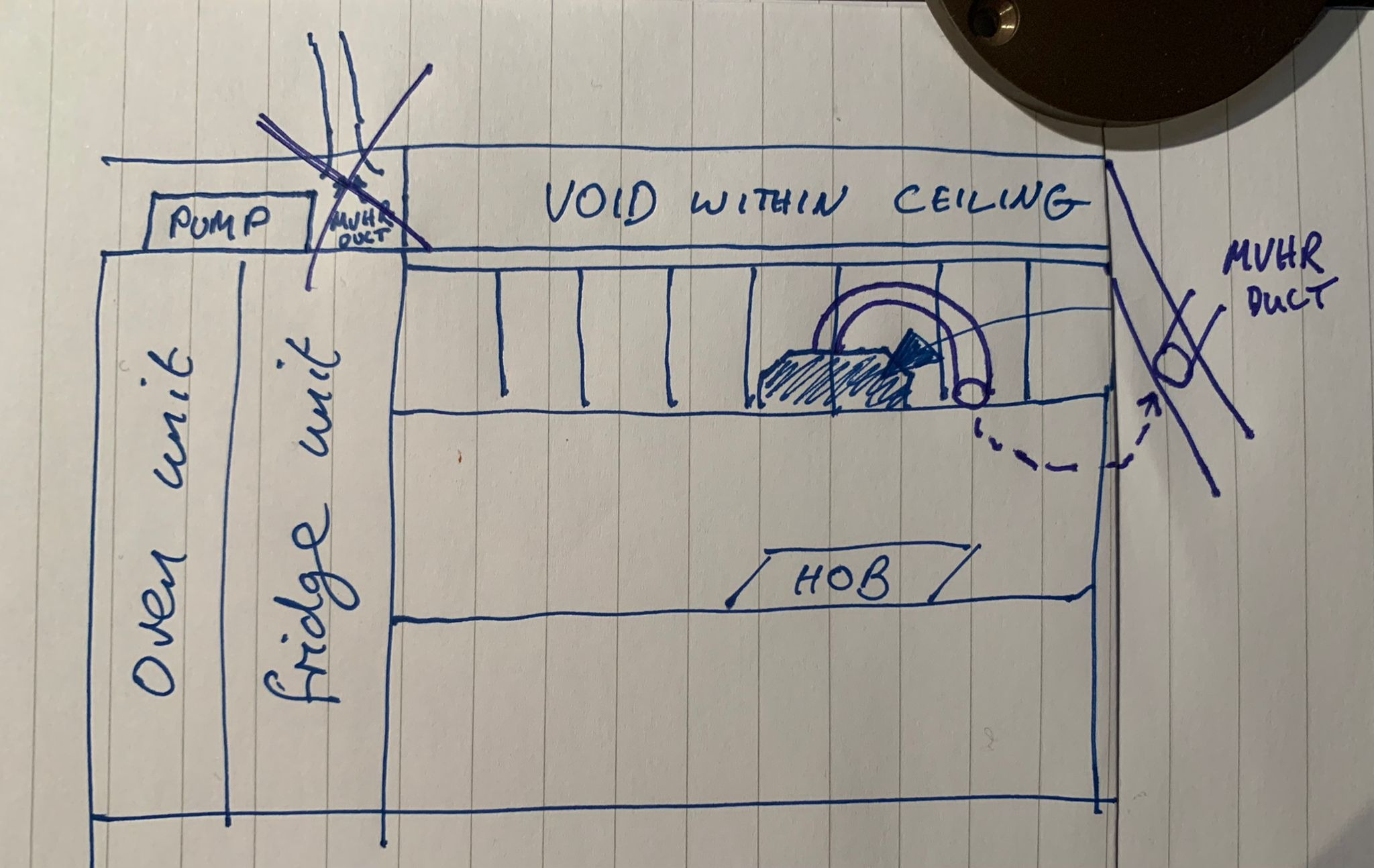
Thanks @joth and @joe90 that's helpful. Discussing with my other half she reminded me that we had planned to close off that 18mm gap to avoid the area becoming a dust trap. So the only way to do option 2 and also close off the gap would be to fit something like this https://www.yesterhome.com/products/black-aluminium-large-grill-380mm?currency=GBP&variant=39424828735572&utm_medium=cpc&utm_source=google&utm_campaign=Google Shopping&gclid=Cj0KCQiA9OiPBhCOARIsAI0y71DyU-1sX52aO1Znry1Klhf32UVEUUa3ehKV7izVJU9BMsHP4rMIUZsaAlzmEALw_wcB which I would spray paint to match the colour of the kitchen units. Would that mitigate the dust issue though? Discussing this further I realised that I had forgotten that we had moved the MVHR outlet. It's actually slightly closer to the hob area, albeit on a different wall that is perpendicular to the wall where the hob is. This creates the possibility of a fourth option, which is to just get the duct to redirect the air by 180 degrees so that it comes out of the adjacent kitchen unit on the underside of the unit. This won't be visible because there is a pelmet that conceals our over-worktop lighting, so it will also conceal the extract if we were to fit it there. It would look like this: The obvious downside of this is that we lose space in the adjacent cupboard, but the units are 31cm deep and the duct is a 15cm diameter one, so we would only lose half the depth of the unit where the duct is. Is another downside that I create some sort of vortex of air going around and around in a circle into my hob extractor, out of it and then back into it, and that vortex in some way messes with the MVHR currents?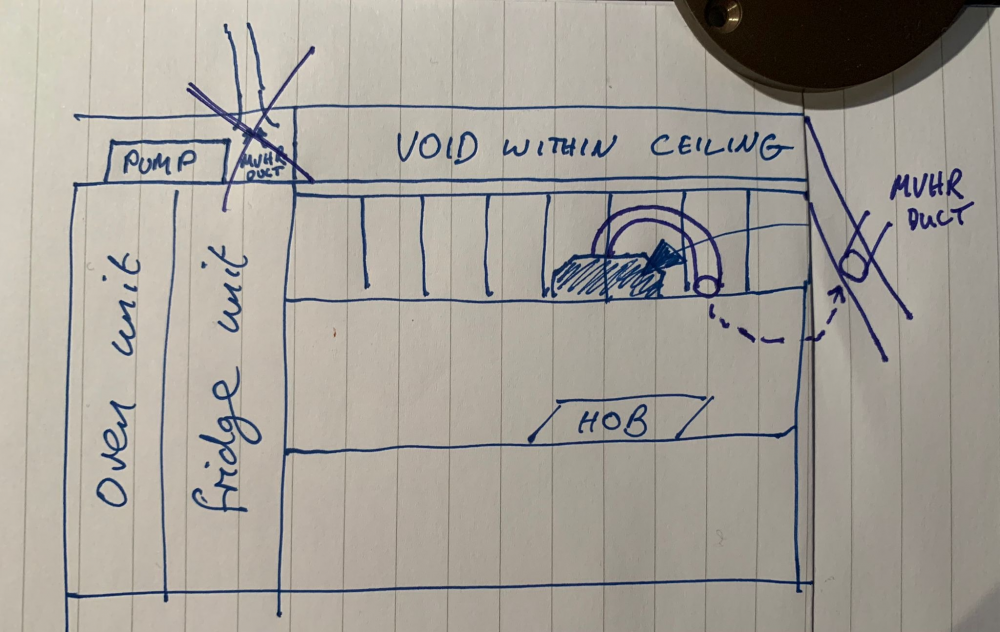
-
Is a cooker extractor necessary with MVHR
Adsibob replied to SBMS's topic in Mechanical Ventilation with Heat Recovery (MVHR)
Yes: this is the hood: https://www.novy.com/en-gb/products/cooker-hoods/build-in-cooker-hoods/fusion-pro/8740/ and this is the recirculating filter: https://www.novy.com/en-gb/products/accessories/recirculation-accessories/recirculation-kit/8740400/ Just reading the instructions on the hood now. Unhelpfully, it just says: Recirculation If you choose recirculation, Novy offers a monoblock recirculation filter which is placed in the hood. The monoblock filter is placed directly behind the grease filter. The exhaust grill to let the filtered air back into the kitchen must be provided by you. Basic kit monoblock filter (without outlet box) 8740400 [this is the one I bought] The exhaust grill to let the filtered air back into the kitchen must be provided by you. Minimum net opening of the exhaust grill: 177 cm². So actually, the very long and thin space I have above the units is big enough to provide that 177cm2 as it measures 1.8cm by 400cm or so. So about 720cm2. But query whether the aerodynamics of such a narrow slit will be problematic/noisy. -
Is a cooker extractor necessary with MVHR
Adsibob replied to SBMS's topic in Mechanical Ventilation with Heat Recovery (MVHR)
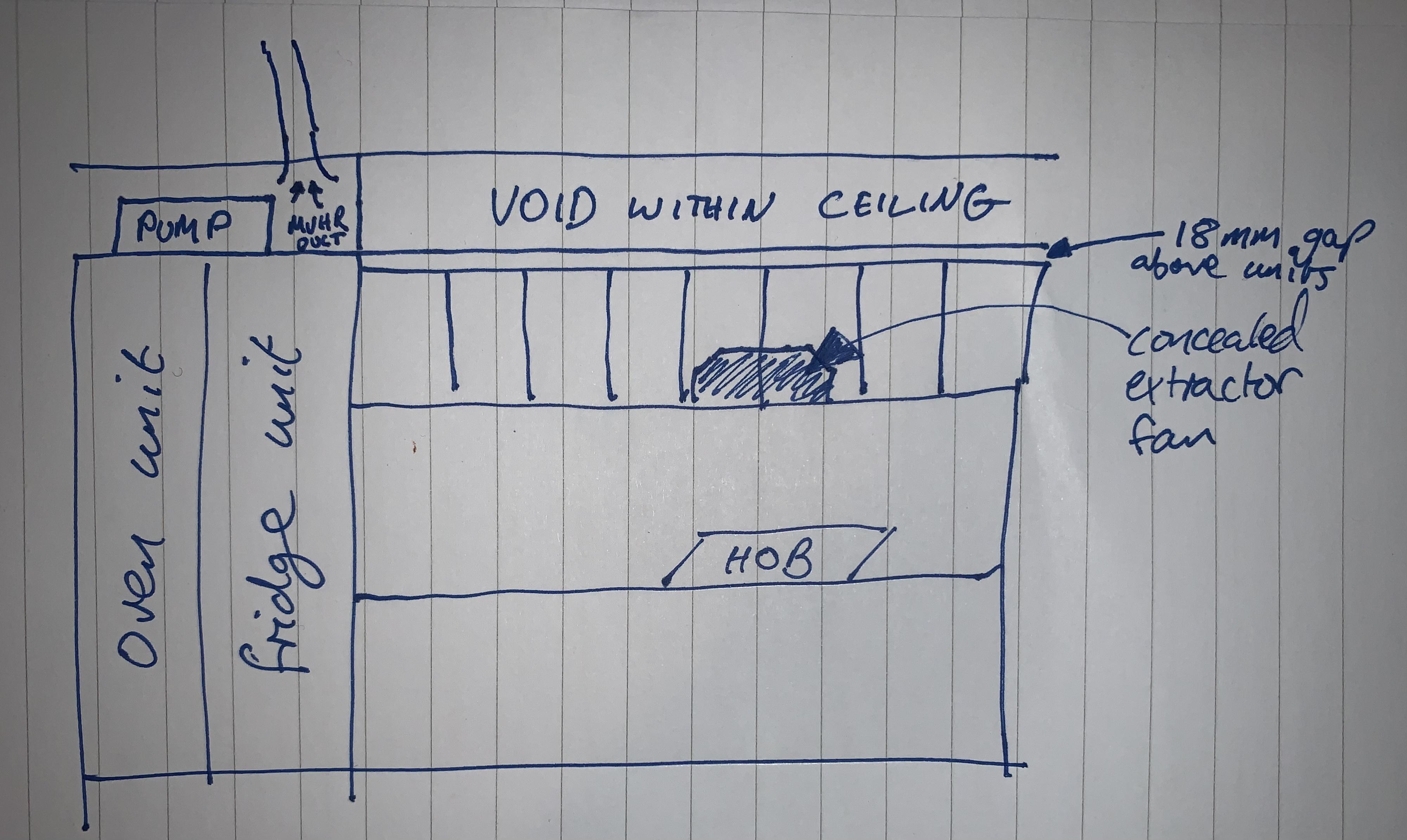
Well it’s a normal (albeit bloodyexpensive Novy) hood, which has an optional accessory pack which enables it to be converted from one that extracts out of the house to one that recirculates through a carbon filter. the issue I have is that if I don’t extract it out of the house, I’m not sure where the exhaust air should be vented to. Here is a diagram showing the concealed extractor within my kitchen wall cupboards. Each cupboard is 500mm wide, so the distance from the centre of the concealed hood to the area above the fridge where the MVHR extract is, is about 2.5 to 2.75m. Option 1: I could take the wall units down, cut a hole in the ceiling above them and get a duct to take the air to the area above the fridge, where it would then get sucked up by the MVHR pipe Option 2: just cut a hole at the top of the kitchen wall cabinet housing the hood and recirculating accessory kit, and let it extract into that 18mm high gap, which I mentioned in my earlier post. The air would make its way into the kitchen and eventually find its way to the MVhR duct above the fridge. Option 3: cut a hole through the wall behind the kitchen units, which is an external wall, and extract there. The only benefit of that is that I can get about £90 for my recirculating kit, as I won’t need that. But the downside is the air tightness issue. Just a reminder that options 1 and 2 both include the recirculation of the air through the carbon filter in the recirculation accessory kit, so as long as the carbon filters are cleaned fairly regularly, the air output by the hood into the kitchen should always be clean and smell free.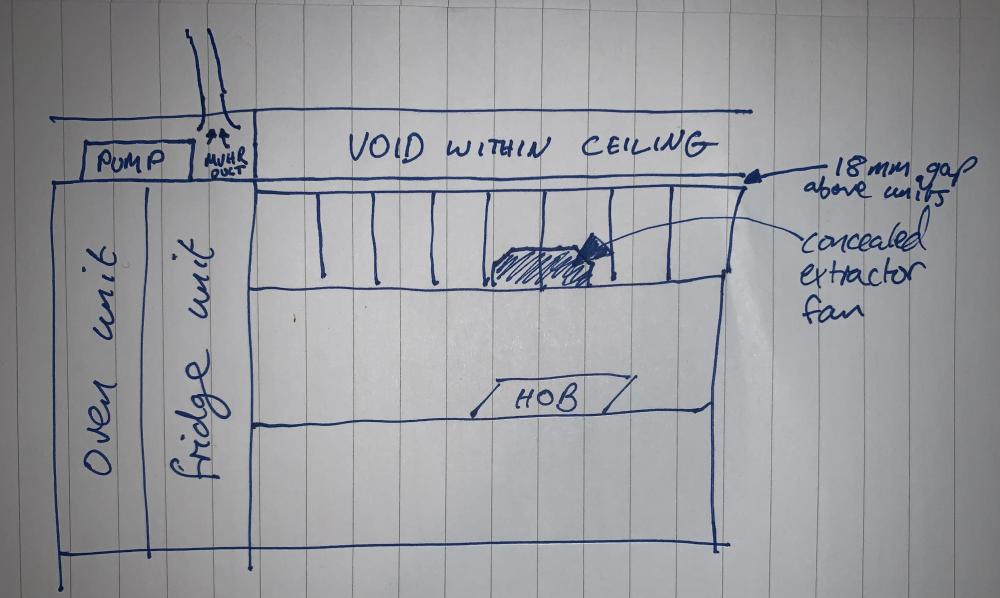
-
Is a cooker extractor necessary with MVHR
Adsibob replied to SBMS's topic in Mechanical Ventilation with Heat Recovery (MVHR)
My hood is concealed within the wall units above the hob. It is a 90cm wide x 30cm deep unit designed to be concealed within such cabinets, as long as they are at least 92cm wide by 31cm deep. -
Is a cooker extractor necessary with MVHR
Adsibob replied to SBMS's topic in Mechanical Ventilation with Heat Recovery (MVHR)
I ordered an extractor hood with a recirculation kit because I knew that we couldn't pierce the envelope of the house as this would compromise air tightness required for MVHR. But now we're coming to installing the hood, I'm wondering where the air which the recirculation kit pushes out should go? My wall units are quite tight to the ceiling, with only an 18mm gap above them. Is it fine to push the air out there from where it will re-enter the kitchen? That run of units is about 4.2m wide, so the area which would act as a sort of vent back into the kitchen is 18 x 4200 = 75,600 mm2. The other alternative is that after the air has gone through the recirculation filter we pass it into a duct that then travels about 2m until it can vent through a normal round hole into the kitchen instead of into the rectangular 4200 x 18 makeshift hole. Which is likely to be less noisy? The builder is asking why I don't just drill a hole through the wall and fit a one way valve, but I'm sure that would mess up the pressure balance, though as some have commented above, there might be ways around this. -
Insulating a pebbledash solid wall and damp concerns
Adsibob replied to Ben Weston's topic in Heat Insulation
I'm not entirely sure. The principle we used is that the inside of the house was breathable to that void, but the outside to the void was effectively sealed. This would allow any remaining damp to dry from the inside. The RICS surveyor liaised closely with the Tyvek technical department who carried out an interstitial condensation risk assessment and concluded this was the best solution. We have MVHR as well, and that was taken into account too. I did ask the RICS surveyor to consider lime render, as I had heard good things, but for some reason he ruled it out. I would recommend you get advice from a RICS surveyor who has expertise in designing these kinds of systems. Each house is unique and has it's unique challenges. There is no one size fits all, and ultimately when one is refurbing a house that is so old (and in my case, a bit damp) there is no perfect solution, just the best solution. I can recommend you my guy if you PM me, but I'm not sure where you are based. -
Just to update everyone, 3 industrial sized dehumidifiers were switched on 4 days ago (today is day 5), one on each floor. They are each almost 1m3 in size. Builder doesn't want to install the tado thermostats yet because we haven't finished painting, so I've ordered some hygrometers from amazon which are arriving today and I will take some readings. They are hoping to start laying herringbone engineered oak flooring on Monday on the top floor. This is not a screeded floor, so no humidity from the floor. It was plastered about 6 weeks ago, and mist coated two weeks ago so will hopefully be fairly dry. Will update later today once we've taken some humidity readings, but presumably I'm targeting a reading of between 56% and 60% humidity? I don't like the air too dry, as it dries my throat.
-
I disagree with this. You are entitled to reject the door and demand that they redo it properly or give you a full refund (their choice). Of course whether they actually oblige is another matter, and maybe that is what @Gus Potter is alluding to. If you don’t want to sue, and you haven’t paid by credit card, you might have to compromise.
-
This is really shoddy work. I think you just need to ask for your money back as it seems unlikely that a second attempt will be much better. There are so many mistakes! If they get difficult, state your statutory rights in writing (fit for purpose, made with reasonable skill and care, of reasonable quality, of reasonable durability, free from defects, etc), attach all photos and explain why each photo shows a statutory right being breached, give them 21 days to resolve the issue by refunding you your money, and then sue them.
-
Insulating a pebbledash solid wall and damp concerns
Adsibob replied to Ben Weston's topic in Heat Insulation
What you are describing is similar to the issues I faced with my 1930s según that was covered with pebbledash. I got a RICS surveyor who designed a system where externally the pebbledash was replaced by EWI covered which was then covered in a silicone based render, and internally we used a Tyvek breathable membrane on the wall, plus a void of air to let it breathe. We only did the internal detail at ground floor because it was only ground floor that the walls were a bit damp (with one wall in particular being very damp). We also introduced French drains externally. -
Insulating a pebbledash solid wall and damp concerns
Adsibob replied to Ben Weston's topic in Heat Insulation
Stay well clear of this nonsense. It’s a complete con. Rising damp is pretty much a myth invented by the damp proofing industry to make money. Damp is obviously a real problem in a country as humid as the UK but it is rarely solved by chemical injection. -
I thought it was only anhydrite screeds that needed priming. Anyway, our tiled floor in the utility room has been down on our sand and cement screed for about 2 weeks and so far no problems. But now this thread has me worried. Though surely my builder knows what he's doing. He's been using the same screed company for a few years and I can't be the first one that has asked him to tile it.