IanR
-
Posts
1841 -
Joined
-
Days Won
6
Everything posted by IanR
-
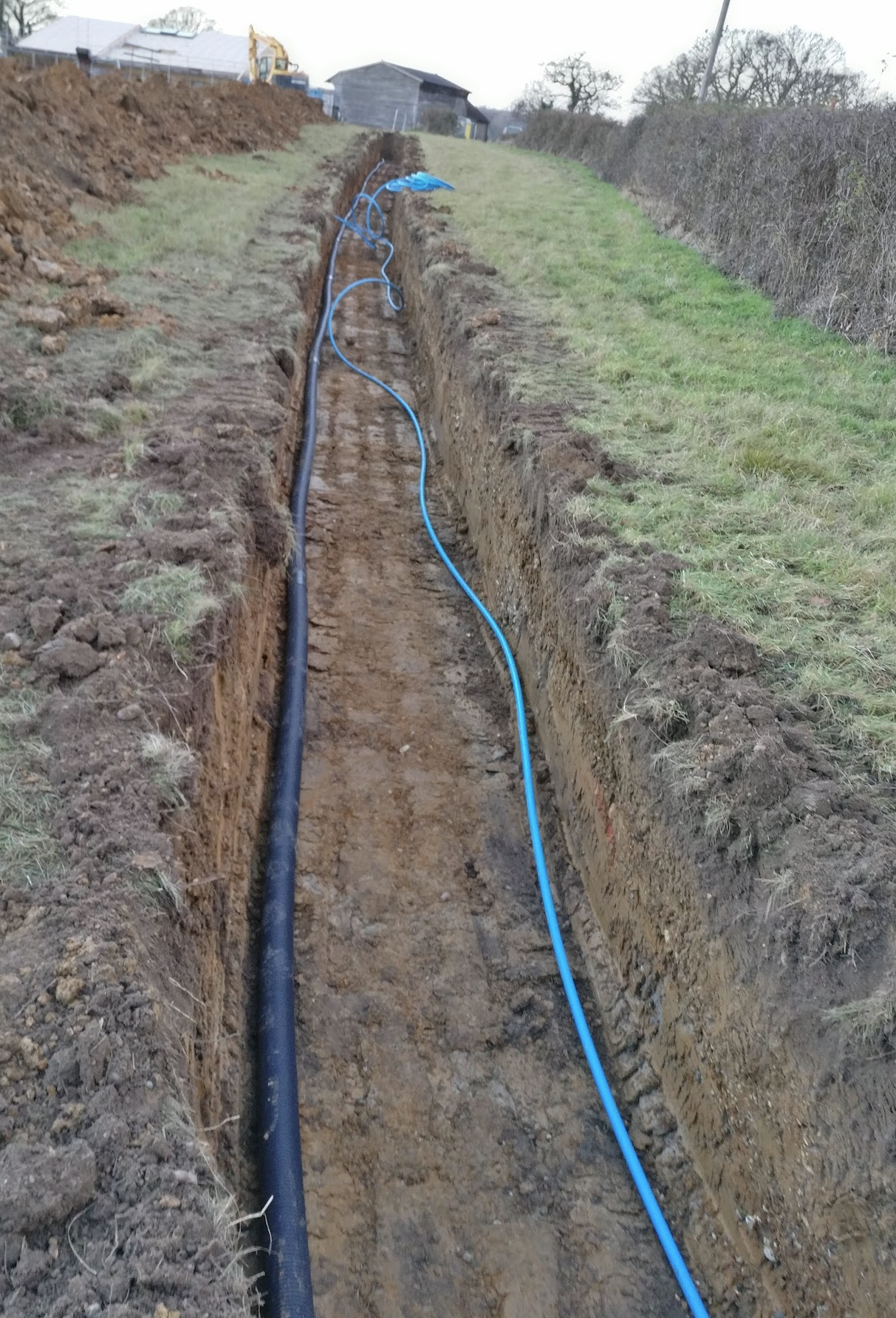
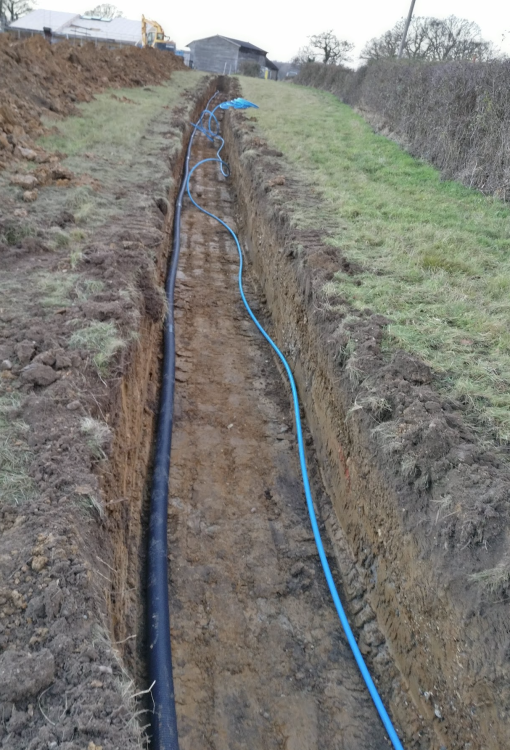
Mine is a gently curving 130m, across a field. As mine was judged to be a potentaily deep-ploughed field I had to adhere to the extra depth, 1,100mm iirc rather than 750mm for power and water. I put the water pipe in the trench, you can get long coils of the pipe to save having connections in the field, but they wanted to see the pipe before I back filled to ensure depth. Power wanted to pull the cable through, but were happy for me to put the ducting in and backfill without them inspecting it. Power did specify Ø160mm duct, but my "expereinced" ground workers said that wasn't needed and Ø100 would be OK. It really wasn't, and Power Networks nearly gave up on the pull-through. The loads were beyond the limit of their cable puller, but they only just achieved it in the end. I couldn't convince Power Networks to come right up to the curtilage with the large, public network cable, they said their rules were to stop 35m from the property and join to a domestic cable. This was still installed by Power Networks, but meant a joint in the field. For yours, I'm sure it will need to be done in 3 pulls, maybe in seperate lengths with joints. My power installation (for 3 phase) was around £4,500 (in 2017) for the pull-through, and connection at either end, then another £3K for a transformer upgrade.
-
Looks a nice project. If you are interested in drilling down into the building performance, it may be worth starting a new thread, perhaps in https://forum.buildhub.org.uk/forum/115-energy-efficient-sustainable-design-concepts/ and get some wider forum input. It really feels to me that something is not correct with your calcs. I'm all on a single storey (so much less efficient) with a higher percentage of glazing and roof lights and achieved the the classic targets. I've not got an MBC structure, but my I-Joist structure on insulated raft performs only marginally better than MBC's twin-stud, but it's a negligible difference. The I-Joists did allow me to go to 350mm deep on the roof to mitigate the inefficiencies of being on a single storey, but even without this I was almost at the targets, much closer than your PHPP calcs are showing. Is the plan view orientation shown above after it was changed? The below comment suggests it's round the wrong way. Wouldn't the balcony with overhang and patio better on the South-east elevation, rather than North-west? Or is it the views that are setting their position?
-
Overheating can be resolved. Ideally with Brise Soleil, but if planning restrictions don't allow (as was the case with me) then external venetians should resolve the issue. Obviously, reducing South-West to South-East window areas and roof lights are the cheaper options, but if you want to keep these then spending some budget on shading is needed. What windows are you specifying, are there solar control coating options? Surprised at your "heat" demands/loads. Especially if you've got lots of solar gain. Just to be sure, you are going with the Twin-Stud MBC PH Wall, with 300mm of blown cellulose insulation? Does your PHPP modeller have experience with this build method and with insulated raft foundations? Have they correctly calculated thermal bridges or are they using some defaults?
-
That's cool, saves a long discussion about whether SIPs are the best choice. Now my next question, why: Have you got a really complex plan profile? I can't imagine how MBC's twin-stud wall + an insulated raft couldn't mitigate most positional, orientation and profile issues.
-
I wasn't aware MBC offered a SIPs option, perhaps I'm out of date. Would you mind linking to the option you are going with?
-
High @Kevin Dawson, and welcome What's made you choose SIPs?
-
There has been a change, but that now makes all new breeches 10 years, from 25.04.2024 Previously it was 4 years for a breech of planning control (accept for a new building, first used as residential, which was 10 years) and 10 years for a breech of planning condition. Not without a Change of Use Approval, but it is immune from enforcement if it continued for more than 4 years.
-
It would be a bit of a project, but Heat Pumps in EVs are DC, although the ones I'm aware of are 400v - 800v, matched to the high voltage architecture on the vehicle.
-
And perhaps they could call it CIL, SDLT and Capital Gains Tax. @ 50 average sized (88m²) dwellings per hectare at £135/m², CIL raises £594,000 for the Council + 5% SDLT to central government, which comes straight off the Land Value, paid to the Land Owner, who then pays (Sale price - £25,000 - business offsets) * 28% CGT. You'd struggle to find another business asset that gets taxed as highly comrade.
-

Planning Appeals - Statement of Case Examples
IanR replied to phykell's topic in Planning Permission
I've never seen that. Loads of Class E examples where it relates to a Subordinate Use though, which would match it's dictionary meaning. -
Planning Appeals - Statement of Case Examples
IanR replied to phykell's topic in Planning Permission
Emin is regularly mentioned in similar Appeals, but not regarding size, in the Emin case it was held that the size of an outbuilding is not relevant for the purposes of Class E, but the building must be ‘required for some incidental purpose’ in relation to the dwellinghouse. Another case often quoted is Wallington v SSE & Montgomeryshire DC [1990] from which the notion that it is the incidental activities that should be reasonably scaled to the dwellinghouse. The size of the outbuildings should then be appropriate to those activities. ie. if the dwelling house can accommodate 6 people, then it would be unreasonable to build a recreational outbuilding that can accommodate 50 (exaggerated) people in the stated activities. There's not a specific planning definition, so take the Oxford dictionary. ie. "lower rank", which doesn't mean smaller. Primary use is dwellinghouse, subordinate use is outbuilding. The dwellinghouse can exist without the outbuilding, but the outbuilding is pointless without the dwellinghouse. -
As long as the breech had started before April 25, 2024, then for Change of Use its 4 years continuous breech to become immune from enforcement. A new breech starting after April 25, 2024 would be 10 years. It does sound like the breech is already beyond that time.
-
Planning Appeals - Statement of Case Examples
IanR replied to phykell's topic in Planning Permission
The word "reasonably" doesn't appear in the Class E PD legislation, and adding it changes the meaning of the sentence. It is not required to demonstrate that the Uses of the planned buildings are "reasonably required for purposes incidental to the enjoyment of the dwellinghouse", they just have to be for a Use incidental to the enjoyment of the dwellinghouse. For Class E it is also not required that the buildings are "Subordinate" to the main dwelling house, the size is controlled by other means. Ref. https://www.legislation.gov.uk/uksi/2015/596/schedule/2/part/1/crossheading/class-e-buildings-etc-incidental-to-the-enjoyment-of-a-dwellinghouse Sorry, can't help with the Statements of Case examples, but on the face of it, it looks like you have an easy win at Appeal. -
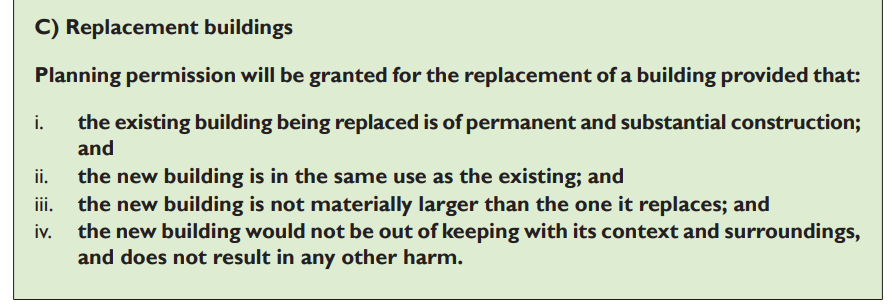
If there has been a continued use, then it may be worth a conversation with the LPA, as you are not at risk of losing the rights to that Use. Your LPA may have a Policy in their Adopted Local plan, that gives more information on how they may would approach it. You'd be searching for something like "replacement buildings in the countryside/green belt". My LPA's policy is as follows: This gives a little more flexibility than a like for like replacement. Personally, if I was replacing like-for-like I wouldn't approach the LPA, knowing that if someone did complain I could put in a retrospective that would be approved. If I was going to rebuild materially different, I'd probably apply for planning. Difficult to advise, my LPA has, over the last few years, made it more and more difficult to talk to anyone. To do similar I'd have to submit a pre-planning advice, just to speak with someone, then submit a planning app if they said it was needed. Hence if you are confident it would get approved, just get on and do it and wait for them to contact you. The closer you are to the original, the less reasons you give them for a rejection.
-
Since there has been some time since it partially came down, and sounds like for a period it wasn't used, then it will be down to your LPA's view on whether the building had been abandoned and therefore the rights lost to the previous Use for the barn. If that is the case it can not be rebuilt. If the previous Use is not considered abandoned then you can rebuild the same shape, size and style, as long as it remains suitable for the previous Use. It's probably not a question you want to ask the LPA, if the Use you are now putting it to (either incidental to the enjoyment of the house, or light industrial, depending on whether the workshop is a commercial enterprise or not) is not the same as the previous Use, which may well have been agricultural, although I hear you suggest it is not. You needs to be in its new Use for 4 years, without a break, before you have the right to continue that use. (The rules have just changed so if it was a Use starting now it would be 10 years). If you've not been using it for 4 years as a workshop and high light this to the LPA, if they were minded to they may ask you to apply for a retrospective Change of Use, which they could then reject. Having partially repaired the barn and begun a new Use, if no one has complained, I'd suggest you could get on and rebuild it. LPA's tend to only get involved when an issue is brought to their attention. Just rebuild the same shape and size with as similar as possible external materials.
-
CCTV not working after internet provider change
IanR replied to Dan1983's topic in Networks, AV, Security & Automation
How do you connect to the cameras when off site? ie. Web access, Serage App or 3rd Party App. If Serage App, have you rebooted the NVR since swap over? Maybe the NVR needs to reconnect to their Server to provide new WAN IP details. If via Web access or 3rd Party App then you'll likely need your to update those connections with your new WAN IP address and configure your new router with Port Forwarding or switch on UPnP. Vodaphone doesn't give you a fixed IP by default, so it will change your WAN IP with each reboot. If you need to use your WAN IP for connection, you can request a fixed IP from Vodafone. -
Cat6a cable everywhere, um, now what?
IanR replied to Tom's topic in Networks, AV, Security & Automation
As mentioned, the foil is only on the external walls, so doesn't interfere with internal Wi-Fi. It does stop the signal from getting outside the house, so plan for an external AP if you want Wi-Fi in the garden. I have two Unifi AP's internally and they give very good coverage across a 465m² footprint. The outside AP extends to 100m with line of sight, and around 40m - 50m with obstacles (outbuildings and hedges) -
Has anyone calculated the psi values at thresholds, especially for large sliders or bi-folds? Why are you discounting an insulated raft? It would perform "better", but by how much is unknown without the calcs for what is proposed.
-
It's unlikely you could rely on the existing Structural Survey. It was not created for you, so you have no recourse to the Author if there's anything inaccurate, unless the Author is in agreement that it can be re-assigned to you. Also, Structural Surveys completed for a planning App are paid for by the applicant and are influenced for a positive outcome. But, to satisfy Building Control, they will need to be convinced that the conversion, including any modifications is structurally sound. The fact that it's stood for many years without falling over is a good start, but any modifications you make changing loads through the structure will require an SE calcs to convince BC. Are you not engaging an SE for this type of thing? They would perform any required survey to base their calcs around. As an aside, there is now a proven route to a full planning approval, using the approved Class Q as a fall-back, this would likely allow you to make improvements over and above what the Class Q is allowing and provide a better conversion in the long run. You do however have to watch the clock as you are on a time limit for completing the Class Q, should a subsequent Full Planning Application get rejected.
-
While you are asking this questions, try and get a proposed section for a door threshold. General wall to floor thermal bridge doesn't look too bad, but I'd be interested to see what the plan is at thresholds. If there is an issue, it would only be along a short length for standard external doors, but if you have any big sliders or Bi-Folds it may be more of an issue.
-
Not that names matter if you are happy with performance, but I'd not call it an "insulated raft", it looks to me like a standard raft with some thermal bridging mitigation. Have you looked at other Insulated rafts? Example: https://www.advancedfoundationtechnologylimited.co.uk/our-products/timber-steel-icf-framed-building-foundation/ Where the raft is insulated from below, rather than above, avoiding the need for a seperate screed. How does what has been proposed to you perform? Has anyone calculated psi values? There's no steel shown in the raft, has that been ommitted from the section? What's the wall build up? I assume there are no loads going through the smaller inner sole plate.
-
Hi @Mrog & Welcome. Congratulations on the plot, how long ago was the Class Q Approved? Have you noticed the condition that requires the build finished within 3 years from Approval? Normally, it wouldn't be a problem to re-submit the Class Q and get the clock restarted, but with the change in Class Q rules that happened this year it may get difficult to get the same planning Approved a second time.
-
Cat6a cable everywhere, um, now what?
IanR replied to Tom's topic in Networks, AV, Security & Automation
I'd definitely use a patch panel, tidier and easier to reconfigure when hardware changes, which it will. Go with as big-a-cabinet as you can fit in. Even though everything you use will not necessarily rack-mounted you can add shelves for things that aren't. You need power to the cabinet, I'd consider a UPS as this keeps Internet and network running (and CCTV etc.) in the event of a power cut. Off-lease 3kVA UPS's can be picked up quite cheap, which can be reconditioned with a new battery pack, generally available a good price. APC units are well support with after market kits. I'd not buy a switch or a router until you know more about what you plan to connect up. If you have a large number of connections it may not be good value to have them all on a PoE switch, and maybe your CCTV will have an integral PoE Switch on the NVR, reducing the number of additional PoE connections you need. The 4G or Fibre provider will generally supply a router, although you can replace this with your own if you see an advantage such as managing Access Points. There are so many different options, I'd spend some time to research and plan it out before buying too much hardware. Edited to add: Should have noted a 3kVA UPS is particularly heavy and deep, so full depth cabinet is required and I'd suggest floor standing. -
I didn't get a price for single phase, as I needed (wanted) 3 phase for the workshop. My connection was around £7.5K, but included 130m of install through a duct in a trench. The 1 phase v. 3 phase difference would have been in the 100kVA pole mounted transformer that was around £2,900 of the connection price. I was told that this would have been lower for a single phase connection, but I don't remember a price. I doubt it would have made that much difference.
-
I didn't. Dithered too long and the introductory price went away. Not sure it represents good value now.