IanR
-
Posts
1841 -
Joined
-
Days Won
6
Everything posted by IanR
-

Planning Appeals - Statement of Case Examples
IanR replied to phykell's topic in Planning Permission
And the moral of this story is to choose activities that require lots of indoor space but only for the number of occupants in the dwellinghouse + a few friends, as the justification on the LDC. Bowling alley anyone? -
MVHR Design: Feedback & Mythbusting
IanR replied to joshwk's topic in Mechanical Ventilation with Heat Recovery (MVHR)
If the air permeability rate of a building is already above that deemed sufficient for ventilation then the MVHR just adds additional air exchanges on top. ie. through natural ventilation there is sufficient air changes to maintain a healthy environment and reduce mould risk. Adding an MVHR in this case just increases energy losses. The air it is filtering, is additional, unrequired air. The 3m³/m².h@50Pa air permeability rate, deemed as sufficient for ventilation, is measured with trickle vents closed. The trickle vents are for adding additional ventilation above this level so should not need to be left open, if you live in a particularly noisy area. The energy loses from extract fans will be lower than the day-to-day running costs (incl. maintenance) of the MVHR. Fit a single room MVHR if you must. Maintain it so it doesn't rattle. To avoid condensation and mould risk, in the first instance design out thermal bridges that bring the internal building fabric temperatures close to, or below the dew point. -
MVHR Design: Feedback & Mythbusting
IanR replied to joshwk's topic in Mechanical Ventilation with Heat Recovery (MVHR)
SIPs is a reasonable product when combined with a masonry skin, for volume builders, delivering building regs houses. There are less positives to SIPs for a self builder, building a bespoke design and wanting better than building regs performance. It's not something that can be calculated from a design. It's set as a target as part of an overall set of targets (U Value, psi value and air permeability) in order to achieve an overall energy loss target for the building and then designed, engineered and built to achieve those targets. If you are happy with a buildings regs level of performance and comfort then there's not much for you to do as everyone supporting the design, engineering and construction will be delivering their normal service. If you aspire to achieve something better for lower bills, improved comfort and/or reduced ecological impact then you need to look to professionals and construction methods that can deliver those aspirations as cost effectively as possible and help you to make the right decisions based on your requirements. PassivHaus performance levels are about as far as it's worth going while delivering value for money, but you can also choose somewhere between PH and Building Regs. With regards to MVHR, unless you are looking for PH or something close, then I wouldn't bother. I'd target 3m³/m².h@50Pa, have trickle vents in your windows and MEV or dMEV in wet rooms as suggested by @JohnMo Yes, I wasn't clear. Unless you're targeting better than 1.5m³/m².h@50Pa, I'd back that off to >3m³/m².h@50Pa, but as close as possible, no MVHR, trickle vents in your windows and MEV or dMEV I can't blame them for that strategy, it's saved a lot of cost. But having said that, my own preference would be <1m³/m².h@50Pa with MVHR and enjoy the comfort and lower bills. -
MVHR Design: Feedback & Mythbusting
IanR replied to joshwk's topic in Mechanical Ventilation with Heat Recovery (MVHR)
Building Control will want to know your "design" ventilation strategy, but they will not get involved again until you have the results of the physical Air Permeability test, in order to sign the build off. If your Ventilation strategy is to have a better than 3m³/m².h@50Pa air permeability, enabled by whole house mechanical ventilation, they will need more detail on ventilation supplied to each room and a commisioning document for the mechanical ventilation system that shows you have achieved it. If you choose to set an air permeability target beter than buiding regs then your Architect needs to know to ensure they have designed for that target, and your SIPs supplier, erectors, and window fitters need to have signed up to delivering that target. In all honesty, if you wish to target a better than building regs result, then it's a fundamental decision to be made before you decide on construction methods, as it will/may require non-standard approaches to some construction aspects that will have a greater or lesser cost impact depending on the construction method you choose to go with. -
MVHR Design: Feedback & Mythbusting
IanR replied to joshwk's topic in Mechanical Ventilation with Heat Recovery (MVHR)
To use another term, its air leakage, so all the gaps and holes in the building envelope that allow warm air to leak to outside. MVHR itself does not improve a building's energy efficieny, it's improving the air tightness that does. You can improve air tightness down to 3m³/m².h@50Pa without requiring mechanical ventilation as it is deemed there is sufficient natural ventilation. Once you are better than 3m³/m².h@50Pa, buiding regs require you to have whole house mechanical ventilation to ensure there is sufficient ventilation. MVHR then allows you to recover some of the energy in the ventilation that it supplies. Until you are below 1.5m³/m².h@50Pa you are unlikely to ever recover the capital and day-to-day running costs on an MVHR system, so unless something better than that was your target, MVHR is pointless. -
MVHR Design: Feedback & Mythbusting
IanR replied to joshwk's topic in Mechanical Ventilation with Heat Recovery (MVHR)
Building Regs currently require you to achieve an Air Infiltration/Permeability rate of 8m³/m².h@50Pa on the finished property, proven by a "blower" test. (Where abouts are you based? I think in Scotland it is 7m³/m².h@50Pa) Judging by your answer you've not considered an improved target over Building Regs. If you've not stipulated anything better then any SIPs suppliers or builders you are speaking with will have assumed just a Building regs pass is required, unless you've inadvertently gone for a package that is offering someting better. MVHR will provide no benefits at that level of Air Infiltration, and will infact increase your energy losses and add additional running costs to the finished house. Don't get me wrong, MVHR is a great product installed in the right home, and I'd encourage you to consider your options to improve the building performance over Building Regs requirements, but if you are not doing that, you are wasting your money on MVHR. -
MVHR Design: Feedback & Mythbusting
IanR replied to joshwk's topic in Mechanical Ventilation with Heat Recovery (MVHR)
You're building with SIPs, which aren't easy to deliver high air tightness with. What's the Air Infiltration rate you are targetting for your build, and has the SIP supplier and follow on trades signed up to it. MVHR has a negative impact at an infiltration rates greater than 3m³/m².h@50Pa, and only starts to pay for itself, typically, at less than 1.5m³/m².h@50Pa. -
Agree on the 10mm all round but just to add, if you're ordering off drawing then allow for beam deflection at the top, on larger windows or if you're measuring the as built openings, check the height in the centre, not just at the sides.
-
Hello and welcome. What does "Eco House" mean to you? Mine's a low energy home built with a tilt towards a low carbon foot-print, but I never think of it as an "Eco Home". But then a locally development is calling their Building Regs houses "Eco" because they've installed UFH and an ASHP.
-
How about a wired RJ45 female face plate into which you insert this: https://www.amazon.co.uk/Mygatti-RJ45-Converter-Connection-Compatible-gray/dp/B0CXSSJJK8?source=ps-sl-shoppingads-lpcontext&ref_=fplfs&smid=A1AIM872KBP6AR&th=1
-
How does your garden grow?
IanR replied to recoveringbuilder's topic in Landscaping, Decking & Patios
In deed. After a very slow start to the growing season, finally the squash are bearing "fruit"...

-
Cat 6 cable query - not fully operational
IanR replied to kandgmitchell's topic in Networks, AV, Security & Automation
Working from Home, moving large data sets, simultaneous 4k streams, gaming. And all at the same time for 6 weeks over the summer holidays. I'd redo the terminals at each end of the cable. If you've still got an issue then I'd hazard a guess that you have a long run with the data running parallel to power, but to be honest I've never seen that cause an issue in a domestic set up. -
Cat 6 cable query - not fully operational
IanR replied to kandgmitchell's topic in Networks, AV, Security & Automation
Hmm, as that seems unlikely, let's just check... What are you testing the speed on? ie directly on the router, or via another device plugged in or wirelessly connected to the router. Are you ensuring there is no other network activity when you do the speed test? How long ago did the new connection go live. It can take 48 hours to optimise. -
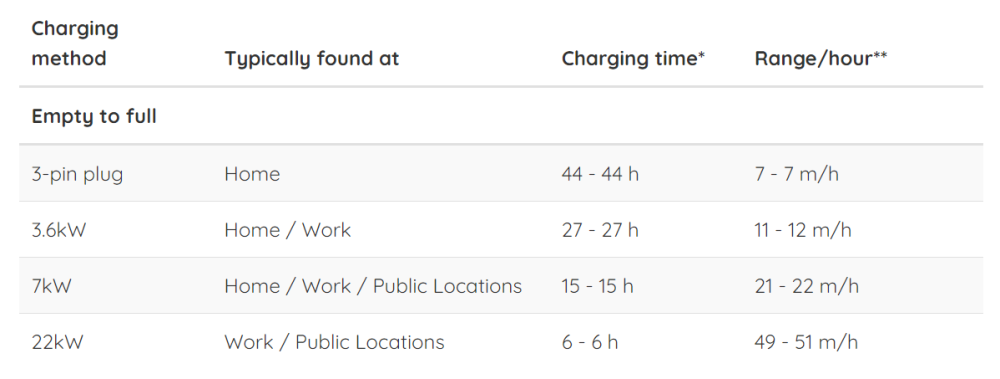
Not at all, I'm not agreeing that averaging out a monthly mileage to a little and often daily charging is how EV owners wish or expect to use their vehicles. Range anxiety is unfortunately not showing any signs of subsiding and the average EV driver wants their vehicle at +80% charge at the start of any journey, so expects to be able to charge to that level overnight, no matter how depleted their battery is. I didn't claim "everyone" will have a 200kWh battery. But with ~100kWh batteries becoming the norm restricting a home to a 7Kw charger would mean you have little choice of when to charge as you'll need it charging the whole time it's on the driveway. Again,
-
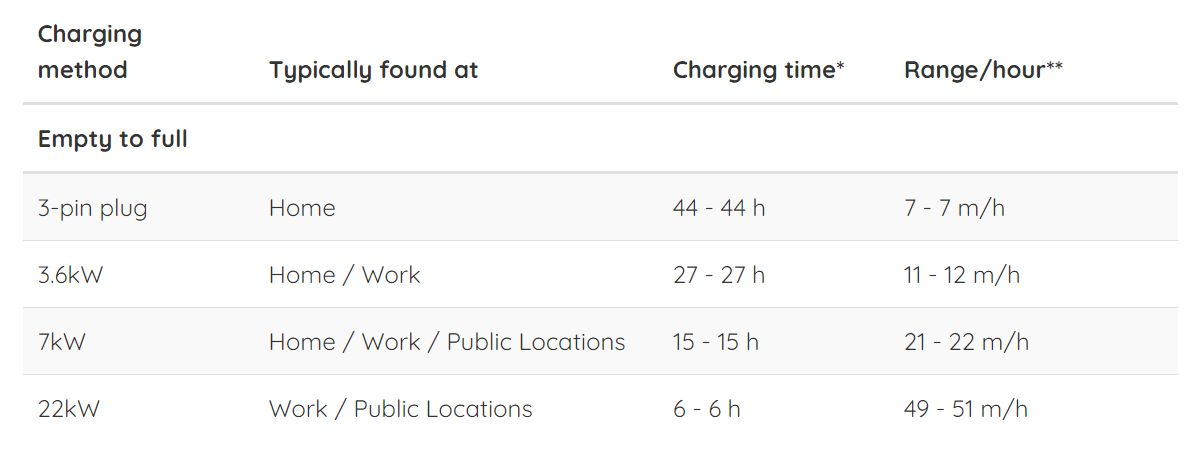
I've not come across 11kW single phase charging. Are there chargers that offer in the UK? Using a Tesla Model X as an example, just because it has 22kW charging capability and a 100kWh battery. It's 15 hours to charge from 0% - 100% @ 7kW and 6 hours @ 22kW 100kWh battery size is recognised in the industry as the base size that family cars need to get to be considered equivalent to ICE cars for range. Cost and battery technology are stopping this from being the case at the moment, but battery technology is changing relatively quickly. We're 5-10 years away from 100kWh batteries starting to become the norm for family sized cars. For the medium size van owner, that keeps their van on the drive, expects to carry 1 tonne in the back and occasionally tow a couple of tonne, their battery size will need to be +200kWh. The next generation of medium van EVs will be coming out before 2030 with up to 150kWh batteries followed up post-2030 with +200kWh batteries. If you are putting a new power connection in now, and it doesn't cost that much more for 3 phase, it's worth protecting for 22kW and multiple 7kW charging.
-
Short-term-holiday let is slightly different to letting out to a family member. It may not now happen with Labour's Planning shake-up, but a C5 Use Class was due to be introduced this summer for Short-term-holiday let. Included was to be a PD that allowed C3 -> C5 and C5 -> C3 Use change. You don't say where you are from, for England, before C5 get's introduced, then a Holiday Let is most likely to be seen as a C3 Use, same as the dwellinghouse, so no Change of Use required. If it's run more like a B&B or Hotel, then it starts to look like a C1 Use that would require a change of Use. This is a grey area and some LPA's are more sensitive to holiday lets and may try to push it towards a C1 Use. If in doubt you need to speak to your LPA. Some LPA's are getting difficult to speak to which could push you towards applying for an LDC, for them to give a formal reply as to whether they feel the Use you intend to put it to falls within what they consider C3. From what you've said It's unlikely you need a Change of Use. However you need to consider the Building and any external changes that have been made. Even if the renovation completed in 1989 did not have permission, it would now be immune from enforcement, unless: changed anything external that would require planning permission. If you are happy the building and any changes have planning permission, then I don't feel there is a planning issue with you using it for a short-term holiday let. If in the future a C5 Planning Class is introduced then once you have rented it out for more than 90 days in a year it would fall into the C5 Use Class automatically via PD.
-
What are you thinking is in breech of its planning Use. Does the Annex have planning permission to be an "Annex". ie. a Use incidental to the enjoyment of the dwellinghouse? And does that permission include the room types that exist in the Annex, ie. kitchen and bedroom(s)? If so then renting that out to another person/family would be the same as having a "lodger" within the main dwellinghouse. ie. within its defined Planning Use. Or, does the "Annex" building not have planning permission, or the use of it as a liveable area not have permission? More info is required. Renting it out maybe entirely within its planning use (although you'll have obligations as a resident landlord), but it maybe that you'd need to be able to prove a 4 year continuing breech to make it immune from enforcement, or depending on circumstance it may be a 10 year breech that you'd need to prove. Only a breech of planning can be immune from enforcement, not Building Control, so it would still need to meet building regs. When was the Annex built? is it attached or separate to the dwellinghouse. When first built, did it have planning permission? or within PD rights. Did it have kitchen and bedrooms when first built? When was it first used for living in and how long since it was last used for living in?
-
Blacho Trapez steel standing seam roof - first experience
IanR replied to Simon R's topic in Roofing, Tiling & Slating
Ours is a Falzonal aluminium roof, and is silent. We're in a relatively exposed area (for Essex) and have a 15° pitch. The Aluminium coils are formed on site and each panel clinched to the adjacent one, on the roof. The small brackets along the side of the trays get clinched into the joint, so there's little opportunity for any movement between the trays. For the Blachotrapez trays, they look similar to Coloucoat Urban that are tacked along one side, but on the other side rely on a pre-formed "U" detail that clips/clamps over the fixed flange of the adjacent sheet. I'd imagine that joint is the weak spot that could allow some movement between panels. -
While the EPS300 typically used under the integral ring-beams of an insulated raft is rated at 300 kPa @ 10% compression, it's not going to see those loads in a typical foundation for a timberframe structure. For mine, worst case is less than a 10th of those loads, on the top layer of EPS, that obviously spreads across a greater area as it goes through the the EPS layers. We're talking 1 - 2mm compression.
-
I can only speak for AFT, who provide a fully insured foundation (by Lloyds of London) and have all the European Technical certificates required to satisfy NHBC etc.
-
It will come down to the bearing capacity of your ground at the dig depth, ie. 600mm - 700mm below finished floor level (likely 450mm - 550mm below ground level). There's no reason why your ground wouldn't achieve the required bearing capacity of, typically, 70 - 100 kPa/m². There are also pile supported insulated rafts for ground that doesn't achieve those values, but cost goes up just as it would for a traditional foundation. If you price up what goes into an insulated raft foundation v. a tradition foundation, and you are comparing like-for-like, ie. a 0.1 U Value with a potential 0.04 W/mK Psi value and include the insulation, UFH and Screed that a traditional foundation requires in order to be equivalent, then materials, labour and Engineering costs of an insulated raft are lower than a traditional foundation. However, an insulated raft foundation remains a niche product in the UK and the lack of experienced ground workers that will install them and the lack of Structural Engineers that will Engineer one correctly (optimised) pushes the self-builder to a packaged insulated raft where margins may be higher and travelling ground-works teams incur higher costs etc. It's a product that needs a lot of researching to get to a good value. If you are willing to take the Installation on yourself, with a couple of ground workers then it can be very good value. I'm happy to recommend Advanced Foundation Technology Ltd. My experience with them was excellent. Their advantage is that the business owner Olof, has been designing and installing insulated rafts in Sweden for +30 years, where they are not a niche product as 70% of houses use them. https://www.advancedfoundationtechnologylimited.co.uk/our-products/
-
How to calculate heat load…
IanR replied to G and J's topic in Energy Efficient & Sustainable Design Concepts
I believe active cooling was a later add to PHPP to support warmer humid climates get under the 10% Max over-heating target and still achieve the 15 kWh/(m²yr) heat demand and the 10W/m² heating load targets (including active cooling). It shouldn't be needed in the UK climate to achieve the 10% Max over-heating (>25°C), for the UK that target seems to me to be quite excessive and should easily be achieved via passive means, but I can understand how including active cooling within the PHPP model can help understand ways to really get the over-heating risk down to a low, comfortable level, say <3%. My comment regarding the resistive in-duct heater for the MVHR is just acknowledging the reason for the 10W/m² heating load target. The PH heat load target is set around one person needing about 30m³ of fresh air per hour, and that volume of air heated to 50°C (below the dust burning temp) via an electric resistance heater in the MVHR supply can carry 300W of energy into the property, so assuming a minimum 30 m² of living space per person the maximum heating load at a given point of time should not exceed 10W/m² of living space. -
How to calculate heat load…
IanR replied to G and J's topic in Energy Efficient & Sustainable Design Concepts
The PH targets are independent of space heating method, they're a measure of fabric energy loss. The targets are set so that you could avoid conventional heating and heat the house via the MVHR, with a resistive in duct heater (not a wet duct heater via ASHP). -
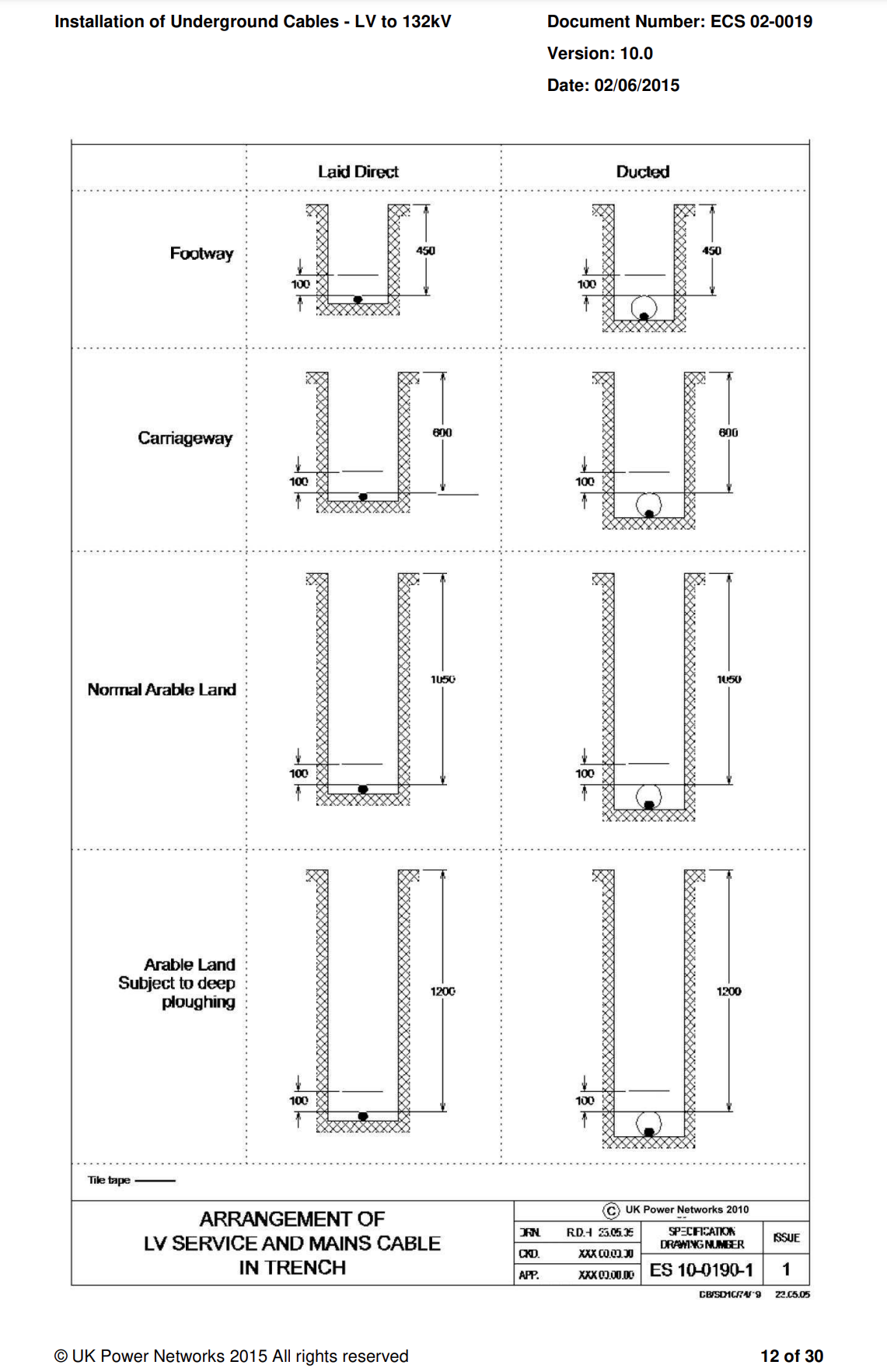
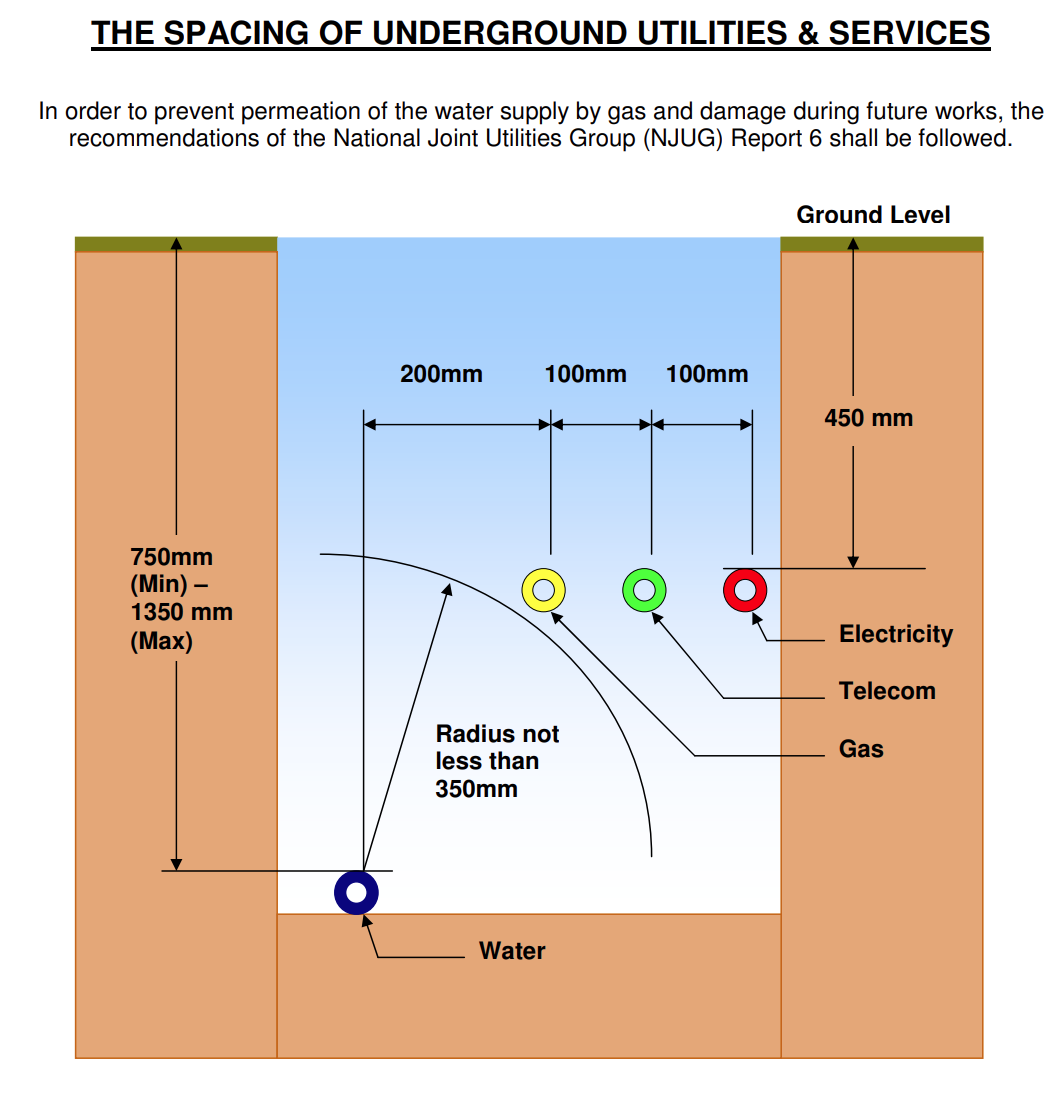
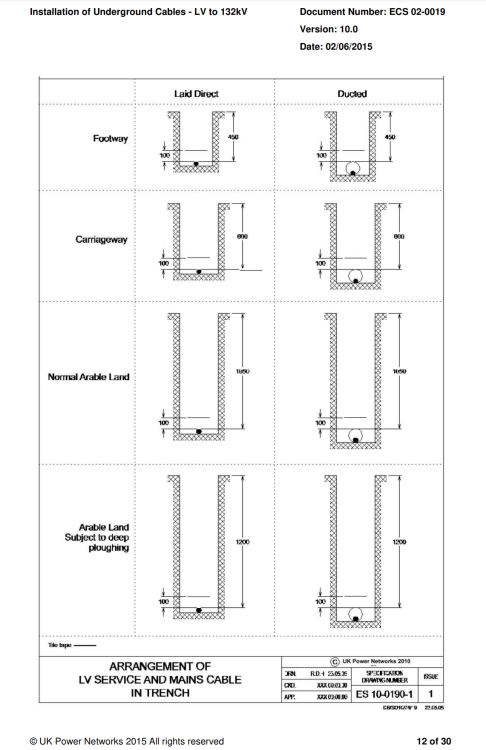
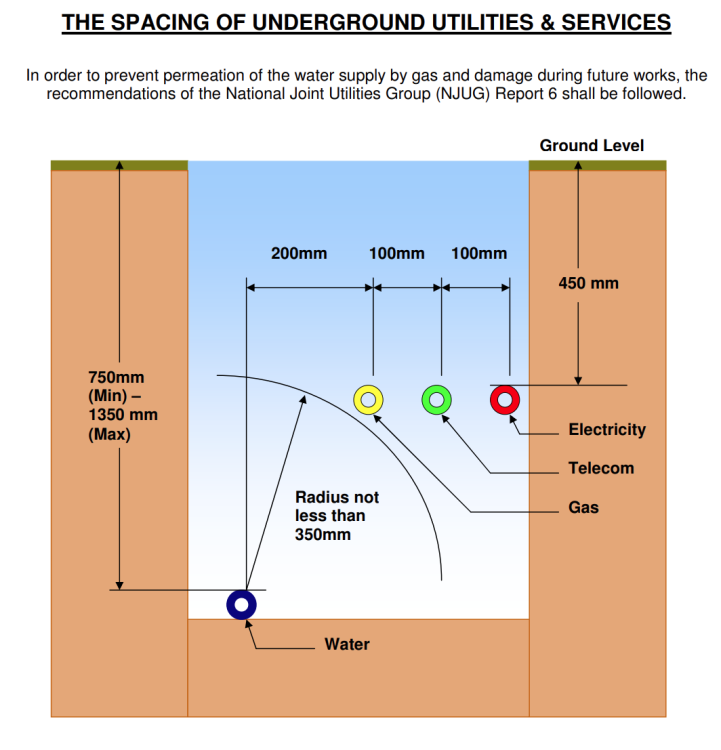
I used a 1000mm bucket (13T excavator), but could have used a 600mm. 1000mm allowed me to use a big vibrating roller to compact the back-fill down. It's UK Power Networks that have the "deep ploughed" depth requirement, although it's 1,200mm. Don't know why they came up with "deep plough", the field is pasture and hadn't been ploughed in 20 years. Water was 750mm minimum, up to 1,350mm With Water and Power in the bottom of the trench, I back-filled around 500mm and then put in the Open Reach ducting (Ø50 rigid) + 2 more ducts for power and data to the gate. This is from UKPN And this from Essex & Suffolk Water.
-
Just checked, and I've mis-remebered, UKPN stipulated Ø125 rigid ducting for Network 3 phase cable, which could have reduced to a Ø50 "service" duct for the last 30m of domestic supply.