IanR
-
Posts
1841 -
Joined
-
Days Won
6
Everything posted by IanR
-
 For which the time frame would be 10 to 100 times longer than the cycling of the heat pump, while it is providing heat to the central heating, so is not relevant to the performance of the heat pump. This also takes us deeper into the physics of temperature stratification in hot water tanks, where I do not feel this conversation needs to go - there are loads of references for it on t'internet. But, in short, the insulating properties at the boundaries of the stratified layers means that the convection currents from standing losses far exceeds any conduction between the layers so the cooler lower area actually cools quicker than the warmer upper layer and the tank becomes more stratified as it cools. The convection currents are caused by the standing losses at the tank wall which cools a very thin vertical layer of water adjacent to the wall. The water of the vertical layer becomes denser than its surroundings and slips towards the bottom of the tank, reducing the temp at the bottom of the tank. But none of that matters while the pump is cycling as the energy losses are minor and covered by the known standing losses for the tank. The standing losses for my tank, based on it being an average 50% charged during the call for heat period is 17.5W. or at a worst case CoP of 3............ 6W of electrical power. Maybe I've not allowed for the times the buffer is fully charged just as the call for heat ends, so gets wasted, but were talking really small numbers that are well within the potential error size of such predictions. If you mean by the water in the the lower portion of the tank, which is at return temp, increasing in volume, while the water in the upper area of the tank, which is at flow temp, reducing in volume so that the boundary between these to stratified layers (the thermocline) rises up the tank a little, the yes it "moves". Unfortunately that's not what I'm saying. There is absolutely no need for the pumps (ASHP & heating circuit) to have any similarity of flow rate or duration, which is lucky because they don't. The heating circuit pump will run continuously while there is a call for heat, while the heat pump will cycle on and off. In a correctly sized buffer, there won't be sufficient turbulence to cause mixing since the heat pump flow rate and pipe sizing will restrict the flow velocity to within the capabilities of the tank. The images and link I posted above show how robust the stratification in the tank is with the thermocline plane in the bottom 25% of the tank and close to a 12 l/m inlet that has only a plain baffle, flat sides, no porting, no pockets no swirl bowl in the lower face. Looking at the colour chart I would suggest the top 70% of the tank has remained at the flow temp, or within 0.5°C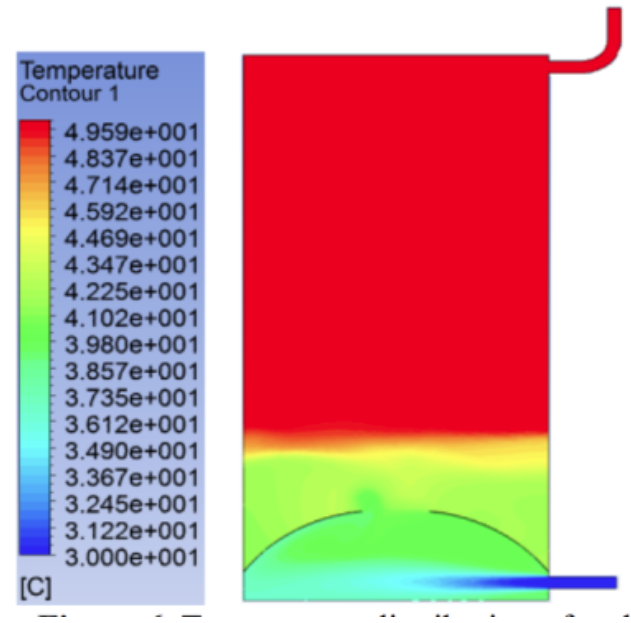
-
But no mixing. The warmer water remains above the thermocline, at flow temp, and the cooler below the thermocline at return temp, the proportions of each body of water increase and decrease, moving the thermocline up and down the tank. No, the bodies of water at the two different temps do not mix. Their different densities keep them apart with the lower density water having the top spot. The volume of each of the bodies of water change in inverse relation to each other as either the heat pump adds more flow temp water to it or the HC removes flow temp water from it. Your version does destroy stratification where there would then typically be a linear temp gradient from top to bottom of the tank. My version requires stratification to remain in place, otherwise there is no point to a 3P or 4P buffer.
-
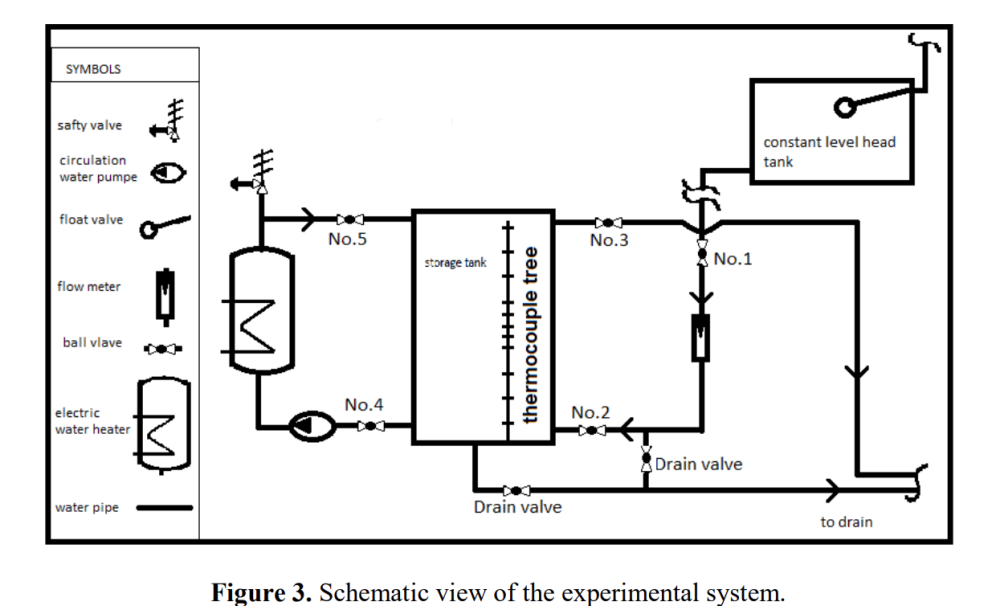
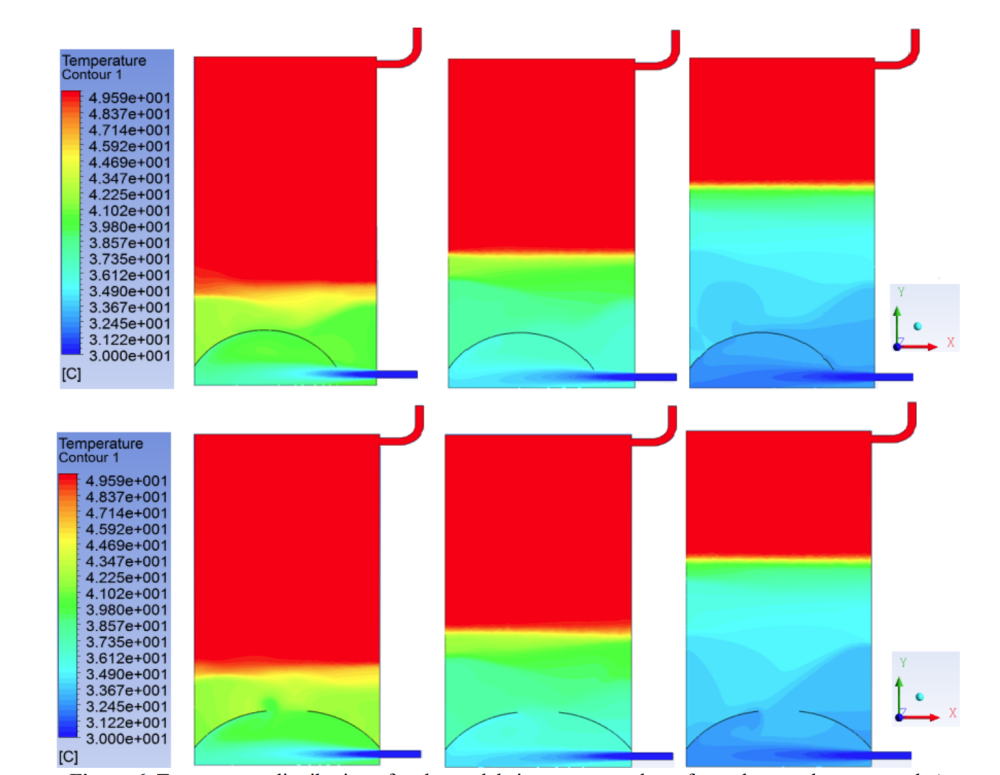
There is no mixing, assuming inlet and outlet velocities are within the parameters of the 4P buffer. In a running system where the buffer hasn't been allowed to cool off entirely, the tank is stratified with flow temp (minus minor standing losses) water at the top and return temp water at the bottom with a thermocline plane at some height in the cylinder between the two different temps (and different densities) of water, where there is a rapid temperature change. Depending on how "charged" the tank is determines at what height that thermocline is. I'm not sure what you mean by "bottom to top flow". What happens when the heat pump is off is the is the thermocline plane rises, the tank hold less energy, but the temp at the top stays the same (minus minor standing losses). The outlet to the CH will be within the upper portion where the temp is @ flow temp, so there is no need to increase the temp of the heat pump. No, you are removing and adding energy to the buffer by increasing and decreasing the portions of the buffer that are at either flow or return temp, so the "average" temp of the buffer is going up and down, but the temps at the top and bottom remain constant (minus minor standing losses) No, the buffer is to stop heat pump short cycling, so it will run for long periods, but then it will be off completely for long periods. Inlet and outlet fluid velocity needs to be kept within the parameters of the buffer tank by flow rate an pipe sizing. Much of the back and forth of this discussion seems to around the robustness of stratification within a hot water tank. It's being treated like a delicate phenomena that will disperse with any slight disruption, when the reality is far from it. It's used to good effect in DHW cylinders with mains water coming in at the bottom at double or triple the flow rates of a heat pump as well as heating elements within the tank that create convection currents and vertical mixing. Within commercial hot water storage tanks where stratification is not wanted anti stratification pumps have to be included to generate vertical mixing to get rid of it. The following may be of interest. It's not for a buffer, but for a solar thermal storage tank, where a CFD analysis has been run to determine the best baffle shape for the incoming water supply. The tank is equivalent in volume to a moderate-to-large buffer, is oddly rectangular in shape which will make reducing the inlet turbulence more difficult than a circular vessel, and importantly has a 12 l/m flow, which is over double my own 12kW ASHP. The simulated system is defined as: The analysis results have been verified against a physical prototype. A significant difference is the inlet on the demand side is at the constant water supply temp, that will be lower than the temp in the tank, at the bottom. I'm really hoping the following image doesn't confuse things more, but to me shows unbalanced, and completely unrelated flow rates between heat source and load, having absolutely no effect on the outlet temperature. Also of note, I feel, is the lack of disturbance of the thermocline until it gets into the lower third of the tank where the disturbance of the 12 l/m inlet is causing some turbulence with one design, but is better optimised in the other. The disturbance shown in the lower, cooler part of the tank, wouldn't be there if the incoming water was at the same temp as the body of water under the thermocline. To put the above images in context: Ref. https://iopscience.iop.org/article/10.1088/1757-899X/518/3/032052/pdf
-
That's the important bit. I'd trust Telford, as I would the larger heat pump brands that all invest in R&D to have developed the buffer to be optimised for its use. That Telford package appears to fit the retrofit market, where fitting within the constraints of the system being replaced are as important as eking out the last few tenths of SCoP. It perhaps also de-risks the installer from misjudging heating demand by including a buffer that may not be required in all circumstances which could also be at the expense of a few tenths of SCoP. The easiest improvement to efficiency you could make, is bypassing the buffer. You'd need to ensure that in the shoulder months a heating circuit was always open with sufficient volume and demand for a minimum ASHP 10 minute run time (longer would be better). You could also reconfigure the buffer plumbing, capping off two of the ports, and configure it as a 2P buffer in the return line. Either of the changes may effect the 7 year Telford warranty.
-
As was I. Yes, your 4P buffer looks challenged to work efficiently. But it's not a unique setup so the manufacturer has likely mitigated the compromises of delivering a tight package, as best as possible, assuming the heat pump, controller and tank combination are "manufacturer recommended". Are there indications that your system is not working as expected? ie. heat pump not meeting heating demand, or electrical consumption being higher than calculated?
-
Unfortunately I haven't been able to explain my understanding of the concept in a way that makes sense to you. There is no mixing in the buffer tank that needs to be avoided, and there is no need to minimise mixing of the heat pump flow with the stored water in the tank, as it will be at the same temp. The flow rates do not need to match, and are unlikely to ever match entirely. Even with those unequal flow rates, the water in the buffer will not mix (it does a little, but not enough to effect performance). When I say the water does not mix, I mean vertically mix. ie. the water at the top of the tank, at flow temp, does not mix with the water at the bottom of the tank, which is at return temp. The heat pump has to be sized to cover the entire heating demand. The choice of a buffer is to protect against short cycling, so by definition the heat pump is over-sized for the heat demand. The heat pump will be off because its max return temp has been met, and it can't modulate down any further, so switches off. It will cycle back on before all useable energy is depleted from the buffer - in fact it should cycle back on before the top of the tank falls below its lower hysteresis boundary and as it comes back on will satisfy 100% of the space heating demand, with the additional energy/flow available, recharging the buffer in parallel. Once the buffer is fully charged again, the heat pump will switch off.
-
I'm probably sounding like a broken record here, but the flow rates don't need to match - the top of the tank is at flow temp (minus minor standing losses). If the flow rate to the heating circuits is higher than that from heat pump, some hot water will be removed from the tank to support the heating circuit load. If the heating circuit flow rate is lower than the heat pump flow rate, then as well as supplying the heating circuit directly, the heat pump will push some additional heat into the tank, not necessarily increasing the temp at the top of the tank, but increasing the volume of water at the top of the tank which is at flow temp.
-
I do have a 4P buffer, feeding two UFH manifolds, each with multiple zones, as well as feeding an MVHR wet duct heater/chiller. The buffer is used for both heating and cooling. I also shut the buffer off from the UFH circuits to allow me to redistribute solar gain through the property via the UFH without having the HP on. I have no data logging, but have had no reason to question the systems performance. I did attempt to confirm the install was working within expected parameters during the first winter, but that wasn't easy. I had to run tests over night, since my property benefits well from solar gain and the background electrical consumption is more easy to control and calculate so that I could be confident in my power consumption estimates for the heating system from only the property's electricity meter. When I crunched the numbers, making allowance for standing losses, an extra pump, the longer run of pipes from ASHP to buffer that I have, I was surprised to see that, based on the heat pumps own heat meter, the HP operating at a higher CoP than the manufacturer suggested. I had thought that was likely to be me over-estimating losses and perhaps the buffer hadn't entirely cooled to ambient before I started the test. The Brendon Uys report may have provided another explanation which is his suggestion the CoP from the manufacturer is based on the H4 boundaries, where as I had assumed it was on the H3 boundaries, hence me making allowances for the standing losses and pump. For me a 4P buffer's ability to remain stratified is not the difference in flow rates between the primary and heating circuits, but the actual flow rate. The higher the flow rate the larger the buffer needs to be to keep the disturbance within the horizontal plane.
-
The design of internal ports and baffles or pockets is to avoid vertical mixing. The cooler water coming in at the bottom pushes the warmer water out at the top, but remains as a layer of cooler water under the warmer water, ie. stratified. "Mixing" is not part of their function, they are designed to minimise mixing. I'm not clear on 'hydronic balancing' within this context. I've only heard it used with regards separate heat emitters and ensuring they all receive the same flow temp. With regards to "why 4 ports", it's because 4 ports, in combination with stratification: ie. not at a mixed temp, but at the ASHP flow temp (minus minor standing losses) Yes, with all things equal, system volume determines ASHP run time. If that additional volume is fully mixed, and the heat pump is off, then the heating circuit flow temp will reduces linearly until the heat pump comes back on, and will then increase linearly, inline with the hysteresis of the heat pump control. With a 4P buffer, if you were to accept that it remains stratified, the flow temp to the heating circuits does not reduce (apart from minor standing losses) between heat pump cycles***. A stratified 4P buffer allows for a wider hysteresis, which can then allow longer cycle times of the heat pump, if required. *** I would expect a small drop in flow temp to the emitters when the heat pump cycles back on, until it gets up to the desired flow temp since the inlet to the buffer from ASHP is at the same or similar level to the outlet to the heating circuit. I don't know you are missing anything. You are believing 4P buffers mix, and I'm believing they remain, to a large extent, stratified. As you have pointed out, there's not much point in a 4P Buffer that mixes, if they did there are other alternatives that could avoid an additional pump.
-
For me his study is far from conclusive and leaves too many questions unanswered. We don't know anything about the 4 port buffer that was used, whether it was correctly sized, or even if it was manufacturer recommended for use with the heat pump. We do know it was installed in an environment with a ΔT of 38°C, so would incur 2.5 to 3 times the standing losses of an install within the thermal envelope. The test rig used was a rig built for another purpose, and missed the most important data points, the temps across the buffer. I can speculate that was because the original rig didn't have a buffer, and therefore no sensors set up for it and there was limited investment to re-hash the rig for the new test. Perhaps the buffer used was one that was "laying around" and unsuitable for the installation it was being tested within in, unfortunately we don't know, so that report is open to being questioned. In order to state the major brands operating in this arena are developing, manufacturing and selling an accessory that doesn't perform as specified, better science is needed. There is also the earlier study that stated "very little difference was seen in the predicted COP between the different configurations". There's not enough detail from either study to know which is correct. Yes, a 4 port buffer will require an additional pump. Some installations will require that additional pump anyway. £50 a year, I would suggest, is at the top end of an estimate on the power used. I appreciate I'm probably towards the lower end of the range, but at today's prices and based on 90 - 100 heating days a year, running an average 10 hours a day the annual running costs for the pump is under £12. For all buffers/volumisers/accumulators there are also additional standing losses, which while they will be inside the thermal envelope, are not controllable so can't be ignored. It's an additional drain on the system of a similar size to the pump. Moreover, there is a capital cost to including a buffer/volumiser/accumulator, so there has to be a justified reason for doing so. [Personally, DHW re-heat times make it an easy justification, ie. specifying a heat pump size larger than the space heating requirement for reasonable DHW performance] I don't believe that's the case, they are designed for stratification, ie. no vertical mixing. Through stratification the heating circuit, including circuits to MVHR wet duct heater/chillers or fan coil units receive their flow at the ASHP flow temp (minus minor standing losses), while increasing the system volume to avoid short cycling. As the energy in the 4P Buffer is depleted (while the ASHP is off), there's no reduction in flow temp to the heating circuits until nearly all the usable energy from the buffer has been depleted. ie. the temp gradient to the heating circuit is changed from linear to something approaching exponential. The ASHP should of course have cycled back on before the heating circuits see any of that temp drop off. A 4P buffer therefore maximises ASHP run time while maintaining a constant flow temp to the heating circuits, if correctly sized. This comes at the cost of possibly an additional pump, and, compared to a system with no buffer/volumiser/accumulator, some additional standing losses. I feel they have different use cases. If increasing the volume of your heating circuit with a 2 port buffer gives sensible heat pump run times, and that's all you need, then a 4P buffer doesn't need to be considered. A 2P buffer in the return line reduces the standing losses as far as possible, so is ideal for this scenario. However, it wouldn't be of any use to a low energy home that could benefit from 1kW of distributed heat input, in an evening during the shoulder months of what would otherwise be a non-heating day.
-
I'm pretty sure they'd be designed for the parameters in which they operate and I'd imagine the primary circuit flow rate very seldom matches the heating circuit flow rate. Perhaps I've missed previous discussions, but where is the evidence that correctly sized 4 port buffers do not operate as designed? Any buffer is an additional expense and will reduce the efficiency of the overall system, so if they can be avoided there's no point in installing them. If you are confident in your energy performance calcs, can leave a zone open that provides sufficient ASHP run time, and don't wish to run an MVHR wet duct heater/chiller or a fan coil heater/chiller, then there's no need for a buffer/volumiser/accumulator.
-
I had omitted pumps and valves in my sketch, to focus on the measurement points. A 4 port buffer requires a second pump on the circuit to the emitters, that some non-buffer installations can avoid. I can't imagine why a 4 port buffer would be designed to mix. The internals of mine are designed very much to not mix. My controller and buffer allows for three buffer temps to be used, top, centre and bottom, but I'm not using that option on my setup. The fact that there are 3 pockets within the buffer for temperature measurement suggests the manufacture believes there will be stratification within their buffer.
-
Thanks for clarifying. I've got the same issue taking measurements, I'd need to peel back the insulation to get to somewhere to measure, and it will need taping up to put it back so won't look the same again. I've avoided going down that rabbit hole of data logging so far, but am now looking at what it will cost to buy a multi-channel temp logger and some probes. I don't believe you can infer that, from the temps provided.
-
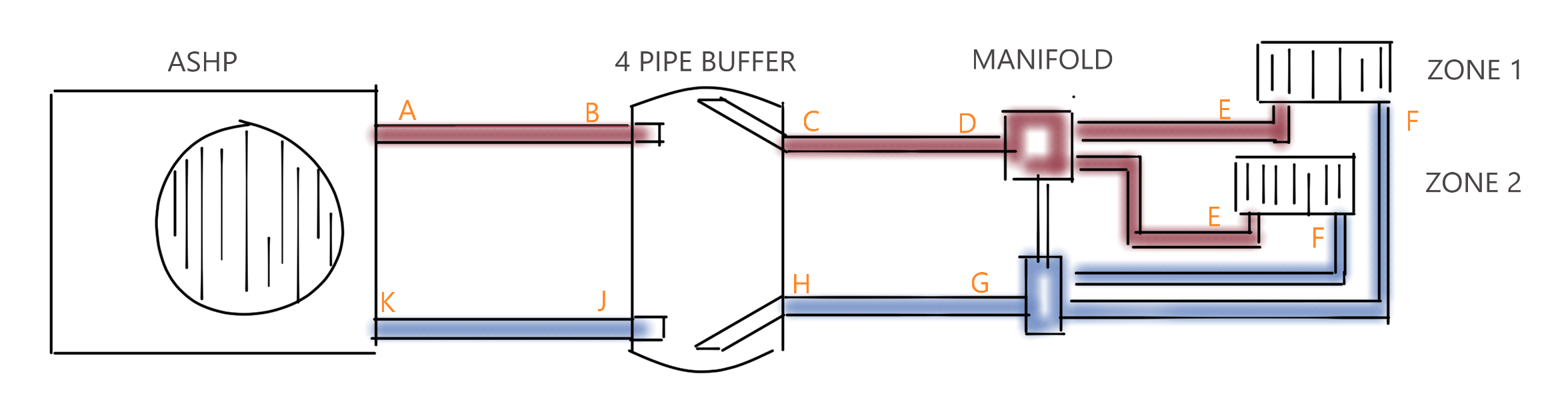
@ReedRichards, Can we clarify where you are making your temp measurements? From what you've said, none of your measurements are at B, C, H or J. But I get confused whether you are measuring across the emitter ie. either D to G or E to F I've made a guess below at what your Space heating plumbing might look like. I believe @JamesPa believes you are providing measurements across the buffer ie. B to C, H to J, or perhaps A to D and G to K.
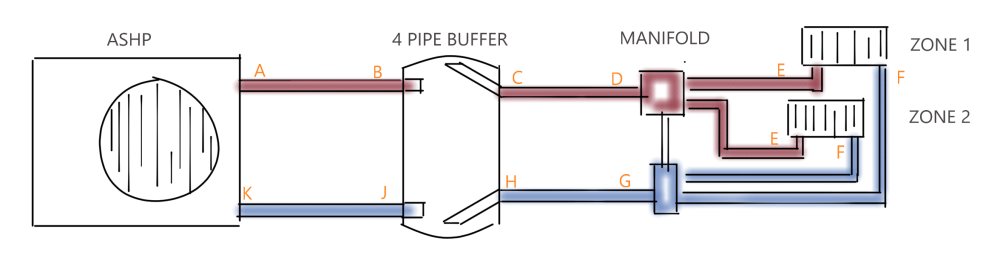
-
OK, now I understand, this wasn't referring to your own 2 port, in the return line. It may be my narrow experience of just one installation designed and installed, but wouldn't a 4 port buffer that is allowing mixing be either poorly designed or incorrectly sized for the required flow rates (or both). I had assumed all 4 port buffers for ASHP space heating were designed and sized to allow stratification. Should your model not be based on a correctly designed system? You would have to allow for the energy to power the additional pump though, should be around 25W, but could be as much as 55W. He did state "with compensation curve" I believe, but then only tested in a steady state, so effectively a fixed flow temp @ 35°C Indeed.
-
Certainly de-risks an install, allowing an over-sized heat pump to be installed to mitigate potential errors in energy loss calcs (more important for retrofits than new builds), allowing zoning of heat emitters, and improves DHW heat-up times. Can you talk me through this, and what buffer/volumiser configuration you are considering with this - I assume your volumiser in return flow. I'm also assuming you are considering this as additional to standing losses.
-
With regards the aspect being discussed here, Buffer tank effect on CoP, the report off the "Kiwa GASTEC at CRE" government website states: "Very little difference was seen in the predicted COP between the different configurations. (Indeed the errors in the predictions probably outweigh the difference, so this should not be relied upon for decision making)". Where as the "Brendon Uys" suggestion shows a 28% reduction in CoP. They are coming to different conclusions, with regards to buffer tank effect on CoP. The report was first written in 2008, and does address that inverter heat pumps are less likely to require a buffer tanks, as you have noted. But there are still good reasons for some installations to have buffer tanks, so I am interested on their potential effect. It's unfortunate that the "Brendon Uys" report has been written as if to prove what he felt was already the case, as well as advertise his services. When his findings did prove what he already believed top be the case, he didn't seek to explore alternative buffer/volumeiser configurations that were less onerous in the system CoP, such as not installing the buffer "outside". Neither report is conclusive, but I feel the "Kiwa GASTEC at CRE" report takes a more balanced approach. There's no denying there will be greater loses from including an additional volume of warm water within the heating system, although that would hopefully be within the thermal envelope for the majority of installations. For a 4 port buffer there would also be an additional (low energy) pump that needs to be accounted for, although with the benefit of stratification if correctly sized. You pays your money and you takes your choice - it's just a shame there's not more conclusive data for the home owner to rely upon.
-
Thanks for that, I've not seen that one previously. Just to offer a different study that brings a different conclusion, I've added the link below. I'd need to spend a bit more time looking the respective Test Methodology, but it seems the "Brendon Uys" study has the Buffer in a space that is at 7°C. If I've understood that correctly, then the message would be to install the buffer within the Thermal Envelope. https://assets.publishing.service.gov.uk/government/uploads/system/uploads/attachment_data/file/198850/hot_water_cylinders_buffer_tanks_heat_pumps.pdf Buffer Tank testing is from Section 5 (page 44)
-
Have you got a link to that study, or has it been discussed here previously? I remember reading an old study that found no effects on CoP of a buffer. iirc. there was a small negative effect from a 4 pipe buffer if the buffer didn't allow stratification due to size/shape. It would be good to catch up, if there's a new study that contradicts it.
-
Apologies for my blunt reply. Before you added this line, which came in an edit just after I had replied, it seemed you were burying your head and not considering you may have erred in your calcs. There's lot's of opportunity for the fabric of the building to not perform as intended as well as you own calcs missing losses and over estimating gains. With regards to building fabric, for instance, you may be using theoretical U values, rather than ones that include the structural elements that cause pinch points with local reductions in insulation thicknesses, or allowing for correct timber fraction, and have you included allowances for thermal bridges.
-
MCS completely over estimated my energy losses, PHPP was closer. I'm surprised that you are not inquisitive about you having U values typically 50% higher (accept for glazing) than most PH houses in the UK, but your calcs are predicting energy losses equivalent to a typical PH house. Especially as your reality and calcs are not currently matching.
-
"windows and doors 0.68 average", not the overall property average. I wouldn't be anywhere near 0.23 for what you are calling a weighted average. Hence me saying you should look into how you are calculating your losses, as they calculate the same as mine, whereas they should be approx. 50% greater than mine.
-
I wouldn't first jump to the conclusion the ASHP Manufacture is cheating the test conditions under which its published (S)CoP figures are based. I'd first look into where your energy losses may be higher than predicted, and the calc used for that prediction. The 88W/°C, for a 157m² house is just inside the PassivHaus target, and very similar to my own PHPP calcs. Summary: Floor old = 0.16 Floors new = 0.14 Walls old = 0.2 Walls new = 0.15 Roof 0.12 Windows doors 0.79 Air Tightness 1.1m³/m².h @ 50Pa For my own property, floor is 0.11, walls 0.11, roof 0.1, windows and doors 0.68 average. The Air tightness figure used in the PHPP calcs was 0.6m³/m².h @ 50Pa My reality is the house uses slightly less energy than predicted, which I can explain by making more of the Solar Gain than calculated and achieving a better air tightness than the figure that had been used in the calcs. I'd look into how you've come up with the 88W/°C, since pro-rata, your losses should be around 50% greater than mine, but you are calculating them at around the same.
-
With regards to the planning rules - within many different Planning "Statutory Instruments" (publicly available on the Gov.UK site), although there is also Gov.UK Planning guidance site that covers their interpretation and can be easier to digest, although it is high level so doesn't necessarily get into the detail. The logic to what appears to be your situation is that, due to NPPF rules the site you have wouldn't be appropriate for a new build. Perhaps it's in the open countryside where the rules are strongly against development "unless there are very special circumstances". Included in those very special circumstances is the re-use of existing buildings. If you are then relying on that caveat to the "strongly against development" rule, you have to base your planning application around the re-use of the existing building(s) on the site. There are then rules about the existing building(s) needing to be structurally capable of conversion to residential with reasonable works. LPA's may treat this slightly differently, although Appeal results tend to keep them within close boundaries of how that is to be interpreted. My local LPA, for instance, has very specific rules about how much of the original frame must exist within a finished conversion of a traditional Essex Barn. They've settled on a figure of 67% and you have to demonstrate how this is going to be achieved. A neighbouring Barn conversion received some storm damage in the early days of its conversion, when the frame was exposed and the scaffold was erected. The LPA issued a stop notice and the owners had to go back to planning to show how they were still meeting the 67% requirement, taking into consideration the portion of the frame that had been damaged. Since you are relying on the re-use of an existing building for your development and that buildings be capable of conversion, a significant proportion of it has to remain in place for the development for it to be within the rules of the planning approval you have.
-
The rules aren't specific to Class Q, they are specific to a Change of Use, in layman's terms, a conversion.