
JohnMo
-
Posts
12467 -
Joined
-
Last visited
-
Days Won
179
Everything posted by JohnMo
-
 You need to go into the guidance notes (attached) page 23 on Basically 0.5 ACH based on house volume. I would also use passivhaus advise on minimum room flow rates especially for bedrooms. Then go there. If your house is large you will need to trim flow rates to closer to 0.3 once house is signed off, as 0.5ach is a bit over ventilated and humidity levels can dive in winter once house has dried out Building+standards+domestic+ventilation+guidance%2C+November+2017.pdf
 -
A PHE need approx 1/3 to 1/2 the area of a normal cylinder coil to do the same job. Mainly due to the turbulent floe within the phe compared to almost static flow in the cylinder. When I was doing hybrid heating against a 3m² coil I was heating cylinder to 50, it would overshoot to 52. But boiler flow temp never went above 55.
-
Only if a seasoned professional, that isn't a politician. But have the case history to back up them old bones.
-
It's the only part of the house that once done, isn't easy to undo and improve, so why faff about for a few hundred pounds in savings. Do it once do it well. Unlike a ground bearing slab you are exposed to air temperature under block and beam so downwards losses are higher
-
It's good to have facts to allow you to make informed decisions.
-
No where near the same insulation value, though. I would do (did) 200mm PIR, the rest either concrete or screed.
-
Attached. Page 33 on At 7 degs the 10kW puts out between 7 and 15kW. The 12kW puts out 7 to 18kW At -7 the 10kW puts outs 4 to 9.5kW While the 12kW puts outs 4.5 to 13kW kl-06-e2-verze-01-18012023-2564719.pdf
-
Big money on eco upgrades for a 8 point DROP on SAP
JohnMo replied to miike's topic in General Self Build & DIY Discussion
I started as designed with a B87 (from memory) that was double glazed, MVHR target airtight of 3 and a gas boiler, stove, 3kW of PV Completed, still had a gas boiler, stove same PV, improved airtightness added 3G windows and more insulation, but most importantly got all the standard details corrected for actual. Jumped to A93. With the ASHP have taken all the d credits for how it will be controlled? -
It doesn't. The UFH controller isn't connected to the UFH or heat pump. It has an external sensor. It allows the heating to be switched on only when average temperature is below an average temperature threshold and switches off the heating when above that. In my case I will use 10 degs average temperature over 24 hrs. Using a room sensor set to 23 (hysterisis set to 3) will complete the logic and will energise the UFH pump to start, (if I had one). I am just tapping the pump live signal to energise a relay. So logic becomes, below 10 degs outside and below 20 degs inside heating comes on, stay on unless house temp exceeds 23 degs or it is warmer than 10 degs outside. All other times cooling is on. All the heat pump will see is the opening and closing of the volt free contacts to select heat or cool.
-
Think it reads more complicated than it is. UFH controller has weather monitoring built in with an already installed outside sensor it senses room temperature, so using it to switch between heat and cool. Do you get any undesirable switching between heating or cooling or is quite stable once switched over?
-
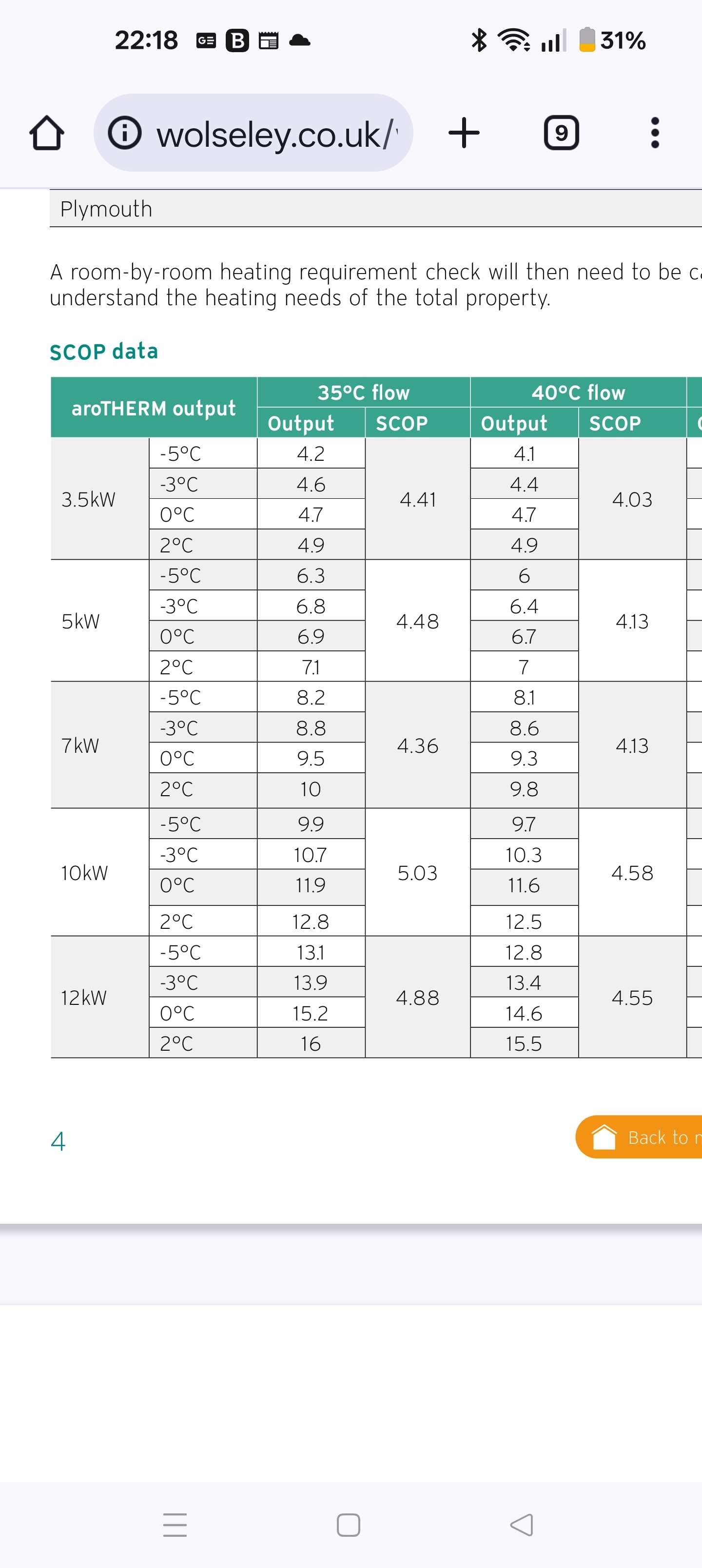
So including DHW if 9kW is correct you need a 10kW Vaillant, but if 9kW is rounded up you could use a 7kW. Your flow temp shouldn't exceed 35, possibly lower and a 7kW puts out 8.8kW.
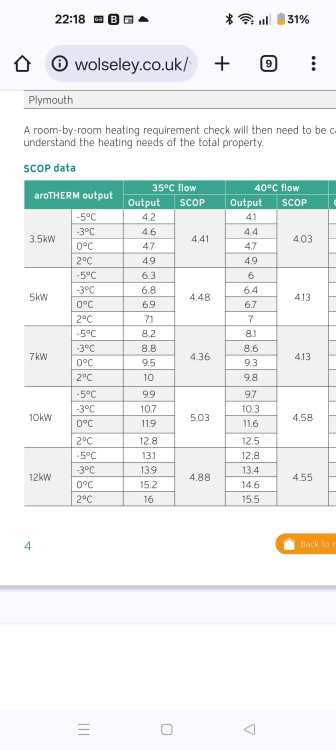
-
Looking to do some automation to switch between heat and cool. Currently just a simple on-off switch, works but... So been playing with ChatGTP and bouncing ideas about different things. I have a Polypipe UFHMCPS controller, which is only used for monitoring and recording room temperatures and as a DHW timer. Also have a few unused shelly relays. ASHP uses a zero volt switch, closed is heat open is cool. Some good features of the polypipe controller are weather dependent heating control, fully adjustable hysterisis of room sensors. Weather dependent control allows a set outside temperature, to make heating possible and you can adjust average time the outside measured over, from 1 hour to 24 hrs. Room sensors can be made to switch heat on with an adjustable hysterisis from 0.1 to 5.0 degs. So the scheme I worked through with ChatGTP is as follows Switching between heat and cool An average 10 degs outside temperature to allow heating permissive. Coupled with house temperature of 23 (-) 3.5 degs hysterisis. Heating system run pure weather compensation, so is never off just in heat or cooling mode, nothing in-between. So this allows heating to switched on, only if below an average of 10 degs outside AND house temperature drops below 19.5 degs. Heating (cooling on) will only switch off if house temperature goes over 23 or the average outside temp goes over 10 degs. Conversely cooling comes on when average temperature outside drops below 10 and/or if house goes above 23. To enable switching, I need to do a wireless switch, so a shelly plus1 at UFH controller with the SW contact is connected to the live pump terminal. The pump L terminal being live when heating is asked for and off when it's not (so cooling is). A second shelly in disconnected switch mode, that open or closes the relay output, which is connected to the heat pump. Nothing done yet just a thought process. Have I missed anything obvious?
-
Do it same colour as the inside of the windows or the the same as the outside of the door/windows if different. Committee decisions on your house colours are normally cr@p.
-
Can't recall, but certainly quite a bit more expensive than ready mix, mostly because the guy stays in site a lot longer. But way less work than cement mixer yourself.
-
5ft drop still needs a structural engineer input, design and still need to comply with BRs We had a section of wall we hand filled used an on demand concrete lorry, he mixed a barrow load at a time, we then back filled the icf with flexible plastic buckets, for zero mess. It isn't quick, and it's hard work.
-
I would be careful your scheme is or should be an approved scheme by SEPA. So they will have reviewed the design and approved it. Changing without prior consent would negate your certification. It is also subject to a building warrant and is likely to reviewed by building control or at least a photo trail.
-
Think your going to need your structural engineer input. With a 5ft drop your balustrade becomes structural and your decking also. Then you need drawings these need to be approved, then you get building control involved... arms and legs and it grows. I would put this in the difficult basket, and move on. If it isn't on the plan, it isn't approved and BC tell you to knock it down. Job for after completion certificate is issued.
-
Didn't you say you had around 7 or 8kW demand at -10 (not a realistic design temperature for England) but installer was planning to install a 12kW Vaillant (which puts out 14kW at -3)? That is some amount of oversizing.
-
If you think there will be a need to cool, don't install radiators in bedrooms. They do not provide cooling, fan coils instead either wall mounted or ducted will provide heating and cooling.
-
Both My opinion and will be on the threads I answer. Is size for heating and DHW. An over sized takes a lot to get your head round and plenty of fiddling to get it to efficiently. It is unlikely to do it out the box. Wouldn't do so again. Heating is the dominant demand for the heat pump. Do UFH so you can do either heat or cool. If you are thinking radiators in bedrooms, don't put in fan coils. Or provision for fan coils pre run pipes and electrical to bedrooms that are in use, do you need them - wait until you have lived in the house. You can always and should open windows when it's cooler outside than inside when you need cooling. The other thing when cooling you don't need the house at 21 degs to be comfortable, 24 is fine. Our lounge is currently 23.6 and very comfortable, outside is 17, so also have a window open in lounge and bedroom. And because the windows are open the heat pump has switched it's self off, because it has no demand , because the windows are doing the job.
-
You need to concider the whole design up front. Ideal is to design system to run at all the same temperature and from the ASHP circulation pump. So you have 300m² of UFH downstairs plus upstairs?
-
Loopcad and free trial will do what you need. Whatever company or person you are speaking to has limited or no experience with a low heat demand house. UFH flow temps are unlikely to exceed 30 to 32. The 70mm screed will bleed down the flow temp to a floor surface temp closer to low 20s. So probes, actuators etc are not needed. Just your manifold and an isolation valve at inlet and outlet points, so 2x valves. Number pumps depends on your circulation pump capacity. So really depends on how close you do the UFH loops spacing and this will define the number loops. Play with Loopcad it will help define things. dT for a heat pump is generally around 4 to 5 degrees (difference between flow and return) but
-
The plague of heat pump installs, like a buffer but worse. So depends if it's in the UFH circuit only. Ideally it wills be. A low loss header just isn't needed, it adds nothing to improve things, but adds distortion (increases return temp and flow temp to decrease CoP). Assuming you are running single zone? Not lots of thermostats?
-
Lots of dT's at play. Boiler dT, dT between boiler flow and the water the other side of the heat exchanger (approach temp). dT from boiler is driven, by boiler algorithm, so flow rate and also how quickly whatever you are heating (air from radiators or water in cylinder) can take that heat away. You know from experience for example, that to stop your boiler from cycling when doing CH while wanting to do low flow temps, you had to up the size of some/all your radiators. Your cylinder heat exchanger is exactly the same. Big HE allows low flow temps AND allows boiler to manage the boiler dT. A smaller HE demands a higher flow temp to enable boiler to manage its own dT with cycling.
-
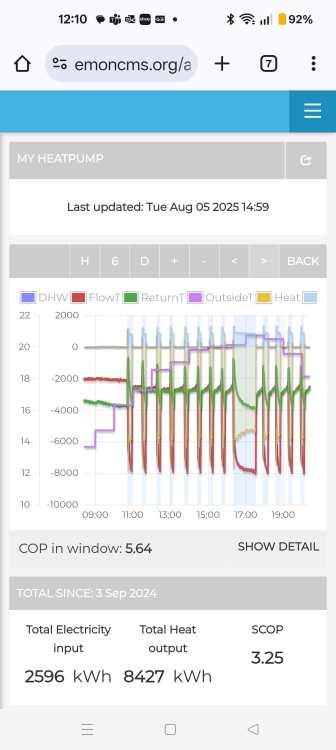
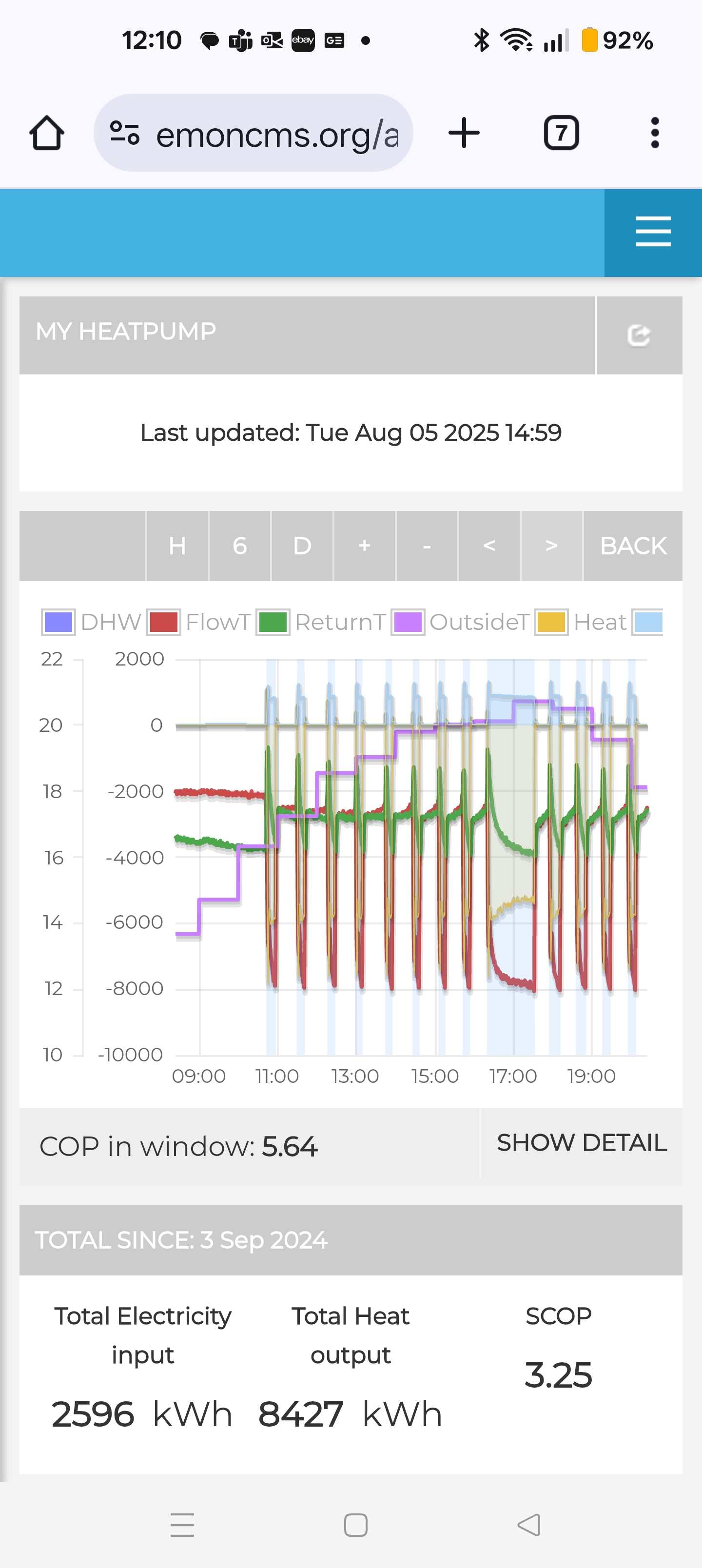
How many times the heat pump cycles on off when asked to do work. The better sized your heat pump to demand the less it will cycle, mine is double the size it needs to be so runs for 10 to 12mins every 30 mins to an hour. So if you run 40 to 50 mins still to a temperature closer to 16. This is mine running the other day, the light blow highlights are the actual heat pump compressor doing work, the gaps in-between are it resting between cycles. Easy way is if the fan is running your compressor is running, if off it's not. Just had a thought, if you have thermostats you will have to wind them up to max temperature to have a demand to heat, even though you are cooling. Also if you have volumiser or buffer, need to make sure they are only in the UFH circuit.