


JohnMo
-
Posts
13292 -
Joined
-
Last visited
-
Days Won
200
Everything posted by JohnMo
-

Heat pumps: how much efficiency is enough?
JohnMo replied to Garald's topic in Air Source Heat Pumps (ASHP)
3kW, in summer, will run your heat pump in reverse, hot water, do the dish washer, washing machine, all your background electric usage. You shouldn't be exporting any or very little. -
Would doubt the fans man enough. Plus you don't want it running until all the inside is sealed up.
-
When you get the tape, make sure it is the paper backed foil tape. Way easier to use. So long as it's shiny and sticks well, either should be fine.
-
Basically there are a number of different air gaps, ventilated, unventilated, and partially ventilated. I would read the partially and ventilated as pretty much the same. Air movement .means they don't perform as well compared to unventilated, where there is minutes air movement. To this you also add if you have a low emmisivity air space, i.e. reflective surface. The reflective part adds to keep heat in or out, depending on the direction it faces. Actis and others rely on the low emmisivity unventilated air space to get the product performance.
-
how to remove bathroom paint from plaster - new paint is peeling off
JohnMo replied to Question's topic in Decorating
With new plaster the first coat is normally a primer, either a diluted emulsion or a specific paint for new walls. The problem with the plaster it sucks the water out of the paint, before the drying process has occurred and I think this can lead to poor adhesion, hence the first coat has added water or is specifically for new walls. I would get the painter back to fix, his issue. -
For what? What sort of flue, solid fuel, gas...
-
I just added a strip of OSB around the top of external wall (for clipping cables to), then 50mm battons vertically and battens at the top and bottom of the wall horizontally (for fixing plasterboard and skirtings to).

-
Why not just have a diagnostic air test done, before you proceed any further. That will tell you if you are ok or not. You only need the house depressed walk around and the back of your hand will indicate where leaks are.
-
But why would you want basic BR insulation standards with energy prices the way they are and heading. Insulation costs you once, heating bills cost forever. Wouldn't worry about the building time, as once everything is place there is not much difference to get a house you can live in, most important bit is to get a builder you want to work with, then use what they are used too. No paid for learning curve. Getting wind and water tight is about 1/3 of the job. I did ICF, because I built myself and suited me, its timber and stone slip clad. Other have done stick build timber others block work Timber frame will normally have a brickwork or block outer skin.
-
Ecodan heats water only to 39C with heat pump
JohnMo replied to FrankG's topic in Air Source Heat Pumps (ASHP)
Sounds like a load of old tosh. Almost all heat pump will provide 55 degC water some over 60 degC. Does you cylinder have a heat pump coil in it? If it doesn't that may be reason. What is your flow temperature, when heating you hot water cylinder? -
Question Do you use less gas heating cylinder to produce DHW or direct from a combi gas boiler? My thoughts are - A combi will start up quite a few times and have a short run times, worst efficiency. Filling a cylinder will be longer run time, so should be more efficient. But I am not sure, what are your thoughts?
-
I ended up with https://www.rfsolutions.co.uk/remote-control-systems-c9/mainslink-remote-control-systems-c25 10 mins to install, no issues
-
Building a retaining wall for a driveway
JohnMo replied to Ivan_England's topic in Bricklaying, Blockwork & Mortar
Ours, 3m long 150mm diameter timber strainers on right-hand side. Concreted in 1m deep, inside geotex membrane, then backfilled. left hand side, are about 700 to 800mm depth and again concreted in.
-
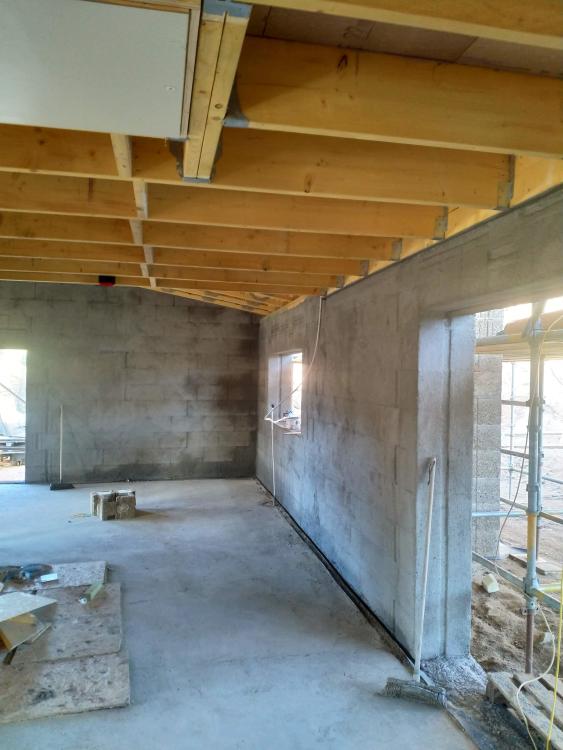
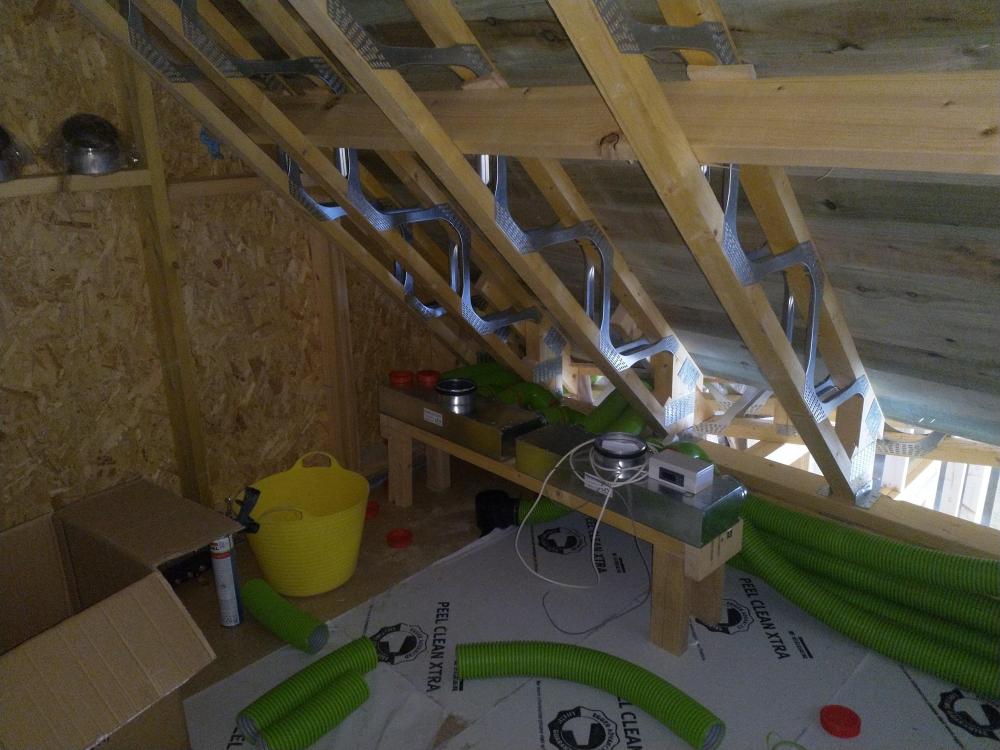
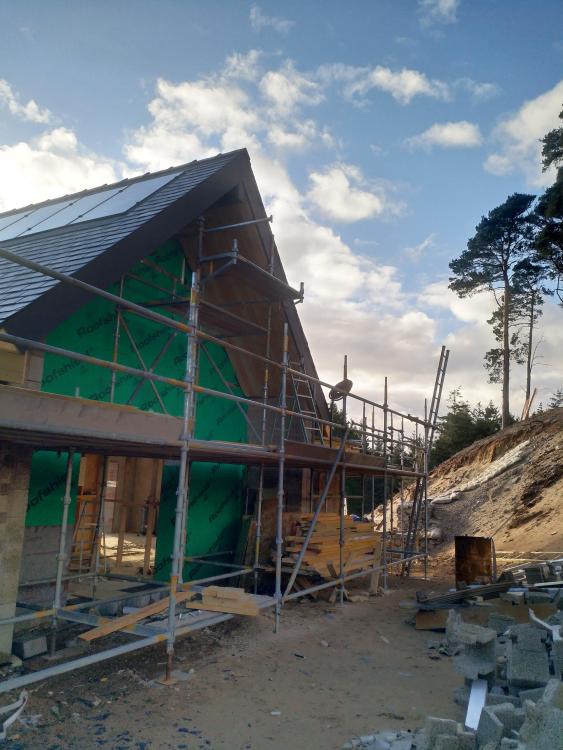
I did something similar on my gable end. I had ICF blocks though, but principal should be the same. We attached a horizontal timber plate on to the inside wall and hung the floor joists from that on hangers. Ours secured into the ICF concrete, yours would be the block work. The timber wall section was formed of from 140x45 timber and external 9mm OSB. The inside was spray foam insulated and then an VCL. Externally glass wool was battened on, and a breather membrane. Mine was wood clad. Photos show, upper floor, on wall hanger plate, internal of timber frame gable, and external of wall once external insulation added and breather membrane installed. Advantage of the above is no thermal bridges and continuity of insulation from ground to roof.
-
But small bear to use the correct backfill material, in the grand scheme of things.
-
Sorry missed your previous posts. Just looked at the Morso instructions and worryingly it states Fresh air supply A wood-burning stove requires air for combustion. As a result, firing a wood-burning stove will help create a healthy climate in your house. If the house is very tightly sealed, and particularly if there is a cooker hood or ventilation system in the house, it may be necessary to install an air grate in the room in which the wood-burning stove is installed. Otherwise there may not be enough draught in the chimney, which may result in the stove not being able to burn properly, and smoke may come out of the stove when the fire door is opened. If it is necessary to install air grates, they must be positioned so that they cannot be obstructed.
-
The hole you make is airtight it allows a feed of air from the outside to fire and make the fire easier to start and your flue will work effectively. Instead of using outside air for combustion, you will using your internal heated air. You will depressurise the house and when you open the door to restock the wood, the smoke will come into the room; as its at a lower pressure. Cut and paste from another forum The biggest concern with woodstoves in airtight homes is if they don’t have a direct air feed from the outdoors to the back of the woodstove. A lot of people omit that one crucial feature, and in doing so you will depressurize your home every time you start a fire. It will also be hard to light, and in combination with a bathroom fan or stove hood operating, it may fill your home with smoke. At the best of times, you will be feeding the fire with heated indoor air which will then activate every tiny leak in your building envelope drawing in cold air.
-
Wrap a soakaway in an impermeable material, you no longer have a soakaway, you have a bucket with stones in it.
-
Another option is to heat via a Willis immersion, they connect to bottom and top of tank, supposedly can heat just the top or the whole tank, no external pumps needed..
-
Would MOT type 1 just block everything up as it has lots of fines in the mix. Gravel or pea would be my thoughts
-
Who knows from the image, is there sellers pack or is that just a Scottish thing? It could be EPDM, PVC, fibreglass, rubbers or felt.
-
High efficiency fridge-freezers
JohnMo replied to puntloos's topic in Kitchen & Household Appliances
The A to whatever ratings all got changed about a year ago, think to old A is something like an F. All fridges were A+ or A+++++ so was very much meaningless. -
Information needed for a quote from the online estimators
JohnMo replied to Indy's topic in Costing & Estimating
Wow big costs for turnkey. -
I think your diverter will only be directed on one immersion. Otherwise you need to divert into another controller that firstly heated one immersion then the other. Mixology cylinder has I believe two immersion heaters and a controller for PV. They use an external PHE to charge from a HP.
-
Or cover the panels with black plastic or card, then there should be no volts. Connect without any risks. Assuming you've done everything Dave mentioned above first.




