JohnMo
-
Posts
13296 -
Joined
-
Last visited
-
Days Won
200
Everything posted by JohnMo
-
The biggest issue is a passivhaus will have really low flow temps for UFH. Carpets just act as an insulating blanket. Our house isn't passivhaus standard but is well insulated. Our UFH flow temp is low, floor surface temperature is 1 to 2 degrees above the room temperature. We have carpet in the bedrooms and the UFH is just rubbish.
-
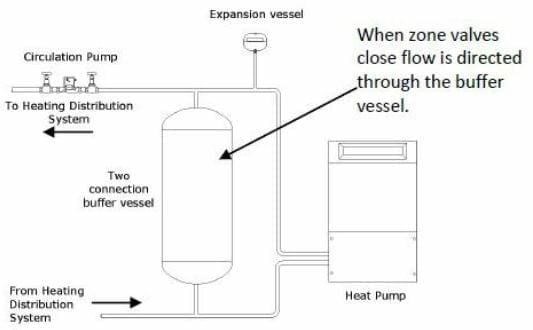
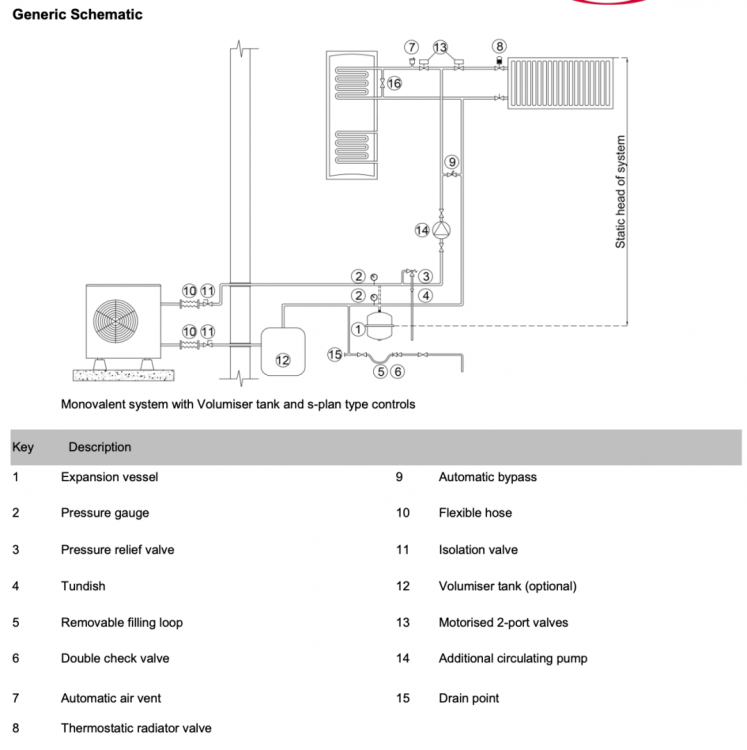
A 4 port can be connected as a 2 port, just flow in the top and out the bottom connection, blank the other two ports off. You would normally have the buffer position so all the flow goes through it for the whole heating system, so after your return tee (UFH and radiators) for a return line two port. Item 12 in the attached drawing If you want to do it across flow and return, install instead of the bypass like this
-

Is there a no-frills R290 heat pump?
JohnMo replied to sharpener's topic in Air Source Heat Pumps (ASHP)
If you put an additional pump on the DHW return side, powered from the same power supply as the three way valve, that will overcome the high delta T of the coil. Mine pulls an additional 31W for an hour or so while doing DHW only. My issue isn't a small coil, but 22mm Hep2O running from 3 way valve for about 8m each way, plus a long run from the ASHP. -
I found the pipes were just getting slightly damp if I went any lower, so settled on 12 also. Running in day is mostly PV powered, our floor will never get very cold as we have 300mm pipe centres in 100mm concrete and I only run in the day time.
-
@JoeBano what temp are you flowing? I am doing 12 degree flow temp, running from 9am until 5pm. We still get some overheating from about 4 til 7 due to big windows and lots of solar gain. But way better than it used to be.
-
Is there a no-frills R290 heat pump?
JohnMo replied to sharpener's topic in Air Source Heat Pumps (ASHP)
Same old, same old, rules of thumb, it's a heat pump it's got to be 28mm. I was being optimistic saying guessing. Possibly a standard cost adder. -
Is there a no-frills R290 heat pump?
JohnMo replied to sharpener's topic in Air Source Heat Pumps (ASHP)
Really not engineering at all, just guessing at someone's expense. Sounds like the Green party in Scotland, more interested in getting power and independence from England, than anything useful or Green -
You need sand to make concrete or make it with ballast, which is mix of gravel down to small fines. Various grades of concrete are mixed with various quantities of sand, cement and gravel. Varying mixes get different properties depending on what you are doing with it.
-
Trade prices direct, quoted me (Dec) about £2k for a Grant 6kW, delivered to IV30*** postcode. That includes VAT. I haggled on price found the lowest price I could and they beat it.
-
What size heat pump are you looking for?
-
Toshiba Estia 300L heat pump cylinder
JohnMo replied to eniacs's topic in Air Source Heat Pumps (ASHP)
If only the size stated, not much chance of heating with a heat pump. No matter what setting you use. -
Two ways to plumb a buffer 4 port basically goes between flow and return. Or two port goes in the return only. Any mixing in the 2 port doesn't affect boiler or heat pump efficiency, where in a 4 port it most likely will, unless the buffer is big and well designed.
-
I just bought from eBay. If new build I suspect you only need a 4 to 6kW Don't appear to be that expensive here https://www.theheatpumpwarehouse.co.uk/product-category/heat-pumps/air-source-heat-pumps/panasonic-air-source-heat-pump/
-
Is there a no-frills R290 heat pump?
JohnMo replied to sharpener's topic in Air Source Heat Pumps (ASHP)
I see what you mean about being marginal. I saw them on eBay from their outlet store, which is normally about 20% off the retail price. Full warranty etc. They have other sizes there also. I looked at Trianco, and they are not inverter heat pumps, when I asked. CoP wasn't great. Riello are rebadged Midea monobloc ASHP. The specs look ok, but no experience, they come up on eBay for good prices. Grant could be worth a look also. -
Is there a no-frills R290 heat pump?
JohnMo replied to sharpener's topic in Air Source Heat Pumps (ASHP)
Or you could get a cool energy heat pumps for about £3.5k, good for 12kW You would need a huge buffer to make use of off peak charging, if your heat demand is 12kW. Can you configure your zones so you don't need a buffer? Then you are down to £2k for general stuff to install - this could be reduced loads with careful shopping and designing. £3.5k for ASHP £250 for destrat pump £2k for your radiators So about £7.5k £6k cheaper than B. -
Good question, hopefully someone can answer?
-
DC has a 1.07% voltage drop based on 60m. The AC 2.24%. If I plan the route I may be able to drop a few metres of the length, and drop the DC percentage voltage drop below 1%. Another reason to stay DC for the long run.
-
Been doing reading up overnight. My AC and DC voltage is about the same. but I have 2x PV strings feeding a single inverter, so the amps on the AC side is double the DC side. Found a voltage drop calculation online https://photovoltaic-software.com/solar-tools/voltage-drop-calculator-dc-ac Have compared the AC and DC voltage drops and power loss. Looks like keeping DC to close to the CU will work best. AC voltage drop 5V Energy loss 90W DC voltage drop 2.5V Energy loss 17W, but 2x strings so 34W Looks like our voltage is in the 240v range, so it makes sense to have the inverter close to the CU for that reason also. So will look to get some 6mm2 4-core SWA cable. Run PV cables into a DC isolator near panels, 6mm2 4-core SWA cable to inverter. AC from inverter to meter, AC isolation switch, CU.
-
At 1830mm why not french doors?
-
Is that the safety group for your cylinder, so you may need G3 installer?
-
I have what looks to be same filling valve, circulation pump doesn't seem to have any issues flowing it's duty rate of 1m3/h through 9 UFH loops, and 12m underground before getting to the house, using 28mm pipe. (No other pumps in the UFH system).
-
So open circuit voltage is 38.8v and 6 panels per string. So 232.8V
-
Why does my combi boiler fire up when I run cold water?
JohnMo replied to joe90's topic in General Plumbing
Mine clicks on, then off when I was filling the central heating, the fill valve is in the cold water line into the combi. Think the flow switch in the boiler must see a slight reverse flow. Maybe we should have a check valve in the line? -
As far as know anti freeze valve are basically anywhere in the outside pipe work. I would place close to the ASHP though. I know the advantages of anti freeze valves, but I chose to just install 20% antifreeze. Worst case for me was, I was away, anti freeze valve opens, heating system depressurised, wife can't, repressurise heating system, so heating remains off until I get home. Me in dog house. Strainer should really be inside not outside. But accessible for cleaning. Same for fill valves. I have my isolation valves direct to heat pump. But depending on pipe length outside, they could be immediately inside house. Remember you need an expansion vessel. What's the pressure reducer for?
-
View in front of panels, looking SW.