


JohnMo
-
Posts
13296 -
Joined
-
Last visited
-
Days Won
200
Everything posted by JohnMo
-
We are on a hill and have used gravel. You need a crushed stone, so they interlock together, then don't move too much.
-
 Not sure my floor has ever hit 25 degs! Why go to the bother of building a passivhaus and then have the heating on in the summer? Just madness
 -
Why would you need to heat the bathroom in the summer in a passivhaus? We're not passivhaus and have just had 2 weeks of rain and very little or no sun, outside temperature around 14 and lower, house hasn't dropped below 20. We still get people coming into commenting how warm the house is. Had an hour or so of sun this afternoon and the UFH has just kicked in.
-
Well that's everything up and running, pretty cloudy today, and the sun does come out it's still not completely clear, but at 2pm was generating about 2.7kW. Only thing I had to correct was the meter got wired the wrong way round so it wasn't recording export. 10 mins to sort out.
-
dMVHR or trickle vents
JohnMo replied to HughF's topic in Mechanical Ventilation with Heat Recovery (MVHR)
I assume English building regs have a minimum size in mm2 for a room, I would go with that. If you can fit to only one window do that. -
Samsung Gen6 ASHP, 40kw used in a day (HW only)
JohnMo replied to Andeh's topic in Air Source Heat Pumps (ASHP)
Why are you running the legionnaire cycle for 5 hrs? You only need for a hour, if you are constantly using water i.e. daily there is a question if you need it all. Are you trying to get the cylinder up to 55 degrees with ASHP or with an immersion? DHW heating, if you have target temp set to high, that the ASHP cannot hit first time, what happens is the heat pump will keep trying and short cycle for many hours until it gets there. During this time it will use a colossal amount of electricity (kWh). -
ASHP, how to decide - I just don't get it!
JohnMo replied to Jimbo37's topic in Other Heating Systems
If you need 4kW for heat that leaves no room for DHW heating if you went for a 4kW ASHP. So you will a 5-6kW ASHP, just need to check it delivers the required temp and kW at your lowest outside air temp. Our house need 3.5kW for heating and I installed a 6kW, mainly because it was super cheap and was near enough. If you have builder, electrician and plumber on hand why are you wasting money on MCS rip off? -
It's fine adding insulation but why? The concrete slab will be no cooler than the air around it, so what does it achieve. If you are touching the wall, the concrete could be wet during and between defrosts, you should consider some DPC between concrete slab and wall. You normally require 300 to 400mm clearance behind the ASHP for airflow, so why does it even need to touch the wall? You need to also ensure you have a suitable soakaway installed to take away defrost water.
-
To amplify @ProDavecomments, this is the procedure I am following. DC panel connections. Make extension wires from first and last panel, install MC4 connectors and terminate at isolation switch. Clip all wires into place - I used UV resistant cable ties secured to unistrut. Connect panels in series and connect extension leads. Using multimeter check voltage is present at isolation switch. Mark each positive wire terminal. DISCONNECT TWO PANELS IN EACH STRING. Use multimeter to verify no voltage present at isolation switch. Make up and terminate cable between isolation switch and inverter. Ensure positive and negative terminals are not mixed up. Make all AC connections prior to connection to consumer unit. Once all connections are made reconnect PV panels. Then follow switch on procedure detailed in inverter manual.
-
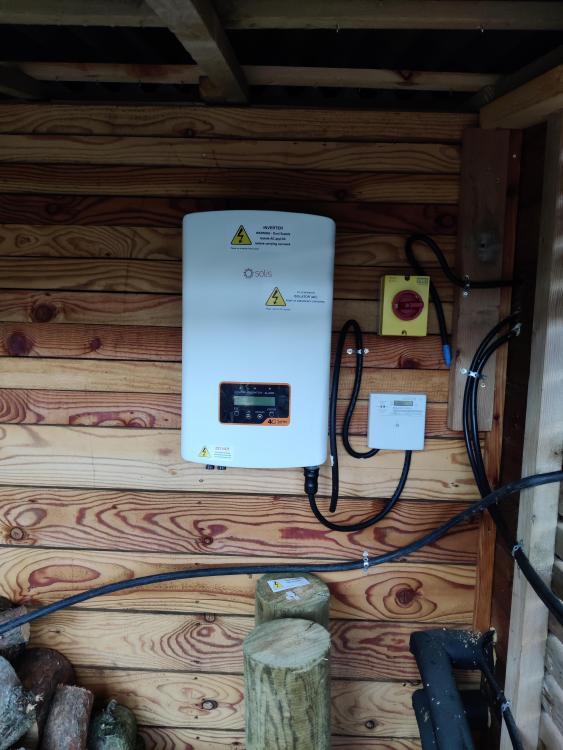
Grid tied - no it doesn't island. Model Solis-1P3.6K-4G.
-
Many thanks. Photo of the inverter. It is located on the rear wall of what was/is an overflow wood shed. My ASHP is at the front of the shed, the area between the inverter and ASHP remains clear of logs etc. The two pipes on the right are the flow and return to the ASHP, the logs are being used as a make shift work bench.
-
Panels are now wired up to DC isolator. Had to replace 2x plugs on the panels as these were obviously damaged when removed from last location. Inverter, AC isolation switch and meter all mounted. 52m, 6mm2, 4 core DC armoured cable routed between inverter and DC isolator. AC cable terminated at inverter and meter. AC cable routed to consumer panel. Jobs for tomorrow - depending weather Terminate DC cable at DC isolator and inverter Terminate cables at AC isolator and consumer unit. Power up
-
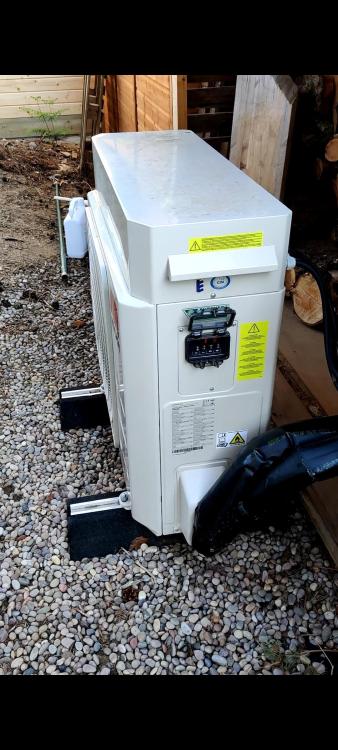
Mine is just sat on gravel, with 600mm deep rubber feet. Seems happy enough.
-
I'm just installing additional panels two x 1710W about 52m from the consumer unit. Have calculated the voltage drop and power loss in AC and DC and found the losses in DC were basically half the AC losses. So you may want to consider having a split array on the garage roof, then run a 6mm2 4 core armoured cable from the garage to house and mount the battery and inverter there. Armoured cable can be surface run if you want.
-
Questions relating to pipe centres
JohnMo replied to Post and beam's topic in Air Source Heat Pumps (ASHP)
I have not seen an issue with short cycling, since I started operating as a single zone. For about 6kW heat input you need circa 40 to 50L of water engaged. If you were operating lots of zones, close centres might be more important. -
Questions relating to pipe centres
JohnMo replied to Post and beam's topic in Air Source Heat Pumps (ASHP)
The chart is one have seen in a few places on line, I think it originated from DIN standards. The flow correlate well to loopcad. And experience on my floor is similar, although I did have to extend the W/m2 line down to 10. 300mm centres works well with time shifting as I was doing this in March April as an experiment. Flowing a modified WC curve running for 7 hours, kept house at a very stable temp until the next night. Having tighter centres does give more wiggle room and quicker recovery times, but 100mm leave that to a houses that require much more heat per m2. Although there are plenty of low energy (heating) houses on this forum, in general there isn't many in the UK as a whole. So you tend to have to find your own way, plumbers have no clue in general. No right wrong solutions as each house is different. But when you drop to about 10W/m2, the heating world is just different from the normal heat sieve. -
Questions relating to pipe centres
JohnMo replied to Post and beam's topic in Air Source Heat Pumps (ASHP)
As you may have noticed from a lot of my replies I run 300mm centres, in fact in a 194m2 floor, I have less than 600m of pipe. My floor U value is 0.09 and the pipe is within 100mm of concrete. It takes a long time for a temperature change in the house, but when running weather compensation that doesn't matter. Generally my flow temp down to zero outside is less than 30. When cooling my flow temp is 12. I run as a single zone, no actuators on UFH manifold, no pump or mixer. The engaged water volume is enough to not short cycle without a buffer. 100mm centres isn't the easiest thing to do, if your risk averse something like 150 to 200mm centres is easy to bend etc. So to show how little pipe you can get away with follow my piping. One loop does, main bathroom, hall and kitchen and is 100m long, the living room has two loops, three bedrooms have short loops in each and ensuite another short loop.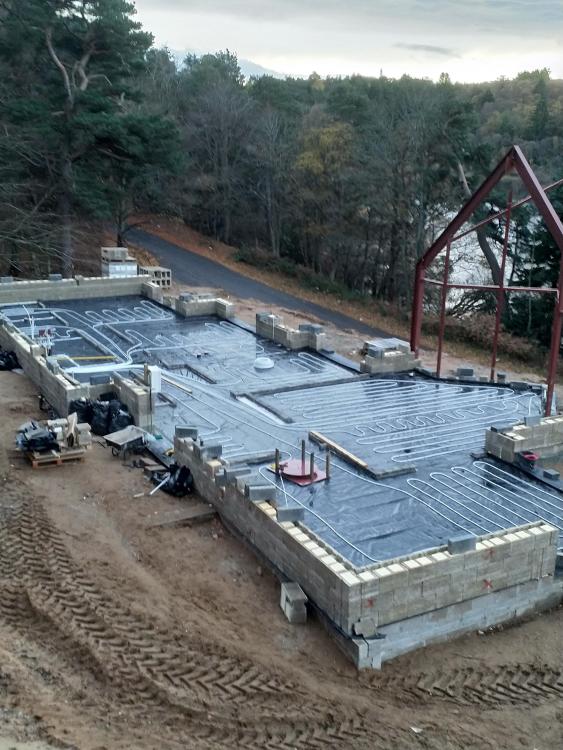
-
Costs to install 8.5kw Mitsubishi R32 ASHP
JohnMo replied to Meabh's topic in Air Source Heat Pumps (ASHP)
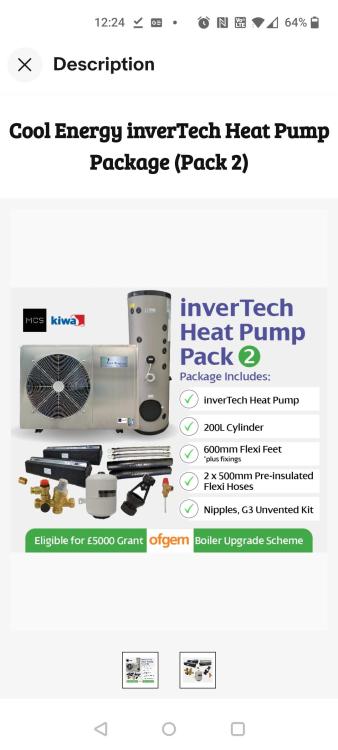
So just out curiosity had a look about for pricing. Quite a few members have and speak highly of Cool Energy ASHP. So on eBay I spotted this package - this will be a vat included price, so you should be able to claim any Vat back as you are doing a new build. Everything you need except the piping and a 3 way valve. Run the whole ground floor as a single zone no buffer, minimal electrics if UFH and cylinder are close proximity to the pipes you pre installed not much plumbing either. You shouldn't even need a mixer and pump on the UFH manifold, just run on weather compensation for heat pump circulation pump. Put an electric towel radiator in you ensuite, with a timer thermostat, that is your second zone for building control.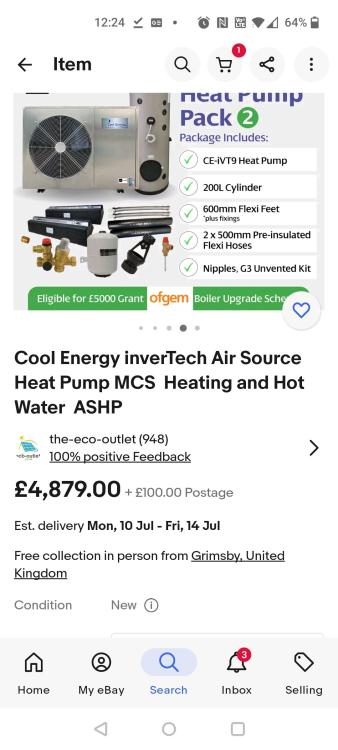
-
Is It Worth Insulating UHF Manifold Feeds/Returns
JohnMo replied to MortarThePoint's topic in Underfloor Heating
Toolstation do better pipe (thicker) than Screwfix, titled bylaw something. -
Costs to install 8.5kw Mitsubishi R32 ASHP
JohnMo replied to Meabh's topic in Air Source Heat Pumps (ASHP)
Why are people obsessed with 100mm centres in a low energy houses? They are just not required to be that close for heating or cooling. Even at 20W/m2 there is only a 3 degree difference in mean flow temp, when comparing 300 to 100mm centres. A low energy low would be in the 15W/m2 or lower, the original poster would be in this range looking at the U values. Once to get close 10W/m2 there is little difference. So much so that both have to run the heat pump at min flow temp for a heat pump anyway for both 100mm and 300mm centres. Which in its self can be problematic with a high mass UFH system as return temperature doesn't drop quickly enough..thumb.jpg.e6f5b10749b0a8b28a782f83356b9791.jpg)
-
Me also, nice to rain at the moment it is slowing progress.
-
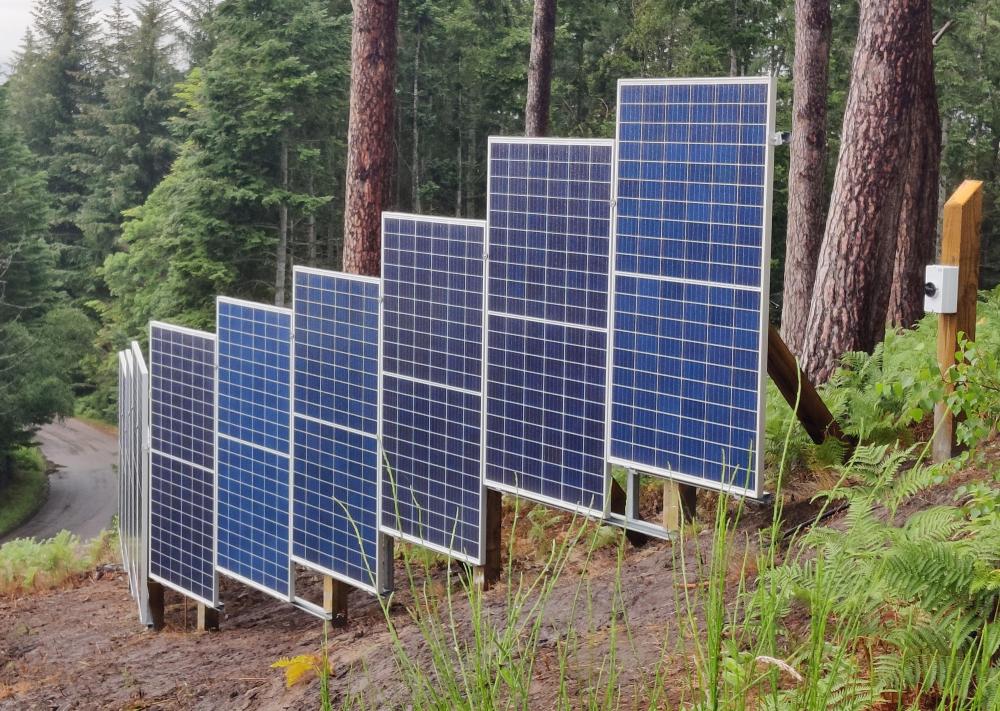
Second 6 panels now in place. The second array is 15 degrees off south in the westerly direction, the first array is 45 degrees off south in a westerly direction.
-
ASHP generally (not seen a modern one that doesn't) a pressurised heating system, so the thermal store will have to be unvented. It will need antifreeze valves or its going to cost a fortune in antifreeze . You seem to spending £2k+ to save a possible £100, but not convinced. You making what should be a simple system super complex. Why not just run the radiators you want in the cheap period, can't see why your bedroom would loose heat that quick, that an hour so earlier or later would make a big difference You can always get the recip saw out and take the existing cylinder out in bits.
-
Costs to install 8.5kw Mitsubishi R32 ASHP
JohnMo replied to Meabh's topic in Air Source Heat Pumps (ASHP)
How big is your new build ICF house to require an 8.5kW heat pump? Let's is know U values, size, single storey etc, airtightness and UFH or rads? I'm at around best part of 225m2 (including plant room) and have just installed a 6kW and could have got away with 4kW. Assume the quote doesn't include the heating system as nothing is mentioned? To me the price looks like a total rip off! -
Solar PV. No grid capacity.
JohnMo replied to gustyturbine's topic in Energy Efficient & Sustainable Design Concepts
You to understand their age, then find a datasheet online and estimate how much they have degraded and much remaining life is left.





.jpg.87d6d75adaec59a22c40fcf0ea8d2464.jpg)
