
JohnMo
-
Posts
12465 -
Joined
-
Last visited
-
Days Won
179
Everything posted by JohnMo
-

Surge protection, fuses and MCBs in loft from PV array.
JohnMo replied to jimseng's topic in Photovoltaics (PV)
ALL inverters need the AC disconnect, prior DC. Big bangs likely in full sun if you don't. Likely to need a new isolator switch if your lucky, if your not, big volt DC isn't good for ones health. -
Details of some of the template sensors This is the import windows defined - have only use morning and afternoon slots binary_sensor: - name: hp_import_window state: > {{ now().hour in [4,5,6] or now().hour in [13,14,15] }} Predicted trigger state sensor: - name: hp_predicted_trigger state: > {% set p = states('sensor.lounge_predicted_temperature_in_1_hour') | float(99) %} {% set setp = 20 %} {% if (p < setp - 0.3) and (is_state('binary_sensor.hp_import_window', 'on')) %} on {% else %} off {% endif %}
-
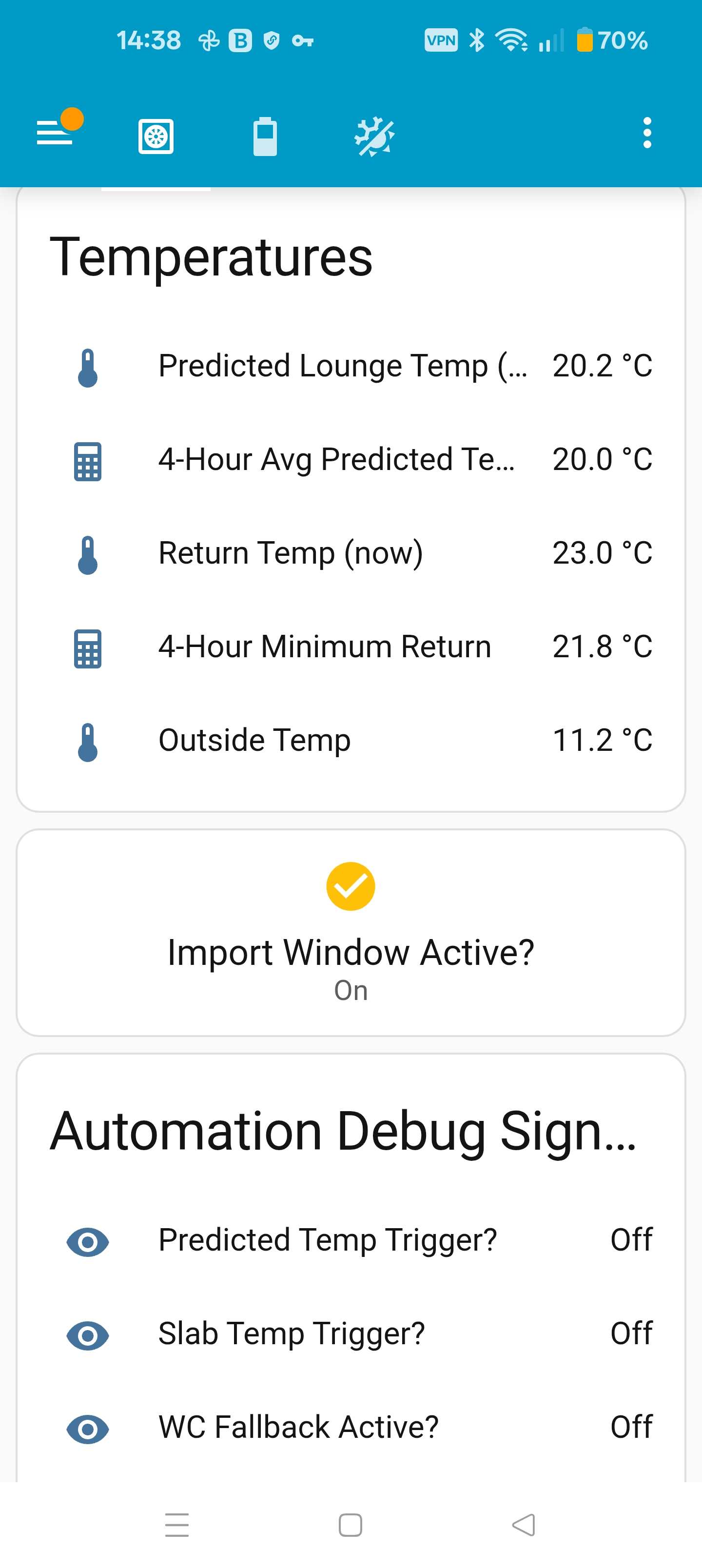
So this is the small dash board on home assistant. I have a target temp set at 20 degC. The yaml code for the prediction automation, this just sends a notification to me if we are running to cool.in the house to see how it works. If connected to an output devise and house was likely to be too cold, ASHP would be started at a flow temp higher than the normal WC curve. alias: ASHP Batch Charge Based on Prediction and Slab Temp description: Batch-charge UFH during cheap windows using predicted + slab return history triggers: - at: "04:00:00" trigger: time - at: "13:00:00" trigger: time actions: - choose: - conditions: - condition: time after: "04:00:00" before: "07:00:00" - condition: or conditions: - condition: template value_template: | {{ predicted_min_4h < (setpoint - 0.35) }} - condition: template value_template: | {{ (return_now - return_min_4h) < -1.5 }} sequence: - action: notify.mobile_app_cph2449 data: message: "Batch heat started test " - delay: "03:00:00" - action: notify.mobile_app_cph2449 data: message: Batch charge finished test - conditions: - condition: time after: "13:00:00" before: "16:00:00" - condition: or conditions: - condition: template value_template: | {{ predicted_min_4h < (setpoint - 0.30) }} - condition: template value_template: | {{ (return_now - return_min_4h) < -1.5 }} sequence: - action: notify.mobile_app_cph2449 data: message: "Batch test " - delay: "03:00:00" - action: notify.mobile_app_cph2449 data: message: Batch charge finished test mode: single variables: setpoint: 20 predicted: "{{ states('sensor.lounge_predicted_temperature_in_1_hour') | float }}" predicted_min_4h: "{{ states('sensor.4h_min_predicted_lounge_temp') | float }}" return_now: "{{ states('sensor.emoncms_emoncms_org_heatmeter_returnt') | float }}" return_min_ 4h: "{{ states('sensor.4h_min_return_temp') | float }}"
-
Been playing with ChatGTP over the last few days, generally going down a rabbit hole. Was looking for a simple way to model Weather Compensation fine tuning and or boosting during low tariff periods. So generally ChatGTP was no help. Had a search for something unrelated on Google and came across this site https://www.diyenjoying.com/2025/04/11/harnessing-the-power-of-predictive-heating-revolutionizing-home-comfort-with-home-assistant-and-derivative-sensors/ And finally a very simple modelling tool became realistic. So using the data on site above to add a couple of helpers to home assistant (hardware is already there - temp sensor). Then fine tuned for my UFH (thick screed etc). You now have a simple hourly and now 4 hourly look ahead at likely room or house temp if nothing changes. The author of that site used the information to start and stop heating, based on a generic thermostat, but taking account of floor inertia to not get swings in room temperature. So start boiler early and stop early, based on likely house temp - not actual house temp. But for weather compensation you just need a simple notification house temp is increasing or decreasing and you can simply adjust the curve. Add a bit of human looking at the day, it's stunning and room temp is increasing - no shocks don't do anything. But if it's dull outside you can decrease curve. So went back to ChatGTP for assistance. I have actually extended everything out to 4 hours to make it a little more meaningful for my house. There are few things this allows Intelligent fine tuning of WC curve. So you can see the likely house temp in 1 and 4 hrs and rate of change as a positive or negative. Options you could implement - you could run a cooler WC curve and boost during cheap periods. Could use it for batch charging alone, add some simple energy calculations based on you heating system store energy etc. Will add a few screenshots later
-
Rainwater pooling next to external wall
JohnMo replied to LLL's topic in Rainwater, Guttering & SuDS
See this thread also Or have you just moved the problem for now? -
Bit of fun - Spot the mistake - or perhaps there isn't one!
JohnMo replied to MikeSharp01's topic in General Plumbing
Apart from the drawing being wrong - nothing much wrong. I would do - cold water main to PRV, then the check valve, (long bit), flexible, then the short bit. Not sure I would be filling the heating to 3 bar though. Mine currently sits at 0.5 bar. -
Sum it up in one sentence then... Go on.
JohnMo replied to ToughButterCup's topic in General Self Build & DIY Discussion
Easy enough if you plan everything ahead, can get complex and expensive if you don't. Or I just paid someone else to do it, it was fine. Or Never been so knackered, everyone asks you a 101 questions every day. Or I'm broke, house isn't finished, can I have another pint, before I go back to do another 4 hrs, loads to do before the contractors get back tomorrow. -
The manufacturers website doesn't even include that detail either.
-
Your system is reacting the same way as an oversized boiler. The reason it does that, is similar to a kettle, you put a cup of water in it it boils in seconds, fill it it takes an age to heat up. It sounds like you simply don't have enough water volume engaged. Then you have a mixer, this will always mix some of the return water with incoming water, and it doesn't make any different temperatures you set them at they always bypass some return water back to incoming water. If your loops are doing 3l/min, your flow through the Willis is nearer 2l/min. Which is a trickle. The other thing is target flow temp goes out the window with cycling as the target is based on average flow temp. Example, target of 30 degs, is fine if running heat input for hours at a time, but if you are cycling every couple of mins, it's more like 20 then 30, so now your average is nearer 25. So you have to set the target higher to compensate. I would do this first - keep all loops open or closed so run a single circuit. So one control thermostat connected to all loops. And - Crank up the loop flow rate to get more water moved about. Flow each loop at max flow, if making any noise trim them back a little. Then if it's still not ok Delete the mixer, add a pipe stat, for floor protection, to the hot pipe going into manifold. Then finally, add a buffer or volumiser to system.
-
Decent "middle of the road" brand for plugin tools?
JohnMo replied to YodhrinForge's topic in Tools & Equipment
I've bought DeWalt and Matika, 230V stuff, all good no issues. A Titan SDS from Screwfix, used it plenty further build, no issues. -
That is a normal approach, cheap pipe stat.
-
Your best way to heat almost any house is low and slow, just keep the house heating ticking over. Heat one room, you are really trying to heat the whole house via one room. The external house walls leak heat more slowly than internal walls and doors. So you have one radiator on it runs balls out trying to make up for the heat slipping through the internal walls to adjacent rooms. By low and slow is more about room temps. The normal way is via short time slots, every time to switch heating on, you have to heat the building fabric, all the metal in the heating system etc, so you over compensate with higher room temps. As cold walls suck the heat from you, heavy radiator driven air currents drag cold air about etc. Leaving heating on for long periods with small nightly setbacks, allows the whole house temperature to stabilise, boiler moves to a more tick over mode than flat out for short periods. My sister did exactly the same as you are trying, I convinced to try longer run times with no zoning, the house became more comfortable, rooms that didn't heat well, all became comfortable, heating cost hardly changed.
-
You can easily heat individual room with enough zone valves or radiator valves. But you get to the point that boiler cannot turn down output far enough and you get short cycling - basically burning loads of gas for little gain. That just means remote access, so nothing smart just an on off device with internet access.
-
An ASHP feeding UFH will only add heat slowly as flow temp rise is capped by dT between flow and return. If I set mine to batch charge - 35 Deg target point, it will take several hours of full load run to get anywhere that target. So if you set timed windows of one hour for DHW, you will have zero issue, if the 3 port diverter failed. Only cold water coming out the tap.
-
So to today's questions on our ASHP install.
JohnMo replied to MikeSharp01's topic in General Plumbing
Can't it - heat loss due to internal 'waterfalling' at pipe connections (tiny little thermal loops where warm water goes into pipe, cools and then falls back into tank, bringing more hot water into pipe). Sounds like a thermosyphon to me. Yes your pipe stays nice and warm at the expense of continuous heat loss, even with good insulation. How many if any seconds it saves you? Just had a shower secondary circulation off, cylinder 20m away from shower, in time it took to take clothes off, I walked straight into warm shower. I will keep the losses in check. -
So to today's questions on our ASHP install.
JohnMo replied to MikeSharp01's topic in General Plumbing
It's a lockable valve. A normal service valve or a motorised valve isn't. @Nickfromwales just beat me to it. -
Distance to combustibles flue passing through wall
JohnMo replied to jimseng's topic in Stoves, Fires & Fireplaces
So you need to cut all this back. I would get a suitably rated neoprene flashing/ grommet to tape to your membrane that will get you airtightness back. You may need to add a metal trim plate to get the plasterboard tidy. The insulation around the flue replace with Rockwool as it's classed as fireproof. Warmcell has a fire rating of around E/F, Rockwool is A1. So you may need to box this part of wall in to keep the insulation from mixing. -
So to today's questions on our ASHP install.
JohnMo replied to MikeSharp01's topic in General Plumbing
1 question if you are doing the UVC yourself, where are you getting the sign off certificate from? Assume you are not qualified, as you would ask the questions. Hot water outlet pipe, I would drop pipe downwards at cylinder edge for about 150mm to stop thermosiphon. Your grey and white expansion vessel is a maintained item, so you need access to the Schrader valves to pressurise - do you have access in that location? Do you need one at all, certainly if you have secondary circulation loop you will have issues installing one with out carefully planning. Yes they are approved. You water less on MVHR also. Ideally needs to be on the return line, but an isolating valve or similar device should NOT be installed between the boiler/heat pump and expansion vessel which could isolate the expansion vessel from the system. -
stainless steel screws for chestnut cladding / decking etc
JohnMo replied to marmic's topic in Building Materials
It's a bit more than that, physically they have different yield and tensile strength and different corrosion resistance. A4 being better than A2. -
Surge protection, fuses and MCBs in loft from PV array.
JohnMo replied to jimseng's topic in Photovoltaics (PV)
So just do long cables, with no breaks between panels and inverter. -
Fabric and ventilation heat loss calculator
JohnMo replied to Jeremy Harris's topic in Heat Insulation
Yes, but you don't need to add anything for DHW. The way they test heat pumps is more for central Europe, which has a dryer atmosphere, so less defrosting goes on. So I would look at nearer 8-9kW (at -3) not a 6-7kW. But as mentioned turn down and modulation is important. -
Fabric and ventilation heat loss calculator
JohnMo replied to Jeremy Harris's topic in Heat Insulation
I got some stupid quote, a massive heat pump offered, even with an 'A' EPC. And an actual heat loss for house, close to 3.5kW even at -9 outside. -
Surge protection, fuses and MCBs in loft from PV array.
JohnMo replied to jimseng's topic in Photovoltaics (PV)
Just put the inverter in the loft, terminate direct to the inverter, then an AC isolation switch and then down to consumer units. Then you have PV array plugs and inverter plugs nothing else on DC side. Or just use longer DC cables and take then direct to the inverter location planned? -
Really depends on heat loss - start with the basics do a heat loss calculation. Then you will know what size you need. 19 radiators in a heat seize of a house and 19 radiators in a low heat loss house require different heat inputs. This will give you an easy means of getting somewhere close https://heatgeek.com/articles/heat-loss-calculations
-
Perimeter insulation - flooring butted up to or laid over?
JohnMo replied to Dunc's topic in General Construction Issues
The reason I said in the first place was, that the flexibility comes from having a big energy store, then you can play tunes with how you heat your house. Pure weather compensation is fine with thin and thicker screeds, batch charge can only be done with thicker screeds. Batch charging can be useful with time of use tariffs. A few on here only heat on cheap rate periods. 40mm is more like a big radiator.