


JohnMo
-
Posts
13299 -
Joined
-
Last visited
-
Days Won
200
Everything posted by JohnMo
-
Think you may be over thinking. The heat pump is just an electric user, it doesn't care where electric comes from. You can keep this Uber simple, 3 port valve to UFH and UVC. If you want to generate and power the full house in a power cut, you only have a couple of options, Tesla Powerwall or Givenergy All in One. Both can fully integrate the generators, grid and car charging. Unless the wind turbine is big, it likely to be piss poor performance.
-
Basically you will have a quick recovery cylinder. No issue driving a heat pump coil from a gas boiler. I found "Ideal" cylinders from City Plumbing to be very well priced. Come with a 28mm 3 port diverter valve and all the safety bits. I would upgrade to a digital dual thermostat, for about £20. Thing to concider If you are running out of water with a gas boiler, you don't stand much hope with a heat pump, with lower storage temperatures.
-

Ecodan 8.5KW not reaching set water temp
JohnMo replied to Gary68's topic in Air Source Heat Pumps (ASHP)
Are you just trying to do things too quickly? Low and slow compared to quick and high. 45 degree flow temp to UFH, says you are trying to heat it up quickly. The result is the heat pump is too small to keep up. Run everything at a lowered temp for longer is likely to fix this. -
Garden Outbuilding - Is this right?
JohnMo replied to J4mes's topic in General Self Build & DIY Discussion
I would buy a garden room something like 70mm log building. Some insulation in the roof and floor. Only requires a simple foundation. Everything required in a single package. -
I would question how are you going to get different temperatures to the different areas and a very different heat required for the FCUs and UFH, or are you planning to run at same temperature?
-
The good thing if you do change the mixer for an Ivar, there are plenty of adjustments and fine tuning you can do. You can actually reduce the dT down quite a bit, think I managed to get the dT down to 5 degs across the valve. The mixer may be gummed or scaled up restricting internal parts moving and you are getting under and overshoot or generally worn. I moved to an ASHP and as I only have UFH eliminated the the pump and mixer all together.
-
I'm in the same boat, no MCS installs, my build started with 3.1kW of DIY solar have since added another 3.6kW of DIY solar and a self installed ASHP. No grants or long loans bothered with. All in about £9k. Have also added a battery, so no export anyway. During summer, once battery charged, ASHP will be on cooling duty.
-
Radiant Heating and Cooling Panels
JohnMo replied to mickeych's topic in Energy Efficient & Sustainable Design Concepts
Follow the thread, then you will get a notification of reply.
-
What Boiler to prevent short cycling?
JohnMo replied to windsor-tg's topic in Central Heating (Radiators)
I have an Atag boiler, they are quite impressive. They are advertised as opentherm, but like a lot of companies they are not fully opentherm, you may need to use one of their controllers to get all the features. -
Do you have the something to read the earth potential (think that's what they call it). You after 200 Ohms reading or lower between it and the live and neutral. My spike went down 8 or 9m to get the reading correct.
-
Mine looks like it goes into the changeover switch, and seems to the joined to the existing earth. So I suppose the earth route can be the original, the new and or both.
-
I just used some decent pair of industrial scissors. Best purchase ever, used them on loads of stuff on the build.
-
Slightly mad thought about split a2w system
JohnMo replied to Beelbeebub's topic in Air Source Heat Pumps (ASHP)
I think if manufacturers weren't constrained by costs things could be different. For example my ASHP is the same external casing for a 4, 6, and 8kW units. Will be a lot of part sharing going on, instead of dedicated parts for the large and small unit. My unit isn't small, but it's no where near the size you are referring to, the 14 to 16kW versions are that size, but 4 to 8kW are 828mm tall and 924mm wide. The 4 to 8kW being more typical of the size being installed. Pretty sure the 4kW, in a dedicated casing could be made a lot smaller, even as a monobloc. -
Slightly mad thought about split a2w system
JohnMo replied to Beelbeebub's topic in Air Source Heat Pumps (ASHP)
Cannot see why that would not work, also if you use the refrigerant to heat the cylinder, (divert it before the plate exchanger) that is around 80 degs. Cascade control schemes are nothing new, my ASHP is already pre-programmed for it. -
Electric Tariff best for Solar and ASHP
JohnMo replied to Ambaz79's topic in Air Source Heat Pumps (ASHP)
So agile has two export tariffs, an agile type and a fixed cost type. -
Electric Tariff best for Solar and ASHP
JohnMo replied to Ambaz79's topic in Air Source Heat Pumps (ASHP)
Is import or export? For export you can be agile export or fixed price. Import if you have a battery would be direct to battery, they wouldn't know or care about it. Even without a battery you would be self consuming or exporting -
What Boiler to prevent short cycling?
JohnMo replied to windsor-tg's topic in Central Heating (Radiators)
He could, but not sure it would change or stop short cycling when only running UFH. He needs water capacity, to dump heat into, which is what's missing. -
Mines been in use for a couple of years, no issues - except to top up the air once a year, when the filter package is being serviced. Mine is outside in an insulated shed.
-
What Boiler to prevent short cycling?
JohnMo replied to windsor-tg's topic in Central Heating (Radiators)
Just looked at my boiler pump (32kW) and it max head is half and flow at max head is half the one installed. -
We have a borehole and have the very thing upstream of the filter system. Couldn't agree more
-
@SimonD I started in the same place - wife demanding, we be able to run 3 showers at once, because it would be required. The system I installed could just do that. Only time 3 showers have run at once is when I did the test. Since then only one shower at time, used, irrespective of how many people are in the house.
-
What Boiler to prevent short cycling?
JohnMo replied to windsor-tg's topic in Central Heating (Radiators)
@SimonDThere are no actuators. At the start of the thread there is a photo of the manifold. Still don't understand how a pump that size (25-80) is expected to cope with only two circuits of UFH pipe, with a demand flow rate of 5l/min, without causing a bucket load of flow related issues.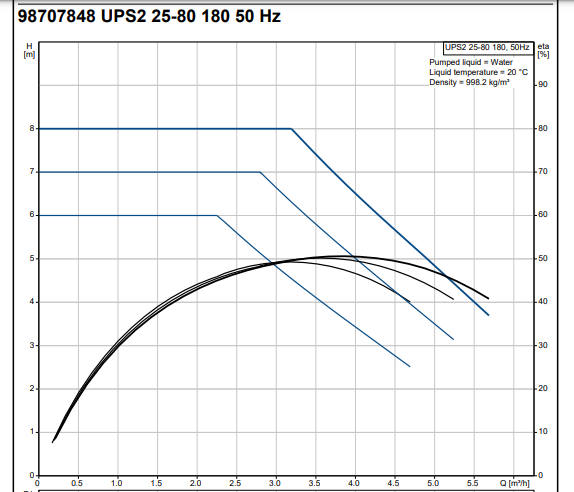
-
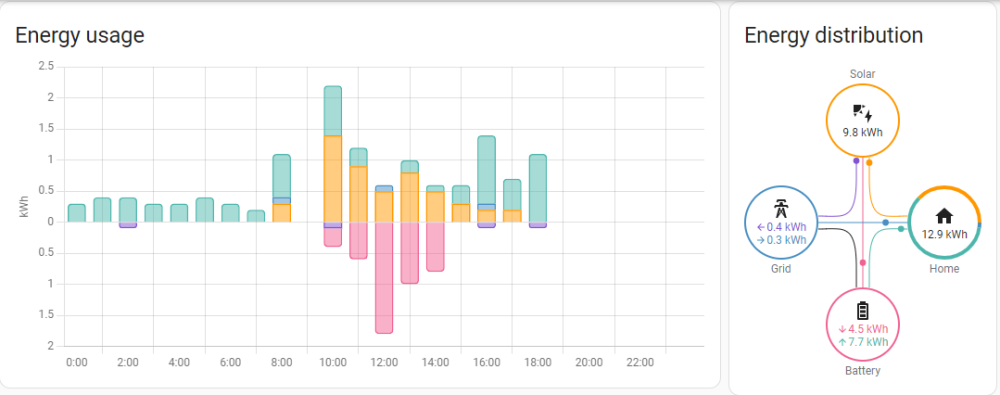
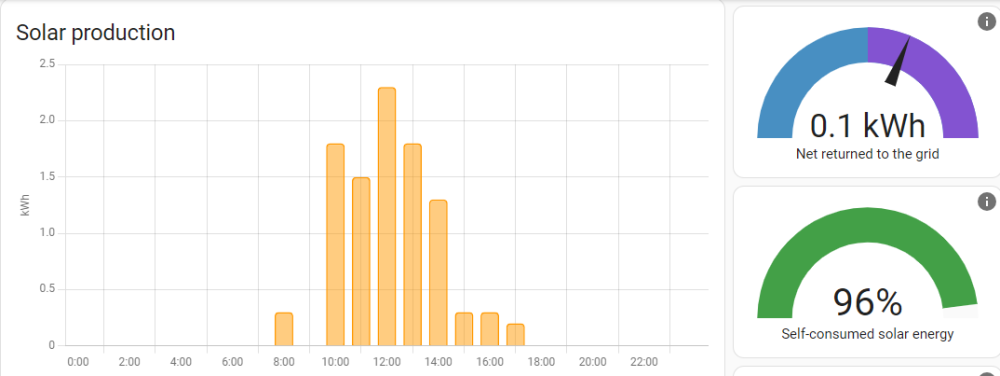
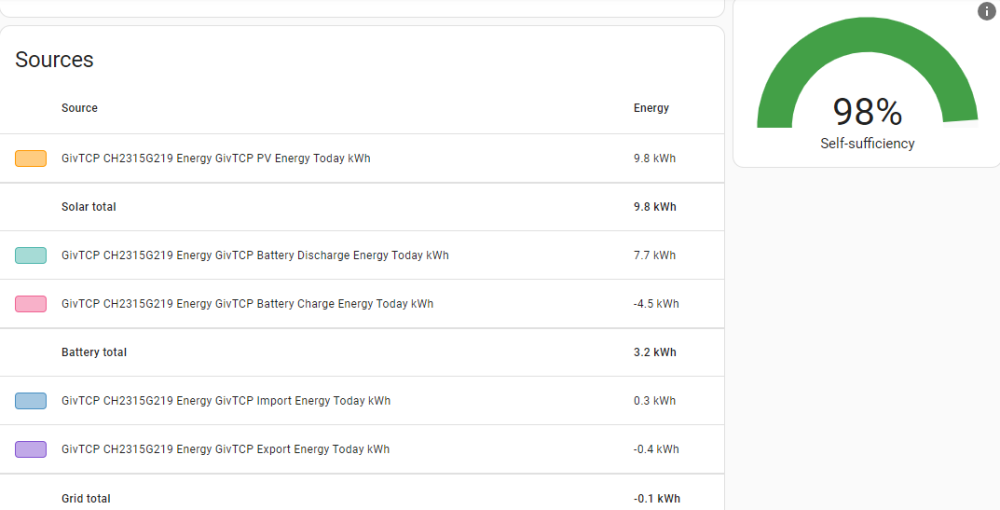
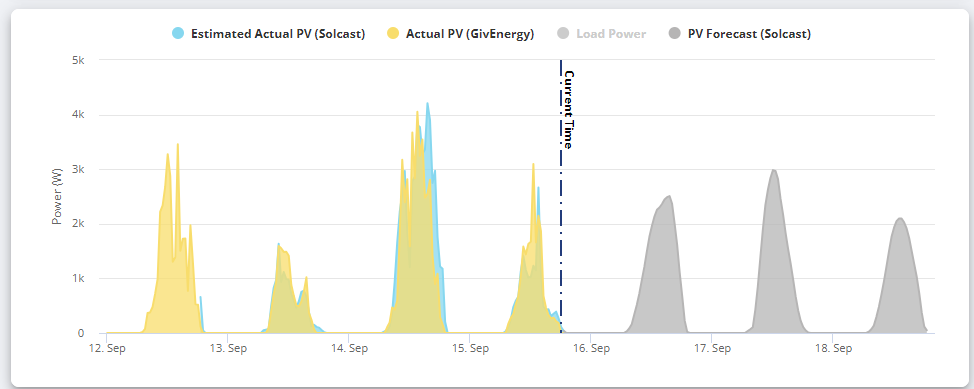
So a small update and stats Have now added the battery inverter to home assistant. The main reason that I got home assistant was to automate the charging on cheap rate, but only charge by the amount required, based on how much PV generation is likely the next day. GivTCP is the app running on Home Assistant, this connects to GivEnergy Inverter via an API, it also looks up the solar forecast from Solcast - another API. Dont get E7 for a couple of weeks, so running generated solar only. Have updated the Home assistant energy page, which looks like this, this is todays stats On the GivEnergy Cloud, there is the same data, but the forecast data is also represented. Fine tuning the Solcast page for my array you make small changes to angle and direction to fine tune the forecast compared to actual, but its not too bad from the looks of it.
-
We had both addresses, no issues.
-
Secondary circulation loop, if you just want to get the shower hotter quicker. No need to add more energy to the system.






