


JohnMo
-
Posts
13299 -
Joined
-
Last visited
-
Days Won
200
Everything posted by JohnMo
-
What are the rooms on the sketch? What is your floor buildup? What's your heat source? Don't be so idle, read up.
-
This what we did but we used posi rafters, the ridge bean is something like 450 X 200mm. Ridge beam is about 16m long in two parts


-

Wet underfloor heating advice for extension and existing area
JohnMo replied to dave2612's topic in Underfloor Heating
Not really, just that you have separate loops confined to each area. Not much a fan of zones. That's them wanting to sell product, not what's correct for your wallet. Physics doesn't change, conduction heat flow will always try to move from a warm area to one at lower temperature. So unless you restrict that with insulation, the heat will flow downwards more than upwards. The issue is with different U values, due to different amounts of heat flow downwards, you can need very different flow temperatures to heat the different areas to similar temperatures. -
Wet underfloor heating advice for extension and existing area
JohnMo replied to dave2612's topic in Underfloor Heating
Main thing I can think of is make sure the loops are confined to a different floor buildup. So kitchen has loops that stay in the kitchen and don't overlap into green or blue area. Reason, the heating properties will be different, so you can fine tune each area with adjusting the flow to those loops. The other thing is insulation - more is better, you need a finished U value of 0.15 or better. If not running costs will be high and you would be better sticking with radiators, if you want something smaller than a normal radiator fan assisted are pretty small with a good output. -
https://www.google.co.uk/search?q=willis+heater+site%3Aforum.buildhub.org.uk&sca_esv=572136157&rlz=1C2CHZL_enGB844GB845&biw=1242&bih=563&sxsrf=AM9HkKkwS3wjGxZxY7DJLcp8_8YKJh4pBw%3A1696924337356&ei=sQIlZdOXFbOkhbIPlbWqmAg&ved=0ahUKEwiTtNri_-qBAxUzUkEAHZWaCoMQ4dUDCBA&uact=5&oq=willis+heater+site%3Aforum.buildhub.org.uk&gs_lp=Egxnd3Mtd2l6LXNlcnAiKHdpbGxpcyBoZWF0ZXIgc2l0ZTpmb3J1bS5idWlsZGh1Yi5vcmcudWtIxS9QAFgAcAB4AJABAJgBeKABeKoBAzAuMbgBA8gBAPgBAeIDBBgAIEGIBgE&sclient=gws-wiz-serp Simple google search above First way cheaper Willis heater I found https://heatingpartswarehouse.co.uk/product/willis-external-immersion-heater/?gclid=Cj0KCQjw7JOpBhCfARIsAL3bobedYz1QFUbkozrSylmP02r3thJ4jJSusqxJSLagpJPn2lzHEGojbZ4aAi3OEALw_wcB
-
Eurocell profile: Can someone interpret this u-value calculation
JohnMo replied to MoDo's topic in Windows & Glazing
Last page bottom left just above the black section where it says 3 A, there is a box saying U window. That is the overall U value of the window, either as plain glass or different window bars options. -
Plenty of threads on Willis heater - basically the same as you have linked too but less than half the price.
-
Decking without footings - bad idea?
JohnMo replied to MarkH's topic in Landscaping, Decking & Patios
But you would always loose in court if it did happen. Glass balustrade, safe but you keep the view! -
A pretty good rule of thumb. Passivhaus heating specs are designed around around heating via the MVHR system. The 10W per m2 value, specified for the max heating requirement, is the maximum value of heat transfer you can provide to the house when the the MVHR is providing 0.3 ACH. Any more than that the air smells burnt. So if you want to provide 60W per m2, you will need a minimum air flow of 6 x 0.3 or 1.8 ACH, based on your house volume. So 93m2 X 2.4 X 1.8, so 400m3/h. If you want to provide 10kW you are looking at the best part of 800m3/h or around 3.6 ACH. That's a lot of air blowing around.
-
Opinions on this MVHR/AC combo
JohnMo replied to yuumei's topic in Mechanical Ventilation with Heat Recovery (MVHR)
If you do, really read the spec, especially cooling effect v flow rate. -
Heat battery for just underfloor heating?
JohnMo replied to Tilbert's topic in Energy Efficient & Sustainable Design Concepts
To many variables really. Buffer no buffer, radiators or UFH, insulation levels, running regime, many zones or one zone, outside air temperature, solar PV and if so how much, what angle it's at, also DHW usage patterns and cylinder size, all have a big impact on running cost. -
Get an as designed rating done, then you will have no nasty shocks. And can reassess choices if needed.
-
Airflow Airflex or Zehnder Comfotube?
JohnMo replied to Jambutty's topic in Mechanical Ventilation with Heat Recovery (MVHR)
Epicair -
MVHR ~ extract from bedrooms??
JohnMo replied to Cognis0's topic in Mechanical Ventilation with Heat Recovery (MVHR)
Sounds a little like you are trying to reinvent the wheel, when nothing wrong with the one we have. -
Airflow Airflex or Zehnder Comfotube?
JohnMo replied to Jambutty's topic in Mechanical Ventilation with Heat Recovery (MVHR)
I used ubbink 90mm and all their fittings, no issues -
To add to what @ProDave says, the first heat cycle may take quite a bit more energy than subsequent ones, as you need to heat your floor more the first cycle to get it up to temperature. My heating went on on Saturday, I too have had steady 7 degs and pouring rain. Up to 12 degs today!
-
Your ceiling of the garage should be well insulated, any additional insulation here is money well spent. Having UFH in the garage is plain (sorry to be blunt) daft. You may as well through £2 in the bin each time you walk past it. Any heat added would just heat the ground - not the garage space.
-
Easy way around that (if you ae concerned) is to have a pipe stat, that breaks the pump supply (normally closed) and if the temp goes to say 50 the stat contacts break to trip the pump
-
MVHR ~ extract from bedrooms??
JohnMo replied to Cognis0's topic in Mechanical Ventilation with Heat Recovery (MVHR)
For MVHR to work you need a flow path for supply and extract. Your wet rooms will generate lots of condensation, if you pull air out of the bedrooms that air could be pulled out of the wet room towards the bedroom. That's the main reason you supply dry rooms and extract from wet. Flow rates from MVHR are such that they are rubbish at moving heat from A to B. -
Simple answer is they all mix flow and I tried a few before I dumped them all and now don't have a mixer. Flow out of ASHP equals flow to and through manifold.
-
I would check for a very small leak in the shop WC or under the sink in the lobby first.
-
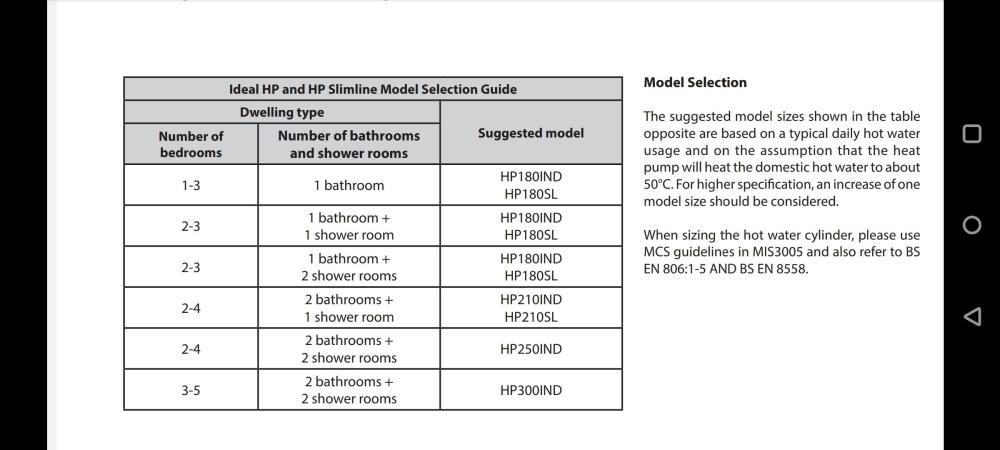
Look at specific heat pump cylinders, if it doesn't state the coil size move on. Ideal cylinders are made by Gledhill, but sold considerably cheaper. 3m2 coil Telford heat pump cylinder 3.3m2 coil. Sizing guide for heat pump cylinders
-
Get a cylinder with a heat pump coil about 3m2. And size the cylinder appropriately. All cylinders are pretty much equal, just capacity difference and coil sizes.
-
Assuming at least one wall is outside, check the ground level outside - is it at least 150mm below the inside floor level? If not it could be outside ground moisture being pulled in to the house.
-
I would move away from using small spot lights and use much bigger brighter ones, and way fewer lights. For example our kitchen diner area is like yours, an L shape (we don't have the sitting area you have), but we have 8 lights in total (instead of your 13), the lights are flush fit 150mm dia. The kitchen is very bright with the lights on.




