


JohnMo
-
Posts
13306 -
Joined
-
Last visited
-
Days Won
200
Everything posted by JohnMo
-
But those are not a just a generic statement in a quote as below Hence raising the question or concern.
-
It seems to say 5cfm at 90psi.
-
Looking for recommendations After a new air compressor for my garage (man cave, not commercial). Needs to be ok for air tools, not make a racket, single phase, budget? - not break the bank My last air compressor was like this one https://www.halfords.com/motoring/tools/garage-workshop/compressors/sip-v300%2F100-vertical-compressor-675810.html?cm_mmc=Google+PLA-_-Motoring>Tools>Garage+Workshop>Compressors-_-Motoring>Tools>Garage+Workshop>Compressors-_-675810&gclsrc=aw.ds&&_$ja=tsid:|cid:18241192209|agid:|tid:|crid:|nw:x|rnd:2205970339728796520|dvc:m|adp:|mt:|loc:1007327&gad_source=1&gclid=Cj0KCQiAlsy5BhDeARIsABRc6Zvtp8DwvKw1falhYtSayVdUQk7qLs9Gt9tVzKyRmGHOUuvpOgQeuicaAqMyEALw_wcB But wasn't the best, lasted about 5 years before giving up, seemed to be poor driving an impact driver, on anything more than wheel nuts. Any ideas or recommendations?
-
Before answering the questions what boiler do have? Make and model? Also how many thermostats are you installing 1 or lots of them?
-
Or would that be return temp? If so the flow could be circa 80 degs?
-
Couple observations You have a combi boiler, so that will have a recirculation pump, there is zero protection for that pump. It needs a min flow valve or connecting via a close coupled tee. Would question the need for the pump and mixer on the manifold at all, it's doing nothing. Your boiler has a pump and temperature control, it could be direct connected. Run on either weather compensation or fixed flow temp and a thermostat switching the UFH on or off. Basically as set up currently the flow through the system is reversed. It's a bodge. The pump and mixer can go either end of the manifold so that's not an issue, it just needs connecting the current way about. Or as above delete it. Also missing is isolation valves between pump/mixer and manifold. To fix it either the pump mixer assembly needs to set up correctly or delete it.
-
E7 cylinder costs about 13p per kWh to heat during E7 period. To replace cylinder with a new one will not make it more efficient. Heating on demand without E7 will be closer to 25p kWh, with E7 30p. Unvented E7, would give decent shower performance without the pump. Look on gumtree, Facebook marketplace they come up often for cheap money.
-
Electric combi - they are so expensive to run Really what's wrong with what you have? The heat pump you refer to is a fixed outlet temperature, so puts out the same temperature for DHW cylinder heating and central heating, it needs a cylinder and would need to be operated as a single zone fully open heating system if you don't install a buffer. Make sure you have a good read up of the manual before you decide, so you now what you are getting and it's limitations. You will need to check it's MCS certified?
-
That's nice for you. Hope you aren't on a meter then. And have a BIG cylinder. Have a suitably rated drainage system And it doesn't comply with building regs.
-
Do you really need it for any domestic property unless your distance from mains to stop cock is about a mile or two.
-
But don't triple tap on 9
-
Our garden room is on sand base - slabs first (cement bedding), wooden perimeter frame 90mm thick (2x 8x2 timber) and 200mm deep. Filled with 50mm EPS, DPM, 150mm EPS, Log building above fully insulated. Floor OSB in 2 layers glued and screwed together floating.
-

SIP wall thickness: diminishing returns?
JohnMo replied to joshwk's topic in Structural Insulated Panels (SIPs)
Pretty much the same materials use by me also. We used 90mm semi flexible, as you only need a single run of it to most rooms. Then all you need to add is the plenum/manifold. No room cross talk to worry about, a branch system need attenuation between rooms. Semi flexible is just so easy to install, the shopping list is pretty simple also - why would you bother going rigid? -
You don't, our planning was completely by the previous owner of the plot and stayed in their name. The VAT people will need to see the land registry entry and sale details in your name. That's how they deal with it. Ring them up to make sure it's ok, but was ok for us last year.
-
could i use my existing UDHWC with proposed heat pump?
JohnMo replied to Gordo's topic in Air Source Heat Pumps (ASHP)
A heat pump cylinder is around the 32kW rating in the same conditions. So 50% or so bigger. -
Considerations of gently sloping site
JohnMo replied to Owain1602's topic in New House & Self Build Design
We sculpted out a hill quite a bit more extreme than yours. So anything is possible. Formed out a platform for the house to sit on, moving many thousands of tonnes, but took nothing away from site Retaining walls were done with gabions near the house, and wooden strainers elsewhere (8" wooden posts) A before and after



-
Vaillant ASHP Subpar CoP Investigation Help.
JohnMo replied to suspicious_squirrel's topic in Air Source Heat Pumps (ASHP)
You may benefit from running DHW on economy /silent mode, which ever gets the running the lowest output. The lower the output, the longer the heating time. This in turn means lower flow temp for longer and gets better CoP. Would strongly suspect your heat loss is about 1/3 of that or less. -
Scaffolding rules are quite strict, doesn't really make much difference if you are domestic or a multi national company. Read up on the rules, make your own call. You (or the main contractor) carry the risk if someone gets injured.
-
Vaillant ASHP Subpar CoP Investigation Help.
JohnMo replied to suspicious_squirrel's topic in Air Source Heat Pumps (ASHP)
Put your cylinder on a timed mode, heat once per day extend to twice if you are running out of water. Do you need legionella? Do a risk assessment, unless you have a massive cylinder and very little hot water usage, keep water below 45 degs or are old and have medical issues, generally not needed. Couple things I have seen while monitoring. I can get a CoP while running of around 5 to 6, but with long off periods this can drop to about 3 to 4 over the whole day. To get a good CoP you need the heat pump ticking away all the time or cycles of about 10 mins on, 10 mins off. The better insulated the property the harder it becomes to get a great CoP, leaky houses do best it seems. We are running WC last run has just finished and it was 20 mins long, previous run was 3 hrs ago and it 6 degs outside. Run time got a CoP of 5.6, but overall the CoP between the two runs is 3.8. standby cost starting to influence running costs -
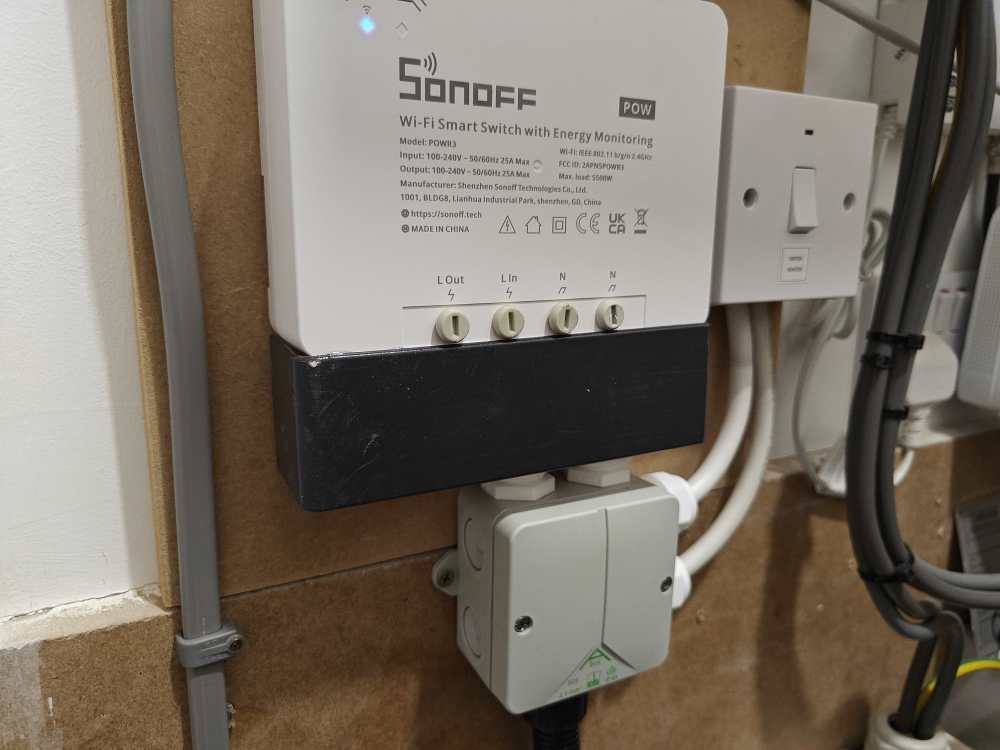
Should all be sorted now. Mechanical protection added to front and sides of the brown and blue tail. Terminal screw points blocked off with removable plugs. Solution keeps plenty of cooling effect around the relay. Cupboard used as an MVHR through space to plant/storage room above which has an MVHR extract
-
Scotland - Ban on stoves in new build houses lifted.
JohnMo replied to ProDave's topic in Stoves, Fires & Fireplaces
Have battery and manual changeover to manual start petrol generator. This keeps the water pump online, heating ect. We had multiple power outages over the last 12 months, generally in the 4 to 6 hours region. Once half way through cooking our tea. Generator on, hot food finished cooking no drama. -
Generally near consumer unit, as they use a CT clamp on the incoming main power from the meter to detect electricity flow direction. The inverter (unless G99 with CT clamp conneected) has no idea where the electric goes. Diverter would normally go in-between the CU and the isolation switch for the immersion. If you get paid for export, why bother heating water, when a heat pump can heat it at a cop of 3 to 3.5. Just take the export money. Some diverters are silly money.
-
We had a house like that in the early 2000s, it was build late 70s. Not sure how you comply with any regs. Not sure it's a cheap solution, wood being way more expensive than plasterboard.
-
That's one of the mounting methods. They supply other fixings Will get the mechanical protection sorted. They are quite deep down, but again will get that issue fixed at the same time. Job for tomorrow.
-
What rubbish. You don't have to use any certified materials, you just have to meet the specified standard. Sometimes it's easier to use certified products, like MVHR, but it's not manditory.




