


JohnMo
-
Posts
12469 -
Joined
-
Last visited
-
Days Won
179
Everything posted by JohnMo
-
Gaps make the insulation a waste of time, bit like a cup with a hole in it. You will be amazed, you have to knock the insulation in place because you have made it a tight fit, next time you look you will see gaps. Taping is belts and braces, if screed does get under the poly sheet and into a gap the whole floor insulation can lift. End result, screed under insulation.
-

Is a dormer possible with thin attic party wall?
JohnMo replied to timber's topic in Lofts, Dormers & Loft Conversions
Aren't there rules about party walls and noise mitigation that requires a load of insulation adding to your side of the cinder blocks? Don't you have plans? Wouldn't you need planning for a loft conversion and to add a dormer? -
You don't mention heat pump size? How long are the primary pipes to the diverter? How far to your cylinder from diverter, what size pipes? If you are starting a scratch install of a heat pump, you really need to doing at as low a pressure drop as possible. 22mm primary pipes - do you have a buffer? You need to give us a lot more details.
-
More insulation the better. Go PIR for all of it at 150mm. So Celotex or similar. Tape all joints, foam all gaps, add a 25mm minimum upstand all round. Prior to screed a thin polythene membrane on top to keep the cement in the screed away from the aluminium on the insulation.
-
MVHR Design: Feedback & Mythbusting
JohnMo replied to joshwk's topic in Mechanical Ventilation with Heat Recovery (MVHR)
Just to provide a bit more detail -MEV and dMEV require trickle vents to be open or self modulating to provide sufficient cross flow ventilation. Testing was completed by BRE and many councils and shows without the trickle vents open unhealthy CO2 concentrations will existing bedrooms etc. This may not be the case with intermittent fans. -
UVC will provide a shower experience way better than a normal combi boiler. I have had both in the same house. Water gets to the shower quicker from opening the tap, flow rate is higher. If you have a storage combi boiler the experience is similar. You do not need a pump. An UVC should be delivering water at 3bar. A vented cylinder will be around 0.5bar depends entirely on height of the overhead tank, that's why they need a pump for a decent shower experience.
-
MVHR Design: Feedback & Mythbusting
JohnMo replied to joshwk's topic in Mechanical Ventilation with Heat Recovery (MVHR)
Air tightness is all about details. Builders will do what is asked if them in general. If airtight details are not specified, you will not get them. This includes how window and doors are installed and then sealed in place. Are joints between sip of panels taped etc... Be careful with aluminium windows make sure you get the UW value from the supplier. Some are absolutely rubbish. Scottish building reg mandate MVHR is airtightness is 3 or better, MEV or dMEV for above 3 to 5, what ever you want after that because it's drafty. There have been studies that looked at it also they concluded similar. I binned all my references when I changed my phone -
MVHR Design: Feedback & Mythbusting
JohnMo replied to joshwk's topic in Mechanical Ventilation with Heat Recovery (MVHR)
Not best location, keep inside the heated envelope. You also need good access to service. It's pretty much mandatory to sound insulate all internal walls. Mine is mounted on a stud wall in a cupboard between two bedrooms. Did two layers of 18mm marine ply to mount it on. You cannot hear it at all. It's not an ideal location next to bedrooms, MVHR is only one noise source. Your architect should be discussing with you and it should be clearly stated on the house specification and drawing. If you are not going airtight better than 3. Don't waste a load of money on MVHR, do MEV or dMEV with demand activation controls. MVHR requires airtightness or it's just another draft, that costs quite a bit to run, for a negative impact on heating costs - not a positive one. As mentioned all this should be sorted at and defined as part of the design stage. Adding and changing stuff, without a sound strategy, is a good way to waste lots of money later. -
I would keep it simple, just run 28mm Hep2O, then without working anything out it will be fine. You also have to allow for the pressure drop through the UFH system as well.
-
Insulated flow & return pipe recommendations
JohnMo replied to Post and beam's topic in Air Source Heat Pumps (ASHP)
No If you are doing 14 l/min and the limit is close to 32 l/min, you have no issues. m/S is velocity l/min is a volume flow - so very different units. -
It's about not depressurisation of the house and carbon monoxide spilling in to the house. It a health and safety issue. An unbalanced MVHR system is just a consequence and really doesn't matter. Not really about what I liked, it's about what you like and suits your home, just make sure primary and secondary are supplied via the inlet duct. Many makes and models don't. I went HETAS, registered for ease of compliance. They also sweep the flue and service annually to keep the right side of my home insurance.
-
Insulated flow & return pipe recommendations
JohnMo replied to Post and beam's topic in Air Source Heat Pumps (ASHP)
Flexible 110mm duct isn't too bad, still big but better. I just did a shallow U shape, so I can vertical up the walls and a 90 Deg elbow to take me through the wall. -
Insulated flow & return pipe recommendations
JohnMo replied to Post and beam's topic in Air Source Heat Pumps (ASHP)
Wasn't convinced the commercial twin pipe was that good, that's why I did my own, each pipe in its own 110mm duct with 25mm wall thickness insulation all around. Also penny's in the pound cost wise. So only has approx 15mm insulation horizontally. Although there is quite a bit vertical, think the losses would just go sideways.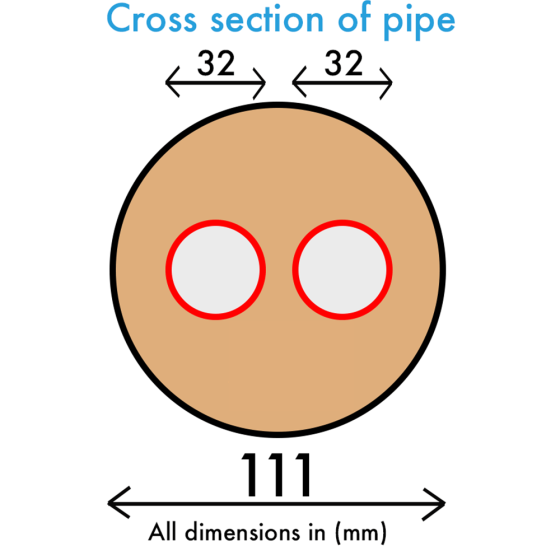
-
Insulated flow & return pipe recommendations
JohnMo replied to Post and beam's topic in Air Source Heat Pumps (ASHP)
I am using 22mm plastic pipe from my UFH manifold (location of the diverter valve) to cylinder via CCT and additional pump. The pump on the ASHP delivers 1.5m³/HR doing hot water. From measuring flow temp temps, even with CCT pump at full speed I cannot get the same volume through the 22mm, as the ASHP delivers via 28mm. 28mm is circa 16 to 18m each way, the 22mm is about 10m each way. Just use 28mm like a sensible person would. Your pumping losses are going to more than your heat losses. -
Insulated flow & return pipe recommendations
JohnMo replied to Post and beam's topic in Air Source Heat Pumps (ASHP)
Page 86 of the attached manual, top of second column of text. Hep2o_Parts_Users_Guide_Australia_2018.pdf -
That is more than my whole DIY retrofit cost.
-
Read up on Buildhub, not the best reputation. I really would do a heat pump cylinder 3m² coil or bigger. CoP of 3.5 should be a regular. Pre plumbed is a waste of money. Do it your self, get a Panasonic monobloc. Slimline cylinder. No need to solder, use either Hep2O barrier pipe or copper or a mix. Use Tectite push fit fittings for the copper and Hep2O for plastic and copper to plastic. Do all as a single zone, no buffer needed. So heat pump to diverter valve. Diverter to top of cylinder or heating system, the two returns tee together back to heat pump. Power to heat pump wiring between ASHP and controller.
-
Dimensional Tolerance for Setting Out of Electrical Outlets
JohnMo replied to PLK-UK's topic in Electrics - Other
Nothing has zero tolerance. Building regs has a minimum and maximum height those are the tolerances. So no less than or no more than. Unless a client supplied drawing states something about a tolerance between fittings heights in different room? -
Slight correction - it's not an unvented cylinder as such, as it contains heating water and uses a coil to produce hot domestic water. It is more closely related to a thermal store. So does not need to comply with G3 regulations, where as an UVC has to comply with G3. Also the OSO cylinders although good, don't have the biggest coil, which put me off. Also the increased price for vacuum insulation is very high.
-
Has any used Paslode Nail Screws (can't get Clad-Tite Screws)
JohnMo replied to MortarThePoint's topic in General Joinery
Like it - a man with a proper plan. -
Yep I walked away from a kit supplier for a lot less part way through the design. Open and honest is all you can hope for, anything less...
-
I had never heard of them until they kept getting mentioned on here. Wife and decided where we wanted light switches and lights, I marked on a plan, electric contractor quoted and installed. If you are using a plumber, mark on drawing where the cylinder and heat pump goes, put UFH manifold in same location. UFH install at 100mm centres in bathrooms, 150 to 200mm elsewhere. Operate single zone. If you want cooling consider installing fan coils in bedrooms, plumber will sort out pipe size and routes. M&E Consultant will tell you less than above and charge you £10k for it.
-
Keep as simple as possible. Blending valve, buffer and all additional pumps delete. Run direct from heat pump circulation pump. Tee rads in upstream of the UFH manifold and the return after the manifold. Run all as a single zone. Have radiator valves to control bedroom temps. Upgrade rads if needed. Run Weather Compensation (WC). Set the flow rates for the UFH at the manifold and then heat pump circulation pump, if not a modulating circulation pump, set the speed to get the correct flow through the radiators. If modulating circulation pump it will sort itself. I have a similar set up, getting a CoP for heating at 9 degrees outside of just under 6. Mine system consists of an ASHP, fan coil, UFH manifold, 3 port diverter valve and a cylinder.
-
Has any used Paslode Nail Screws (can't get Clad-Tite Screws)
JohnMo replied to MortarThePoint's topic in General Joinery
Make sure you use stainless steel fixings or black streaks will result. I just used stainless ring shank nails, any particular reason for screws? -
When the UFH flow Temp is <35C, dhw?
JohnMo replied to Post and beam's topic in Air Source Heat Pumps (ASHP)
Technology reduced for a backward UK market - suitably amplified by the OP plumber thinking he needs S or Y plan for a heat pump.

