


JohnMo
-
Posts
13292 -
Joined
-
Last visited
-
Days Won
200
Everything posted by JohnMo
-

Europe’s heatwave is the hottest and most humid ever
JohnMo replied to SteamyTea's topic in Boffin's Corner
Must be a couple of months since this conversation happened, may a couple of weeks - Sorry another boring is climate change real or fake thread. Fact, politics moves the truth to fit their own agenda, same as others on social media, most wouldn't know fact from fiction and say black was white if it suits the narrative they want. Another simple fact, glaciers get smaller at an ever increasing rate, so it not getting colder. Another is CO2 concentrations in the atmosphere pretty much starts increasing at the start of the industrial revolution and has kept increasing since then. Prior to this moment in time, CO2 was at a relatively consistent level - so made made or natural, I vote man made. So not sure I buy your view of the world. -
Sounds like a disaster ready to happen. You can't manage a project like that, you are working when all the trades are working. Who is managing what? My advice is get someone to do the management. That doesn't need to a project manager, it could be the architect. You need someone that understands the process and understands how to engage the right people at the right time with no gaps in responsibility. We did a renovation project that way and everything worked well basically a principal contractor responsible for delivery of the project, architect did the contract tenders, held progress meetings, managed timescales, managed the detailed quotes for 3rd party stuff like windows, heating, electrics etc. The house build I did myself working full time at site. You either take time off yourself or you get someone else to do it (from start to finish) and you do your day job. Short cuts, expensive, take longer and cause stress and general a poor overall outcome.
-
Never ask a question you don't want the answer to. If they had issues you would be the first to know and know already.
-
If it lasts 10 years, why not use the same again - Hammerite?
-
Heat Pump Running Cost Poor Reporting And Misinformation
JohnMo replied to PhilT's topic in Air Source Heat Pumps (ASHP)
Thing often missed when comparing gas to heat pumps, is the gas standing charge goes without gas CH (maybe a hob change also). -
Sound proofing portion walls.
JohnMo replied to Russell griffiths's topic in General Self Build & DIY Discussion
Holding gravel in place while adding the plasterboard may be tricky. 🙌 -
Europe’s heatwave is the hottest and most humid ever
JohnMo replied to SteamyTea's topic in Boffin's Corner
We peaked at 26.4°C, in NE Scotland - different world temperature wise. -
Sound proofing portion walls.
JohnMo replied to Russell griffiths's topic in General Self Build & DIY Discussion
With the empty void even with 2x plasterboard each side, its still a drum. Air is a great way to carry noise. -
Sound proofing portion walls.
JohnMo replied to Russell griffiths's topic in General Self Build & DIY Discussion
90mm studs 50mm dense mineral wool I used rock wool Flexi - zero issues and normal 12.5mm plasterboard on each side. -
I bought a couple of these, the accuracy is pretty pants, was running around 4 degs dT. My return was reading higher than the flow, so consigned to the useless parts bin.
-
Don't. We are about 20m as the crow flies and it's 15mm Hep2O. Zero flow issues and gets hot water quick enough. 22mm the delay getting hot water will drive you made. So how are you calculating this? It should be balanced feed either take from the cold outlet on the cylinder combination valve or add an additional pressure regulator valve to the cold inlet to the house. If you do the additional pressure control valve you need to add a check valve to the DHW outlet. Cylinder size upsize and don't heat as hot. Less chance of scalding anyone. There are two of us and we have 210L, we heat to 53 degs and we can get 3x showers out of it if we have guests
-
On a radial system set you longest run first, that is your index run. Not sure how your MVHR unit adjusts fan speed, but you really want your index run with a fully open terminal and flowing the correct amount by adjusting fan speed. Then set the others ideally work from the next longest and finish with the shortest, adjusting terminals. Then check them all again and do any fine tuning needed.
-
Not really all DIY, 2x 500W panels cost £60 each, inverter £150 and an isolation switch. Wood not that expensive and brackets.
-
The system are you running semi flexible ducts via a plenum box or rigid branch system?
-
Forgot about that, mkII version would get slightly closer together angle plates in the roof.
-
A quick image search brought up this - import duty and shipping to pay so not sure if the final price - but looks a different scale of price, many other came up also

-
But should be quite low, only taken from 90% to 50% If it fails it because I always use, it's doing its thing 24/7 anyway as it's AC coupled battery system. The Axle VPP is none of those things. I was replying directly to a comment made by @scottishjohn on the scheme. It's a scheme to boost grid when available power can't keep up with demand, so pays £1/kWh plus you also get 12p from Octopus, so it pays a real £1.12 per kWh. It's a scheme that sits above the normal maths you should do, prior to any PV or battery installation. My normal import/export were costed and installed a long time prior to the Axle scheme coming along and it only helps boost the value of the battery.
-
As a follow up we have now had 4 export events over a 4 week and a couple of days period. Overall with Axle and Octopus both paying me to export it added £20 to the bank account - not much but averaging over the year that's £240, for nothing, plus the £25 intro fee and they pay the GivEnergy Premium fee as well which is another £60 a year. So year one equivalent income £335. In winter I may have to top the battery up during cheap periods, but in summer it's all been PV generated electric.
-
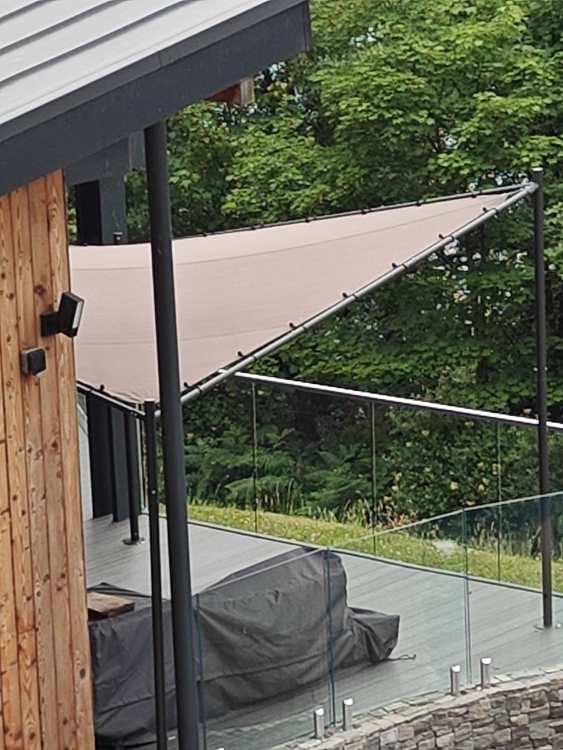
We are very exposed location and if high winds expected I remove the sail. Off the shelf item from local garden centre. Thin wall tubes rock about in the wind. Have thought about changing the steel work for some thicker walled and more robust. How about a strip of double glass PV panels on a free standing wooden frame to provide shade and electricity? Double glass look the same from top and bottom (black glass). Add a flat narrow walkway near house for doing your gutters?
-
We have a sail thing which covers a seating area outside. But it does provide shade to a set of french doors also. Whole sun exposed front of house has a large roof overhang, depending on time of year, time of day is quite good other times not so good.
-
Think the mega wave stuff is straight out of China with a new badge. Would do an image search and see what comes up.
-
Our last house had them but installed inside the window. Didn't use them much but they transform the way the house feels. But ours were built in to the window frame 200 years ago. Having them inside has a number of advantages No wind rattling them. Or trying to pull them off the wall if not fully restrained. Friction of the hinge is enough to hold them in any position you want when inside. They keep heat out and in if you want. Safety, if you are trying to get out if the building on fire you can, on the outside not sure you could. You can add a layer insulation to the inside shutter and make it thermally ace. Not sure I understand that point
-
For the cost of manifolds, swop the manifolds for proper ones. These are the first ones I found many other options out there, they just screw together to make as many outlets as you need. Others in the site https://www.bes.co.uk/riifo-plumbing-manifold-3-4-x-1-2-valved-outlets-4-port-red-levers-27474/
-
The biggest advantage of a manifold is the isolation valves in my opinion. They allow parts of the system to taken offline while the rest stays active. No a no valve manifold is a missed opportunity. Just look at Screwfix they offer a couple of different options.
-
You'll be digging deep in to the pockets. Have you considered a ducted unit or is that not practical?




