


JohnMo
-
Posts
13296 -
Joined
-
Last visited
-
Days Won
200
Everything posted by JohnMo
-
External blinds are best, internal blinds ok. UFH run in cooling mode. Fan coils.
-
The 4G ones apparently have just been issued, in the last week or so. Believe a few have been installed around us - near Elgin. Octopus are still playing about, insisting they attempt the smart meter install 3x, before moving to getting a SIM card meter.
- 70 replies
-
- 1
-

-
- utilities
- electric bill
- (and 3 more)
-
I doubt they would really know, they would have no idea if I did 5 miles a day or 500 miles.
-

Ufh manifold, blending valve with ASHP.
JohnMo replied to Russell griffiths's topic in Underfloor Heating
Have you bought these heat pumps? -
1.4 is m³/h·m² . You know the m² figure You need to work out the house volume in m³. Now you have house m² and house m³. Multiple 1.4 by your m² area. You now have the air loss per hour atv 50Pa. Divide your answer by your volume. That should be your ACH at 50Pa
-
Ufh manifold, blending valve with ASHP.
JohnMo replied to Russell griffiths's topic in Underfloor Heating
What are you heating? That 26kW isn't enough? -
Self installed Air Conditioner
JohnMo replied to Annker's topic in Mechanical Ventilation with Heat Recovery (MVHR)
You need to find the R290 versions, these can be self installed, anything else is covered by F-gas rules and CANNOT be self installed. R290 is not a F-gas. Such as https://www.appliancesdirect.co.uk/p/eiq-9wminv/electriq-eiq9wminv-air-conditioner?refsource=apadwords&utm_source=google&utm_medium=cpc&utm_id=22547259545&cq_src=google_ads&cq_cmp=22547259545&cq_con=&cq_term=&cq_med=pla&cq_plac=&cq_net=x&cq_pos=&cq_plt=gp&gad_source=1&gad_campaignid=22550830981&gbraid=0AAAAAD9z1-3QTKHge6o0Ghos-COyYa2ow&gclid=Cj0KCQjwjo7DBhCrARIsACWauSlh7hYyhbBpFfYGkXsuY0rfa8ZEzg2dcAcbQv2hdl2iRtp-u5p6tyUaAo-qEALw_wcB -
I can run the HP at full load during cheap rates (E7 hrs) via a second set point, but if I add hot water in the mix, I cannot get enough energy in the floor when temps start to get close to zero (mostly defrosts limiting ultimate output), so as temperatures drop the heat pump runs longer in the day. I can get to the point by teatime I have a flat battery, then I am using 32p instead of 14p energy. Cosy would give the opportunity to charge again during the day when needed. Then I could just run straight WC and do it all on cheaper rates. Thats interesting
-
Unfortunately I don't have an EV, go and drive type tariffs won't work, unless they don't really ask you to prove EV. I am thinking Cosy maybe a good choice, easy to programme times for charging etc. But an EV tariff is way cheaper
-
UK Power Networks info required for new supply
JohnMo replied to Furnace's topic in General Self Build & DIY Discussion
This is the energy chart for a 6kW heat pump, it's doing cooling but same power is used for heating. Over a 3 minute period it hits 1130W electric draw, then ramps down. Electric is the blue line at the top. So no big energy spikes at all. Our battery doesn't show any spikes either.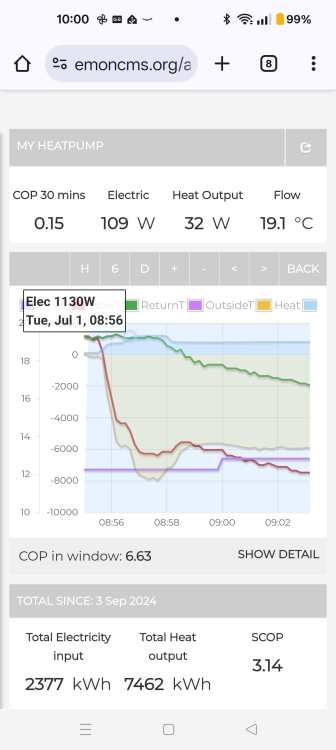
-
Sort of answers, your question! We had a water diviner, water was exactly where he said and depth. It may be worth exploring first. Help decide if your going 150m down or something more cost effective. They should also be able to tell what is feeding into the well of water. For example we have 4 streams underground.
-
True, but you also don't have to pay for metered water or a fixed water rate. For us and our council tax banding, the cost is around £500, which I don't pay as I have private water. The service cost on average is about £150. If I need a new pump, not cheap, but balanced over the years it's not a lot different I suspect. Biggest difference for me is no chlorine in the drinking water. Which is added to water here. I would happily pay extra to have no chlorine taste.
-
Fancoil - Best invention ever no contest!
JohnMo replied to Dave Jones's topic in Air Source Heat Pumps (ASHP)
Our floor area is 192m² and we have a heat demand of 3.5kW, so it's really a huge radiator. We only have about 600m of pipe in the floor, at around 300mm spacing. Generally when you get to low outputs from UFH pipe spacing makes very little difference to flow temperature required, but it does change reaction time. But running low and slow and on all the time reaction time is not really a factor that is important. No, you size the heat pump based on kW required. Flow temp really has a big impact on running costs, with heat pumps the lower the flow the better. -
Fancoil - Best invention ever no contest!
JohnMo replied to Dave Jones's topic in Air Source Heat Pumps (ASHP)
Basics are the colder it is outside the hotter the flow temp you have and vice versa. I find it regulates house well, there are no thermostats used for heating or cooling. Only deviation from that is if I have excess solar PV I have a smart relay set a second set point on the ASHP to add 3 degs to WC curve in heating and remove 1 Deg to cooling. As an example, my WC curve runs from 20 degs outside with a flow temp of 25, then at -9 outside I flow 32.8 degs. Reality is at about 10 degs average outside the cooling goes on. So I run either cooling or heating only. -
Fancoil - Best invention ever no contest!
JohnMo replied to Dave Jones's topic in Air Source Heat Pumps (ASHP)
That is pretty hot for UFH, unless you are a retrofit or batch charging on a smart tariff. Its still pretty hot. I would be running a weather compensation curve. -
Currently have no smart meter that works due to a poor signal, after talking with a smart meter installer I now know how to get a working meter. Will explain for any one in a similar position. Electric supplier has to have 3 unsuccessful smart meter installs. You then request the case is raised with the DCC. 6 weeks later they allow a 4G meter to be installed. Problem fixed. So to my dilemma Have ASHP, GivEnergy 13kWh battery, PV but don't get paid for export. What is the best tariff to be on Standard tariff make no sense with a battery. E7 currently on that, easy to manage, but may not be most cost effective? Cosy, seems easy to manage? Agile, GivEnergy has controls built in, but expects export from what I can tell. Any suggestions or users doing anything different? Should I just pay octopus the £250 to allow export and be paid?
-
Not sure you do know a lot more? Our HP dryer adds almost no heat to the room, a little radiated from the door but not much. 2.5kW is enough to heat the whole house at about -4 degs. Room temp would be about 50 degs if the dryer worked as described up thread.
-
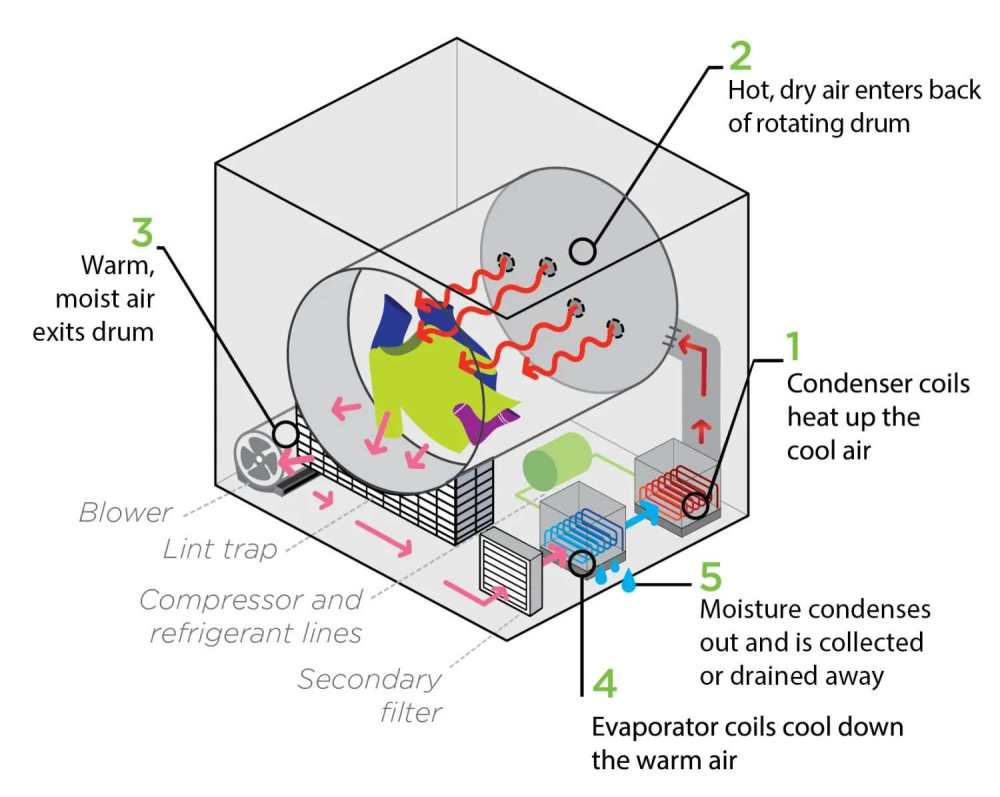
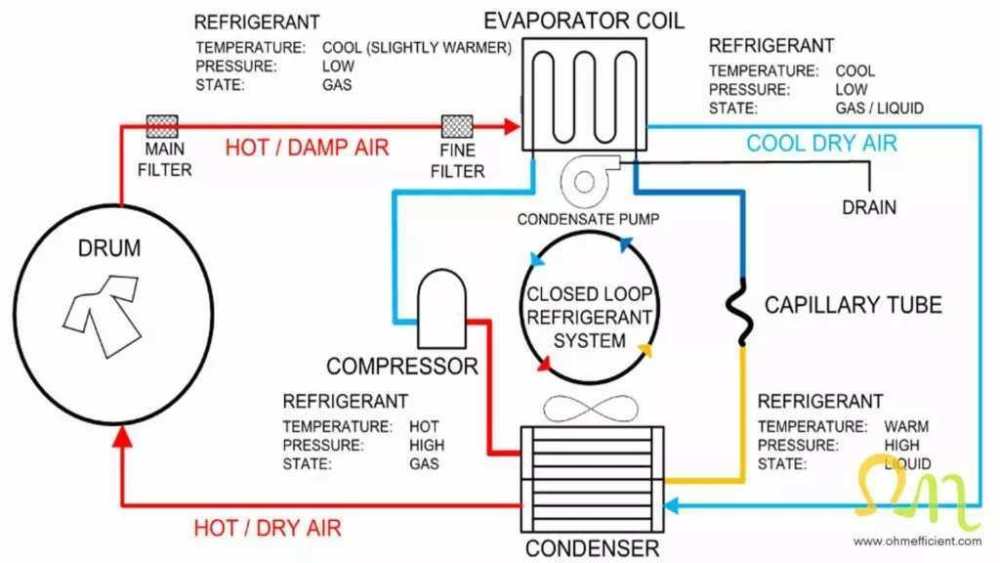
Outside the dryer air isn't used on the cycle at all, once you close the door. Not sure where @jack gets the interaction with room air?
-
Watched the video to the half way point, sorry it's rubbish. He really has no idea how the heat pump side works. Testing with a dry drum is nonsense. The moist air condensing will be playing a major role.
-
Sorry to throw a spanner in the works. A heat pump dryer does not take or give air to the room. It a self contained system. Look here for a simple explanation https://goclean.masscec.com/article/how-heat-pump-clothes-dryers-work/
-
Did mine at Elgin college. It's part of the highland and islands university. I just rang them asked if they did G3 training, they said yes, booked in the next week, nothing else asked.
-
A2A + A2W ASHP or a more powerful A2W ASHP?
JohnMo replied to puntloos's topic in Air Source Heat Pumps (ASHP)
Not answering for @puntloos. I would keep it simple, monobloc ASHP with UFH on ground floor. If a single storey, concider fan coils instead of UFH in bedrooms. Similar for a 2 storey, no UFH upstairs (except wet rooms) but concider fan coils in bedrooms if you will need cooling. Run everything above dew point for cooling at a single flow temp (UFH and fan coils). Run everything same temp for heating (weather compensation). No hydraulic separation no additional pumps all run as a single zone. -
Fancoil - Best invention ever no contest!
JohnMo replied to Dave Jones's topic in Air Source Heat Pumps (ASHP)
Generally no, they are sized the same as radiators in a lot of respects. So during heating the cooler the flow the bigger the radiator or fan coil is going to be. Cooling is the same the warmer the flow the bigger they need to be. A unit with a water flow temp of 7, will be half the size compared to one flowing 14 degs, in rough terms. You need to read the datasheet and size accordingly. But a fan coil is generally a lot smaller than a radiator of the same output. -
Our fully installed costs were Pump was £1500 installed, accumulator, filtration system was £2300. All rated at 40L/min. The borehole 34m deep, drilled and liners installed (mostly steel, due to sand down to 27m), was £5000. All the above includes VAT. So all in cost around £9k.
-
No Condenser dryer, collects water the same as a heat pump one does. A condenser dryer uses an electric heating element, the HP a heat pump. A dryer that needs an outside vent is neither of the above, generally as old as the hills.




