


DevilDamo
-
Posts
1483 -
Joined
-
Last visited
-
Days Won
6
Everything posted by DevilDamo
-
But there are drawings of which the architect, engineer or builder would be able to check and confirm? ?
-

Got planning permission @Graven Hill - now what?
DevilDamo replied to Steve Squires's topic in Introduce Yourself
Oh apologies. Not familiar with the name/site where the majority of others are. Just giving standard commencement advice following grant of Planning. -
Just starting out! Two storey extension
DevilDamo replied to RoseD's topic in House Extensions & Conservatories
Do you have any existing floor plans, even if they are the agents’ plans for when you bought the property? You may be able to find these via Rightmove or Zoopla. Do you have or can you take and upload some photos, which will also help? I’m pretty sure SketchUp designs can be saved into various formats of which are supported here. So just save them as JPG’s or PDF’s. When are you looking to engage an architect/designer? What is your budget, assuming it’ll be in excess of £120k? -
Got planning permission @Graven Hill - now what?
DevilDamo replied to Steve Squires's topic in Introduce Yourself
Just make sure all your pre-commence/development Planning conditions and CIL notices are dealt with prior to starting ? -
Can your architect, engineer or builder answer that?
-
Loft conversion - minimum height 2.2m - why?
DevilDamo replied to puntloos's topic in Lofts, Dormers & Loft Conversions
That document is incorrect and misleading. Assuming you’re referring to Page 3, it states... ”The main thing that any loft professional will be looking for is whether the tallest part of your unconverted loft will be less than 2.2m high by the time a new floor has been fitted and the ceiling has been insulated and plastered. If it’s lower, there won’t be enough headroom to meet planning regulation requirements.” I believe it should read “the tallest part of your converted loft”. Also, the headroom doesn’t have anything to do with ‘planning regulation requirements’ or whatever those are. There is not a minimum ceiling height but only headroom to a stair. Headroom is generally 2m but can be reduced to 1.8m at the edge and 1.9m in the middle. However, those regulations normally apply to loft conversions and not new build lofts. -
Also check to see if the conversion works require Planning approval.
-
New Member with Permitted Development Question
DevilDamo replied to y3mbailey's topic in Introduce Yourself
It means you cannot convert your garage under PD and a formal application would be required to change its use to a habitable room. You have two options... submit a Variation/Removal of Condition application or a Householder application. Whichever type of application you decide to proceed with, the LPA may well want to see that adequate off street parking can be provided for the dwelling following the loss of the garage. If your garage is already considered to be sub-standard, i.e. does not meet the minimum space standards, you could have an argument that its loss would not result in a loss or change to the existing parking arrangements. -
Always a handy link and reference table... https://www.ibstockbrick.co.uk/wp-content/uploads/2015/08/TIS-A2-BRICKWORK-DIMENSIONS-TABLES-STANDARD-BRICK.pdf
-
It may be quicker to just build what you want and deal with any applications retrospectively. You can guarantee any works that are in breach of Planning will soon move up the queue at the Council ?
-
If I’m designing something with standard casement windows, then I work on the premise of 600mm (1-pane), 1200mm (2-pane), 1800mm (3-pane) and 2400mm (4-pane) wide windows. In relation to their heights and working on the basis of 2.4m floor to ceiling heights... 1200mm deep for standard windows and 1050mm deep for those above worktops, i.e. Utility and Kitchen. Also use 1050mm deep for window above W.C.’s. All of those would have head heights 2.1m above DPC.
-
Outbuilding construction drawings quote
DevilDamo replied to oldkettle's topic in General Self Build & DIY Discussion
Assuming the OP would be going down the LDC route, the LPA would asses the size of the outbuilding in context with the existing dwelling at the time of the submission of an application. So it’s always advisable to extend a dwelling prior to applying for a large outbuilding. The only potential issue with this is that LPA’s can look to withdraw PD rights following grant of ‘formal’ Planning. -
Land Registry MapSearch...
DevilDamo replied to Mulberry View's topic in General Self Build & DIY Discussion
Anybody can register an account and view title information. Search for the property here and then follow the on-screen instructions... https://eservices.landregistry.gov.uk/eservices/FindAProperty/view/QuickEnquiryInit.do?_ga=2.205752086.420198860.1605345033-221297155.1605345033 -
Outbuilding construction drawings quote
DevilDamo replied to oldkettle's topic in General Self Build & DIY Discussion
On that last point, have a review of the attached.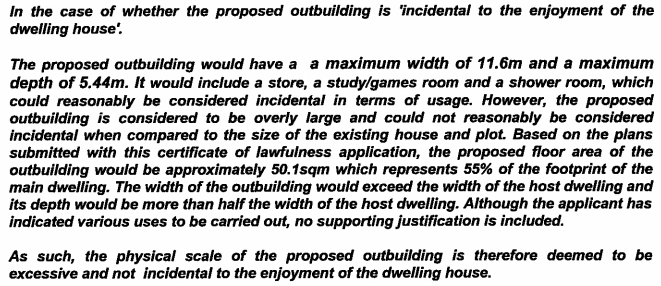
-
Outbuilding construction drawings quote
DevilDamo replied to oldkettle's topic in General Self Build & DIY Discussion
So you can get a pitched roof designed to come under 2.5m on a footprint of 10m x 6m? The PD rules for outbuildings do not include for it to be used as a residential dwelling/annexe, so be careful there. Although under PD there are no specific rules on how big outbuildings can be, their size has to be relative to the existing dwelling. I can't see the LPA agreeing to an outbuilding under PD, which is more than 50% of the floor area of the existing dwelling to be relative/ancillary. -
That may not be as straight forward. Do you have any drawings you can upload here, which we can review? Do you have an architect/designer on board?
-
Not necessarily. However, it’s quite rare to have the option of further extending under PD once you have already extended as it would take you beyond the PD limitations. Where properties have specific protection status, i.e. Green Belt, LPA’s do look to withdraw PD rights once formal Planning has been approved.
-
Outbuilding construction drawings quote
DevilDamo replied to oldkettle's topic in General Self Build & DIY Discussion
Although not directly answering your questions, but I have a few questions... - How close to a boundary is the outbuilding to be? - What is the outbuilding to be used for? - What is the floor area of the existing dwelling? -
A minor comment in relation to the En-suite on the first option. If you are keen on having a 4-piece suite, I’d personally consider turning the bath at 90 degrees so it’s positioned width ways. Have the W.C. next to the bath, the washbasin next to the W.C. and then the shower in the same corner as shown but accessed opposite the En-suite door. Unless there is space to access the shower from the side next to the washbasin. If you don’t mind the En-suite having a 3-piece suite (as the Bathroom is a 4-piece), then have a walk-in shower running width ways on the bottom, W.C. and then the washbasin. The size of the shower will dictate the position of that window, which you could shift up a little.
-
Amendments can normally be dealt with via three ways... Non-material amendment, Variation of Condition (Section 73) or a revised application. Due to the changes you’re proposing, I don’t think the LPA would consider a NMA application as they don’t appear to be ‘minor’ although there is no statutory definition across LPA’s and is on a case by case basis. So your two options may well be a VoC or revised HH (Householder) application. Both those two applications can take up to 8 weeks to be determined. You’d have to pay an application fee for a VoC application and you may be entitled to a free go for the revised HH application, providing you and the application meets the exemption criteria.
-
That’s the reason why builders are builders and should only advise on builders’ items. As you mentioned the complete proposals are included on the one (formal) application, then any changes do require a formal approval process. If this was treated separately as PD, then that’s a slightly different story.
-
Any variation to the Planning approved drawings should go through the formal channels and re-approval process. Your architect/designer should be able to advise on the best way to deal with the changes as there are different types of applications, timescales and fees.
-
View (glass) vs energy efficiency (walls)
DevilDamo replied to WWilts's topic in New House & Self Build Design
ADM (Approved Document M) Just on the basis if the W.C. arrangement meets the space requirements as set out in the regulations. -
To clarify, both of those options are showing four Bedroom's? I personally prefer the first option as it's a good balance for a 4-bed property... Bedroom 1 with an En-suite and the other Bedroom's sharing a Bathroom. Assuming there is a Cloaks on the ground floor, it can be seen to be a little over-kill to have four W.C.'s for a house of this size.
-
View (glass) vs energy efficiency (walls)
DevilDamo replied to WWilts's topic in New House & Self Build Design
Assuming this is a new build, what’s the reason for the cavity wall to the Lobby? The W.C. doesn’t appear to meet ADM? Appreciate I’m going on a bit of a tangent to the original question though.

