


MortarThePoint
-
Posts
2294 -
Joined
-
Last visited
Everything posted by MortarThePoint
-
Distance between neighbouring property, help!!
MortarThePoint replied to DanielAllen's topic in Planning Permission
Should have looked at your plans first. No windows on the elevation facing your parents. Is the planner OK about the distance to the building to the West? I presume it's a building. It could be about right to daylight? If so the orientation of the duo pitch roof could be rotated by 90 degrees to put an eave on the North elevation and from a daylight perspective that lowers the roof -
Distance between neighbouring property, help!!
MortarThePoint replied to DanielAllen's topic in Planning Permission
Could obscuring glass satisfy the planner? What rooms having windows facing you parents? You could fit standard windows with stick on obscuring film and then find it doesn't last very long. -
Top tip: check your piece if wall plate isn't twisted ? It was only enough to put the bubble at one mark of the level at one end of the section and at the other mark of the level at the other end. Confused me for a moment though.
-
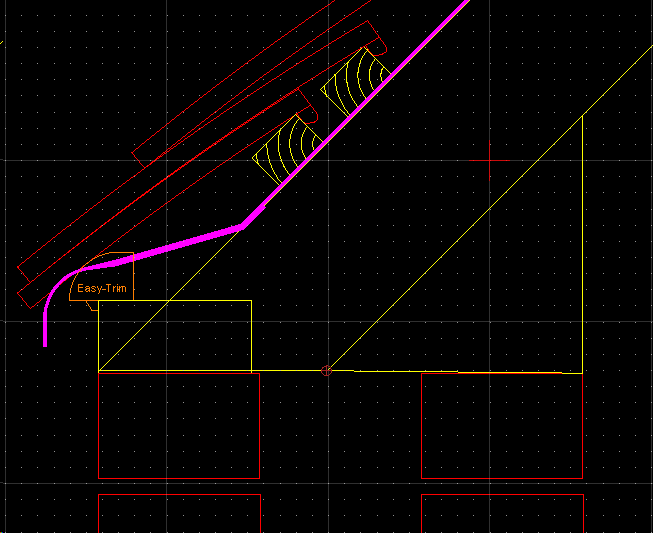
Depending on whether I shift the roof line by using a counter batten, below is my plan for the eave. Simple 4x2 rafter and a 4x2 on edge for the eave vent to sit on. There won't be any vent at the top of the pitch, but the roof section is so small (approx 1m2) it shouldn't matter. I can either birds mouth the rafter to sit on the flat timber. Funny to be putting effectively a wall plate on the outer leaf but will be fine. It needs to stop at the outer leaf end so the brickwork can come through there. Any reason not to be running the outer rafter in the cavity?
-
A Basementette - Tiny box for plant? Good idea?
MortarThePoint replied to puntloos's topic in Basements
Sounds like an expensive way to stash your plant. The water cylinder would drive the height over 6ft. I think a wine cellar would be more of a feature, but needs to work with the rest of the house. It wouldn't be strange to enter a plant room through the downstairs toilet, but it would make people worry about your chardonnay if you entered a wine cellar from there. It's hard to find a decent reasonably priced horizontal DHW cylinder as I want one to put in a roof space. -
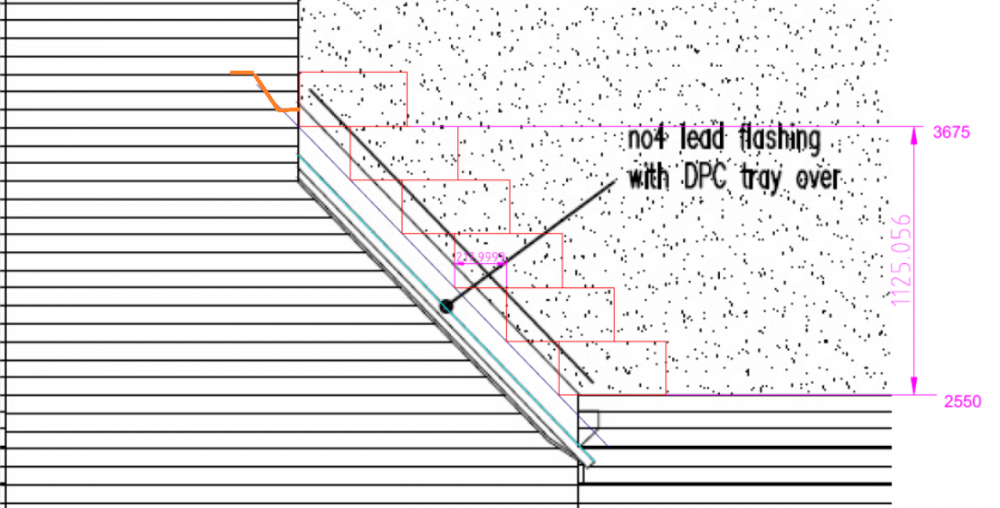
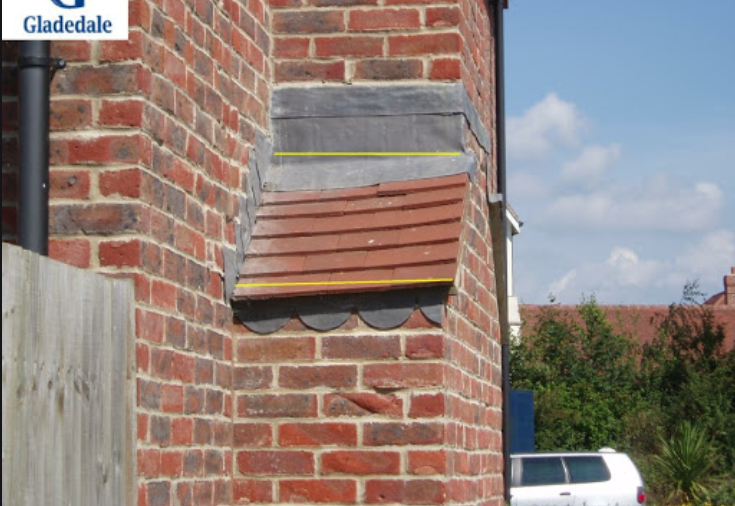
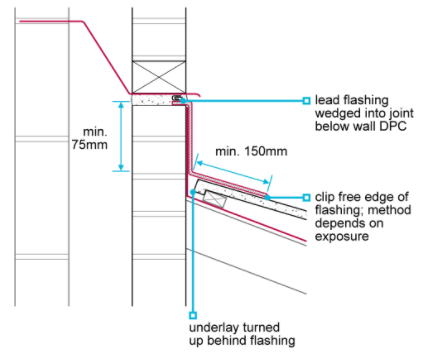
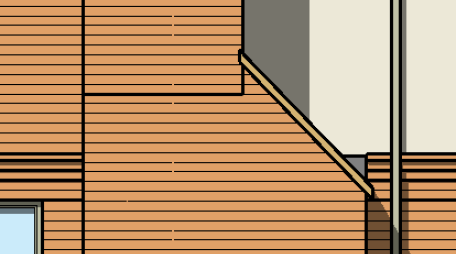
My cavity tray (shown orange below) is a course higher than ideal, so I end up with the three choices below. In the image below, the red the blocks have DPC cavity trays on their left and bottom sides forming a stepped cavity tray down that side wall. Dress the lead flashing ~180mm up the chimney stack to the DPC cavity tray. Could look a bit silly being so high and being visible from the front of the house. It dresses down the tile too >150mm so would create quite a prominent band. Note as prominent as the photo below and hopefully I'd get it all level as well. Leave a gap of 1 course between the top of the lead flashing and the DPC cavity tray. Minimal water would be able to get into such a gap, but it is like an exposed midriff. Shift the line of the roof up a course, which makes the cavity trays round the red blocks lower than ideal ?Too low?
-
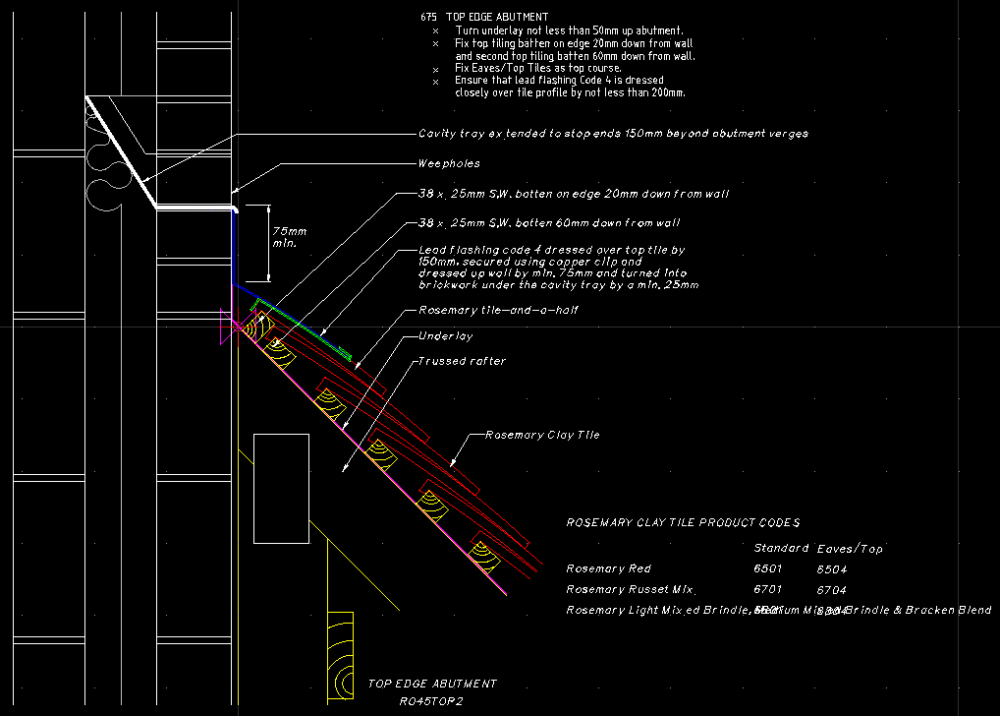
I'm using Redland tiles for the roof and they have some handy CAD resources where you can select your tile type and what detail you need. As they've drawn it, the timber comes up to a bed joint which is handy. They say 75mm min. for the lead flashing. Checking NHBC confirms 75mm min. , 150mm is for flat roof abutments. I think I have my cavity tray a bit high unfortunately as I think I allowed for 150mm.
-
Thanks, but not as keen on how that looks. I know another option is to do in brick instead. I'd prefer tile.
-
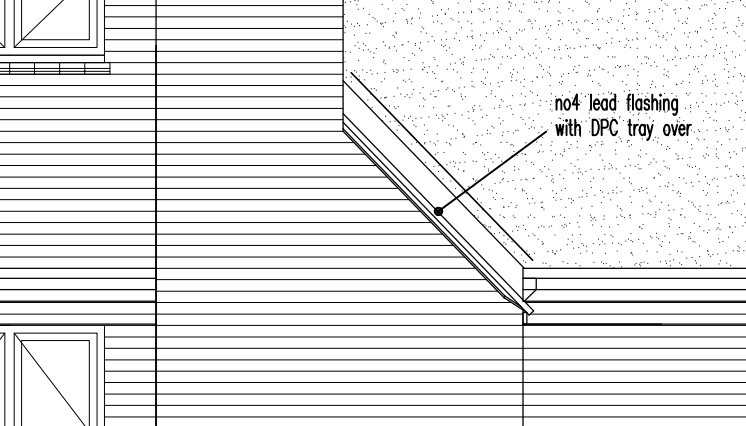
Does anyone have a chimney shoulder detail they can share? My plan so far in the absence of a detail drawing. Below are sections of images from the architect. The chimney sticks out ~600mm and has a cavity wall all round. Left to my own devices, I'd bolt a section of 4x2 to the house side wall and build a frame off it that rests on the inner leaf of the chimney outer face (the outer face being the surface you see here). Battens across the top of the frame. Tile overhand around 35-50mm to chimney return (return = front face, next to drain pipe in diagram below). Two options for how tiles end relative to the brickwork face of the chimney that is visible below: flush - tile side is flush with the face of brickwork and gets cement mortar between brick and tile. The top surface of the battens to come ~10mm above the 45 degree cut of outer leaf bricks. That 10mm is to allow the space for tile lugs and some cement at the verge. overhang - side of tile overhangs face of brickwork (e.g. 35mm). Cloak board placed on top of the cut bricks and mortar between cloak board and tiles. If doing this I should probably have the battens go on top of the cloak board like at a normal verge. That will create a much more visible mortar verge, but do a tidier job. I am leaning towards option 2. Lead dressed down to tiles on the other two sides. No gutter at end of pitch. What do people think? Hopefully this is roof small enough that I can't go too far wrong ?
-
Crazy Rafter Roll insulation cost
MortarThePoint replied to MortarThePoint's topic in Heat Insulation
Here are the prices I have been quoted. It's interesting to see how much the price/performance figure varies (from 50p to almost £5). [t] Name lambda cost Price/Performance 90mm FrameTherm 32 £8.80/m2 £3.13 [lambda*cost/t] 90mm FrameTherm 35 £5.70/m2 £2.22 140mm FrameTherm 32 £?.??/m2 £?.?? {£14.11/m2} 90mm OmniFit Slab 35 £4.05/m2 £1.58 100mm RafterRoll 32 £14.15/m2 £4.58 75mm RafterRoll 32 £10.80/m2 £4.61 100mm LoftRoll 44 £1.15/m2 £0.51 150mm LoftRoll 44 £1.69/m2 £0.50 {£2.16/m2} 200mm LoftRoll 40 £?2.60/m2 ?£0.52 {£3.32/m2} 180mm OmniFit Stud 34 £18.05/m2 £3.41 Vari Rockwool Flexi 38 various £1.76 (e.g. £4.65/m2 for 100mm) All prices are from the same source except {prices}. You pay a large premium for self supporting rolls. OmniFit Slabs probably represent the sweet spot for Knauf between the rafters. It highlights how cheap the LoftRoll insulation is. I have heard of builders stapling this at rafter level and I can understand why. FactoryClad has a very large minimum order quantity. I have heard of price fixing of insulation in some territories and, given how expensive it is, I am not surprised. There must be a lot of fraud around it as well since someone could easily claim to have used something twice as expensive and it's hidden away, plus hard to tell even if you can see it. -
I read the following on one website: "If your boards are exposed to varying weather conditions before fitting, they are likely to cup, warp and split; the ideal time to fit cladding to keep this to a minimum is between the months of October and April and within 7 to 14 days of delivery." [link] Perhaps a good excuse to hold off then. That is of course on the hope that the prices come back down any time this year.
-
Looks nice. I was thinking of 200mm 25-6, but shrinkage probably makes 200mm a bad idea.
-
I've been wondering about that and perhaps even covering over with DPM plastic. DPM plastic is about £0.40/m2 and saves the UV damage to the battens and roofing membrane. I want to get the job done though, so I have to way that up. The Oak price seems to be less affected, but I worry about it being fresh sawn. Could end up with a lot of firewood!
-
Our garage is designed to have timber cladding above a brickwork plinth. It's now ready for the timber cladding and prices are very high. We've not been overly clear on which wood we want to go with. Options we're considering: Oak - £26/m2 for Green Oak. Larch - £20/m2 to £40/m2 latter being Siberian (Siberian was £26 just last week). Western Red Cedar - £107/m2 so that's a no then. It is double what it was in April 2021 (i.e. 2 months ago). Green Oak worries me as a self install since I don't have experience and could all warp and crack nastily. Does anyone have any advice to make me more confident as it is our preferred choice. Lots of suppliers I've spoken to have said prices are expected to go up >=30% at the end of the month.
-
Partitions: Timbers studs Vs Metal C studs
MortarThePoint replied to MortarThePoint's topic in General Construction Issues
Is that because there isn't a moisture resistant Habito? -
Partitions: Timbers studs Vs Metal C studs
MortarThePoint replied to MortarThePoint's topic in General Construction Issues
I had planned to use a sheet of OSB3 behind the plasterboard, but think Habito probably negates the need. -
British Gypsum's Habito plasterboard allows direct fixing of loads up to 15kg: https://www.british-gypsum.com/products/gyproc-habito?tab0=3 It's only available as a 12.5mm TE plasterboard at various lengths. It is expensive at around £19.66+VAT / sheet. Habito: 12.5mm with area density of 11.8kg/m2. TE only and 1200 wide x 2400, 2700, or 3000 long
-
Partitions: Timbers studs Vs Metal C studs
MortarThePoint replied to MortarThePoint's topic in General Construction Issues
I don't know why they are drawing the distinction, but I'd be ale to skim Habito boards on metal studs surely: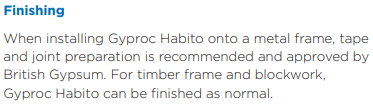
-
Partitions: Timbers studs Vs Metal C studs
MortarThePoint replied to MortarThePoint's topic in General Construction Issues
In the installation video the Habito is touching the ground at the bottom edge. Aren't you supposed to raise it up slightly or does that not apply to Habito? -
Partitions: Timbers studs Vs Metal C studs
MortarThePoint replied to MortarThePoint's topic in General Construction Issues
Cheeky bodgers! -
Partitions: Timbers studs Vs Metal C studs
MortarThePoint replied to MortarThePoint's topic in General Construction Issues
Nice: https://www.british-gypsum.com/products/gyproc-habito?tab0=0 These plasterboards are really strong enough to hang kitchen cabinets on? Perhaps not with all of Grandma's fine china in it! -
Partitions: Timbers studs Vs Metal C studs
MortarThePoint replied to MortarThePoint's topic in General Construction Issues
Are they doing something like skipping a step of screwing the vertical stud to the bottom and top u-channels then? If so, I'm sure I can cope with that necessity ? -
Partitions: Timbers studs Vs Metal C studs
MortarThePoint replied to MortarThePoint's topic in General Construction Issues
Could you elaborate on the more versatile bit please. Naively, it seems to me that it's harder to hang things off unless planned in to the construction of the partition (e.g. pattress). Does it create a wall that feels as solid as timber studs or does that more come down to the plasterboard used? -
Partitions: Timbers studs Vs Metal C studs
MortarThePoint replied to MortarThePoint's topic in General Construction Issues
Mine would mostly have blockwork walls at one or both ends. Did the contractors screw up installing them or doing some other works years later. I can see metal studs would be less easily adapted down the line. -
Partitions: Timbers studs Vs Metal C studs
MortarThePoint replied to MortarThePoint's topic in General Construction Issues
I think you're right. I don't have enough partitions for it to make enough of a difference.



