


MortarThePoint
-
Posts
2294 -
Joined
-
Last visited
Everything posted by MortarThePoint
-
I guess it can depend on soil conditions. It's quite easy clay here. Tree roots?
-
Our new build is about 77m from the roadside where there is an existing water connection to the house behind which we are building. We currently own that house too. We'll want the mains pipe to enter a further about 15-20m run away. The boundary to the front house is about 45m from the road. We'd like to avoid any pits in the garden of the front house. Is it possible to mole 45m or even 77m in one go? Based on this link it doesn't sound too expensive if it is possible. That was £950 [2018] for 30m with 4 inspection holes. The process seems quick, so even 77m should be OK in day ?? Below is a useful video. Seems to be straightforward to steer the mole as it goes. Also, judging by the number of rod sections on the dolly it looks like it should be able to go a long way.
-
Where to put the electricity meter
MortarThePoint replied to MortarThePoint's topic in Consumer Units, RCDs, MCBOs
For the isolation, I guess a 100A one of these could work: The fusing would need to be separate though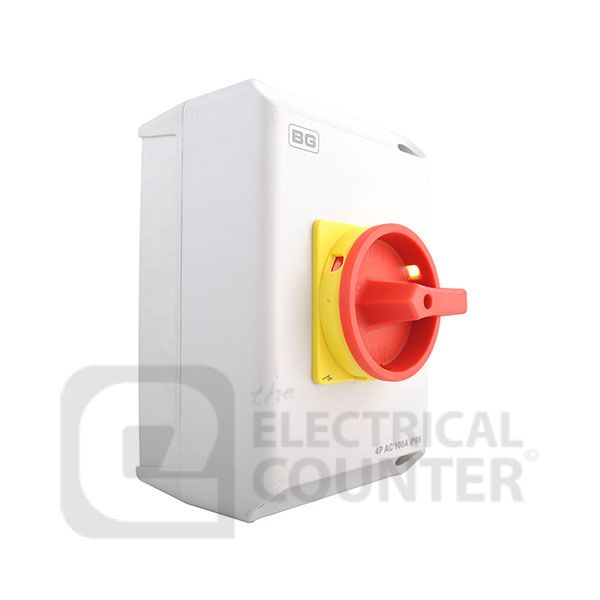
-
Where to put the electricity meter
MortarThePoint replied to MortarThePoint's topic in Consumer Units, RCDs, MCBOs
Smaller and cheaper to have a single phase switch per phase though I doubt that's allowed -
Permitted development is a crazy system in that you're allowed to do something but expected to check anyway.
-
Where to put the electricity meter
MortarThePoint replied to MortarThePoint's topic in Consumer Units, RCDs, MCBOs
Do you know if there is a compact a 3-phase version of this? -
I've clipped my pipes every 300mm with Talon clips so they'll either all be speaking or my pipe's going nowhere
-
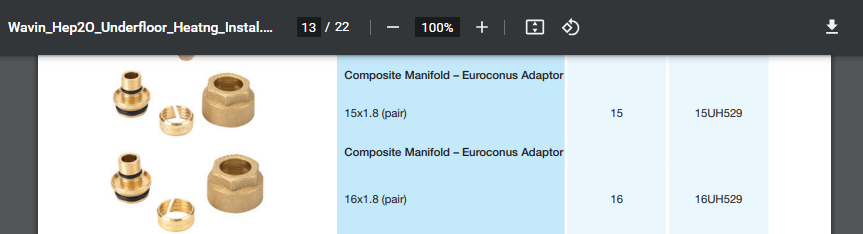
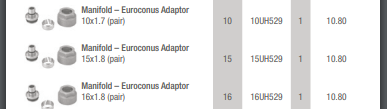
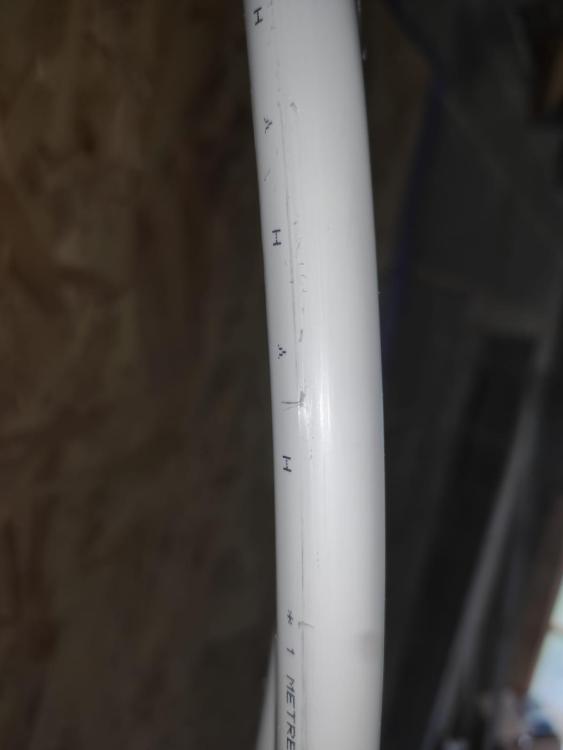
The scratches are pretty continuous so can't cut short and splice on a new bit using a Hep2O coupler to solve the issue. Wavin list their own Euroconus adaptor on their website, so its fully legit : https://www.wavin.com/en-sg/product/b7e4577d-69fb-44c2-a1e0-23ab58110bb2 Available from a few places [1] [2], (~£8 each or a pair unclear). There are others for the same diameter and wall thickness. I have also seen for 10mm pipes [3].
-
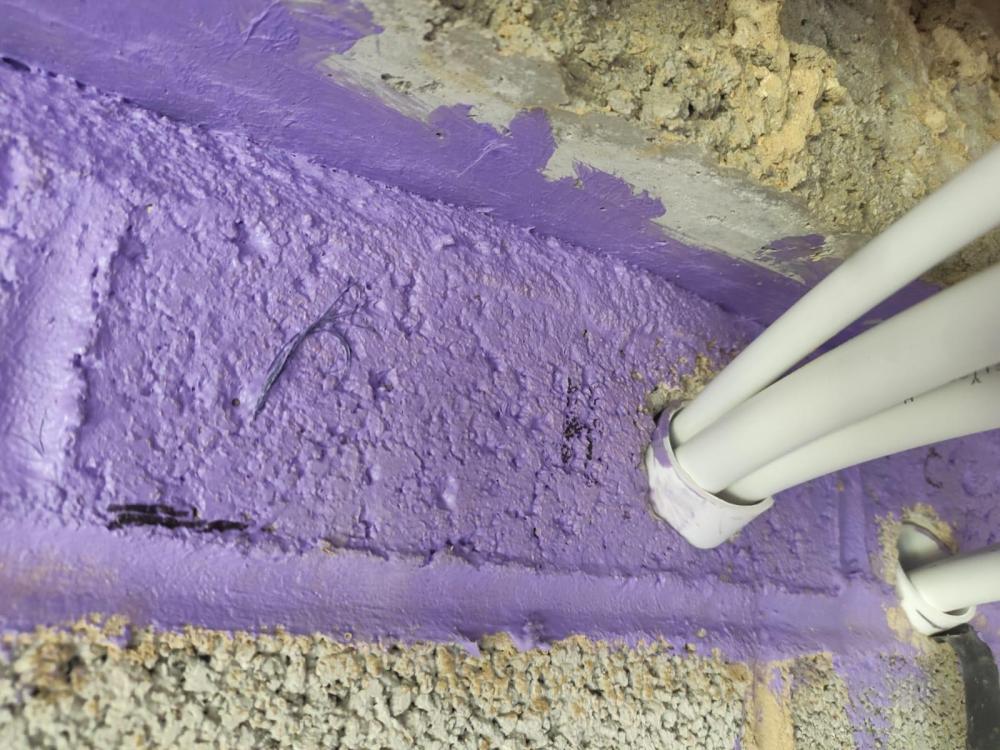
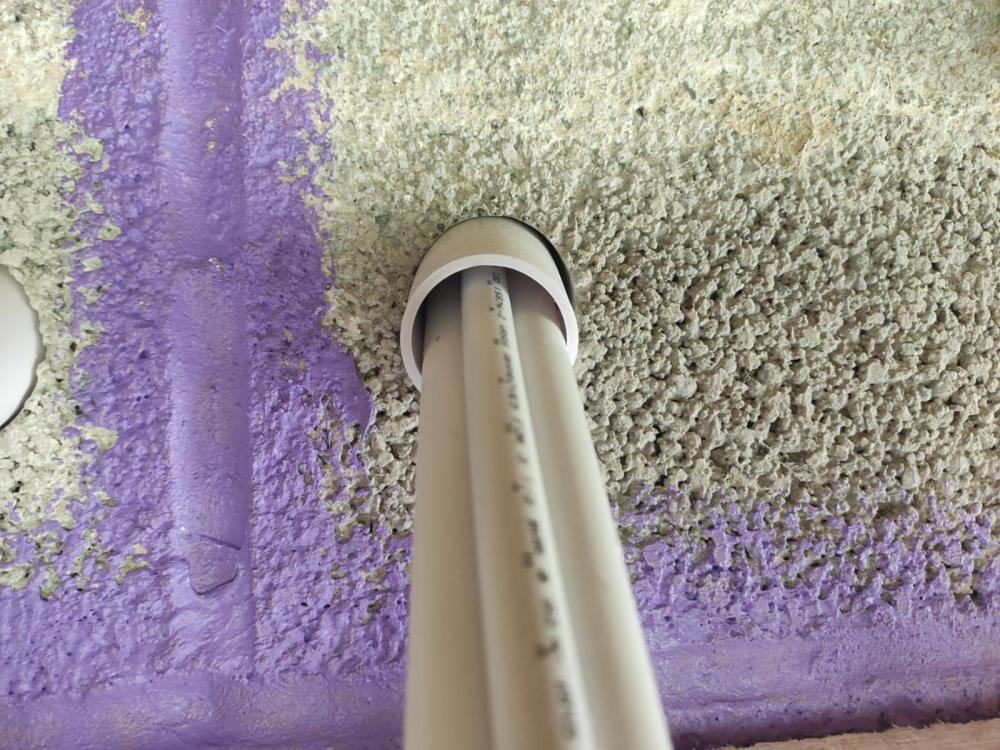
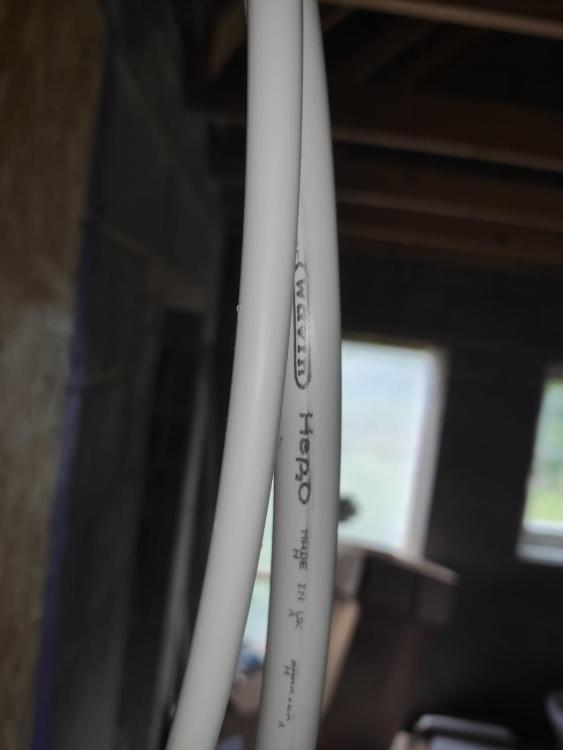
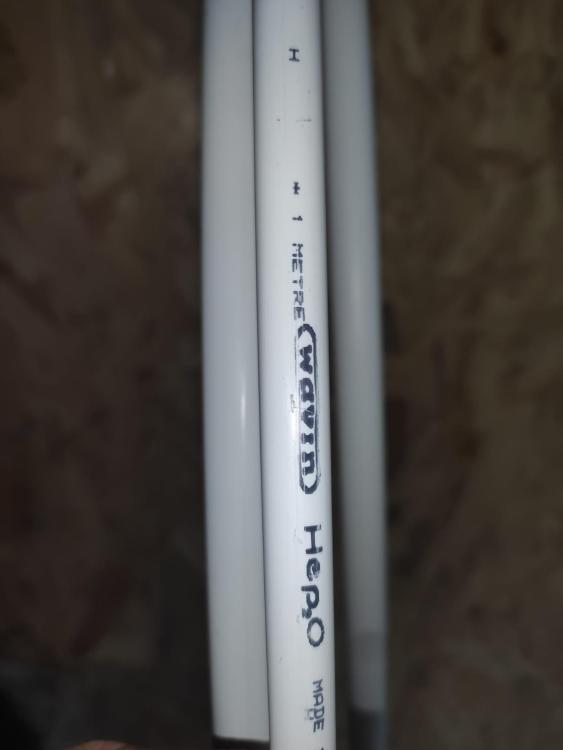
Here are some pictures, though it can be hard to work out the scratches in some of the photos. Photos show 2no. 15mm and 1no. 10mm. You can see some small wisps of scratched plastic.
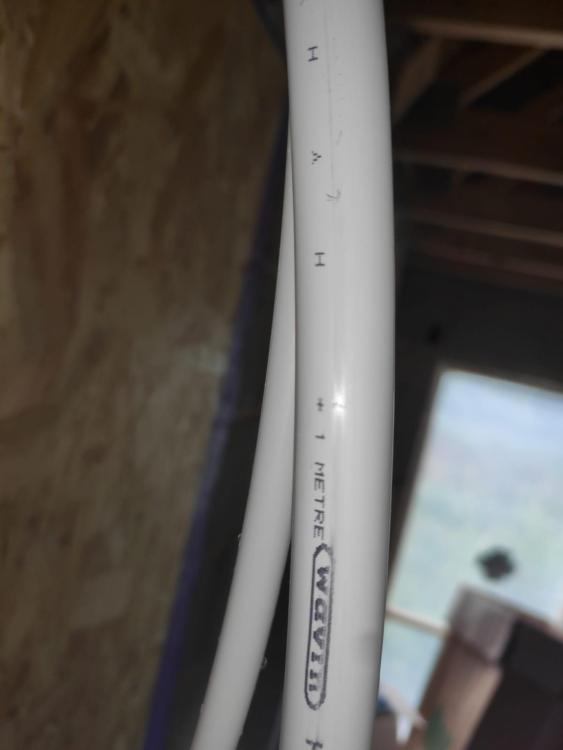
-
It's where I am squeezing 2no. 15mm and 2no. 10mm pipes through a section of 35mm waste pipe at 45 degrees through a blockwork wall. It's a tight squeeze and any slight debris will cause a scratch. It's not the cost, I'd swap it if I thought it would work. Do you not like the sound of the Euroconus fitting approach? Hep2O is designed for use with Euroconus.
-
Do not scratch your Hep2O pipes and take them back if they come scratched. Line any penetrations through blockwork etc with conduit or foam insulation. Hep2O fittings seal onto the outside of the pipe using a rubber O-ring. There is a Hep2O lubricant designed for refreshing their fittings that could help with pushing pipes and reducing the chances of a scratch. I have ended up with a scratched pipe(s) that I can't replace with confidence that the new pipe won't get scratched, here are my thoughts as to what I could do: [Maybe] Light scratches may be OK though I am a bit nervous. I only have light scratches and smeared printing. Sometimes a leak occurs at lower pressures that at a high test pressure so I always test at multiple pressures. [No?] polishing the pipe with fine grit sand paper or wire wool. I don't think this is a good idea as it will reduce the OD of the pipe and that is where the O-ring seals so likely to be bad. Has anyone had success polishing scratches out of Hep2O or similar polymer pipe? [Maybe] Use a compression fitting with copper olive. I have heard bad things about using compression fittings with Hep2O ( @Nickfromwales ), but it may be better than the alternatives. Wavin don't approve any sealant, just recommending PTFE tape if needed. A selant manufacturer may state their product is OK for Hep2O though. [Promising] Pegler's plastic push-fit system uses inserts that seal on to the inside of the pipe rather than the outside. I don't think you could mix brands (different ID?, tolerances, etc), but this made me think of Euroconus fittings which are used for UFH, but you can get WRAS approved parts. They also seal on the inside of the pipe using one or more o-rings. You can get 15mm straight couplers that would allow a cut and splice approach. I am thinking of using 15mm Euroconus to attach to a Euroconus manifold which you can also get WRAS approved. The main downside I can see is that it constricts the ID on the pipe fitting. For a 15mm pipe (ID approx 11mm) I guess the Euroconus ID would be around 7mm. A 7mm orifice at 6 L/min drops 0.53 m of head [link] which is equivalent to about 4m of 15mm Hep2O, so not bad. There may be a tighter orifice in the manifold itself. I believe Wavin approve the use of Euroconus fittings with their pipe, so it should be a robust solution. Any advice or other possible solutions?
-
One downside of a low hot water temperature is that you asking for a higher flow rate through your pipes as it will be further from a 50:50 mix of hot and cold. I was thinking 12 L/min for a shower, but it looks like it might be lower: "In the USA the maximum flow permitted from a shower head is 9.5 litres a minute and the UK government is looking to bring in an even lower rate of perhaps 8 or 9 litres a minute." [link] 15mm Hep2O which I am using has a maximum flow rate of 6 L/min if you are trying to stay under the 1 m/s flow velocity recommendation for low noise applications. Netherlands guidelines of maximum 1.5 m/s for hot water (2.0 m/s for cold). If all the shower water was going through the one pipe, the flow velocity would be higher than 1.5 m/s so could get noisy.
-
I spoke to Wavin Technical yesterday and they said they don't get complaints about using Hep2O with compression fittings and it should be fine. They reiterated the preference of using a copper rather than brass olive and importance of using the insert. True knowledge comes from experience, of which I have very little. Can you share some of your experiences here? Have you had leaks with Hep2O and compression fittings in the past (grey pipe of white pipe?)? Have the leaks presented themselves straight away or worse after some time?
-
-
Yes it is, but I phone a few of the IDNOs and they didn't seem very good. Can you suggest one?
-
A warning to others not to make the mistake I did. I had a 3-phase connection to a building that was demolished to make way for the new build. I paid UKPN for a disconnection (£451) and am now looking to pay UKPN for a new connection (£2,441). If I had been wiser, I could have moved the connection for £1,345. I am going with a meter kiosk near the pole, so I could have just done that once saving £1,547, but even doing it twice to have the meter somewhere else after the build would have saved £202. At least I saved a meter standing charge which would have added up to about £600, but I guess I could have had the meter disconnected and saved that. £2,441 feels like a lot for a new overhead connection to a pole right next to a kiosk. It will take their engineer(s) about an hour I expect and it's probably less than £100 worth of cable and ducting needed.
-
BCO is strict about TMV requirement for baths and showers have them already. I'm wondering if I can set my cylinder temperature low enough to not need a TMV. That would make whole system run at the restricted temperature (45C?). I can't think of a reason we'd need warmer than that at any taps. A cooler tank is good for ASHP efficiency but not so good for hot water volume. That should be fine though. Tank would probably have to do some legionella magic periodically though so that may be tricky / make it impossible. I suppose the legionella cycle could be done using an immersion heater wired in parallel with a NO 2-port valve that closes whilst the water is too hot. There's a time delay issue there, but is anything like this ever done?
-
Battery VAT claimable? Battery choice
MortarThePoint replied to MortarThePoint's topic in Energy Storage
Cell balancing is a definite requirement as far as I am concerned and it's surprising/unforgivable if the Pylontech batteries don't feature it. -
Battery VAT claimable? Battery choice
MortarThePoint replied to MortarThePoint's topic in Energy Storage
@Nickfromwales 🤯 pretty scary photos -
ASHP vs Oil in 2022
MortarThePoint replied to MortarThePoint's topic in Air Source Heat Pumps (ASHP)
(17*38.63 + 7*16.21) / 24 = 32.09 Assumes uniform use. Hard to adjust to the new prices. Economy7 is about what peak used to cost. -
ASHP vs Oil in 2022
MortarThePoint replied to MortarThePoint's topic in Air Source Heat Pumps (ASHP)
Simple calculation to work out the SCOP required for ASHP to be cheaper than oil: SCOP > (elec_cost_kWh) / (oil_cost_litre / (10.35 * oil_boiler_efficiency)) Where 10.35 is the kWh per litre of oil. A modern condensing oil boiler has an efficiency of 92%, so that becomes: SCOP > 9.5 * (elec_cost_kWh) / (oil_cost_litre) Today, for me that works out as: SCOP > 9.5 * (32.09p) / (54.43p) SCOP > 5.6 The 32.09p/kWh figure is a weighted average of peak=38.63 and Economy7=16.21. If I had battery storage (guess 95% efficiency) the elec_cost_kWh=16.21/95%=17.06. SCOP > 9.5 * (17.06p) / (54.43p) SCOP > 3.0 Remember, SCOP is the average across the season, so not the worst performance when -5C outside or the best performance when +15C outside. -
Has anyone successfully claimed VAT on their energy storage battery or hear of it being done? Same goes for the inverter charger. Might wall mounted ones be more 'claimable'? I'd like a battery system and need to size it for expected ASHP demand, but probably something like 15 - 20kWh. That's 3 or 4 server rack batteries a charger and hybrid inverter (are they combined?) So probably looking at £6k+VAT. Would allow me to effectively use E7 electricity during the day when air temps are higher so COP better. I expect I would need to have an inverter capable of sustained 5kW to allow ASHP at full wack, lights and cooking. Options I'm considering: Fogstar 5.12kWh: https://www.fogstar.co.uk/collections/server-rack-batteries Fox ESS LV52: https://www.itstechnologies.shop/products/fox-ess-lv52-5-12kwh-48v-battery-module Pylon US5000: https://batteryfactory.co.uk/products/pylon-us5000-4-8kwh-li-ion-solar-battery-48v Premium Lithium system: https://premiumlithium.com/products/tripod Solis hybrid inverter: https://www.ginlong.com/global/inverter.html Useful resource: https://dcguy.co.uk/server-rack-battery
-
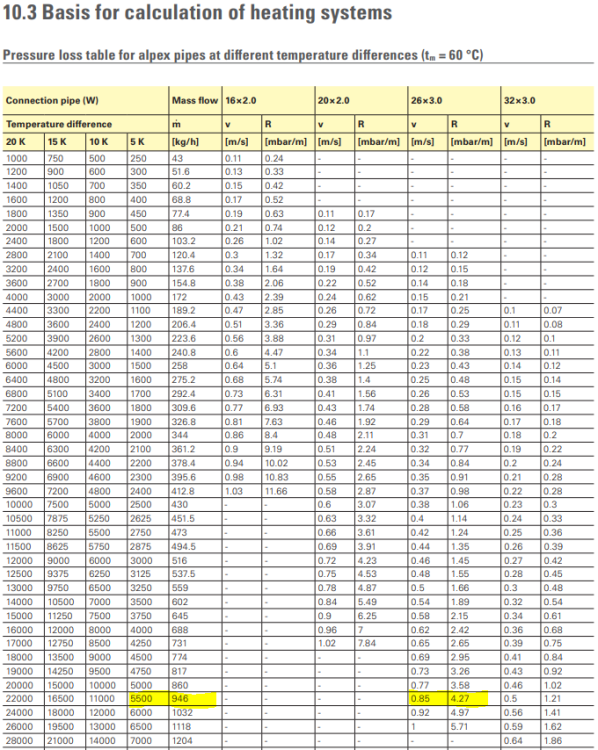
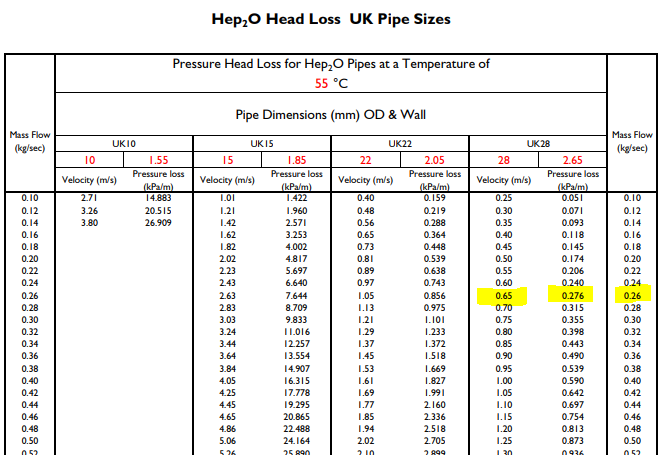
I thought I would share by deliberations on pipes for the feed and return to UFH manifolds. I have an 11.2kW ASHP and two main Manifolds meaning the peak power a manifold is around 5500W. Based on a dT=5K, that works out as a flow rate of around 5.5W/(5K*4.2kJ/K.kg) = 0.26kg/sec = 943kg/h = 0.94m3/h. My head calculations when considering a circulation pump were based on 28mm Hep2O. I was considering using 26mm multilayer pipe with compression fittings, but it turns out that would be much more resistive (~55% more) and the higher flow speeds would also be noisier. I expect a peak flow to a manifold of around the 946kg/h line of the table. For the multilayer pipe that works out as 4.27mbar/m or 154mbar=1.54m of head loss for a 36m run. Hep2O on the other hand the drop would be 0.276kPa/m=2.76mbar/m or 99mbar=1m of head loss for a 36m run. That's a 55% difference. If flowing 50% of the time, the difference in electricity use would work out as (24*365*50%) * ((0.26kg/3*9.81N/kg*0.55m) / 50%) = 12.3kWh/yr. Not much. I'd be more worried about being closer to the 1m/s advisory limit for flow rates based on noise. The multilayer pipe has the advantage of holding a shape when bent to it and more reliable fittings. It doesn't suit my situation though as I can't easily change to the larger 32x3.0 size that would be needed. 28mm Hep2O looks to be the better choice.

-
One aspect this neglects is all the bends in the UFH pipe. They aren't sharp bends, but with a bend radius of around 12.5x bore if a 90 bend or 6.3x bore if a 180 bend. Using this tool [1] I get pressure drops due to bends of these sizes of equivalent added length of 67mm and 96mm respectively. There is one such bend every ~3m so that's a pretty small addition of around 3%. [1] http://www.pressure-drop.com/Online-Calculator/
-
@JohnMo When you are running less than peak power, the flow temperature goes down, but does the flow rate go down too? I guess it can go down since the water dT between room and water is lower and so to get the same flow vs return temperature difference, the flow would need to slow down. I expect to be optimal, you want the dT of at the ASHP to be the same as the dT at the UFH manifold. That wouldn't be the case though since I think the ASHP circulation pumps will run at constant speed.



