


Thorfun
-
Posts
4892 -
Joined
-
Last visited
-
Days Won
36
Everything posted by Thorfun
-
it's an interesting point of view and I will definitely bear it in mind when making a final decision on manufacturer. thank you.
-
they use glass wool within the stud work covered in PIR (which seems pretty standard) and so would be easier to fit without gaps. it seems that 140x38 are the stud of choice as all the quotes I've had are using that size timber stud. one company did offer a 184mm wide stud though as an option.
-
thanks all. it's very interesting and good to know that a 400mm centre walls/building feels more solid. from the online U-value calculator the 400mm studs adds 0.003 to the U-value which is so little it isn't really worth mentioning! for me this is another tick in the good box for this company. ?
-
yep! I guess it could be as simple as that. ?
-
this is interesting and seems to be what the guy was saying on the webinar. but that would mean that the timber frame company would have to come back to site at some variable time in the future after the roofer has been. which I doubt they would do. I'm confused (which is easily done!)
-
thanks for the response. but the quote is for 140x38 CLS (C16) kiln dried stud work and none of the other companies feel I need 400mm centres and are using the same sized studs. I'm just confused why this company would. I have asked them, btw, I'm waiting for a response.
-
I'll try and find something...even if it means attending the replay of the webinar and asking it on there.
-
Hello, can someone please explain to me the benefits or drawbacks of using 400mm centres for external walls in a timber frame? I've had a quote from a company that is using 400mm centres and it's the only one from the various quotes I've had. all other manufacturers are using 600mm centres. apart from the obvious worse U-value due to more timber in the walls. what are the other good/bad reasons for using the narrower centres? cheers. ps. after attending the NHBC webinar on timber frames I am now aware that if you're not using a double header plate on the wall panel then the ceiling joists need to be in line with the wall studs. so I guess this could be a reason as the suspended floors on the quote are specified to be 400mm centres as well. but I would've thought that from a manufacturing perspective it would be cheaper to use a double header plate than to use more studs in the wall. but, maybe I've just answered my own question and it's because the joists need to line up with the studs! ?♂️
-
I signed up to a couple of these. one of them was the Timber Frame construction webinar. one this that they said that I wanted to ask the community is that the internal first floor walls should not be installed until after the full load was put on the roof. i.e. the roof fully tiled. now I presume this is to do with load and shrinkage of the timber frame with the roof covering on and seems to make sense but from all the reading I've done every timber frame manufacturer will come to site and erect the timber frame including the internal walls and then leave with the roofer coming to site afterwards to fit the tiles. if NHBC say that fitting internal walls is a big no-no until after the roof has full load how/why do the timber frame companies get away with this?
-
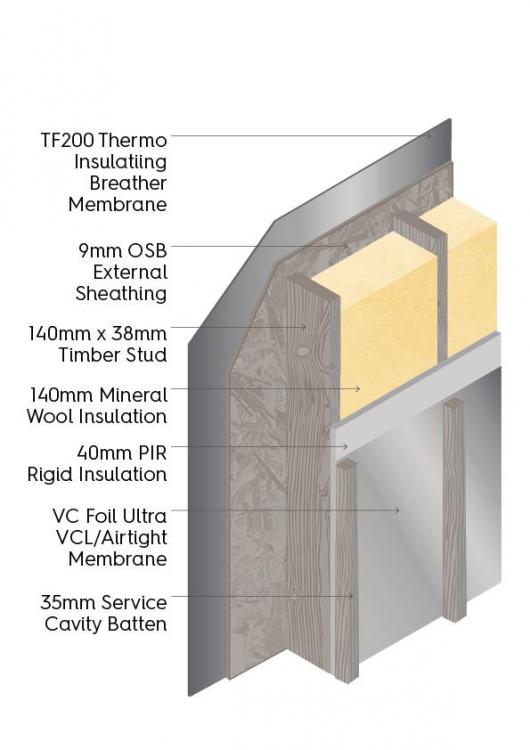
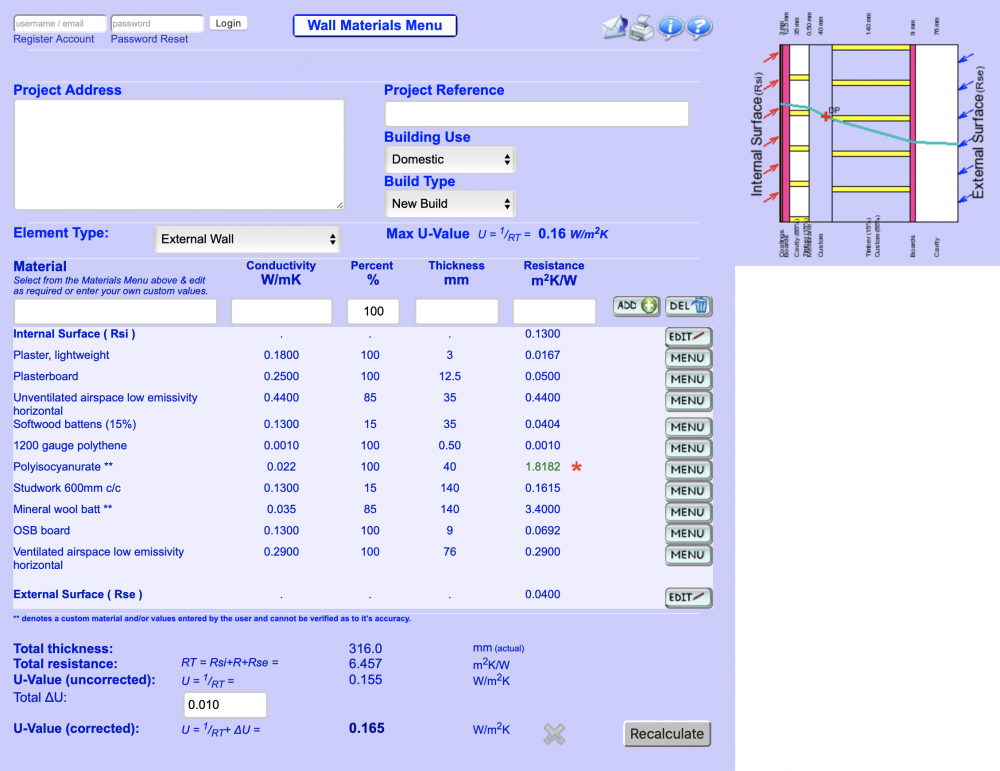
Thanks @A_L I adjusted the calculator to 85% mineral wool and 15% timber stud and it worked. I also adjusted the internal services cavity to include 15% timber batons. I didn't even know you could do that so thank you very much. it makes my rough calculations just a little bit more accurate. what's interesting now is that the corrected U-value is now failing the test and is above the Max U-value of 0.16W/m2K. Also, what's interesting is this wall make up is the same as MBCs 0.14W/m2K wall apart from them using the VC Foil Ultra VCL/Airtight Membrane (see below) can you, or anyone, explain the differences in the U-values received? although I guess it's that they use a different type of insulation as if I change the lambda value of the mineral wool and PIR to 0.032 and 0.020 respectively then I get an uncorrected U-value of 0.144W/m2K so that must be it. so, I'm still a bit confused but I think I'm getting there!
-
Not tried this but will give it a go tomorrow. Thanks for the tip. Ok, cheers. Will take a read again as I must’ve misunderstood it fully.
-
thanks for the additional information on points 1, 2 and 3. the calculator does indeed allow custom values and I've changed the lamda value of the PIR and Mineral Wool Batts to reflect the chosen insulation (defaults are 0.023 and 0.038 respectively). if I'm reading this correct, the timber frame itself has a massive impact on the overall U-value of the wall! I would assume that increasing the thickness of the PIR would reduce the impact the timber frame has as there is more insulation reducing cold bridging? I read somewhere (apologies but I can't remember where!) that the timber cladding would add an amount of insulation even if it is outside of the ventilated cavity. is that not the case at all then?
-
thanks for the response. I'm not in a position to buy stuff at the moment and so I haven't asked the manufacturers yet but I will do so once I get to that stage. I'm really at the planning stage to see how much I can reduce my reliance on PIR. 1. corrected/uncorrected: ok, this makes sense. so I would use the 0.14W/m2K U-value in this instance? 2. I thought this was dew point as well. I'll ignore this for the time being then and wait until I get proper calculations from the manufacturers or architect. 3. this is what I thought and no airspace is required. I will stick with fully filling between the studs. other comments: 1. is this true if using something this http://www.protectmembranes.com/protect-vc-foil-ultra-insulating-avcl/p/12? or do you just mention it because I have just got a basic polythene layer in the example? my intention is to use something like the Protect VC foil VCL/Airtight membrane but I couldn't see a way to accommodate that in the u-value calculator. 2. I haven't a clue how to do that in this calculator!
-
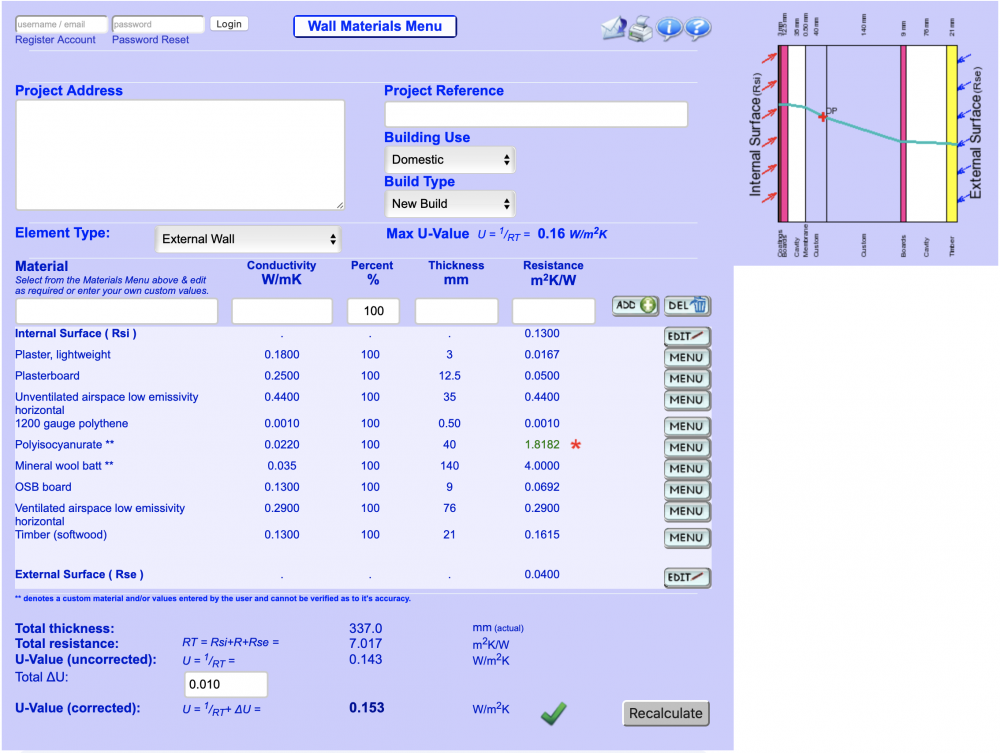
Hi all, I've been going through an online U-Value calculator to try and figure out my external wall make-up to get an idea of what I need to get a U-value. I have a few questions on the output: my questions on the screenshot below are: 1. what is the U-value (uncorrected) and U-value (corrected) differences? i.e. what is corrected U-value and which one would the TF manufacturers use in their marketing materials. so would this be a 0.14W/m2K or a 0.15W/m2K external wall? 2. on the right there is an image of the make up of the wall with a cross denoting "DP" within the 40mm of PIR. can someone please explain what "DP" is and is it being in the PIR an issue? also, where should it ideally be? 3. I have specified 140mm of mineral wool/glass wool (e.g. Frametherm 35) on this calculation. my architect has said that you shouldn't fully fill the stud work and should leave an air gap between the PIR and the mineral wool. is that true? if so, why would you need that? as leaving an air gap will reduce the U-value. thanks in advance.
-
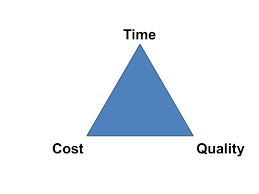
as @ProDave has alluded to above if you want to build for near to £1000/m2 (especially in the south of England) then it takes time. one of either quality or speed of build will have to give and from reading his blog it is definitely not quality that has suffered! remember the time, quality, cost triangle. you can only have 2 of those choices.
-
Thanks again. It’s good to know I’m slowly getting a handle on things. That is until I start looking into another aspect of self-building!
-
thanks @A_L . if i'm reading page 12 of that document correctly (thanks for it btw, I shall read it in more detail when I have the time!) it looks like using something like the TF200 which is a low-emissivity surface will increase the external surface resistance further still to 0.29m2K/W. correct?
-
If using timber cladding then I assume that an external membrane on a timber frame would be a ventilated cavity though, right? as you have the external OSB covered by the membrane with the silver facing outwards into a cavity that has batons and the timber cladding on top. as the cladding is not airtight I presume that's considered a ventilated cavity. by that rationale the only external unventilated cavity would be brick cladding? we are having timber cladding so if that's the case then the silvered membranes won't benefit us at all.
-
it does seem that the TF200 is a popular choice with the timber frame manufacturers and I'll probably end up going that way although I guess it depends on who I choose! it's good to know that there's probably not much difference between the lot of them. the foil may well block mobile signals but I also think the 300mm of cellulose might have an impact as well! so I think even without the foil you might suffer.
-
this is a very interesting subject for me. I'm in the process of getting quotes for a timber frame and each manufacturer seems to have a different take on the external membrane for the frame. a number seem to go for the Protect TF200 Thermo with some offering it as an upgrade over the stock membrane. another has offered the Proctor Reflectashield TF0.81. do all these do pretty much the same thing? if so, does it simply come down to the timber frame manufacturers personal choice (or product endorsement for higher profit margin). I'm finding it really hard to determine what the best is or how to easily compare all products. e.g. the TF200 says "Aged Thermal Resistance 0.77m2K/W, the Proctor says "claimed thermal performance of 0.81m2K/W". So I would assume the Proctor Reflectashield is better as it has the higher R-value, but what does Aged mean? and I couldn't see an R-value listed on the specs of the Novia stuff! so, how does one determine the best membrane to use?
-
Thanks @Temp . sounds like a risk I don’t want to take for a few tomatoes!
-
yeah, fair comment, I just thought BT might want to upgrade the master socket to one of their new ones that don't need filters attached to them is all.
-
I would have thought it is a new router and master socket for FTTC at least and if it's FTTP then there's definitely a new box to accept the fibre cable required, so a home visit is definitely required. not sure what your 4g coverage is like up there but you could get a 4g modem and an unlimited data plan to see you through until you can get your new connection.
-
morning all, firstly, sorry to hijack this thread but I have a similar question so thought if I post it here it might be useful for others. We are still awaiting planning approval and there's a greenhouse near where the new house will eventually go. the ground floor plans from the architect that were submitted as part of the planning show the greenhouse location and it states "existing green house to be demolished". with the current lockdown we are thinking of moving it from it's existing location and putting it elsewhere on the plot so we don't have to demolish it and can use it in the meantime to grow veg. so, my question is would moving the green house be considered starting work and make us liable for CIL?
-
Hi and welcome! I'm a newbie here too. ? I have previously looked at Control 4 but it seems it's not that prevalent on here as a search for it really does not yield any posts. On an aborted project a number of years ago I had a couple of quotes for home automation using Control 4. one of them specified Lutron lighting and the other Control 4 lighting and the prices were dramatically better in favour of the Control 4 lighting. I have also recently had a demo at a store for Control 4 and it seems that their lighting controller looks very good and so maybe you should consider control 4 lighting instead of Lutron if going for a control 4 system anyway. oh, also I believe the lighting systems for these products uses Cat 6 cabling rather than normal lighting cable. so if you're going to put normal lights in to start with it might be worth checking with Lutron/Control 4 installers and running cat 6 cable along side the normal lighting cable for future upgrades. just a thought.



