ToughButterCup
-
Posts
11835 -
Joined
-
Last visited
-
Days Won
101
Everything posted by ToughButterCup
-
Folks, what's an ICERT? What are dead tests? And what are (is) TT earthing? I loathe electricity. I really loathe how stupid it makes me feel. Loathe it. Big time. Loathe it.
-

Grease Trap. Don't read this before meal times.
ToughButterCup replied to ToughButterCup's topic in Waste & Sewerage
@JSHarris, that set of posts written by you (one of which is here) were instrumental in giving me just enough courage to make a start on this journey / saga/ comedy/ set of hiccups. Its just that I feel -at the moment - every day I need to screw up my courage more than usual. Reading posts from people like @MikeSharp01 , @Onoff , @Construction Channel and many others, it is completely clear that they have forgotten more than I will ever know about building. So, the slope is steep. But not impossible to climb. And a grease trap looks like fun because its simple to build. (Did I really write that?) -
Grease Trap. Don't read this before meal times.
ToughButterCup replied to ToughButterCup's topic in Waste & Sewerage
I can feel a post coming on entitled ' Perceptions, Uses and Affordances of Delay in the Self Build Sector ' But, thats for another day. -
Grease Trap. Don't read this before meal times.
ToughButterCup replied to ToughButterCup's topic in Waste & Sewerage
You aren't the first to suggest I over-engineer or over-think stuff. I'm just like anyone else who knows sod all about what they are doing , and prepared to make enough mistakes. -
Grease Trap. Don't read this before meal times.
ToughButterCup replied to ToughButterCup's topic in Waste & Sewerage
Right. I have an old useless coal bunker made from concrete rings. Now I know what to do with it. I've got a digger, I've learned how to make concrete, I have a load of 393 reinforced mesh left over. What could go wrong?- 35 replies
-
- 1
-

-
- sewage
- grey water
- (and 1 more)
-
Grease Trap. Don't read this before meal times.
ToughButterCup replied to ToughButterCup's topic in Waste & Sewerage
I think I'm getting into the tough on spending and tough on the causes of spending phase of the build. I can see the logic behind installing a grease trap. But boy do I resent paying for one! It's almost as bad as buying socks. And looking at YooChube, people are being very creative about solving the problem. I'm tempted to use Ed's ( @Construction Channel) mantra: How hard can it be? Its a plastic box with mesh for the hard bits (quite like a pre-pump filter for a water pump) and an arrangement that slows the flow down as much as possible. Add some baffles. Draw the water off at a lower level than the input level. Here's a model Tempted, tempted I am -
Plenty of time left....
-
Definition of a self builder.
ToughButterCup replied to Moira Niedzwiecka's topic in General Self Build & DIY Discussion
Buildhub is the only dedicated self-build stress relief zone I know. -
Definition of a self builder.
ToughButterCup replied to Moira Niedzwiecka's topic in General Self Build & DIY Discussion
Then there are those intending to turn the visit into a day out; and by 10:00 have realised it's the opposite. How much? Stupid prices! They think we're a gold mine don't they? By 12:00, they're cross, by 1:00 they're off home. We begrudge the time now. Unless we plan to meet up with mates from BH. That's always a tonic. -
Tell us, do! What kind of car do you drive? A pantechnicon? Most of us would give our eye teeth for a garage that size. Good luck; I'm wincing for you....
-
Grease Trap. Don't read this before meal times.
ToughButterCup replied to ToughButterCup's topic in Waste & Sewerage
I'm trying to protect our digester and our local water courses. Every little helps. -
Grease Trap. Don't read this before meal times.
ToughButterCup replied to ToughButterCup's topic in Waste & Sewerage
Well, we can't complain about the lack of entertainment now can we? I mean, how many people do we know who willingly go around dynamiting balls of watery fat and in the process deluge a car parks-worth of cars? H+S rules were invented to put a stop to this sort of hooliganism. No, thought not....... -
If you don't want to know the result, look away now. Don't read this until well after tea time . I need a grease trap. For my digester. Anyone got any experience of them? Can't find out much about them. (that isn't Yankeee)
-
Suppose you aren't feeling blue about it anymore: oh, hold on.....
-
They've moled the road and connected us up today. Meter in middle of December. British Gas are coming to fit it then.
-
I mis-read Woking (for working maybe?)
-
Where , @oldkettle? You might want to edit your profile (click your logo> edit profile)
-
Well, that didn't take long. British Gas will fit a meter for free, tie us into one month contract (rolling) for a standing charge of 26.01 per day and a unit price of 15.69/ KwH. So, if we don't use any electricity, we're looking at a cost of about £10 before switching to Ebico (Robin Hood Energy) for a zero standing charge. I've missed something haven't I? It's going too smoothly.
-
Electricity cable installed today. (with a mole) Now I need a meter. My current supplier (Utility Warehouse) can't supply a meter for free, and helpfully suggested that I look for a company that will supply a meter for free. Anyone know of a company that will install an electricity meter for free? Ian
-
Garden wall: DPC ?
ToughButterCup replied to ToughButterCup's topic in Landscaping, Decking & Patios
Cheapest, quickest, easiest. The cheque's in the post @Russell griffiths. Thanks everyone for helping me think this through. Much appreciated.. -
Garden wall: DPC ?
ToughButterCup replied to ToughButterCup's topic in Landscaping, Decking & Patios
Wall starter? Whasssar? -
Garden wall: DPC ?
ToughButterCup replied to ToughButterCup's topic in Landscaping, Decking & Patios
Yes; with rebar and all the works, plus newt bridge and built in lighting and built in drainage. -
Garden wall: DPC ?
ToughButterCup replied to ToughButterCup's topic in Landscaping, Decking & Patios
That's a decision, then. @nod, you've been out-voted, mate. (PS, I still owe you half a days labouring.) -
Garden wall: DPC ?
ToughButterCup replied to ToughButterCup's topic in Landscaping, Decking & Patios
Exactly right. I have a two week window in which to get bits and bobs done, and this wall is one of the issues to sort out. The main game is getting the First Fix organised. And I thought a wall would be p1ss easy (given the ICF experience I now have) . I was going to get the wall up and done in an hour or two first thing in the morning and last thing during the day. You know, like normal self-builders who have a full time job and build their houses. But, but, but. The creation of a wall would also give me an outside, but undercover work area that - most importantly - is in a wind shadow. -
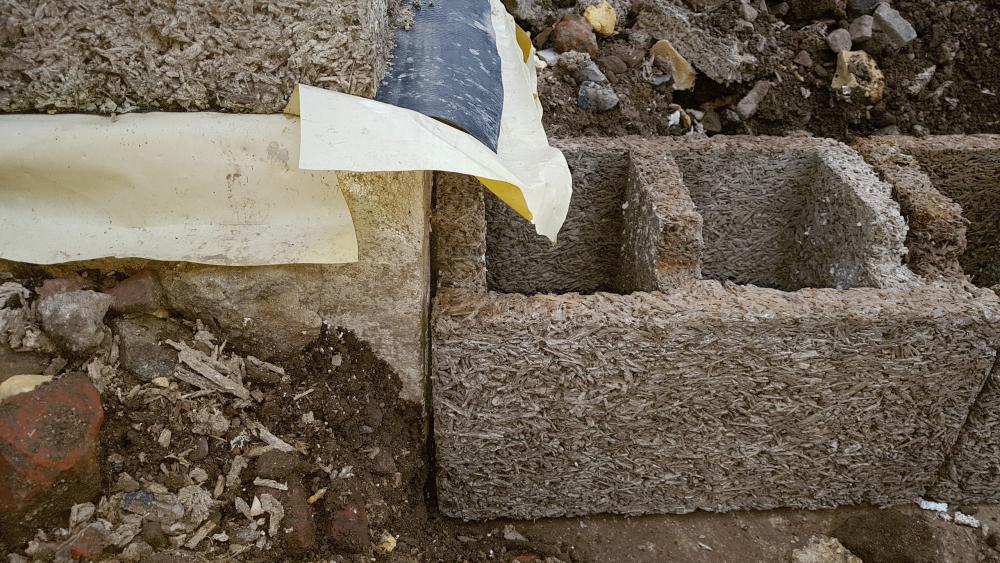
Just about to build the wall connecting our house to the piggery. The wall has a full-on foundation, piles and all (for which there is no need, but thats another story) This is the junction between the house and the wall. You can see the DPC and radon barrier in the house. The wall hasn't been poured yet. (empty Durisol blocks) You can see the EPS300 butting up to the Durisol block. There's a 100mm + gap to make up the wall to the house DPC level. As it's a garden wall, there's no need for the horizontal DPC is there....? But should I run some DPC vertically between the house and the garden wall?