


puntloos
-
Posts
1575 -
Joined
-
Last visited
-
Days Won
1
Everything posted by puntloos
-
What about flying elephants. Sure, they are a myth today but they are one nuclear accident and a bit more climate change away! Seriously though, can someone answer my question: Can a normal, but somewhat specialized cleaner or roof team reach my flat roof from the outside? Or asking it somewhat differently: If someone *has* to get to the roof, how much will this cost each time? Do we need a huge crane and trample all our flowers, or can some strategic ladders get you there? (as a layman, I can easily see that on a 8.5m tall box shape, you can just get a 10m ladder. But since the top of my roof is sloped, a ladder can get you only to that tipping point, no?)
-
Ha, yes, that was the main purpose of the smaller rooflight! But then people pointed out you need a secure fixing point. And then inspect it yearly. And.. My *preference* I think still is to have that secure fixing point anyway but the hassle with building regs team feels daunting, and my architect says I'd need a specialist to design it to be strong enough etc.
-
Seriously though - without roof-access from inside the house, will a normal-ish trade be able to get to the roof and clean, inspect occasionally without having to rent helicopters or an army of drones?
-
Will that be more than @saveasteading's 8000 GBP?
-
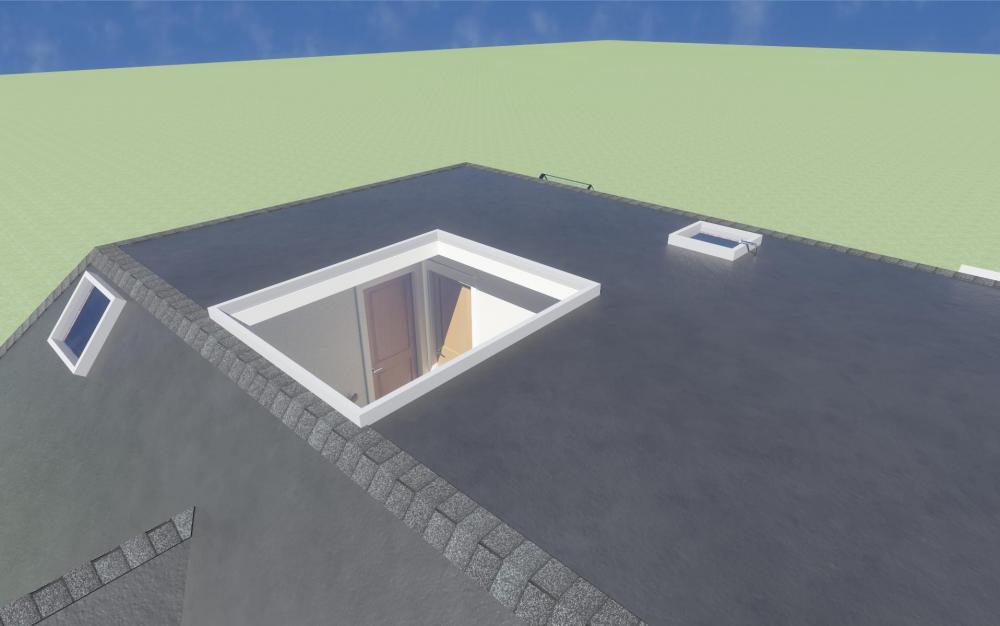
Interesting point. Currently it is indeed a 2x2m opening. I didn't really think of practicalities, 8000 is a lot of money but it is quite a feature Yup. It currently looks like this: With (of course?) built-in shutters so we can block light and heat if we need to. I suppose one alternative is something like this (pic found on the internet) But are lanterns *truly* self cleaning and you have to never worry about them? Surely some inspections, at least the upstand, need to happen?


-
The main thing I can't work out is if the main skylight above a void can be cleaned without any 'easy' roof access. Are you saying a specialist can access my skylight 'reasonably easy' perhaps by standing on the flat garden room roof (top right corner)? Of course I understand it will cost more but that's fine, within reason, to do once or twice a year...

-
I'm looking at this from a super pragmatic point of view, which is that I certainly prefer not to go through the hassle of provisioning a fixing point especially because the cleaner might not trust it anyway. But I'm still not 100% clear under what circumstances I HAVE to provide an anchor point. Which detail would push me from "don't have to" to "have to"? Crucial set of steps/questions: - Do my skylights need cleaning at all? They are flat, horizontal, I can perhaps apply self-cleaning coating Perhaps I can still angle them slightly? Would that suffice? I imagine I'd still have to clean, at least once a year. - If there is no way to access the roof, can cleaners still get to the two skylights anyway? My garden room has a flat roof, but might not look too kindly on having people (and pointy ladder legs) stand on it. From the ground, the ridge height is 8.2m but given that it's a crown roof it's a little harder than if the house were a box It's okay if it is hard-ish and I'd have to pay a premium to the cleaner because of the difficult access but I don't want a situation where they are flat out refusing - If none of my roof windows open far enough to let a human through, it's fine to leave out the fixing point?
-
I'd be inclined to agree this is not great.. but if I understand @pdf27correctly, the reqs require a house to have some type of fixing point? For context, this is my roof: The big skylight is over void, won't be really openable (perhaps to let some heat out but no more). The small one would - theoretically - be usable to get to the roof if one were so inclined. So do you think that the skylights are 'safely cleanable' without providing any roof access? Nah, I gave up on that idea without making it a *proper* terrace which I don't think is worth it. (plus not allowed anyway, I don't think) I assume your question is rhethorical but I'd trust the affixed-to-the-roof one more - assuming it's well-built of course, I have no idea how to make a roof solid enough to be able to withstand such a pulling action....
-
Ah, but the 'snag' then is that the roof itself needs to be able to catch a 100kg weight bouncing off the roof (if I read this site correctly). Can normal roofs hold that from one anchor point? Or would the SE need to design that special?
-
Hi pdf27, do you know what's required for such a "secure fixing point"? Do you have any example design or something for me to look at?
-
Well, if that's the case then why would people use wall ties at all? (I don't know genuinely asking)
-
Thanks @Temp - I think that info is exactly what I need. Indeed, they look a lot more expensive but I suppose in my case it's only for one room so I'm sure it won't add up to a huge sum.
-
So the simplest, and most efficient way of soundproofing is (if you're building from scratch): Wall(block) - void(or insulating material) - Wall(block) But - I imagine these two parallel walls need to be connected to each other else they might fall over? So how would you *normally* attach these two walls to each other, and in the case of soundproofing, would you use e.g. some type of rubberized clips? https://www.tmsoundproofing.com/decoupling-explained.html seems somewhat helpful but they don't go into detail on how the walls connect to each other, if at all. Can they just 'coexist' without any interaction between them?
-

New build floorplans - opinions welcome
puntloos replied to Indy's topic in New House & Self Build Design
Allow me to be somewhat contrarian here and note that it all depends on what you want in your house. Sure, having a nice looking house on the outside is cool and all, and some features (such as the wrap around garden) can be a benefit, if you like gardens.. But .. Guy ate lunch every day in the eifel tower so he didn't have to see the eifel tower. I think function is over form here. You don't actually see the outside of your house. (the council who have to approve it do.. so there's that) But there's certainly also some improvements to be made in the 'filling' design -
Perfect worktop doesn't exist - but how about optimal?
puntloos replied to puntloos's topic in Kitchen Units & Worktops
Hmm, I should look into dekton. I believe @joth has sapienstone which was/is my go-to, its main problem being the brittleness but as long as you don't have big overhangs or perhaps some protective strip of metal (?) around it it might be fine? -
Perfect worktop doesn't exist - but how about optimal?
puntloos replied to puntloos's topic in Kitchen Units & Worktops
Welllll I've had a few wood surfaces and both of them would very very easily stain even after being 'properly' treated. Of course I'm not necessarily talking about right in the middle but for example the place where the sink is embedded in the worktop - there's often waterdrops sitting on that seam and they will make their way into the worktop. Sure, but lemon juice on granite.. define "slightly" - I guess aesthetics are a funny thing, many people like wood (I do too!) but I guess I like "perfection" more than I like wood, so indeed wood with some discoloration or even a small-ish bump in an otherwise smooth surface will bother me. Some people are absolutely fine with a deeply battered surface! -
To understand what the optimal worktop is, you'd have to know what you care about. Separately, it'd be good to know if all worktops of the same material behaves exactly the same. For example - are all quartz worktops equally easy to stain? Does anyone know a list? I'd love to see something like: wood (type?) - easy to stain by water - easy to stain by curry - impossible to crack - heat resistant up to 100C corian - heat resistant up to 200C - impossible to stain by water.. - easy to crack .. etc Or am I wrong? Is there a perfect uncrackable, unstainable, super heat resistant material? Obviously price is also a thing but let's start with does it even exist?
-
Well my sound spectrum includes both I guess. I'm in a fairly nice-ish rental place now and the list of noises that the door handle+latch are making is impressive - but yes it's not *just* one or the other in my particular door.
-
Why are door handles so hard? So many door handles I've had in my life make a ton of noise when turning. <krrrrrr> generic cracking <ping poing> maybe a spring? No idea why springs need to make noise but eh <pop> the latch that pops loose apparently had some tension <shhhhhhh> door that slides across the carpet <squeeee> hinges (ok this I can kinda fix with oil.) How do I find quality doorhandles?
-
FWIW I have Eclisse in my rental and the 'standard' ones we have are actually pretty good in noise isolation.
-
Now put them in ascending order.. You know, for science.. Meh, concrete isn't doing great either.
-
Medium block would be fine though, right?
-
Incidentally, lifespan, I'd note that a timberframe, properly done (rolls eyes) will last for ages, but if you have a tiny leak somewhere, where some spot of the frame gets exposed to long term water.. I could imagine it turning into a weak spot that might require major support to prevent it from killing the entire house frame. With a brick house.. replace brick, drink a cuppa.. Obv take this with a grain of salt, as you can imagine I chose masonry, so now I'm invested in not being wrong
-
I've done the whole TF vs Masonry debate myself. My impression is that the skill of the individual builders is what makes or breaks either. TF is more exacting but if you have a good brickie doing it properly it'll be fine. TF is less audio-insulating but a properly done TF will be fine.. At the end of the day I had a proper QS evaluate my design on doing it TF and doing it masonry and the TF came out about 5% more expensive. Also for what it's worth, clearly having more mass means the audio energy first needs to move the house/wall before it can move the air and start transmitting noise, so a heavier wall (aka block) tends to be more noise-insulating, but again, a properly built <either> is going to be fine. Not worth the huge hassle of changing, which costs. You could apply that cost to buying better wall insulation, or paying your brickie a tip if he does it reaaaaly carefully.
-
Yeah they are super fragile. I assume that if laid correctly they gain the strenght needed by getting the right support in the right places. This also makes me think the curve of the forticrete might actually be intended to create somewhat of an arch structure that spreads the attacking forces (similar to an egg being able to resist much more than you'd think)


