


puntloos
-
Posts
1575 -
Joined
-
Last visited
-
Days Won
1
Everything posted by puntloos
-
 Yeah, Gutmann doesn't seem so good, man. OK I'll see myself out.
 -
A few thoughts: - For me the user interface is crucial. The best by far was an industrial 1-burner induction hob I had (because my rental's main hob was standard electric horribleness). The crucial part about this hob was that it was rated at 3300W and the power level was controlled by a phyisical dial that would go from 100 to 0 in less than a second. I've played a bit with some bora and novy's and while they are OK the sheer precision lacked. I think bora has such dials on one of their models. - Extraction, I'm sure one is somewhat better than the other noise vs suction but I don't think you'll go wrong with most modern brands. - Induction quirks One thing that I think is not fixable but happy to be enlightened is that all induction hobs I've had so far don't do 'low power' well, they just start clicking on and off which is annoying, esp with pasta you see it boil.. nothing.. boil.. nothing.. ergh. Is there any hob that can be precise at simmer levels? - Extractor Design Aesthetics, here the Novy wins hands down because it's situated behind the burners, and it actually blocks the view while cooking. This is an aesthetics point - hiding the 'messy cooking' while you entertain guests - Extractor cleaning - somehow the bora's location in the center feels like it'll have to eat a ton of food spills which doesn't sound good to me. Novy feels better but @SimonM says a pain to clean.. can you elaborate? I imagine you have to clean it fewer times than the bora though, so is the total amount of time you spend cleaning perhaps the same? - Power - I used to think I'd want all my burners to be able to run at 3000W (or above) at the same time, but I've come to realise that I certainly want one burner to be able to do 3000, while I can still use the others at a reasonable tilt (in particular while making soup, if you dump cold-ish ingredients in with already boiling ingredients you lose your boil, and of course you want to get back to boiling asap) What's special about Gutmann?
-
Yes that's a fair point, the centering will be weird if we don't commit to or the other. Will have to take a look how this works out.
-
To be clear - I can still change the .. setback? (thanks @MikeSharp01, I never know these words..) from the current 300 to say 400 as per @AliG - I don't need to store clothing, we've sized our clothing wardrobes properly I think, but "random crap" storage might be lacking in our house. So 400 setback as the default would be a good idea?
-
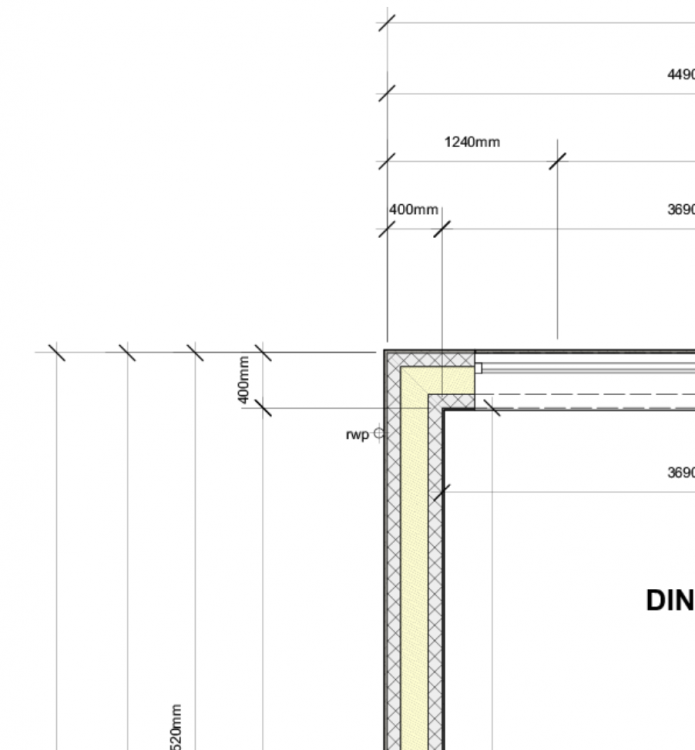
Take a look at this corner of our house design: Very exciting but the question is - if I would want to put a closet along this wall, it'd stick out into the window which looks weird. So - what's a "reasonable minimum" size of stick-out to accomodate future closets or freestanding wardrobes I'm leaning towards 350mm since a small-but-okay freestanding cabinet is 300mm, and I imagine making it built-in requires a bit of a wall so 350? Or would you go larger, sacrificing more of the window?
-
Fan Coil Noise considerations
puntloos replied to puntloos's topic in Mechanical Ventilation with Heat Recovery (MVHR)
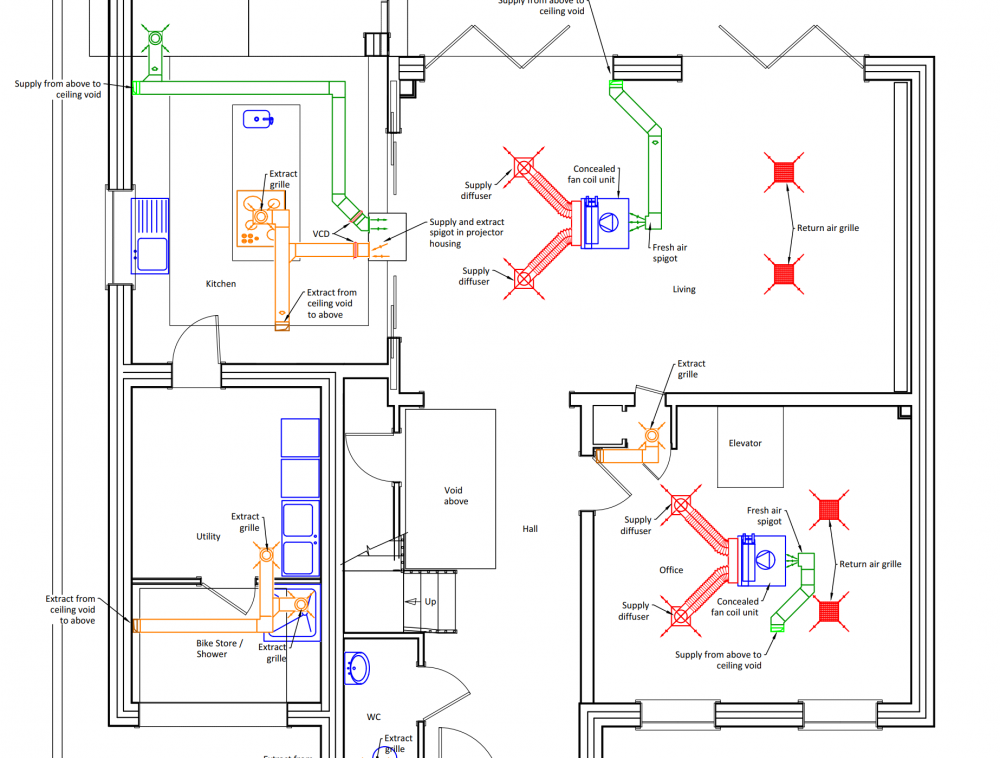
Yep I have exactly the same memory of my office- 2 years ago now. Us humans are very good at blocking out 'constant noises', but well, I can't help but believe this noisy 'landscape' does take its toll. So I have 2 FCU designs by my heating guy: Simple: And Advanced: Which one is better? ? (sorry, now updated)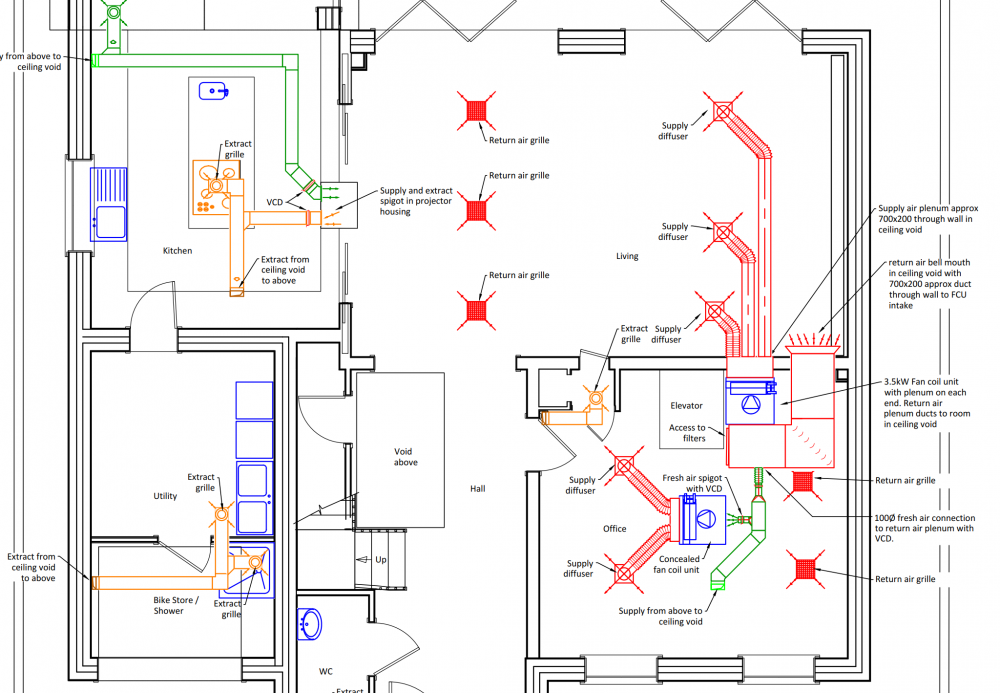
-
A few quick questions. I've been doing some 'noise tests' in my current livingroom which really is close to whisperquiet. Then using a noise meter I tried to compare 22dB to 25dB to 29dB which are the 'lo/med/hi' noise levels my heating/cooling FCU would produce. (note that they don't say, but I assume this is actually 'at 1m measuring distance') My questions about FCUs in particular: 1/ Where does most of the noise come from? Does it come out of the exhaust pipe? The intake pipe? Or is it the entire thing that vibrates and produces noise? 2/ How long can I make exhaust pipes? Clearly if I put a FCU in another room ("the garage") then some of the noise would be pretty far away, but presumably there will be efficiency losses trying to push the air that far 3/ How often is an FCU off? Is it "always on, but on low" or is it "only when needed, mostly low"? I know this depends on lots of factors like the current air temperature vs target temp, how much in a 'rush' I am to get it cooled/heated, capacity of the device, but in "Your average, well-designed, well-dimensioned" situation? Basically any noise in a whisper-quiet room is a bummer. Trying to avoid that.
-
How many sqm of floorspace do I get for 37bn?
-
Also with a block and beam ceiling & masonry walls?
-
It's certainly a great question of what is 'fair' when it comes to how much to charge, how to be competitive etc. When your customers don't know you yet, it's tough to convey that you truly care, perhaps even 'overwork at Greggs' for a customer, while the uncaring competitor charges less, but sticks to the hours to the minute. At the end of the day it comes down to trust, starting small ideally etc. @Gus Potter thanks, yes indeed, not to mention what to focus your time on. As a novice self builder there's just too much stuff for me to wrap my head around. I'm getting somewhat proficient in heating but (shockingly, for a CS/microelectonics engineer) I know next to nothing about electrical, and indeed hardcore construction ('how to build the junction between 2 walls without a cold bridge'). It is very hard to figure out if studying any given topic will pay off the most.
-
So - how would you go about this if you were me? - I've done some work during planning and because we're trying to eliminate cold bridges, the elimination of 'noise bridges' at least is helped somewhat by having similar focus of those 'material lines' rather than the thin fluffy insulation stuff.
-
I suspect that if you set yourself some theoretical goal of xyz dB you'll likely be disappointed. If you stand in room A in absolute quiet, then turn up the bass in room B, you will be disappointed. But "from day to day" I think it will be fine, even if you only do a "decent level of basics".
-
But.. everything is additive, especially due to the way humans turn up the volume on noticing small things once the big things are done. If you 'go nuts with all the trimmings' but leave out say the wall ties, then adding the wall ties will make a perhaps noticeable difference because you're already listening really carefully. But if you *only* do wall ties and nothing else then the result will be completely unnoticeable.
-
I'm in somewhat the same situation - detail design pretty much ready and time to start tendering soon. My(our?) crucial problem is that I don't know what I don't know. For example the resilient bars thing was new to me. Is it in there, if not, has it been considered and rejected for the wrong reasons, the right reasons? How much will it cost to do it after-the-fact etc etc. And that's just one technology that is new to me, I bet there are many more. Then again, some might be too nitpicky for tendering as well, for example Acoustic Wall Ties - they seem to *slightly* help with sound insulation but they surely look expensive, but then again to insulate my room-inside-a-room cinema will probably benefit somewhat might cost say double the cost of standard ties so roughly 150 quid extra.. maybe not worth quibbling over.. etc etc.
-
Still, @Adsibob and @Gus Potter started a good list. Let us continue: This is for soundproofing? I'm not even sure what resilient bars are Why does this matter? Meaning - I get that different products have different specs, so if there's a particular thing you figured out you care about (glueyness!) then sure, make sure you specify it - but not sure if each of us should care about glue It makes sense to have a good idea about the 'heat performance' of your house, but I'm not sure the brand of primer spray needs to be listed for tendering? Why do you think this is needed? Certainly agree everything unusual should probably be listed, but not sure the detail impacts the tendering too much? Why would you want to supply any materials yourself? Are there materials that individuals can get much cheaper than a builder would charge for them? Is there the proverbial "popcorn in the cinema" material that a builder tends to overcharge for? Fair, but as said - heating plan. .. ha.. I think I am wearing my team fairly thin with my level of communication frankly. - but well I am pretty detail oriented and they perhaps under-quoted initially so they might be close to running a loss. I've been reasonable about this though and have paid for extra hours to a point. Can you rephrase that last sentence?
-
One thing that plays is that some detail is not worth it to figure out. For example you can have a complete M&E spec laid out, but they are notoriously changeable, so you might pay 3-4000 quid for it, and then that goes out of the window (to a point) once another contractor gets the job and has to do it. Not to mention that the team who built the spec before tendering have an unfair advantage in how sharp they can price their offer whereas other teams still have to guess and buffer for unexpecteds.
-
Quick ping - How long can the exhaust and intake pipes be to a device like this?
-
Capital Gains on self build value increase
puntloos replied to puntloos's topic in General Self Build & DIY Discussion
Wow, thank you for pointing that out. It wasn't our plan to rent after building but could well imagine it "happened to work out that way" if I didn't know. Gotcha, but nah main plan is to live in it immediately -
Capital Gains on self build value increase
puntloos replied to puntloos's topic in General Self Build & DIY Discussion
Thanks Suzie, yep fictitious but no, it's a normal house, detached, on a small plot (just enough for a small garden). No CIL over here as far as I'm aware. What do you mean? If I were to build then immediately try to sell, fail, then rent..? At the end of the day it is certainly most likely that we will build to live in the place, but its a complex calculation on how much CGT we have to pay on which parts of the (friends rate) rent we charged, actual gains due to market upswing, investment in actually building a new house.. asking an accountant will probably be the right thing to do next. -
Capital Gains on self build value increase
puntloos replied to puntloos's topic in General Self Build & DIY Discussion
I find it funny that France have a reputation for surrendering. Other than that, no plans of moving out of the UK -
Capital Gains on self build value increase
puntloos replied to puntloos's topic in General Self Build & DIY Discussion
This certainly is the case, we own only one home. Slight 'detail' I suppose is what you count as the home, is it the specific stack of bricks? If we knock it down is the new house a 'different home' for some tax purposes? Would literally living there for "1 day" (by at least moving our council tax there etc) suffice? I couldn't find a proper definition of living there. This is still for that 'surrender' option right? As outlined: - Bought mid 2019, while we were in rental A - mid 2020: moved to rental B for covid reasons. - Today is end 2021 so we have not lived in our property for 2.5 years. - Design has happened, but I assume that doesn't count as 'being built' yet? - Actual building works would start hopefully early 2022 -> assuming we do go ahead, would it make financial sense for us to live in that house for "a month"? It would be a huge hassle to cancel our rental, move in, find a new rental, move out.. Good to know. Not sure we need this really, but I guess it's to make sure a house doesn't stay empty while you've moved on? Do you think we should apply for this at this point? Not sure we can even apply since we haven't lived there ever for the 2.5 years we've owned it, hopefully the build will be done at the 3.5-4y mark (early 2023). Will read those! -
Another CGT topic, hoping you will read along and make sure I got this roughly right: Let's assume a few numbers 2019 - Poor quality House bought for 1,000,000, but we don't move in (instead in a rental plus paying mortgage yay) 2020 - Tenants while we design the house 2022 - House price currently 1,250,000 (as estimated by Zoopla) 2022 - Full knockdown & rebuild 2023 - Build finished, total cost 750,000. and then: Option "surrender" - 2022: Give up on building. Sell the house at zoopla estimate, so we make 250,000 (minus rent paid, plus rent received) that gets taxed. Then we move to France. - The 'zoopla estimate' of our house went up 250,000 - I think that's raw capital gains. When selling in 2022 I will have to pay CGT over that 250,000 Option A- "build poorly, sell" 2023: We sell house immediately for 2,000,000 (so pessimistically we don't lose money but the build process didn't really add value either, and we never lived in the house). Move to a hut in Nepal, start a yak shaving business in shame. - We pay same CGT as 'surrender'. The building process had 0 increase in our total money/asset value. We just converted money into bricks. I would say there is no "gains" but does the taxman agree? Option B- "build well, sell" 2023: We sell house for 2,500,000 (because my house design is awesome, and we never lived in the house). I bundle all my buildhub posts in to a book I sell on amazon. - If our hard work does yield more value - we sell for more than original value + cost of bricks & labour 2,500,000 (sell value) - 750,000 (build cost) - 1,000,000 (buy cost) -> CGT paid over 750,000? (250 housing market increase, 500 value over 'brick cost' due to amazing building skills) Option C "build to live" (our actual plan) 2023: We move in 2030? 2040?: We sell (let's say.. 3,000,000) - We pay the same as case B, since the only difference is that the property also increased in value simply while we were living in it, but that's not taxed with your only house? How do we determine which price increase is due to "time elapsing" (not taxed?) and which price increase is due to "amazing building skills" (taxed?)
-
I'm finding myself in so-far-reasonable, but still- discussion around those 'gray areas'. My Architect delivered good work overall, but the points of contention I've run into: - They agreed to design a 'high insulation/airtightness' house, yet with their current design there are still some cold bridges and their design featured very thin walls - They didn't give any details around the tresholds (which is needed to determine airtightness) I've had to tell them to do better on the above points, and I'm a beginner, so as @joth suggested I'll probably have to hire some 3rd party to validate the design, because ha other than a few comments on buildhub I don't know if I've missed any major issues in the house design that will come to haunt me. So far they haven't been unfair when discussing these points. I did make very sure to say I expect the source design files (DWG, VWX(vectorworks) and they have delivered those. I guess before you commit to a contract, call out as many points as you can explicitly.
-
One thing I'm still considering is noise levels. The FCUs are "pretty quiet" - 30db on max, 25 on min. But straight above your head... i'm not sure if it's ideal (my town is fairly quiet). - How long can an air outlet pipe be without trouble? - Will the air outlet pipe still be the major source of the noise? Or will moving the main device into the office be a big noise improvement?
-
There's always 'the next thing'. Even if you get 6E, it will be ages before some, let alone most of your devices (both endpoints and network itself) both support *and* need the next gen. Wifi 6 itself offers meaningful improvements over wifi 5 and is supported today (my macbook pro and newest phone both have it). So yea, I disagree - not to mention wrt your price point - the unifi wifi6 AP is $99 and the wifi5 one is $89.


