


Nick Laslett
-
Posts
687 -
Joined
-
Last visited
-
Days Won
1
Everything posted by Nick Laslett
-
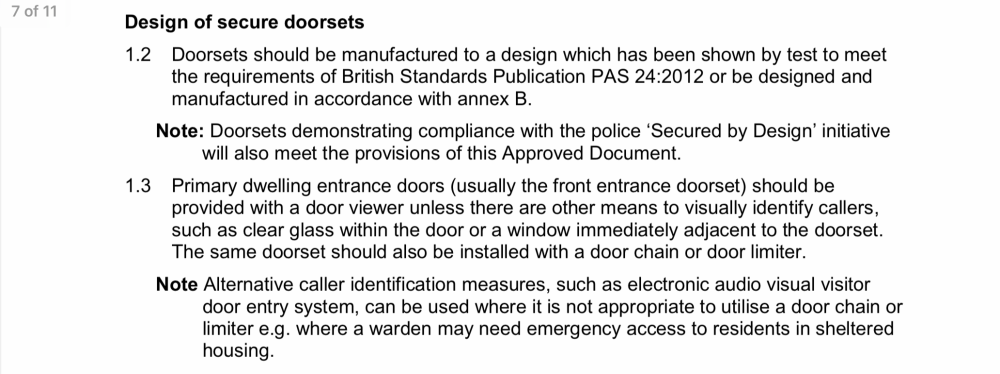
Wow, it is always a surprise to find another building reg, that you haven't observed. My inspector didn’t seem to care about front door spy hole, nor the security chain. Is this actually a building reg? My door supplier never mentioned it. The answer is YES. It gets worse, apparently the DDA Compliance (Disabled Discrimination Act) dictates the height of the spy hole. Sometimes you will need to fit two to comply, eek! Here is the passage from Approved document Q: @Berkshire_selfbuild, you will be alright with a Ring doorbell.
-
I used these guys. https://www.owlshall.co.uk/sewage-treatment/sewage-treatment-plants/1-4-bedroom/premier-tech-rewatec-asp-6-person-gravity-outlet/ Lots of technical support, found them very helpful. The Condor ASP 6 had a few people install back in 2018-19, like @ProDave. Most of my decisions are strongly informed by @Jeremy Harris, who was a strong advocate of many things and had a great blog, that is sadly no-more. This thread is possibly the one that pointed me in the direction of the condor asp 6.
-
Some interesting YouTubes of Fermacell finishing. The second video is a series from a French couple, more general, but interesting nonetheless.
- 78 replies
-
- 1
-

-
- dry lining
- fermacell
- (and 1 more)
-
As an aside, I did an estimate last week, and made my final Fermacell board order, we have 42 boards left to put up. I dread to look back at how many boards we needed for the whole house, my wife and I could only handle deliveries of 48 boards at a time. The wastage with boarding is just heart breaking. But I feel with Fermacell because of the boards integrity you do get to use a lot more of the board off cuts. Our bedrooms are in the roof, so many angle cut boards. I also stupidly made the dwarf walls 1350mm high, when I thought we would use 2700mm boards. At the time they seems to be hard to get hold of, so used 2400mm, but this led to a lot of half cut boards. Not sure we would have been able to manage 2700mm boards, so probably a blessing.
-
I picked up a 2nd hand Mikra Leros with dust extractor early in my build. The extractor works great on my tracksaw when cutting the fermacell. It is essential to use the PDC blade, creates a lot less mess. https://www.makitauk.com/product/b-33685.html I only finished one room myself to understand the process. I then engaged some tape and joint specialists with experience with Fermacell. Observing them and consistent with my own experience; the best method is multiple passes with joint filler, with sanding in between, then FST. They only used the Mirka for the final pass, and hand sanded most of the time. I think this is because they did not have access to the Mirka and it was a different person that did the finishing pass. When I was doing the one room I did myself, it was very quick to just run the Mirka over the wall. I actually found buying the most expensive Bosch multi material blade, was the best solution for cutting out the pattress boxes. EXPERT PAIZ 32 APIT MULTIMAX PLUNGE CUT BLADE https://www.bosch-professional.com/gb/en/expert-paiz-32-apit-multimax-plunge-cut-blade-2867251-ocs-ac/ To echo Garry, the router is also very useful for finishing certain aspects of the boarding. I used the router for corners, door openings, window reveals. It means you can be less accurate with your cuts if you know that you are going to router the edges. A dust extractor is essential if you use a router, most mess from any Fermacell cutting process.
-
@G and J, I believe a competent individual can self certify drains testing. These guys provide a handy web based test certificate. https://wilkinsoncc.co.uk/drain-testing/ https://wilkinsoncc.co.uk/self-certify/ The building inspector should really inspect the drainage and observe an actual test, if he has any concerns with competency and workmanship.
-
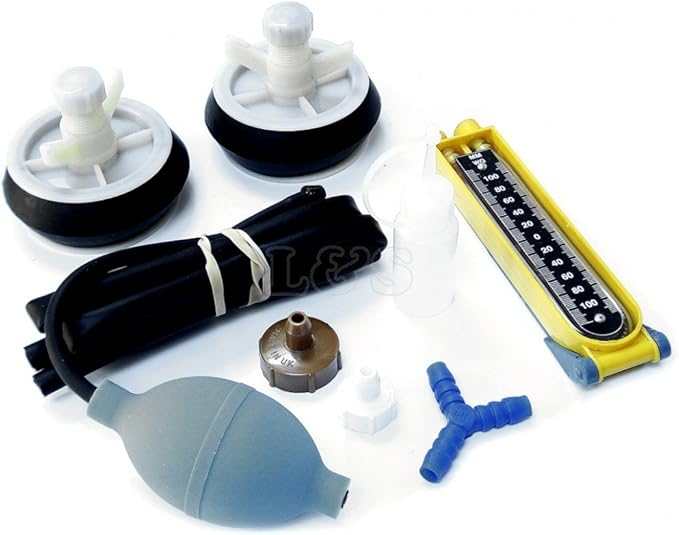
Easy to do it yourself. This video covers the internal test, but also goes over the manometer details, so is useful. Pressure leakage targets are different for the two areas. You can borrow my manometer, tubing, plugs etc if you want? https://www.amazon.co.uk/dp/B076MWGCW3/ref=sspa_dk_detail_1?psc=1&pd_rd_i=B076MWGCW3&pd_rd_w=Un0db&content-id=amzn1.sym.46187d6a-4306-4bc6-830c-7b2085e0e39f&pf_rd_p=46187d6a-4306-4bc6-830c-7b2085e0e39f&pf_rd_r=22G43YJVPT8FHEGD79C7&pd_rd_wg=87pEV&pd_rd_r=17700e09-12af-4429-9c99-74b20425ba8b&s=diy&sp_csd=d2lkZ2V0TmFtZT1zcF9kZXRhaWw
-
Good sound proofing, is a bit like airtightness. The devil is in the detail. Types of transmission : 1.Airborne noise Sound that uses the medium of air to travel through. Common example include talking, music and TV. 2.Impact noise Sound generated by two materials coming into contact, sound vibrations travel through the materials. Common examples are footsteps and washing machines. 3.Flanking Transmission When sound vibrations travel over, under or around a barrier. This could be using holes in walls made by light fixings, shelves or picture hooks. Another common example is pipe work which can vibrate with sound waves and travel between various rooms. You need to cover how each one of these types of transmission will be reduced, with Decoupling, Insulation and Absorption. Other simple wins: Standard doors will undo a lot of the benefit from a solid wall. Sound transmission through down lights. The wrong type of MVHR configuration can also carry sound between rooms. Don’t have plug sockets and light switches back to back in a wall between two rooms. I quite like this YouTube channel. They have a website too. http://www.youtube.com/@iKousticSoundproofing This website has lots of guides. https://soundstop.co.uk/pages/soundproofing-guides
-
Looks great. Continental, good UFH gear. Good luck with the pour. I went round snipping all the zip tie tails. Just can’t bare that sort of thing.
-
@Benpointer, my understanding with the new ‘K’ and ‘L’ ranges is Panasonic doesn’t have a simple monobloc option anymore. You would need the ‘J’ range for the traditional monobloc installation. With the ‘K’ & ‘L’ ranges they come in a kit with an additional indoor component.
-
The warm edge spacer bar is a material placed between glass panes in the TGU. You already have this.
-
Proper surround sound
Nick Laslett replied to Pocster's topic in Networks, AV, Security & Automation
I would recommend Dirac. -
Sorry to be less than useful, I have the Comfopost cooling/heating add on with my Zehnder MVHR. As recommended by Pauls. But my system is not yet commissioned, so no idea if it adds much. There has been much discussion on this topic here at Buildhub, with general consensus that it isn’t worth the money fitting the comfopost. Search on my name should surface these earlier discussions. I am only looking to reduce the temperature of the upstairs rooms in the house by 3°C. I have multiple cooling strategies for my house, but was not aware of the fan coil radiators until too far into my build.
-
Cedral Cladding - Hiding Screws ? Urgent
Nick Laslett replied to Spinny's topic in General Construction Issues
I might be wrong, but I thought you could get screws with colour matched heads Might be a different supplier. I did order some bespoke colour matched screws for my soffit boards. -
We have 3 pocket doors, and I spent a lot of time looking at the various options, Eclipsse is very popular and there are some good YouTube installs. Other systems I looked at were from Portman, Ermetika, and Scrigno. https://portman-pocketdoors.co.uk https://www.ermetika.com/en/sliding-doors https://www.scrigno.com/en/categoria/wooden-sliding-doors/ This was something I was going to install myself, so I spent a lot of time looking at the install guides to see which was the easiest to install. You really want a carpenter that has experience with one of these systems or a specialist that deals with these installs specifically. In the end I did a bespoke install using the sliding door product from Smart Systems Aluminium that matched our French doors. Because I was building the stud walls from scratch, it made incorporating the doors a lot easier. The various kit options do have some neat extra features. Hafele also do a kit which gets a lot of positive ratings. https://www.hafele.co.uk/INTERSHOP/web/WFS/Haefele-HUK-Site/en_GB/-/GBP/ViewParametricSearch-Browse?SearchTerm=+pocket+door&SearchParameter=%26Category%3DhmAKAOsFdfwAAAF.B87iJvmA The point of the kits is that it should remove a lot of the issues about getting everything plumb and true.
-
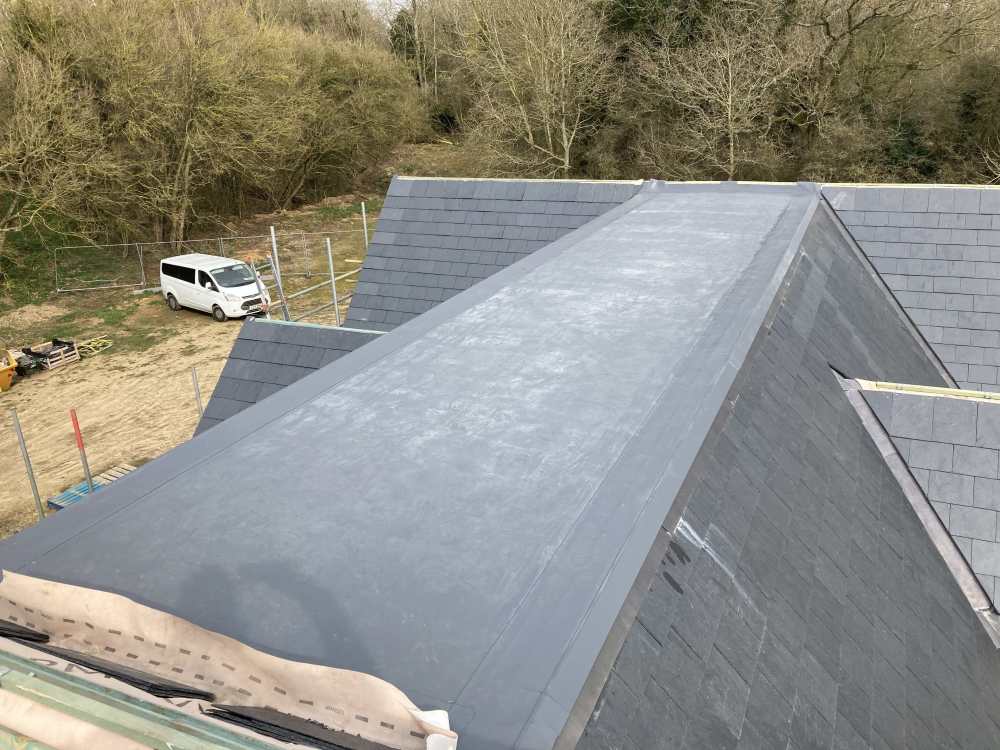
@G and J, good luck understanding the various Sika offerings. Their website is a labyrinthine mess. We have Sika Trocal, which is welded and glued down. But our flat roof is very simple as it is just a table top, chopping off the ridge line. Even Sika Sarnafil has many variations. We have a 20 year Sika Manufacturer guarantee. This is who did our design and installation. http://jcservicesltd.com/services/cladding-installation They talked to Sika technical to clarify the design requirements.
-
Good thread here on this topic. Like most of these discussions, the choice of material is less important than the skill and experience of the installer.
-
@Great_scot_selfbuild, Blogs may not be the primary focus here, but they are still easy to access and follow. What is missing is that the Browse/Blogs tab, just lists the latest blog entries in date order, and you have no way of knowing if this is of interest to you. You can use the website Activity/Search function to just search blogs to find those that might be of interest to follow. Select “Search by Tags”, under Content type, select “Blog”. Enter some tags for topics which match those you are interested in like “foundations”, “timber frame”, “ashp”. You will then see the blog posts that have these tags. Once you have found a blog you want to follow then it is easy to get automatic updates, etc, using “My Activity Streams”. You can even create a custom activity stream just for Blog content. The quality of the bloggers tagging will have a big impact on how effective this type of search of blogs will be, but it is one place to start. Here is the search for blog posts that mention cladding: https://forum.buildhub.org.uk/search/?&type=blog_entry&tags=cladding&search_and_or=and They do try to promote tags, but it is down to the users to add them, here is a plea from the forum on the topic. https://forum.buildhub.org.uk/topic/2783-tags-please-use-them/ When you start a topic, you are responsible for adding the tags, not sure if this can be done after the edit window has closed. So for example this topic could have been tagged with blogs.
-
How to regain traction...
Nick Laslett replied to Mulberry View's topic in General Self Build & DIY Discussion
Hello, @Mulberry View, I was on a long drive yesterday and was thinking about you and your situation. I was worried about your morale and thinking of sending you a positive message. And then this post popped up today. If you can, you have to keep making progress. In the situation where the outcome of the build falls on your shoulders, then you have to move forward. Your situation is a classic project issue, where mistakes create inertia and the whole thing grinds to a halt until this one aspect of the project is resolved. On our build, I was unable to successfully fit inward opening aluminium French doors in one of the upstairs bedrooms. I ripped them out and hired the guys who fitted the front and back doors to fit them. They did struggle, and I think the frame might not have been straight. It was difficult to know if I should have gotten the manufacturer involved and replaced them. Anyway time moved on and it became clear that the French doors leaked when there was rain with a fierce wind from a southerly direction. This probably happens 4 - 5 days a year for our specific house. The inward opening design doesn’t help with the water tightness. At this point the external rendering had been done and it was the following Autumn that the leaking became obvious. To remove the French door now was going to have an impact to the rendering. So I added additional gaskets to the door seals to stop the driving rain leak and drilled extra drain holes in the sill to move the water quicker. This does seemed to have fixed the problem when I tested with water from a garden hose. But looking at the doors more closely, it is clear that they don’t fit the frame correctly, and whether this was caused during the fitting process or during manufacturing is unclear. Basically this specific large aluminium French door is not stiff enough for its intended purpose. These really need to be crittall steel style French doors, which is what we wanted but was way over our budget. I resolved that at some future point we would possibly revisit this issue and replace the door with a better one. We have three more French doors downstairs, but outward opening this time. But I have a sneaky suspicion that when I have my air tightness test they will all leak, outside their spec. I can imagine it would be pretty difficult after all this time to get the manufacturer to take them all back and replace them with better made doors that meet the design spec for air ingress. This is just one of the many flaws that occurred in the building of our house. That might one day be addressed. I appreciate that the situation with your roof is slightly different, but perhaps parking the problem and moving on with the rest of the build is an option. There is no right decision, but only the one you can best live with. The hardest thing is to reconcile these issues in your own mind, when you try to explain your decisions to other people they would think you were mad, but during the build process it is rarely possible to make the right decision at the right time that will pass the test of hindsight, or the judgment of others. I have a more prosaic take on the build process and sometimes even BuildHub can make you feel that everyone is building perfect houses, that they are happy with. This is not the case, and flaws and compromises are everywhere. *Edit: I think @ToughButterCup nailed what I took paragraphs to say in a few good bullet points. He is ever the guiding star for advice here. -
Lots of excellent posts in this thread. For me the cooling aspect of UFH, in concrete with ASHP was actually more interesting. It didn’t seem to get as much commentary. Maybe, the considerations for UFH cooling are basically the same as heating? There is the dew point issue. I put more UFH in my upstairs concrete floor than I did downstairs, purely for the extra cooling. I was always going to have a poured concrete first floor, so being able to use it for cooling was another positive. Like a lot of my buildings choices, this might be a foolish solution for cooling a house. A note about Air conditioning. I spent 12 years living in the Middle East, with A/C running 24/7. Even if you only need A/C for 2-4 weeks a year in the south of England, I was really keen to avoid having to install it.
-
@flanagaj, you would just remove the window restrictors after the house is signed off and you have moved in. @Bancroft Just remember to leave some cross opening windows so that you can do purge venting. I really struggled with some MVHR concepts when I first had to grapple with them. But after 6 years on this forum, I get the strong impression that there is a lot of window opening being used in conjunction with the MVHR. I believe the idea that MVHR negates the need for opening windows, in a UK context is a bit of a myth. But it is a complicated topic, with a lot of different opinions, so please do not take my comments for gospel. 😉 Good discussion here:
-
@EinTopaz, @craig is the forum member with a lot expertise on this topic. A 3G window will perform similar to a 2G unit if the gap between panes is too small, e.g. a 28mm unit will perform the same, whether 3G or 2G due to these gap sizes. For a good performing 3G unit the gap size needs to be 16mm as a minimum. *Apologies if my understanding on this topic has been superceded with more recent developments, very happy to be corrected by those better informed. Good discussion in this thread.
-
@Russell griffiths, @ToughButterCup, great looking houses, gentleman. Well done. I might have seen pictures previously, but in any case, good to see them again.
-
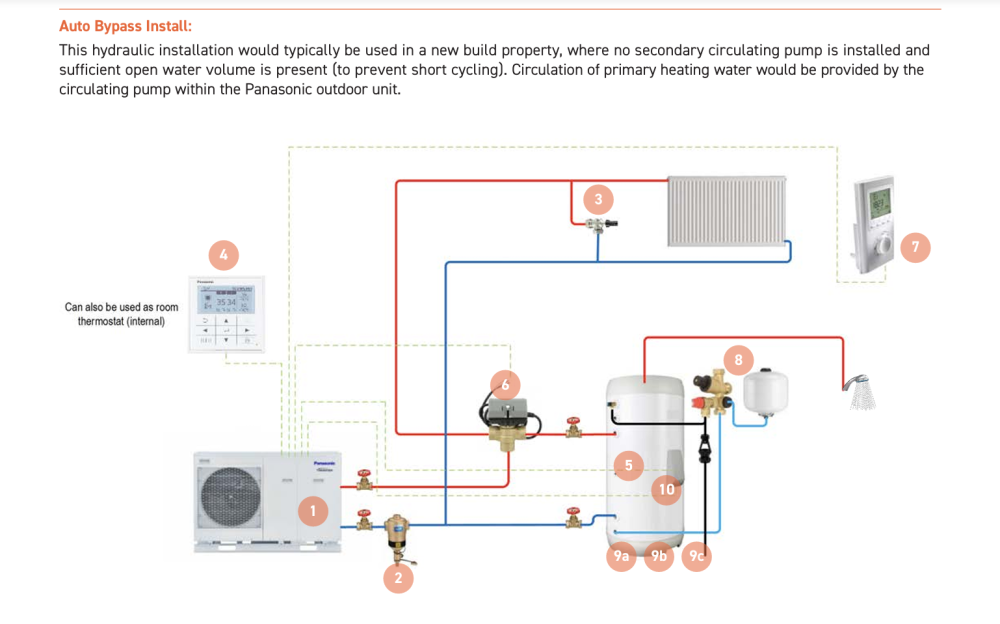
@zzPaulzz, like JohnMo, I did my install myself. Electrician connected it up. I went with Sunamp, to avoid G3. But a pre-plumbed UVC is easy for a G3 registered plumber to fit. Just a days work. We had a UVC fitted in our rental to replace the gravity fed system and it took the plumber a day. Secon Renewables have all the guides to most major brands. https://www.seconrenewables.com/heat-pump-technical-manuals-962-c.asp I went with Panasonic because at the time I thought their install guide was the easiest to understand. For a new build, you will be designing in the requirements for the ASHP. I can appreciate with retrofit there is more value a heating engineer can add. Questions like heat loss, water volume, etc, you should be able to answer, so spec of ASHP is much easier. You will also control how all this stuff comes together, so UFH manifold, UVC will all be in same place. The ASHP is only 2 pipes, 2 power cables and a control cable.
-
Take a look at this long thread, where many forum regulars from back in the day have a discussion about MVHR cooling.



