joth
-
Posts
2861 -
Joined
-
Last visited
-
Days Won
5
Everything posted by joth
-
What exact make/model of charge controller do you have? It may have built in state of charge monitor, but there's dozens of pages of them on that website. Alternatively you can add a stand alone battery monitor like this that has a relay output that can be configured to flip on when the battery is below a certain SOE and off again when it's above a high threshold. If the generator has a remote start input and also charges the batteries when it's running this should be all you need. https://www.photonicuniverse.com/en/catalog/full/505-Victron-500A-12V24V48V-Smart-Battery-Monitor-with-Inbuilt-Bluetooth-BMV-712.html
-
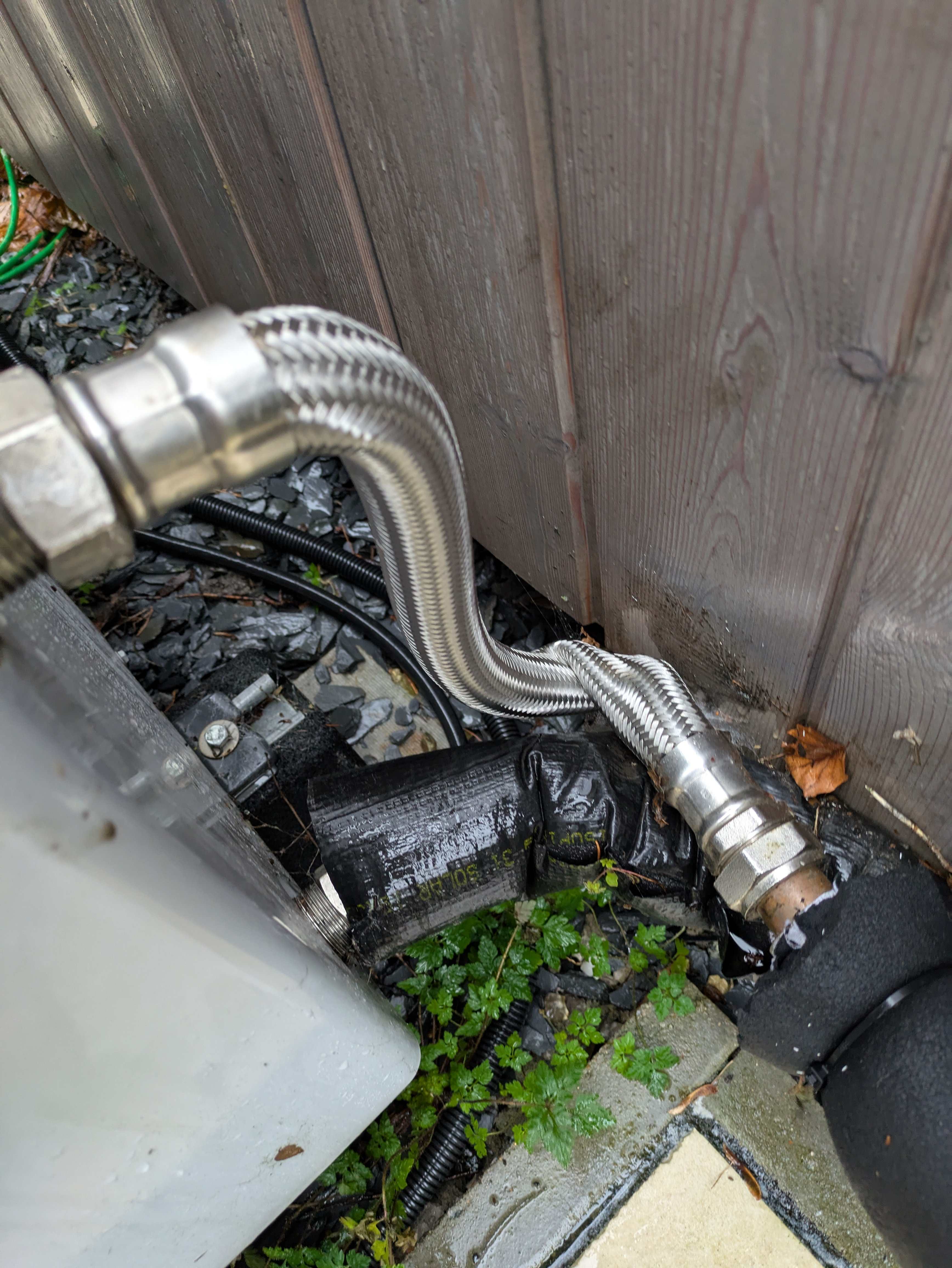
Finally got some real progress on this. I decided to check the flexi pipes again, and after removing the insulation jacket discovered this It was incredible how hidden this was under the insulation. The fact the flow decreased over time suggests it was slowly twisting itself into this shape, and May - Aug is cooling season so perhaps these flexi pipes are more prone to doing this when cooling rather than heating. (I think the issue was introduced when I had anti-freeze valves installed the year before). Disconnecting the pipes from the outdoor unit and running mains water through the circuit, the (existing) flow sensor started reading 1-2V (so 10-30 l/min) again, but with the flexis connected to it (open to air far end) it would stay stuck at 0.3V which seems it's base output for flow rate below its minimum sensitivity. So The existing hose seems permanently kinked, doesn't seem like it can be salvaged. I've had a minor heart attack looking at replacement prices. Over 200+VAT at City Plumbing! The "MCS compliant" tax is strong. These looks better. https://www.bes.co.uk/inta-pre-insul-heat-pump-hoses-1-bsp-f-swivel-elbow-x-28mm-comp-x-750mm-pair-26190/ Longer hose to avoid the sharp kink, and I'll cut back the feed pipe a bit, to try and reduce the increase the radius.
-
On the electromechanical side yes Loxone TRVs do support fine grain modulation, although I'm not convinced the software would do what you ask for out of the box. AFAIK the self learning is just about time to reach comfort, not keeping the eco setback temperature satisfied with a constant minimal valve opening. With enough patience the software can be configured to do this though. Next disclaimer: for cost and reliability reasons I've always gone with conventional on/off actuators (or self-balancing actuators) on UFH zones, but I'll be using the modulating TRVs on an upcoming project using rads. It'll be interesting to see how they compare.
-
Fwiw in a conventional UK house (poor insulation, no active cooling) this is easy to do with Loxone TRVs: use an eco temperature setting for the room overnight and then a comfort target temperature at getting up time. It learns the typical room warmup rate and will start preheating the room at the appropriate time prior to wake up. (Or bed time, or home time, or whatever regular schedule timings is set for comfort). It takes some more fiddling to have this play nicely with overnight cheap rate batch heating (which is of course in intrinsic contention with wanting cooler rooms at night) and to deal with defrost cycles (but that's largely because heat pumps lack a clear instruction & signal output for "I'm doing defrost or freeze protect, please open all zones"), it's not out of the box ideal for heat pumps, but it's very configurable so technically doable. Regarding a TRV designed for heat pumps, I know startup aiming at this https://www.adiathermal.co.uk/ (Disclaimers: i install Loxone systems. An ex colleague is cofounder of that startup)
-
I believe DamonHD is the founder of OpenTRV https://www.theregister.com/2014/08/25/doing_my_own_ting_making_money_from_a_startup/
-

OVO which tariff first before heat pump add on
joth replied to connick159's topic in Air Source Heat Pumps (ASHP)
hahaha good to know. keeping on top of their tariff salad is a full time job https://octopus.energy/help-and-faqs/articles/which-export-tariff-can-i-combine-with-my-import-tariff/ -
OVO which tariff first before heat pump add on
joth replied to connick159's topic in Air Source Heat Pumps (ASHP)
@Luke1 no worries. I eventually got the ASHP back online (documented elsewhere on this forum), and on Dec 30th E.On completed the switch over to Next Drive tariff so I believe I'm now seeing the savings expected. I say believe, because as you say the eon website/app is rather lacking so does not confirm meter reading or daily charges between billing cycles it seems. Cynically, I think they intentionally take >14days to register new users on the discount tariff, as that's the statutory cooling off period so this way they have the supply switch locked in before confirming what you'll actually pay. o/c I could still switch back, but my previous Octopus tariff is not offered anymore (Go, with Octopus outgoing for export) so I'd never get the same deal again there And totally agree, with fixed tariff "economy 7" pricing like this, and SEG, there's really no incentive for me to move to a dynamic / intelligent type tariff. ~2p per unit of heat delivered is stupid cheap. -
Well that part I've emphasised is not true: keep with a Loxone install (per my original suggestion) and there's hundreds of certified partners in the UK that will maintain it after you're dead and gone. They are more concentrated in the affluent south so definitely avoid it if in the North, for now. OTOH if you're in Netherlands you can't leave your front door without tripping over one lol (I don't know what a mod box is, but the modbus extension is a standard Loxone part any competent installer will know their way around) To the wider point, totally agree KISS is much preferred to complex controls, but that ship sailed long ago in this post: adding ASHP to a existing dual fuel Gas + Solar thermal system is anything but simple. Hence the suggestion to use one of the more (the most?) established control systems for more complex domestic HVAC scenarios.
-
Totally agree I avoid anything with public internet dependency. Where possible I avoid wireless and network dependency of any sort for critical functions like heating and lighting, which tends to steer towards a hardwired PLC like Loxone for those things rather than Shelly / HA. I have a growing army of shelly devices and been running Home Assistant for 8+ years, it's great for a lot of stuff but find it takes much more hands-on tinkering to keep working, ymmv
-
Couple thoughts Running Cost savings Forget timing ASHP usage for when COP is above 3.5. You won't know when this is without firing it up and measuring and then if it's not at the target you've wasted electricity finding out. Instead get a flexible or dynamic import tariff, e.g. octopus Go or eon Next which is 7p/kWh for 7 hours. This gives 2-3p per unit of delivered heat for almost a third of the day: not just cheaper than gas, but cheaper than gas heating has ever been. In a well built house this can provide 99.99% of the heating requirement. Controls Having setup a few complex systems I can't imagine doing it with anything other than Loxone or an equivalent customisable and programmable system. This integrates with everything and can fully automate selecting the most cost effective solution at the time. Also integrates well as an Aircon control if that's ever ok the cards Not cheap and a serious learning curve (or more cost in having someone else set it up). But a mini server compact, modbus extension and 32 waveshare relay could be done for under £400.
-
Opening windows is generally a requirement for building regs. But Non-opening windows do tend to score better on phpp, not because of airtightness but because they have less frame. If the frame has a lower U value this is a big deal. We went with one non-opening picture window 2x2 m for this reason, don't think opening would have been practical anyway. But the room has plenty other fenestration too
-
Bit of an inconclusive update. Got a replacement flow sensor today, but was unable to install as the pipework is clamped so tight around the existing one I can't open the threaded connectors out enough to remove it. Decided that's a job for after the holiday. But then noticed the instructions say it shouldn't be mounted up downward flowing pipe, only upwards or horizontal, which perhaps is the cause of it failing. Firing back up the FTC controller then failed in error code EE, comms failure with outdoor unit. Checked all wiring, all seems fine. Did many power cycles to no avail. Eventually re enabled the flow sensor dip switch 2-8, and it boots right up. But now I'm back to the L9 error whenever it tries to do any work. It's four years since install.
-
OVO which tariff first before heat pump add on
joth replied to connick159's topic in Air Source Heat Pumps (ASHP)
I signed up on Thurs so you should have a referral incoming. The switch over went over very quickly, just over 24 hours. Predictably enough, they're having trouble connecting my smart meter so I'm on the standard tariff over Christmas. And even more frustratingly, for completely unrelated reasons I rebooted the ASHP this afternoon, and for unexplainable reasons it's failed to reconnect to the outdoor unit; ecodan communications error code EE whatever I do. So now I'll be spending Christmas paying 26 p per delivered kWh of heating/DHW, rather than the 3p I was on a couple days ago. All I wanted for xmas was a 900% price hike. Not. Sometimes I really should heed that distance voice whispering "don't tinker with it, just leave working shit alone". 🙄 -
Well if the difference is 5m3/h that's about 30 watts for deltaT of 20 ° so not exactly killing ya. And that's probably just biasing the direction of flow of the natural air changes due to imperfect airtightness. The (pessimistic) MCS method has our house natural air changes at 200 m3/h for comparison
-
Your numbers look right. MCS uses an "Air Change Factor (W/m³K)" of 0.33 which is basically your 1.25 kg.m-3 * 1 kJ.kg-1.K-1 in watts. Then multiplies that be (volume x delta-T x ACH). The empty MCS calc can be downloaded here if you'd like to play more 😄 https://mcscertified.com/wp-content/uploads/2024/12/MCS-Heat-Pump-Calculator-Version-1.10-unlocked.xlsm Basically, it's a very big room.
-
Agree -5°C seems low for a design parameter, but also I can't see how it's consistent with other energy loss rates from the same table. E.g. for the external walls we have 99÷(0.15×20.5×2.3) = 14 K delta T. Which yields is 7°C OAT What gives?
-
OVO which tariff first before heat pump add on
joth replied to connick159's topic in Air Source Heat Pumps (ASHP)
OK super useful to know. I'm about to pull the trigger, but want to confirm that i can get export with them too. Looks like I should be eligible for the 16.5 "Next Export Exclusive" which is 1.5p better than I have with Octopus https://www.eonnext.com/electricity-and-gas/smart-export-guarantee clearly EOn on a major customer share land grab; I'm sure these prices will revert in a year or so, but seems worth making use of in the mean time. I've looked at the EV again... about 10k£ to upgrade for a similar estate car to our ICE (well, definitely downgrade in performance, 280 down to 160bhp, and lose AWD and a foot of boot space) which will take 8 years to payback, as we only use it ~5000mi per year. Hmm -
OVO which tariff first before heat pump add on
joth replied to connick159's topic in Air Source Heat Pumps (ASHP)
This is very interesting. I'm on Octopus Go, which recently increased from 4 to 5 hours, but 7 at a lower rate again would be very useful. I can almost certainly stop driving the heatpump so hard during cheap rate and still meet daily requirement from the cheap window. How strict are they about EV ownership, and how do they verify it? I fully intend to get one someday but it never seems a priority or justified. -
Yeah, if the ASHP is driving ufh only then you don't really need mixing valve. Is it adjustable? Else you're just stuck with whatever it is set to
-
L9 error with Mitsubishi ecodan heat pump
joth replied to Michel463's topic in Air Source Heat Pumps (ASHP)
This comes up every few months. Probably more now it's winter and working harder Here's my experience Despite all the advice to the contrary, after trying everything else I just disabled the flow sensor dip switch and it's seemingly been working fine ever since... I'm trying to get hold of a replacement sensor to swap in and confirm if it's the fault. Unfortunately they're expensive and hard to get hold of 🫤 -
You can't use a double check valve or similar as there's not guaranteed to be enough pressure in an overflow situation to open it. Drains normal stop back flow using gravity, that's essentially what the standpipe is for in your setup, and in a washing machine outlet, and the tundish mentioned above is essential the same idea. The problem is water softeners don't have much vertical drop hence the very crammed standpipe and risk of it filling up and syphoning back. Our softener is installed on a meter high pedestal to give more drop
-
Just to clarify, I also think it is condensation. This normally forms at the coldest spot on the wall/ceiling, and a thermal bridge is most likely cause of such a cold spot - hence my question. (I wasn't meaning to suggest there's a penetration that moisture seeps in through, just any break or simply a thinner patch of insulation would be prime cause of a slightly colder spot )
-
Are there any penetrations through the kingspan that maybe creating a thermal bridge? How is the membrane and plasterboard supported? You could get THERM modeling done to identify thermal bridge condensation risks, but that's normally pre build activity. A thermal camera maybe quicker and cheaper at this stage, especially with some nice cold days coming up
-
No refrigeration pipework makes self install much easier
-
For ground floor install that makes sense but I think a lot of attraction on the DIY install is that can be done on any story of a building with no external works needed. (I'm struggling to remember how the external grill is installed and made good from inside, but pretty sure I saw video of it being done) Then just plugs into a wall socket.