joth
-
Posts
2861 -
Joined
-
Last visited
-
Days Won
5
Everything posted by joth
-
 So this bit ^ I definitely like. How the shaft is ventilated is the tricky bit. It needs a different strategy for mid winter vs mid summer. If I was doing this, my own inclination would be: 1/ vent the shaft into the loft 2/ use a high power variable speed fan to purge the shaft into the loft as/when needed 3/ ensure there's a clear "return path" from loft back to the network cupboard via the hallways and living spaces, so this excess heat gets best chance to percolate around the building a bit in winter. This maybe just a dedicated open grill from upstairs hallway into the loft, or use the service void all around the perimeter of the house, or something else. 4/ have the 20L/s MVHR extract in the loft rather than in the shaft, to keep the systems somewhat isolated (avoid risk of shaft purging reversing the MVHR flow) but still allow MVHR to contribute to moving this excess heat around. 5/ have an automatic opening roof window in the loft to stack purge the whole lot overnight in summer. Ideally this is coupled to another automatically opening window/door somewhere downstairs to maximise the stack vent effect. (An electric opener on a small fanlight window somewhere might do it. Ideally something hard for cats / burglars to get to) 6/ Think a bit about how FCUs can help if there's a genuine heat wave (>25ºC overnight for several days) and the loft is never getting cooled. By no means is that lot ^ a proclamation of how you should do it! Just working through my own thinking process on it.
 -
For you, yes, yes it is. I know you. Always after the latest gizmo or whatever. In a few years time you'll change your mind again when some other new thing comes along and then wish you'd done it. IIRC it was about £3k for us to go 3ph and I didn't --- mostly because of the extra project risk having to close a main road before works could begin, but I really should have just sucked it up and done it really....
-
Death of MHRV unit
joth replied to DaveAndAnnaUK's topic in Mechanical Ventilation with Heat Recovery (MVHR)
Post it on YouTube and put the link here? Various file sharing sites could also work (Dropbox et al) but they're a bit more bother to use. you may be able to share it via photo sharing platform of choice (Google Photos, or whatever the Apple version of that is) -
Or install 3G, 4G and 5G antenna on the masts? Or even maybe reuse the 2G antenna for 4G, given the spectrum reallocation and software defined radio they'll soon be making this sort of change without any site visit. It's not like yodafone is going out of business.
-
Er I think we're going in circles here: see the OP and my first reply. Vodafone are turning it down from 2023, but O2 (as used must M2M users) will be years longer, not least because smart meters depend on them
-
Hopefully? The main driver for discontinuing 2G support is to free up the big blocks of spectrum they use (900 & 1800 MHz) for the much more space efficient 3G and 4G protocols. /me makes note to self to replace the Car and Cat GPS trackers by 2033.
-
Ecodan W60 R32 and cooling and pipework layout?
joth replied to jfb's topic in Air Source Heat Pumps (ASHP)
I can't vouch for that exact model, but we have the 8.5kW one, which also uses the FTC6 controller, and that does support cooling. As you suspect, it's a dip-switch flip inside the controller to enable it It depends on the heat emitters. Conventional (non-fan) radiators would really struggle. UFH can work at a very low and slow level of cooling. Fan assisted rads / FCU can work well if all sized correctly. We used a standard schematic, 2 position valve to switch between heating and UVC, nothing stands out as being designed for cooling. We used an electronic motorised mixing valve for the UFH, which allows it to adjust set point for cooling vs heating mode, but this is a standard supported design for the FTC6, recommended when using it for 2 heating zones with differing flow temperatures, regardless of enabling cooling The key thing is ensuring that ALL pipework, valves, pumps, etc are fully insulated/lagged so no condensation can form anyway. Also ensure you have a buffer tank sized for the cooling as well as heating pattern.- 1 reply
-
- 1
-

-
UK Smart meters use Telefónica / O2 as back haul, so it will depend on their turn down timeline. That said I think UK govt are planning to withdraw the license for 2G spectrum in the not crazy distance future. There's some lightweight analysis of the issues in https://www.stark.co.uk/wp-content/uploads/2020/01/20200801-Response-to-the-2020-consultation.pdf (section 5.4) and https://www.smartme.co.uk/technical.html claims that the meters will be exchanged for 4G versions by 2033. (Why not 5G I ask myself...)
-
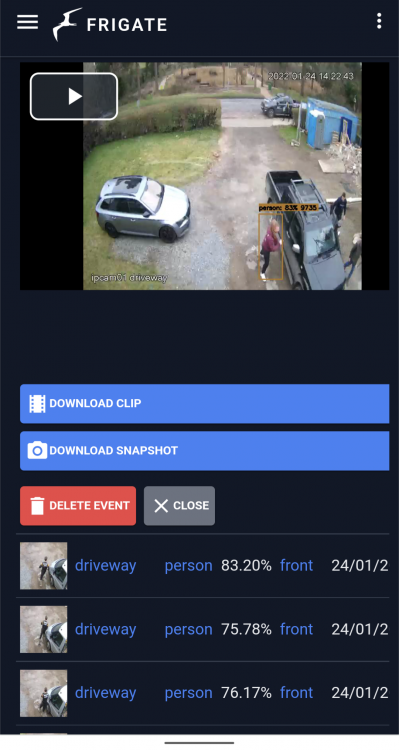
I recently set frigate.video up on the old server PC for CCTV recording and I'm very impressed with it. Planning to turn down my windows machine currently running BlueIris on. Frigate uses Tensorflow for real-time object detection, and works best with a coral.ai EdgeTPU. They're difficult to get hold of now (global chip shortages) but I did manage to but a M.2 PCIe one from RS. Two adapter cards later (M.2 R key to PCIe mini, and PCIe mini to PCIe standard!) and it's working very reliably. But for simplicity definitely get the USB Dev dongle if you can! Constant image detection hardly adds any power demand to the 50W this machine already draws (mostly on 6 spinning disk raid array) so I will knock 40W off my base load by turning down the other windows machine. Configuration took a bit of tuning, the cameras have substreams and it's best to use those for lower res feed for the image detection and then it will record clips from the corresponding high Res (8MP) feed when anything is detected. The built in webui is simple but very usable, far better than the clunky android app for BlueIris, or the QNAP NVR I briefly tried. Good MQTT support and a premade Home Assistant integration so easy to build into other use cases. I found the driveway PIR I installed was false triggering the front lights all night, so I've disabled that and instead use the "person" detector from the CCTV, covers a much larger area with so far (2 weeks) zero false positives. We have a shared driveway, with the zones and masks and detection I can easily set it to only trigger when someone walks on "our" side of the driveway. Great fun! I've set it to detect other interesting object types (car, bicycle, cat, elephant) but I think I'd need much higher res detection stream for cat detection to work, and our street is disappointingly devoid of wondering elephants.
-
To clarify, I don't find them unusually or notably ugly. Just stating that, objectively, they are ugly. In the entire history of houses, I don't think anyone every put a big oil tank in front of their house to add aesthetic charm or to enhance the street-scene. So my conclusion is they are at absolute best aesthetically neutral, and on average will detracting from the visual appeal of the property.
-
This is a really good point. Front of the house also has road noise so putting the heat pump out front helps mask one with the other. I think it's only controversial because it's uncommon. Cycling around rural villages I see plenty of ugly oil and LPG tanks sat out the front of cute looking cottages. And ugly TV masts, satellite dishes and telegraph wires/poles. It's just a matter of time for heat pumps to become common enough that people don't notice them so readily
-
No, by switch I mean replace, exchange, unplug one and plug the other one in instead. FTC has a Single port so you can only plug in a single adapter at any given moment in time.
-
You can switch, but you have to buy new adapter at about £100 each.
-
You're still in the pre-tender design stage, so aside from the time investment there's little downside in leaving all these luxury items in, and then value optimising them if needed post tender. That's the best way to get the data you need to cost/benefit it all. (There maybe some indirect signalling to the tendering companies that, with this much luxury items, they should change a few % more on every item as you obviously can afford it (like the old adage about hiding the Mercedes before getting a trade around to quote), but TBH I think they can get 98% of that signal from floor area+postcode alone. I mean, it's not like you're including a basement swimming pool or something)
-
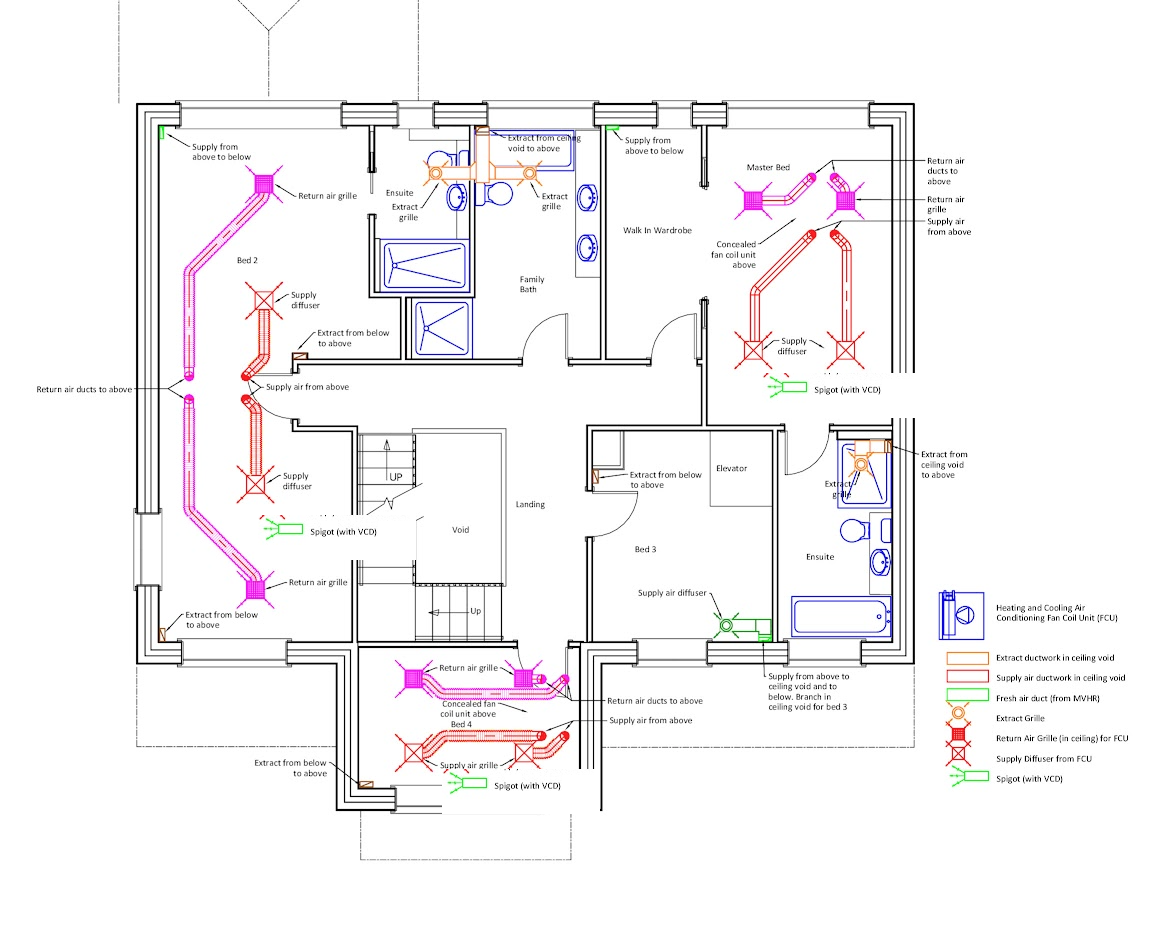
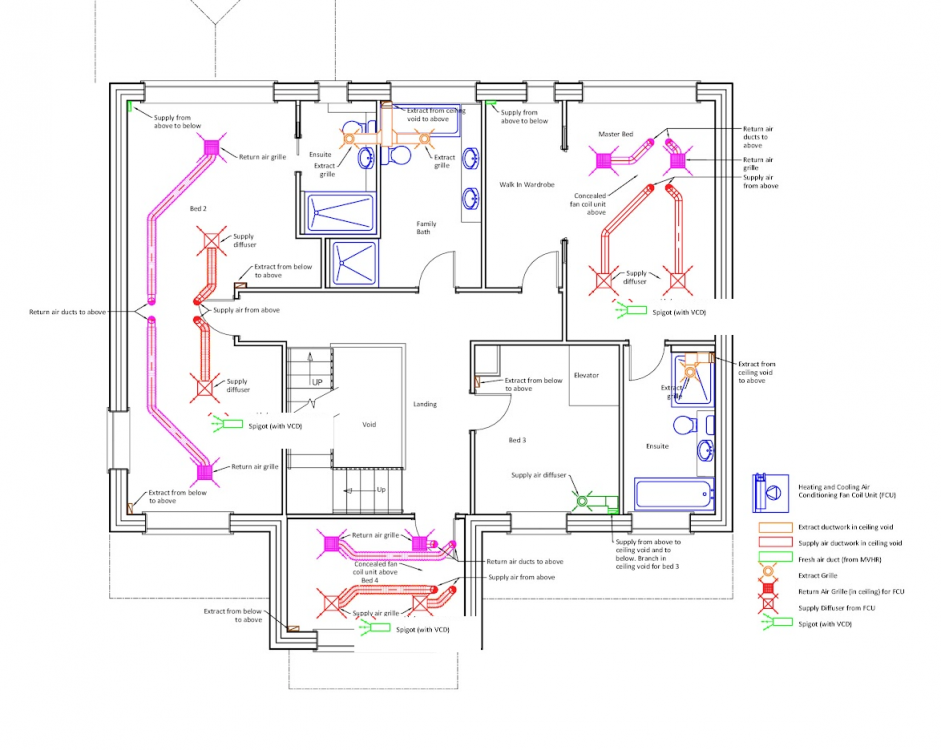
Indeed, I understand how the design works, the fact each FCU is a closed system per room makes it elegant in many ways, but just saying unless you already have someone lined up to install it that has done this before, don't be surprised when there's lots of head scratching at install time, and potential for screwups. Tbh the whole M&E install will need a lot of oversight, if you're heating guy is on it that great, or maybe he's just specing it extra complex to ensure he's retained for the duration, I can't tell. Btw I was distinctly underwhelmed by the MelCloud app, and if it can intelligently coordinate across controllers then it is doing so via the cloud so be aware your heating may go wild if the internet is down/server maintenance/they discontinue the service. Unfortunately the FTC6 only has one controller connection port, so it's WiFi *or* modbus control, the latter being far more appropriate for a real BMS brains to drive it via.
-
Exactly. The element gets red hot, about 600°C. So at that temperature it only needs to move 2 l/s to dissipate 1000W. For another extreme example, imagine (just got a moment) me on my indoor stationary bike. My body can't deal with overheating by more than a couple °C so even though I'm only putting out a couple hundred watts, I need a gale force strength fan to keep cool.
-
Close? My Google calculator says 80 l/s but I'd love to know if there was a bug I made it that - I can't see it. My MVHR on normal setting moves about 4 l/s per vent. Right, that is exactly what I was saying was my suspicion too. You asked for feedback on the design, and that was my feedback: this is a more complex design and likely more complex (=expensive) to balance and commission and maintain, and could still unbalance the MVHR if the FCU is on full. If you couple the systems like this, you'll definitely want a single installer commissioning MVHR and FCU (and so presumably doing both ASHPs too) else you'll get never ending buck passing between the trades.
-
Remember there's a range of ways to move 1000W through air, from a small amount of superheated air though to a lot of slightly warmer air. Your electronics will thank you the cooler you can keep them, thus toward the higher volume, lower temperature end of that spectrum. I think that's my main point: to move 1000W at acceptable temps you need very considerable air speed. yeah higher chance of short cycling, but your buffer should solve that. at some point it becomes a lot large twin fan beast and eyesore, and around then it also demands 3ph, but 8 kW seems a sweet spot. You'll probably want 3ph down the bottom of the garden anyway, given the amount of plant you're hiding down there. /sub I'm interested in this too, mostly looking at 100L as that fits in the space I have. There is some rule of thumb about 10-15L per kW of ASHP (IIRC?) but the real answer is calculate smallest emitter size (UFH of your smallest zone) and then either look at the water volume or kW mismatch to the ASHP spec when just that is in use. I'll see if I find the links again Anyway for now, for tender I'd say put in 150L and you can reduce it if needed when you get into the detailed layout planning before ordering. Maybe I wasn't very clear. Then normal idea is bedrooms (and living rooms) only have MVHR supply vents, never extract. My point is Bed 1, 2 and 4 don't have a supply valve at all - it's in the loft at the FCU intake, so may not make it to the room if the FCU is not running. (or if hard tied to the FCU plenum, risks unbalancing the MVHR if the FCU is put on full) My preconception said it would normally be done like this:
-
It'd be Option 1 for me, or option 2 if you have more showers in the new second story and think multiple showers need to run at the same time, or the DHW runs will be very long to those showers (a UVC allows for secondary circ) Presumably you don't have a working boiler already that could just be moved? Can you get any EWI onto the downstairs walls now? (or as a separate job in future, which maybe VAT 5% if not done as part of the larger works). It'd make the ASHP future that much more attractive, and reduce running costs/impact of staying on gas. And, if at least designed into the profile of the new upstairs wall the EWI can be done in a less obtrusive way.
-
Actually now I think about it we put in a 75mm high PIR upstand around the perimeter to keep the screed off the walls. The upstand was actually all put in first so the horizontal boards propped it up
-
Presumably the DPM will ensure nothing can get into / under the PIR+EPS sandwich? We had DPM under the insulation so taping was a lot more mission critical. Again DPM should mean it's not necessary, but you might want to anyway just to help pin everything in place? I doubt the aluminium tape will hold on the block work/concrete though unles you cover it with sprayon primer first? Feels like a job for heavier tape.
-
You can achieve the same thing with a pair of WRAS approved solenoid valves https://www.solenoid-valve.world/shako-co-ltd/12-wras-solenoid-valve-0-7-bar-22-nclosed-brass-pu220d-04 In fact for this application you'd probably get away with one valve: have it permanently feed back into the 2nd return high level port, and optionally injected via the solenoid valve into the cold water inlet. That will effect the desired tank agitation even if only a small % of the circulated water actually returns via the cold inlet. You could also do this with a dedicated pump from the top to bottom of tank independent of the secondary return loop. Whichever way, just make it's sure it's all happening downstream of the mains no return value ?
-
If you drive it from motion detectors and temperature probes in the tank, it becomes a software problem to chose the correct trade off of stratification vs maximum storage requirement. This is what I went with: install the hardware (pipework at least) during the build, decide when to turn it on (if at all) later
-
You don't need to run the water up to the loft and back down again, just use a 2-pipe buffer tank, and install primary sized (22mm IIRC?) pipe from the hydrobox up to the buffer in the loft. Tap the two manifolds off of that pipe as it passes them, with a 2-port zone valve per manifold. This is *almost* what my installers did, except they reduced the pipe size on the final branch to the loft as it "only" has a single FCU on it, but that makes it tricky for me to upgrade to more loft-hosted FCU or to add the buffer up there. I should have insisted on using full size pipework right the way through. But yes with the buffer tank I can see lots of reasons it might (one day) prove useful to have it, but very little downside to adding it right away. Especially as you have a split system so don't need any glycol in the system.
-
It's been done before! https://cleantechnica.com/2019/12/13/2-tesla-powerwalls-solar-power-tesla-model-3-true-energy-freedom/ Their current battery only works with 6kW inverter, I'm waiting for them to bring out the 8kW option later this year, for exactly this reason. (And because DC tied battery needs less components and is more efficient to run)