
Radian
-
Posts
2586 -
Joined
-
Last visited
-
Days Won
15
Everything posted by Radian
-
So average of 8.5kWh/day in October, 15kWh/day in Novemeber. Something's almost doubling your consumption this month - any idea what it might be? 46 panels on 3-phase sounds like 11.5kW peak coming from older 250W modules unless the inverter is throttled. Should still be generating enough to null some of your consumption. My little 3.2kWp array generated 8kWh today, down here on the South coast where it's been sunny all day. On an intermittently cloudy day like yesterday it only managed half that. That meant 12kWh imported from the grid plus 4kWh self generated = 16kWh = typical day for the three of us in a 4-bed detached property around 300m2 Your generation should be at least three times ours so 24kWh today, 12kWh yesterday roughly speaking. That should be covering your usage but we don't have a figure for your generation - only what you import. What metering do you have?
-
 To what extent did you factor solar gain into the design?
 -
This does seem to allude to thermal expansion of the nichrome heating element and encapsulation materials. Cycling in the order of minutes is commonplace in oven and grill elements. Burst firing is somewhere in-between frequency wise so between milliseconds and minutes the extremes seem to be covered. I'll do an autopsy on mine if and when it fails but I'm not expecting that to happen in my remaining lifetime.
-
OH NO! I'm doomed then. Mine goes on and off 50 times a second! WTF are they on about?
-
This is why we need to know the losses that need to be made-up for with the UFH. If a company has spec'd a 5.8kW boiler I'd hope it wasn't expected to do a 100% duty cycle. But anything over 10% would be painfully expensive. I'm going to get a reputation here and ask if air-to-air has been considered. COP 5 is commonly achieved.
-
That might help them hold out if it really is only for a few months. It's amazing how difficult it is to get an effective seal as repeated heating and cooling makes the air expand and contract which pumps it out and in, along with whatever moisture is in the outside air.
-
Books are really hard to store in such conditions. The air that's contained along with them, be they in a bag or box, will still have a moisture content that periodically condenses and wets the paper. Only a vacuum bag will get around this because even if you seal them in dry conditions it's virtually impossible to do it in air with sufficiently low humidity. For instance air at 20oC with an almost impossibly low RH of 25% has a dew-point of -0.5oC which is possible even in London. If you can't get them in a proper vacuum bag, you might be able to improvise, otherwise the shed ventilation should be as much as is practical while achieving the other goals such as keeping out the rain and vermin. Paradoxically, books might fair better outdoors with just protection from blown-in rain and mist, picture them outside in a big tent with a flappy door.
-
because the envelope of a shed delays mixing between outside and inside air, when conditions change outside, some of the moisture inside will condense on the cold surfaces and degrade the fabric of your shed - and your stuff within it. The more the air is exchanged between inside and out, the less this will happen. Hence why cattle sheds are so draughty with great gaps between boards.
-
Building a Block Workshop - ADVICE NEEDED!
Radian replied to stunotch's topic in General Self Build & DIY Discussion
Part of a big loop that continues up on the roof? -
How many kWh are you expecting to consume with the UFH each year? Electric boilers at £0.34/kWh - soon to be £0.50 (or who knows what) simply don't add up any more IMO. Tempting, I know, because of simplicity and super low equipment cost. But even if you ran a 3kW Willis heater for around one sixth of a day, over a 5 month period, that'd put £1K on your electricity from next April. And unless you cover the back garden in PV, you won't be getting any of that out of your PV.
-
Advice on gluing an external concrete sill
Radian replied to catrionag's topic in Doors & Door Frames
Anyone getting a better price than £14.99 for 290ml from anywhere? I know it's supposed to be good, but... -
You don't see many like that anymore. Pull out individual fuses to isolate the circuits - although I'd throw the main breaker first. Safety wasn't such a priority when these were installed. The fuse carrier will expose a certain amount of live conductor as it comes out.
-
You'll do it in the workshop, but you won't do it at home
Radian replied to MDC's topic in Tools & Equipment
In the case of a grubby workshop where you're on your feet for an hour or two at a time, the relatively low cost of the equipment for direct electric heating is about the only reason you would consider it. Other forms of heating are available, with higher efficiencies, but the cost of the equipment is difficult to justify because of the relatively short durations of use. Having said that, I'd still consider a no-frills mini-split which can be bought for around £500 and with a COP of >4 might pay for itself over a few years. -
You'll do it in the workshop, but you won't do it at home
Radian replied to MDC's topic in Tools & Equipment
Amen to that. I've got around 60m2 of "workshop" space that gets intermittent use. When I say "workshop" it's carpeted and furnished so high levels of comfort are expected when we're "working" in there, on demand. A couple of mini splits now do the climate control and I still can't get over how little power they sip while doing an incredible job at heating the space. Yesterday I was struggling to paint some shelving units out in the unheated garage - with the water based paint refusing to dry properly even after six hours. So brought them in to the workshop and cranked the A/C up to 23oC. It got from 18 to 23 in around 20 minutes and kept it there all evening. The energy to do that was something less than 2.1kWh (the total for the full day). Unlike IR heating, it's all-round warmth. Prior to the A/C being installed we were using ceramic panel heaters and while they were quick to heat you up when sat within a couple of meters of them, the contrast with everything else in the space being cold, was decidedly unpleasant. All that for a totally unaffordable electricity bill at today's prices. No thanks! -
Ah, an untrained squirrel then.
-
I just googled that and there were lots of cute pictures. Nothing that would make a clean vertical cut without lots of training though.
-
Should have added that other things on the LAN such as Rpi security cameras, and a Z-wave gateway were all unreachable as well.
-
Yes, this must be a big clue. I literally had this problem last Saturday. The Headless Raspberry Pi in my equipment cupboard hosting MQTT and node-red lost touch with everything on the LAN. It's wired on Ethernet so normally bullet-proof. It was listed as a device in the connected devices tab of the router control panel and I could ping its IP no problem. But neither HTTP on port 80, MQTT on port 1880 or SSH on port 22 would respond. Regular HTTP POSTs coming from a Python script to a cloud based MYSQL server were still ongoing so like everything else, WAN access was OK for the Pi, but not LAN. The issue persisted over a complete reboot of router and satellites and after about 30 minutes of faffing around, I was all set to haul a monitor and keyboard over to the Headless Pi when one last attempt at SSH'ing in succeeded. I have no idea if the reboot had helped restore things (after a silly long delay) or if it would have recovered anyway. My main router is a Netgear Orbi RBR50 with three additional satellites. Of course this is different to your setup but all these things are based on the same open-source code running on Linux so it could well be the result of a bug in a common library.
-
I just had to think about that for a moment and then it hit me. 200mm of PUR might be buoyant enough to 'float' a concrete screed. Maybe even 100mm. What sort of power loss are you having to accept?
-
Could it be DHCP lease expiry? I'll swear some of my stuff loses it's IP address every so often and takes a while to renegotiate. Similar experience to yours of stuff being unable to connect over the LAN while WAN unaffected. I seem to recall I could ping them on their IP address though which doesn't make sense.
-
Was your router doing an automatic firmware update? Check its logs?
-
I would agree. The 'exit wound' is wider on the underside of the floorboard - as you'd expect from a blunt trauma from above.
-
Only got that 200mm wide slot to work through - I'd have to tear down the top of the plasterboard box to get to it properly. It's only got plaster splashes on it. Admittedly it's not laid in particularly neatly but it's not my handywork.
-
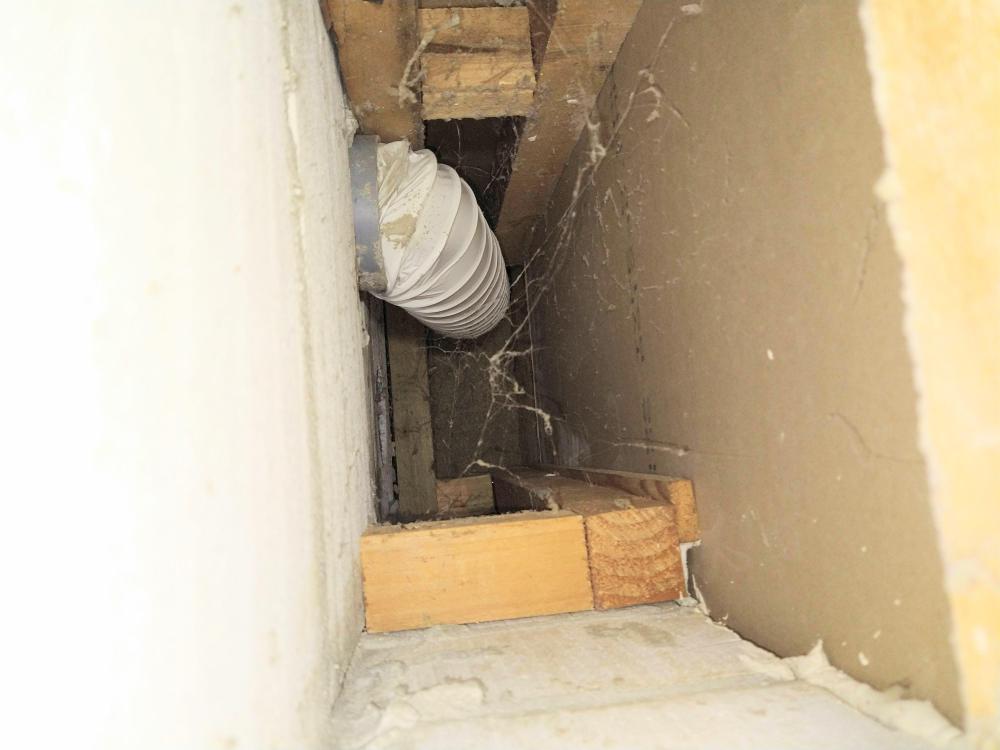
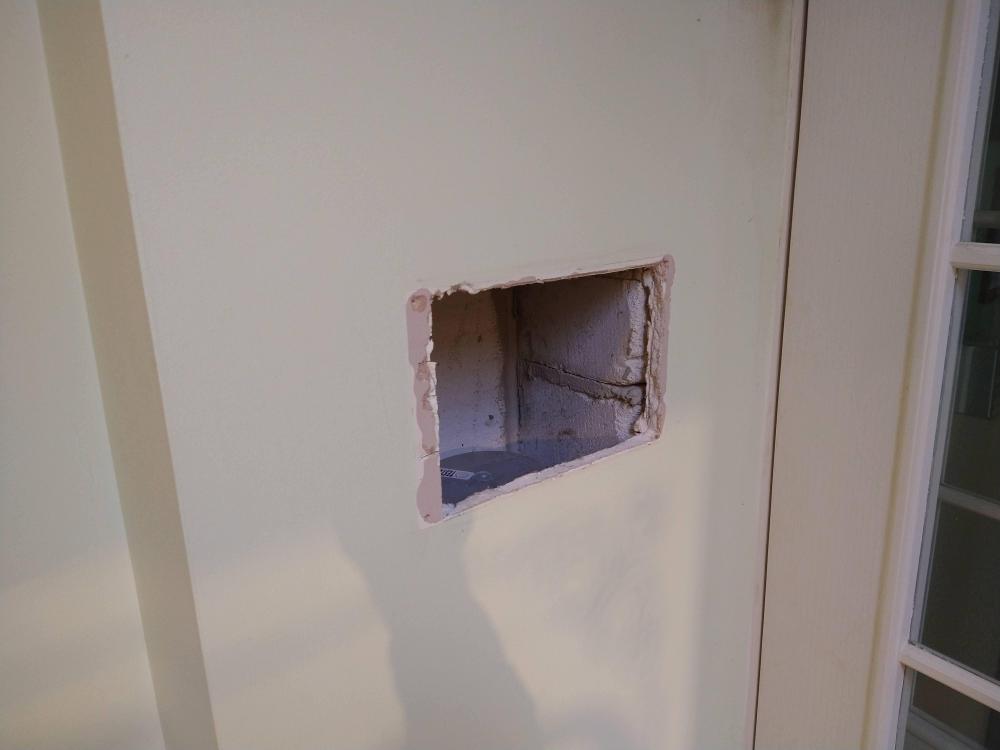
I've still not addressed the upper vent. The first cold snap will probably spur me into action. But the utility room feels much better now, a combination of gap filling around pipes to the outside wall and stuffing rockwool in and around a boxed-in AAV that also connects with the ceiling void where the extraction duct for the loo runs: The box spans from floor to underside of upstairs floor with the AAV coming half way up to the access hole. I filled some bin liners with rockwool and pushed them in and up through the little letterbox.
-
Crazy ain't it! The heat loss is in the order of a couple of kW but difficult to pin down as, while the insulation is reasonably good, the airtightness isn't. In the end I've gone for a couple of mini splits (3.5kW Daikin Emura 3rd gen) and so far they're more than capable of keeping things toasty. The clincher was getting PV on the roof and the scorching summer we just had. The need for cooling coinciding perfectly with PV generation is one of those rare times PV works out the way you'd like it to.