
Radian
-
Posts
2586 -
Joined
-
Last visited
-
Days Won
15
Everything posted by Radian
-
You're supposed to put a little heat into the room as well though 🙄 Seriously - aren't you worried about burst pipes in there or is the water off?
-
Yes. A good airflow above the insulation is essential - cross ventilation is the only way to ensure this. Keeping moisture from the inside from getting into the roof space is also highly desirable. All this makes it very difficult to achieve using keyhole surgery like you were discussing. Have a read through this article by tlxinsulation for some more info about interstitial condensation. You set out your most cost effective solution using loft roll. That still stands. If you avoid covering it with boxes or boards and the loft is well ventilated, you are onto a winner. Don't forget the loft hatch!
-
No problem. Keep reading. No. Without an effective vapour barrier and airtight seal, you might have big issues. You keep saying you don't want to create a warm roof but that's almost what you're doing - the sort that cowboy builders make and home owners discover, years later, is growing mushrooms under the decks. I suppose you could argue that the PIR is just like having thicker mineral wool, although the later provides free passage to vapour, but you intend to board over the insulation and this is where the real problems lie. The vapour needs a good amount of air circulation to transport it to the outside. Even in a heated and ventilated room, looking behind furniture next to walls you may find signs of mildew simply because of restricted ventilation in those areas. The outside temperatures you'll find in lofts amplify this effect enormously. It's not uncommon to go up into a loft space and almost immediately have drips of condensation fall from the underside of the roof as the warm air from the house rises up to it. If your detailing is not correct then this effect is taking place 24/7 throughout the heating season and it's the cumulative effect that will begin to cause problems. I related elsewhere how I had put a large sheet of 100mm celotex up into our loft in preparation for cutting and fitting to the back of the loft hatch. I put it up there laid flat across the top of the fiberglass insulation. After it had been there a while and I finally got around to the job, I was amazed at how much mildew had developed on the underside of the celotex and what a swampy mess the fiberglass was in below. Vapour passing through the plasterboard ceiling could not escape to the air circulating in the loft so condensed on the foil surface of the insulation.
-
You've got to get your head around the fundamental issues. I can tell you haven't completely because if you were to use a closed-cell foam insulator like celotex then very little vapour would get past to require ventilation. You would have, in effect, a locally warm room. But to create a warm roof you need to have a full vapour barrier on the warm side. With breathable insulation like mineral wool, then the sort of gap you need to guarantee no problems with condensation are kind of 'loft sized'.
-
No. If the air gap was vertical then maybe, like when you put PUR between between rafters and leave a 50mm air gap to the roof membrane. But air is able to circulate by convection in that case. When the layer of air is horizontal it needs to be much bigger to allow for dispersal. Your dewpoint would occur on the underside of the boarding and the dew would just drip down. I think people massively underestimate the issues with using non-breathable insulation in cold roofs.
-
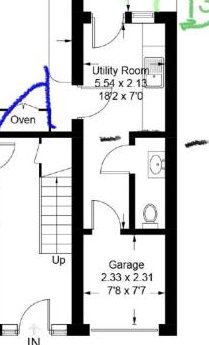
 No, I thought the room for the loo was taking up far too much space. just jiggle the loo around by 90o, use a compact basin and you free up several sq. m in the utility room: becomes ->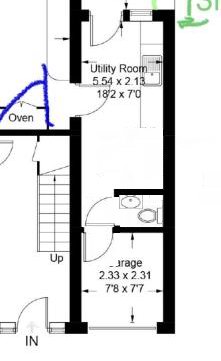
-
Your combined usage figures are the total of day and night, but what periods do those relate to? Assuming those figures are average power in Watts for 15h/day time 9h/night time then in Jan/Feb you consume 9kWh in the day and 3kWh during the night. I don't know where in the world you are but in the Northern Hemisphere a 4.9kW system might deliver 5 or 6kWh on a good day. A 3.3kWh battery might have to be charged exclusively on off-peak and you would have to self consume all 6kWh while the Sun was shining - and you're still coming up short. Off peak you can cover your night time baseload as well as charging but the tricky time will be evening when all 3.3kWh might go in a couple of hours or less. I think you need at least 10kWh battery.
-
Closing top of wall cavities before blown in CWI
Radian replied to Spreadsheetman's topic in Heat Insulation
Yes, I did something similar myself only I did it in a hurry the night before the installers arrived so just rammed the mineral wool into the exposed cavity from inside the loft. Worked a treat. What I must do now is go back and fluff it up a bit as when compressed it loses its insulation properties. I didn't want it to be forced out by the beads under pressure though. While they do use around 100psi at the nozzle it's fairly diffuse when spread around the cavity. Having said that, if there is a gap, it just keeps on coming and coming and coming...- 1 reply
-
- 1
-

-
I'll just take this question - yes you certainly do need a gap between the insulation and boarding. In a cold loft the board will be at outside temperature. The insulation is vapor permeable as is your ceiling regardless of how it is constructed (unless the builder was as meticulous as the specialised types who construct passive houses). This means there's a load of water working its way towards your cold board and when it meets, it condenses and drips back down. The essence of a cold loft is having plenty of airflow to transport vapour unhindered to the outside world. The temptation to use lofts for storage is great and I understand that perfectly. However, it creates numerous problems and should be resisted. If you must have somewhere for the xmas tree, I do have one left-field suggestion though: get a big cargo net and suspend it between rafters hammock style. This adds minimal extra weight and promotes plenty of airflow around the space.
-
Insulate internal door *and* put a cat door in?
Radian replied to Garald's topic in Doors & Door Frames
No, I don't think so. The magnetic item in that ones description is to do with the locking system. We had one where the plastic flap had a magnetic strip around its perimeter and this firmly pulled it into the closed position. It had no lock other than a two-way barrier selector. -
Insulate internal door *and* put a cat door in?
Radian replied to Garald's topic in Doors & Door Frames
"3.979 W/(m²K) is a very good result for a pet door and far outperforms all standard catflaps. A typical catflap with an acrylic flap of 2-3mm thickness has a U-value in the order of 6/6.2 W/(m²K). The lower the figure the better." Ubakus gives a 3mm sheet of polycarbonate a U-value of 4.444 W/(m²K) so if a regular kitty flap was 0.2m square (0.04m2) that would be a 3.5W loss with delta T of 20oC. The ones with a magnetic closer are pretty good at being draft free. -
Beach party! Aw, can't get a flight into STT (Saint Thomas Cyril E King) until Sunday. 😪
-
I know it's already in but the gangway to the front half of the garage takes up too much space. If the partition for the loo (rotated 90o) was mostly across the width, with a slim basin, it could have freed up over 1m for the utility
-
Looks more like the Ritz-Carlton in St Thomas. Maybe St John's is where your crappy iPhone thinks you are.

-
Air conditioning Manufacturers
Radian replied to crispy_wafer's topic in Air Source Heat Pumps (ASHP)
Ah good, that's getting better populated now 🙂 -
HI IGP, I think it's quite common for condensation to become more focussed on the remaining cold areas after improving the insulation elsewhere. I've been wondering why - given that the unimproved regions are no colder than before. I suppose it could be that the vapor content of the air mass inside has changed with the warmer air (due to better insulation) being able to hold more water. Another way of putting this is to say the walls were removing some of the water through distributed (less noticable) condensation. The only other explanation might be that the insulation has also reduced air leakage through the cavity (via cracks around windows etc.) and this was formerly a bigger path for vapor to the outside world.
-
Air conditioning Manufacturers
Radian replied to crispy_wafer's topic in Air Source Heat Pumps (ASHP)
Added the data for my Daikin Emura 3's (I see LibreOffice has slimmed down the file byte count but all data seems intact) MoreDetailPerformance Aircon.xlsx -
Air conditioning Manufacturers
Radian replied to crispy_wafer's topic in Air Source Heat Pumps (ASHP)
Daikin - mostly because of spec and a personal recommendation for a particular installer by a satisfied customer of theirs. I didn't see any advantage in asking for a different make. -
Yes, my options are a bit limited in that area until I get to grips with the glowworm eBus protocol. I've got a Flexicom that can be controlled via that interface but it's something I've been putting off as I know it'll be like heading down into yet another rabbit hole. But without doing this I'm stuck with a minimum flow of 65oC to achieve DHW of 55oC as I only have manual control over one flow temp.
-
It's a fascinating phenomenon to me - that you can feel the effect of radiating your body heat to a cold surface. Sitting in a room with large glazing units at a comfortable (stable) air temperature, it can start to feel colder as the sun goes down just because of increased radiative cooling. Ears and forearms seem particularly sensitive to this effect. Daft Q: How do you measure the temperature of your glass? Is it with an IR thermometer?
-
Thinking on a bit more, what's the alternative? If a rad is in a room with solar gain then the room may well overheat with a fixed flow. So bring back the TRV! The problem is more indicative of having a buffer to separate the work the boiler has to do from the work required to get every room up to temperature. But the radiators themselves represent a large volume of water so why isn't this enough to buffer the demand? Could it be that the flow rate is too low I wonder?
-
Just about everything I ever printed in PLA has now delaminated and failed. Unfortunately, that includes some important parts of the 3D printer itself 😂😢
-
Following all the usual recommendations for heating controls, I have TRV's on all radiators except for the one in the downstairs hallway which also has the overall demand thermostat in the same (quite large) space. What I notice is that from cold everything heats up quite well but as the rooms approach the desired temperature, the rate of heating slows down. At this time the return temperature to the boiler is going above 55oC and the (condensing) boiler is losing efficiency. The flow temperature is set to 65oC, and the boiler may cycle on and off a few times before the setpoint is finally reached. So the boiler is modulating down to its lowest power level for the last push to reach the overall setpoint measured in the hallway and many TRV's have all but closed by then. It seems to me that just by having the radiators correctly balanced and no TRV's, it might not spend so long at minimum modulation. Seems rather fundamental but everyone appears to think TRV's are a good thing.
-
It's actually pretty simple. You just make a big list of all your external surfaces - walls, floors, roofs, windows and doors and work out each of their areas in square meters. Then you find the U-value for each surface area for which you can either use typical values or for more accuracy a calculator such as this one at ubakus.com. You then multiply (each surface area in m2) * (U-value for surface area) * (temperature difference inside to outside) to get the heat loss in Watts for all your external surfaces. Total up all these Wattages and that's how much power you lose through the building fabric for a given temperature difference... in order to maintain this difference, you have to put in this much power. You can then divide this amount of Watts by 1000 to get kW and multiply by 24 to get how many kWh per day your energy use would be for a given inside to outside temperature difference. You can literally verify this by looking at your energy bill. There are other losses due to ventilation but these would be considerably smaller (unless you have big holes in the walls - in which case you should have included those in your list of surfaces 😁)
-
Boiler broken, new build around the corner. What to do?
Radian replied to Goodremy's topic in Boilers & Hot Water Tanks
Quite right, but that was my take on the OP's particular situation. I should have phrased it differently. Indeed my own boiler is heat-only but it says it's suitable for use in both vented and unvented systems.