
Great_scot_selfbuild
-
Posts
409 -
Joined
-
Last visited
Everything posted by Great_scot_selfbuild
-
Spray foam on cold bridge steels
Great_scot_selfbuild replied to NCXo82ike's topic in Heat Insulation
@Nickfromwales I’m trying to picture this but struggling - do you have a photo you could share? I’d be using it externally, as well as possibly internally (though internally I imagine I have more options available to me). Was this alu profile a complete covering or just on the edges to butt up against the window? @JohnMo @Nickfromwales any recommended suppliers of compacfoam? It looks muck easier to work with than aerogel. -
Spray foam on cold bridge steels
Great_scot_selfbuild replied to NCXo82ike's topic in Heat Insulation
@Nickfromwales it looks like compacfoam is an alternative to the aerogel(?). This prompts two questions for me: 1. How do you fix it to the smooth steel column? (I understood @Super_Paulie‘s comment to imply they used a foam as an adhesive - I was picturing something like the foam glue used on my caberdek boards by the installers). 2. Have you used both aerogel and compacfoam? Why opt for compacfoam? (Not a challenge, just understanding why) Thankfully this was where I ensured we got a good quality (50mm) thermal break underneath the column - something I spotted as being omitted from the design. -
Spray foam on cold bridge steels
Great_scot_selfbuild replied to NCXo82ike's topic in Heat Insulation
@Super_Paulie are you saying you attached the aerogel with foam? I have a similar vertical steel column that needs wrapping on the outside (it’s a corner post between two full-height windows). -
Spray foam on cold bridge steels
Great_scot_selfbuild replied to NCXo82ike's topic in Heat Insulation
@NCXo82ike I can empathise. Had similar experience and it was only because I’d done my reading & research that I spotted our cold bridge and managed to get a thermal break in before the steel dimensions were finalised. Close call! -
Yes, thanks to this group, this is almost my first question to the supplier. If I’d became clear they didn’t understand modulation (some didn’t), then they ruled themselves out. The Nibe I’m considering does have good low level modulation.
-
The ASHP market is a bit of a minefield, and I recognise that many will have their own preferences. I’ve done a lot of searching/research and have a quote that I have all-but committed to. The company does also supply and install other makes (Vaillant, Daikin to name just a couple), but they have started to install more and more Nibe. I’ve had Nibe recommended to me personally, and have heard positive reports about their user interface in particular. So, whilst I am still keeping an open mind and will take on board recommendations about other brands, the main reason for this post was as a final check for any reasons why I shouldn’t get a Nibe (installed by an approved installer with a 7year warranty). thanks
-
Useful tip - TY
-
I’m looking to put another layer of sand & cement wet slurry mix on our beam & block floor before starting the DPC & PIR. This would just take out a couple of imperfections (fortunately the beam lengths are short, so we haven’t got difficult cambers to cope with). The b&b floor had some slurry put on it initially, but a lot has happened since then and l’m looking for it to help make sure there aren’t any noticeable air gaps under the PIR board. I don’t have a cement mixer and would like to do. This without having to call the builder in for this part. Grateful for some specific practical advice / instructions.
-
Thanks @Gus Potter, a useful reminder to follow the ‘KISS’ principle. I’ve been wondering about the strength of these pipes once they’re laid (before screed goes down) - some of the spacing is quite narrow, do we need to make sure that no-one steps on any of the pipe once it’s laid? (I’d have assumed that the practicalities of a building site would make this very unrealistic) I’m not doing the loop design myself (I’m drawing the line at buying a windows laptop just to use LoopCAD), and although the suppliers don’t share their designs before we commit to using them, we’ve had some say their design has 7 circuits and others say they have designed for 11 circuits. Are you advising that we make sure we ask for more than one circuit per room for the redundancy (just to make sure they factor it into their design)? Almost always ‘no’ 🤣 Thanks for the reality sense-check
-
Well spotted (I know a little and am learning a lot fast) - looking at GIRA app control, but not seen what the other hardware and equipment will be. Good point, it may be very little indeed. I’ve added this to the list of things to discuss with the designer. completely agree here, just trying to make sure in making one choice I don’t *unknowingly* create a problem or challenge elsewhere (it’s fine if I’m making a conscious choice aware of the implications) - part of the reason for asking this question is to glean any experience and knowledge from others who might do things differently or recommend things that worked out well etc. I like the sound of all of this, though not all applies in our design. Added to the list to discuss. Thanks @joth
-
Missed off @jimseng from here. How do people learn about calculating the heat output from UFH for a given room size and heat loss? Any recommended books/reference material/youtube accounts/online courses? I’ve been wondering how the downstairs heating might perform if we had wider spacing in the living room compared to the other areas, and where to put the thermostat as the whole of the GF will be single zone 🤔🧐. Even just as an exercise, I’d like to be able to work through the calculation as an exercise. Has anyone done this before?
-
Soil vent - does this look right?
Great_scot_selfbuild replied to Great_scot_selfbuild's topic in Flat Roofs
Couldn’t agree more - fear not, I do this too 😁👍🏻 -
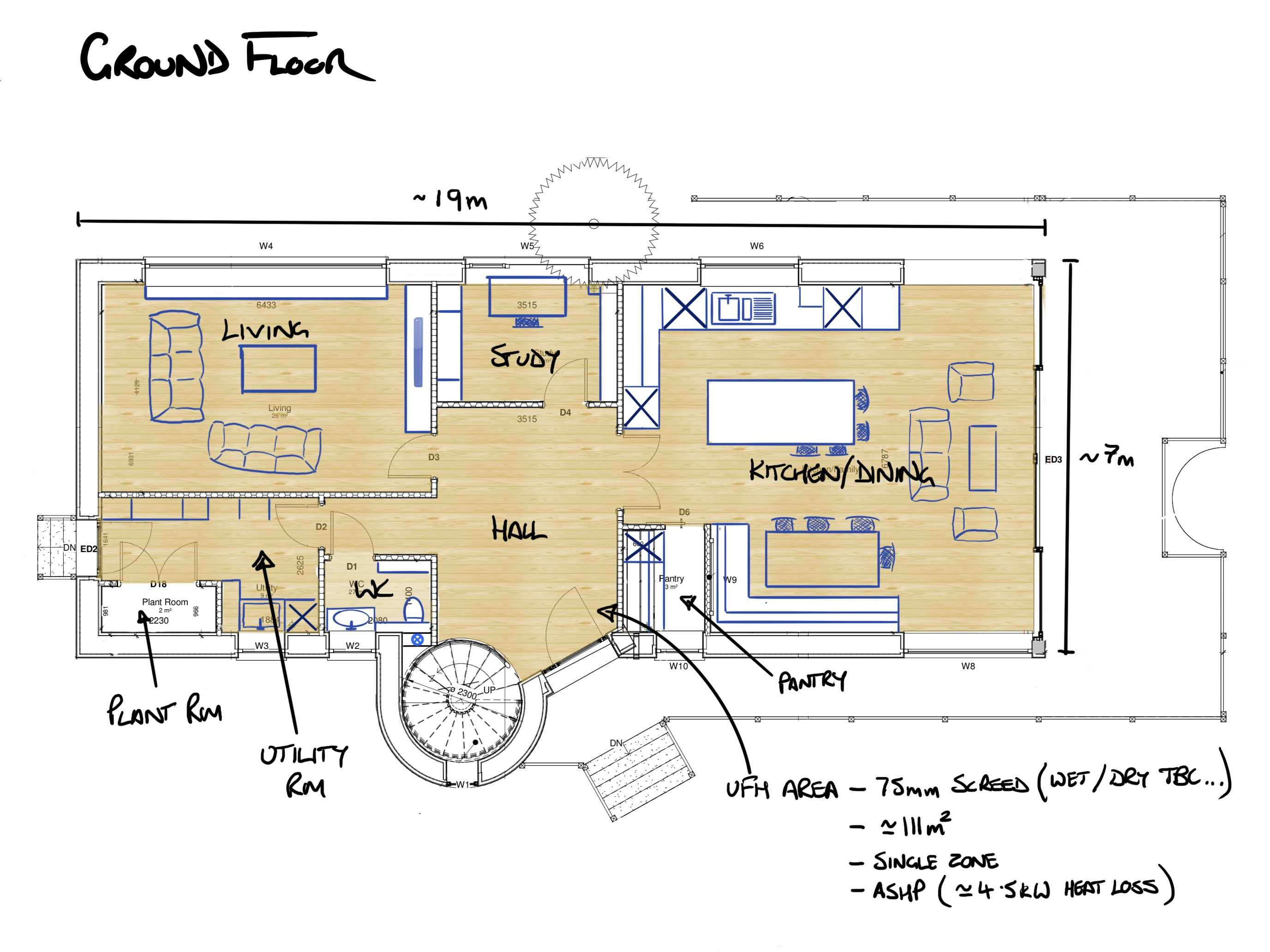
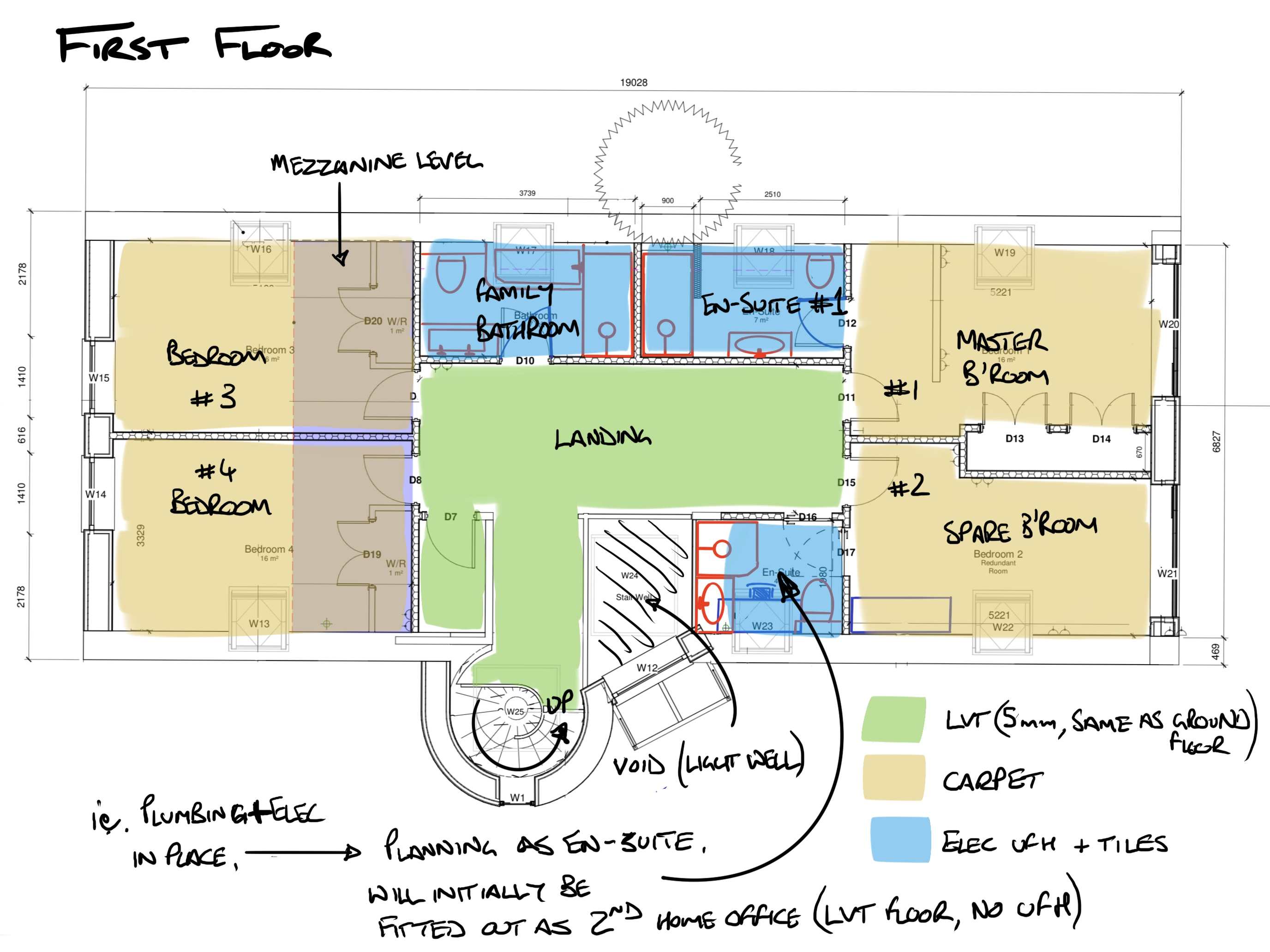
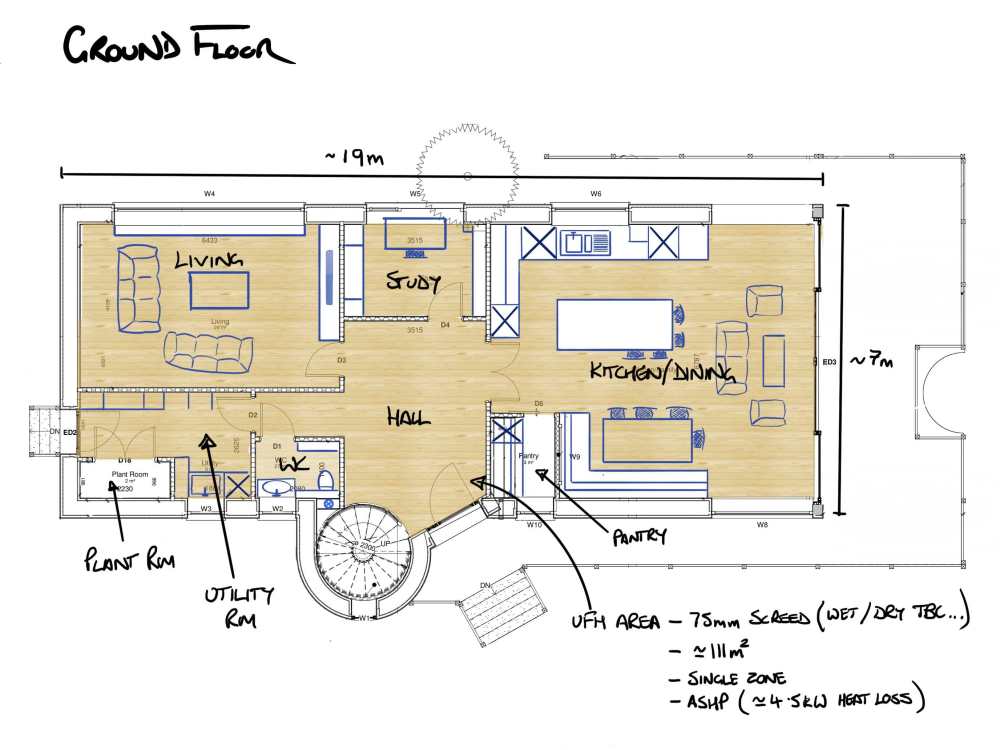
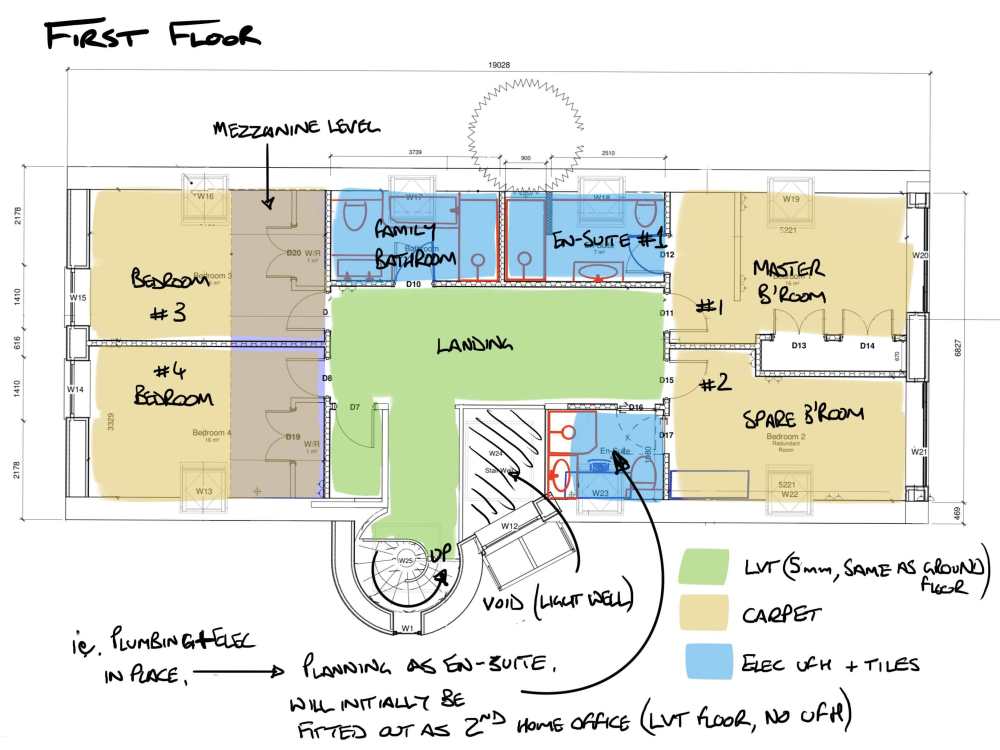
Where to start. I'll try to set this out logically. I thought I'd landed on a plan for how to go about the ASHP (and by close association, UFH), but as we're now going for a smart home using KNX, the ASHP we were looking at doesn't have native KNX integration and so I'm taking a fresh look at this. Many of my issues chime with that of ___ in this thread - https://forum.buildhub.org.uk/topic/46547-how-can-i-roughly-calculate-ufh-output-at-given-flow-temps/ Bottom-line: We need an ASHP, 300L DHW cylinder and UFH design. Passive-level of insulation & air tightness (MVHR planned - DIY, Zehnder Q600). Ground floor height = 3m, First floor is into the roof space (steep pitch) - ceiling = 4m. Open void at the entrance to a double-height space. UFH - 111sqm ground floor only, single zone, spiral pattern, multiple circuits. Upstairs will have electric towel rails and UFH mats in bathrooms just for the ‘warm floor’ feeling rather than to heat upstairs. I’d like to vary the spacing so that the single zone system heats the rooms at a different emitting rate (bear with me) - the thermostat will only be set in one location, whilst there are 5 separate areas (living room - no opening window), study (small, has an opening window), hall (massive tbh), WC (tiny), Utility room (clothes hanging to dry), Kitchen/diner (massive and huge sliding doors). I’m suspecting that I may struggle to get this ‘done the way I imagine it could be’ as all the companies just roll out a default - same spacing everywhere plan. AC - detailed modelling shows we don’t need cooling, but we’ll install power to the locations where an AC unit could be installed, but we plan to live in the house without it. Shade is ‘not a problem’ we have plenty. Smart home integration - we’ve managed to get a KNX designer on board at a manageable cost and so want to ensure we can integrate the heating into it as the KNX controller could negate the need to duplicate having an ASHP controller separately. KNX is a protocol rather than proprietary system and so is widely compatible, but I’m looking to choose one that is directly compatible rather than via a 3rd party controller; I understand Vaillant and Panasonic are just 2 examples that are compatible. ASHP - I’m no plumber and lots of threads (here and elsewhere) refer to ASHP only being any good if they’re set up well, and getting someone who knows the specific make will know how to get the most out of it etc, etc. I’d love to learn this stuff, but I don’t have much time and this feels like something we should be getting done by an ‘expert’. The plumber (via our builder) doing the rest of the house is not familiar with ASHP and just needs a flow and return to connect up our UFH, but his only experience is system that have a buffer and when I started describing having a simple / optimised system with no buffer, it wasn’t clear to him. He’s clearly practical at all other aspects of the plumbing, but not one for designing a system. We’re approaching the point of laying floor insulation and being ready for UFH will be straight behind that. I’ve got UFH quotes for design and supply, but I’d prefer to need a plan, and the relationship between the UFH. Options (there are undoubtedly more that I can’t think of - it’s late…): Contract one company for ASHP design, supply & install, with UFH design & supply (some of the MCS quotes have insisted on having upstairs emitters as the calcs won’t work otherwise (apparently - I’ve got no way of knowing if this is correct). Rely on my heat loss spreadsheet calcs, purchase ASHP direct from a supplier (not sure how to install - is it as hard to set up as I’m led to believe?, do they come with instructions), get a company to design & supply UFH, lay the pipework myself and get our plumber to help connect it up, if we need. Something else?… Grateful for your collective advice on ASHP options that will be KNX compatible, and how to go about our design/install. Our journey so-far: Pre-buildhub days: NSBRC, Architect recommendations… approach ‘Renewables company x,y,z’ Single ‘do it all’ coherent blah, blah, (all sounds great until the crazy quote eventually arrives). Oh, how little we knew then! Local self-builder: Sheer luck, came across a local self-builder whose build was almost the same SQM, very similar passive-level performance, UFH downstairs only and only needs a 5.5kW ASHP (Samsung). This gave me a yardstick for what we would be expecting. Initial research: ASHP theory, all quite straightforward (in principle - reverse fridge etc…). Find a local ASHP firm that had a good sales pitch, MCS registered, quote didn’t take the ****, but scratch the surface and they really didn’t know the maths and understand WC curves and flow rate details. Seemed to very much be a UK office where ‘technical’ was more on the practical installation rather than actually calculating how the setup should be done. Buildhub reading began in ernest: Jeremy’s heat loss spreadsheet - https://forum.buildhub.org.uk/topic/439-fabric-and-ventilation-heat-loss-calculator/#comment-4407 (everyone seems to find their way to this eventually; I put this off for a while tbh, I deal with too many spreadsheets at work, I wasn’t actively searching for more). Measured everything up, ran the numbers, ~4.5kW before factoring in DHW. Quotes: Throughout this journey we’ve had blips of focus at trying to ‘commit’. We’ve had quotes proposing 14kW (WTF!), lots of default ‘buffer + pre-plumbed cylinders, no questions about UFH’ and the list goes on. Who to trust: I really struggle with working out which company actually has the competence to *design* the ASHP & DHW cylinder installation optimised for our build. DIY vs MCS: As I’ve learned from threads on here, the cost of parts can completely negate any benefit that the MCS grant suggests. There have been 2 quotes that have actually brought the cost down to zero/near zero through an MCS umbrella company, but I seem to recall there was another reason they put me off (will have to dig through the quotes & emails…). I would much prefer to have a system that we have someone to go back to if we have a problem (plus I don’t know if our building warranty will want some guarantee behind the install - just remembered as I type that I need to check this). Landing towards entrance void.JPG Hall towards plant.JPG Kitchen-Dining.JPG Living.JPG

-
Soil vent - does this look right?
Great_scot_selfbuild replied to Great_scot_selfbuild's topic in Flat Roofs
We keep them all well stocked in a bottomless supply of decent snacks, drinks, tea & coffee. But yes, there will be beer at some point. -
Soil vent - does this look right?
Great_scot_selfbuild replied to Great_scot_selfbuild's topic in Flat Roofs
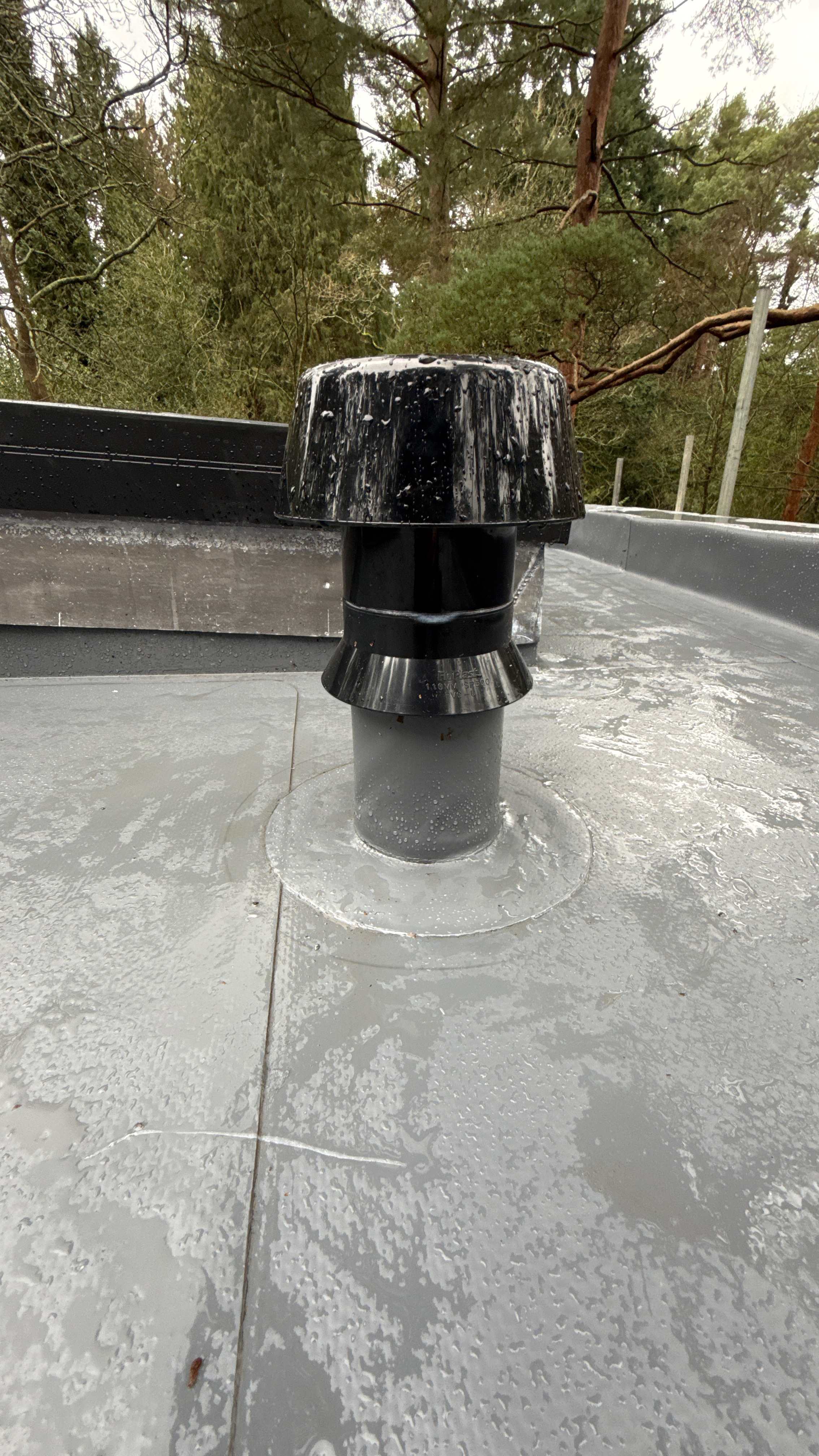
I'd seen it initially when it was all loose (waiting for the EPDM seal to be installed) and just assumed the black section with the splay would go down to the floor, that was all. -
It's been a while since I had to work nights, and had various instances of particularly long shifts to press through. I'm definitely finding that they have prepared me well for this 'experience'! Personally, offloading some questions into this forum helps me. I have the notepad and pencil (tick), copious use of the iPad and the 'Procreate' app to annotate over images and drawings, but I typically find it takes a while to wind down from the day job and then spool-up some motivation to try and articulate the issue/challenge of the day. Then, a bit of Buildhub research before posting allows me to get the question out into the ether and hope that the following day an answer or two has nudged me a little further along. Secondly, radio 4 comedy shows are an easy listen and by then I'm normally shattered. Just know you're not alone in the challenge @ToughButterCup! Thanks for starting this thread.
-
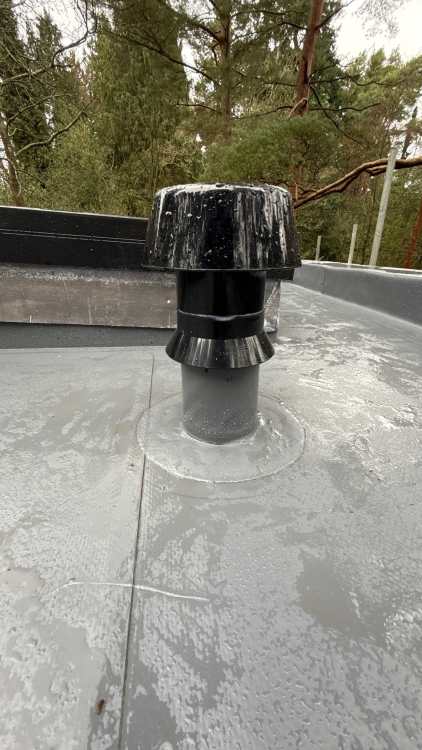
Prior to the single ply seal being installed around the base of this soil vent I was expecting the splayed plastic section to be fitted to the bottom on top of the EPDM (not based on anything, just an assumption). It seems to be fixed in place now and I’m wondering if it is in fact to stop rain splashing upwards into the vent (just my best guess). I’ll ask my builder, but I like a second opinion from here. Scaffolding comes down this week, hence I don’t have much time to question it. in case you're wondering, no the window doesn’t open and yes it is far enough away from opening windows (laterally & height).
-
Following with keen interest... keep persevering @jimseng, I'm tucking into your slipstream! 🙂
-
@jimseng I’m loving your posts - it’s like you’re asking my questions for me! (I feel your frustrations/pain).
-
Ahh, I see.
-
The never-ending challenge of getting work done. The flashing done on the garage rooflights looked far better. There are other bits of lead work that look much better, but these bits are not pretty at all. I’d love to do some lead work myself tbh, but then I’d have no insurance guarantee to fall back on and if I did some bits and they did others, it would only introduce the inevitable argument/challenge if anything was wrong. Fortunately, the roofer team is a sub-contractor through my builder who is of the same opinion as me, and it turns out he has already snagged this with the roofer, and will make sure it’s sorted (doubt this will address the folds etc. though). I’m choosing which battles to pick and working on the basis of: 1. Functions as required 2. Insurance / warranty supported 3. Aesthetically important 4. How much is it going to bug me if I don’t resolve it (unfortunately sometimes this one jumps to position 1 🤣)
-
Without covering what? Can you elaborate please?
-
The roofers have just finished welding the lead flashing; I've 2 questions: 1. How do I clean off the white staining? (the flashing on the garage rooflights hasn't had this appear). 2. They've only welded the folds at the corners. Should I expect (or ask for the vertical mid-section overlaps to be welded? IMG_9456.MOV
-
Timber Cladding, Zinc Guttering, Brise Soleil and External blinds
Great_scot_selfbuild commented on Thorfun's blog entry in West Sussex Forever Home
@Thorfun stunning house and cladding in particular. We’re doing cladding too (different style) - what did you use for fire stops? -
I'm comparing UFH quotes and I've had to prompt for the detail of the pipes and materials that would be used by one of the companies - has anyone got experience of these (failing experience, I'll take an opinion):AmbiFlex-M16-UFH-Pipe-Datasheet.pdfAmbiente TraffiPipe T16 Pipe Datasheet.pdf All I'm really comparing this against is the quotes I've had from other suppliers direct, but I'd prefer to get the UFH design and supply from the same company I'd be getting the ASHP from (again, I'm still weighing up lots of options).