
Great_scot_selfbuild
-
Posts
409 -
Joined
-
Last visited
Everything posted by Great_scot_selfbuild
-
@Susie Thanks! - photos of it in use is really helpful. We have spoken to countless people about the screed options and I was surprised that I have been advised that for dry screed (which were going for) we don’t need a membrane/layer on to[ of the PIR insulation as, although it’s pumped in, it’s simply not as runny as liquid screed. What type of screed did you lay on top? Either way, I like the approach of using the grid membrane @torre included a link to. Our ASHP supplier is working on the heating load requirements, and the UFH supplier providing the UFH design. I’ve asked for the additional design information beyond just the drawings, yes. @JohnMo 🤣 they’re welcomed! 🙏. Posting publicly is always a risk, and sometimes the best comments are those that challenge your (my) current position, either to present an alternative not yet considered, or to make sure the path chosen is done so in knowledge of the risks/compromises (which there always are), so thank you - very much appreciated 😁. 1. I have wondered about this - why the runs to/from the loop aren’t also spaced as the same as the heating yrs serving the same function after all. I’ve not had any design / response look any different to this (nor seen ones do it in the photos I’ve seen on this group - they’re all bunched together in getting to their destination). I’m going to ask I again, but have low hopes that they’ll have the skill or wherewithal to do that. I’m getting used to the professionals’ not living up to expectations, even when they just specialise in that one aspect of design. 2. Noted. 3. Not sure I understand what you’re saying? (FYI the whole downstairs is single zone, and provides heating up through void in hallway for upstairs). 4. Manifold is in the utility, yes. This is the first I’ve had anyone mention insulating pipes, though it makes perfect sense - can you please elaborate? (Photo appreciated, to help me interpret what this looks like before screed is laid on top). 5. Yes, and yet this seems to be the way the industry operates. I approached quite a few M&E firms but the prices were quite ridiculous. Would be ha[py to pay a reasonable fee, but not how they marked everything up and tried to oversell. Rather made me very sceptical about the whole lot tbh (on top of me having to correct some of the professionals I have paid).the spread of inputs from this group helps me balance out the options and weight it all up. I agree, it isn’t a design.
-
Thanks - I had read about this. I’ll DM you 😁
-
@Barnboy that is exceptionally helpful, especially with the photos added - very much appreciated. Chalk line ordered!
-
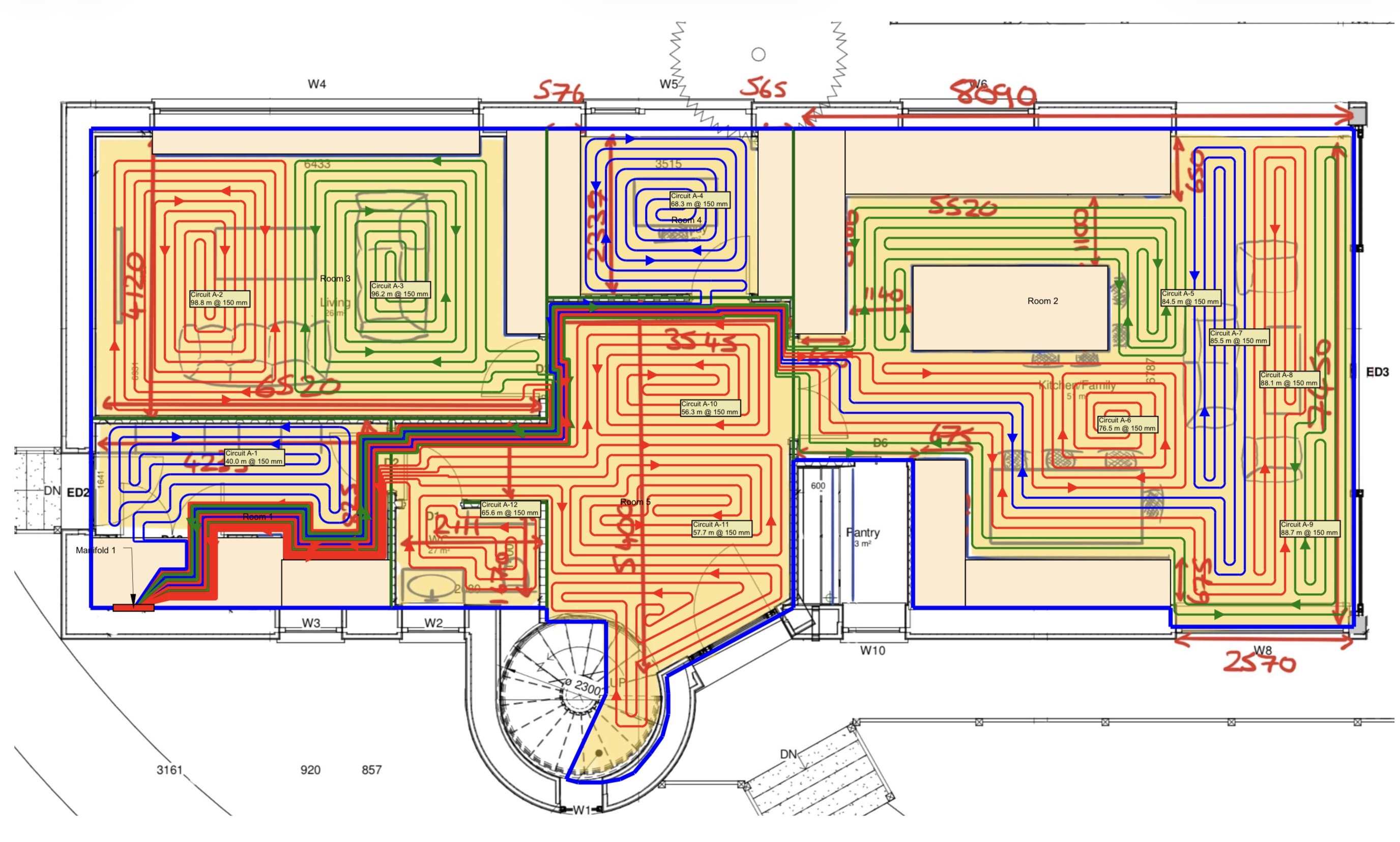
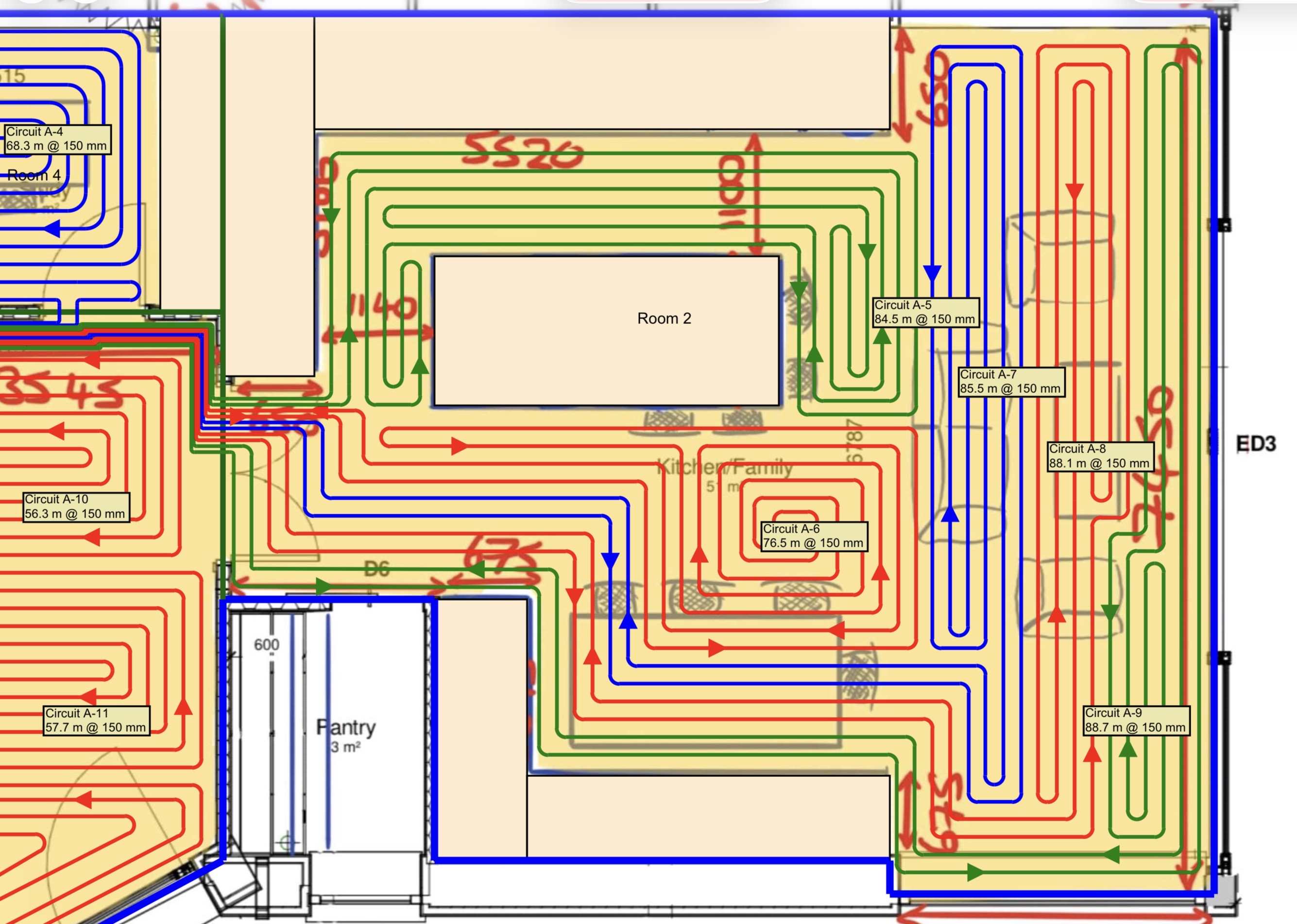
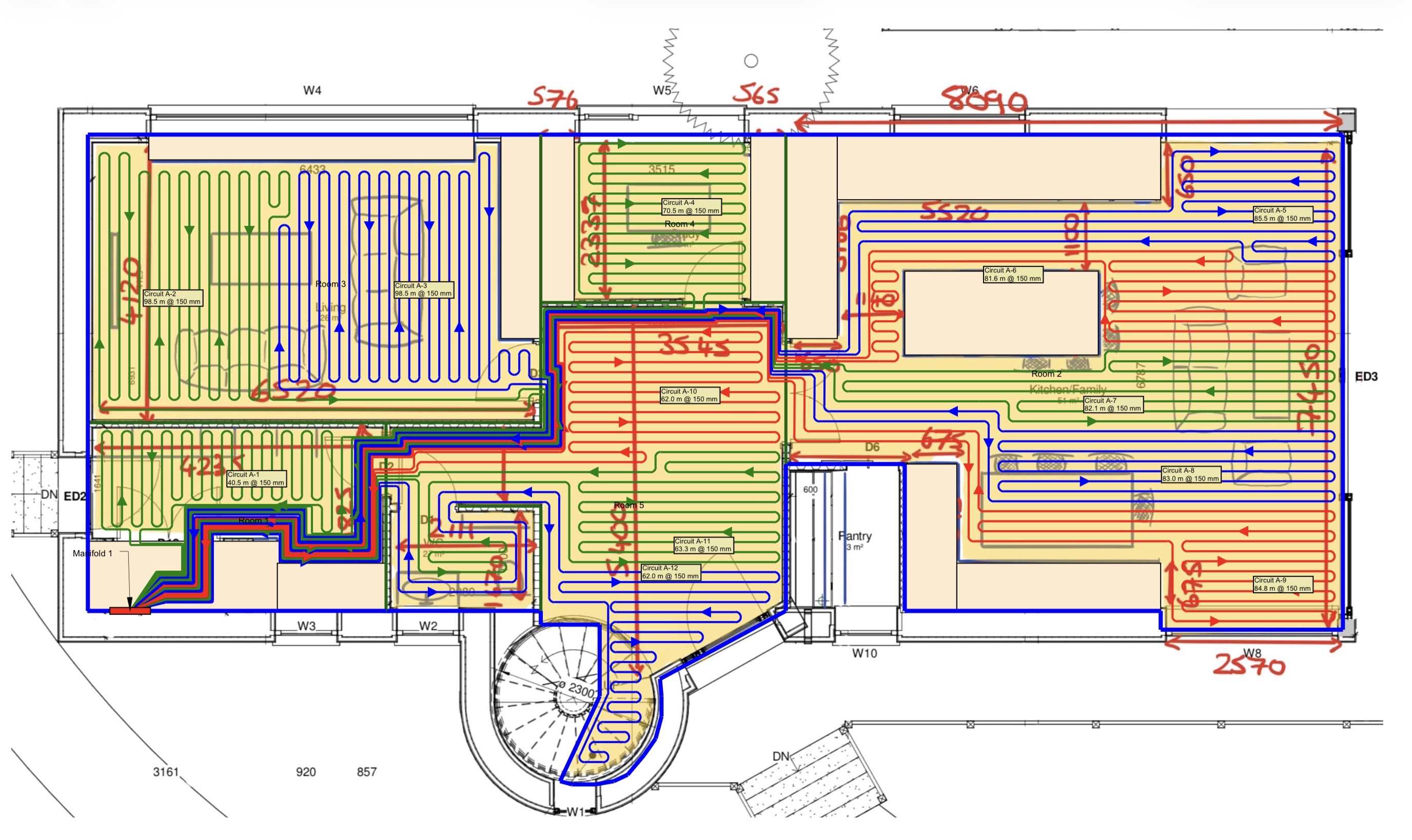
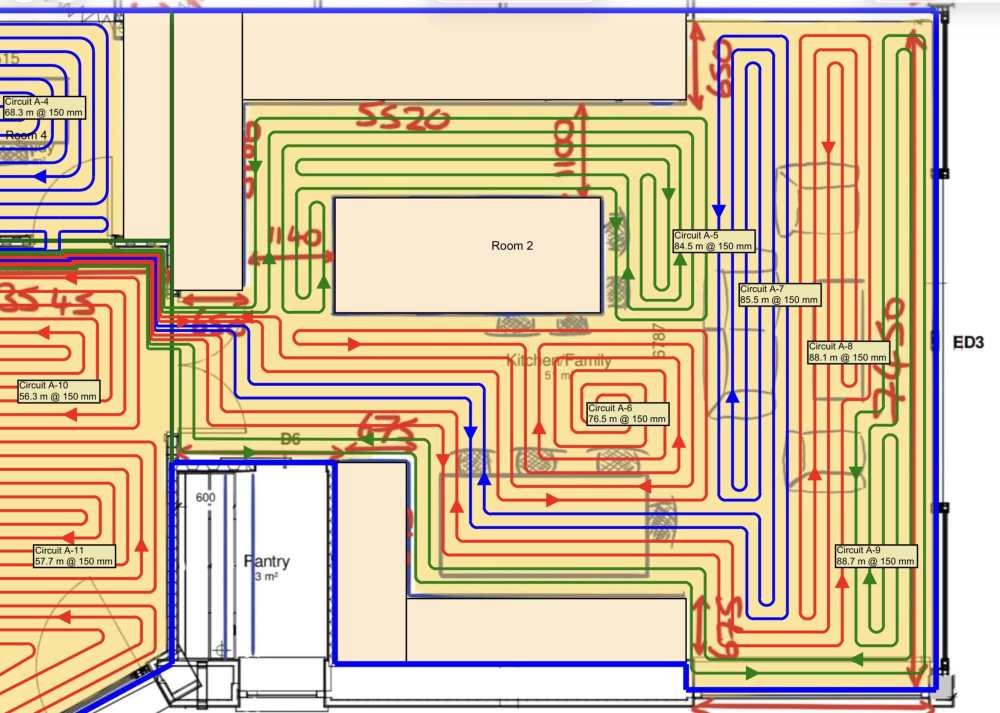
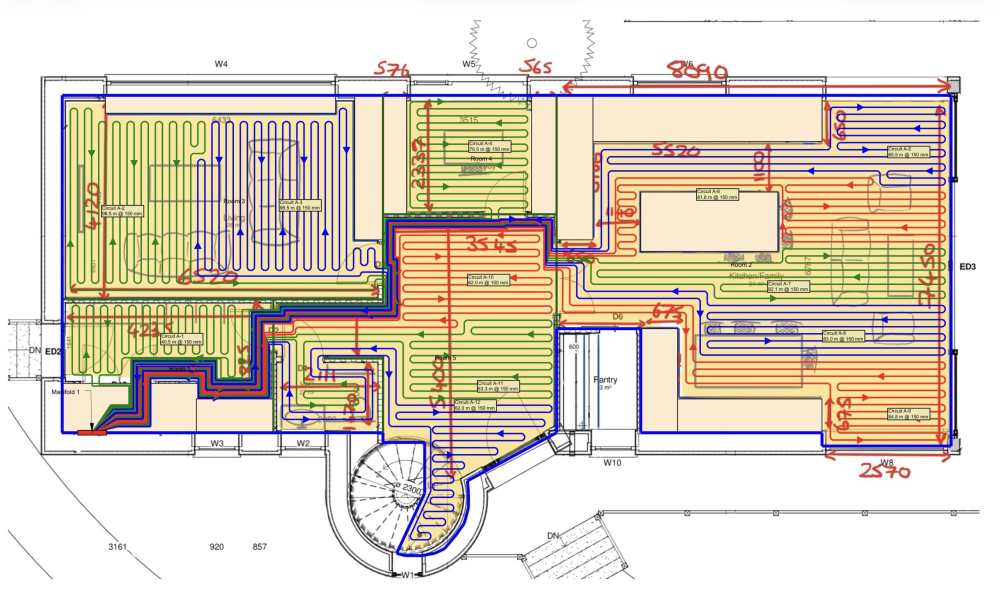
Given the challenge of getting a UFH design done, now that we’ve (eventually) selected our UFH supplier, I thought I’d share the layout design they have provided. I had requested a spiral pattern and first time they sent over a serpentine design. I’m pleased I checked it as soon as it arrived as they they re-ran it and sent the spiral pattern, but I do like having both as a comparison. We will be installing the pipework and now that we have a design to look at I’m interested in hearing advice on how best to tackle (practically) the layout. I’m purchasing a UFH staple gun and decoiler for the pipe. I’ve got a couple of weeks before we start this. My initial thoughts are to mark out 150mm spacing across each room in both directions (partly to double-check the design), and lay the longest loops first. Spiral configuration that we’re installing: Close-up of the longest runs:
-
UFH - do I need floor probes?
Great_scot_selfbuild replied to Great_scot_selfbuild's topic in Underfloor Heating
I’ll leave the data analysis to my wife. She’s the clever one… 🤢🤮… 🧐 I think I’ll install one probe and have a connection to the plant room in case we decide we want to. thanks all - I’ve whittled the UFH quote down quite a lot thanks to input from here and it comes to just £1060 ex VAT for a 115sqm area coverage. Over £1k cheaper than some of the quotes I had in! -
We’re installing UFH in a dry screed with an ASHP that has reversible function and may be used in a cooling mode. Ive read a little about floor probes, but our ASHP installer is saying they’re not required as dew point just requires us to know the air temp. 1. When are they required? 2. What for? 3. Where should I put them? (I’m having a single zone with 11 circuits across 6rooms).
-
We're planning our UFH as a single zone, open loop for the downstairs with only one thermostat. I've been round this a lot elsewhere and on this forum, but just before going ahead, our ASHP installer has mentioned that building control tend to want to see temperature control in each room. I've read the Building Regs Part L and it does mention zones, and there's a brief mention of low heat demand homes, but I'm asking here to find out what the lived experience is in dealing with approved building inspectors on this topic. Ours is very particular, and hard to get hold of to discuss questions like this (which I will try). In short - I'm wanting to know if anyone has actually encountered this issue, if they've had to argue the case, or if there's a simple way to phrase it to demonstrate it's compliant with the BR wording (screenclip of the BR section I've found on it). Thanks

-
Question: I know that the MCS installer applies for the grant on our behalf, but when during the process can they apply for it? / when does it pay out? Background / reason: I thought that we would only pay the amount remaining (full quote minus BUS grant) but we’ve had a couple of installers (small businesses) say we need to pay in line with their standard stage payments as they can only claim the grant after install is certified and then the final payment is taken care of by the grant, plus a refund for any difference. I realise many here will say just don’t bother with the grant, but on balance for us, we’re keen on going with the NIBE ASHP, which requires approved installers and comes with a 5 or 7 year warranty. I’m just looking to check that this pay / refund isn’t unusual or unreasonable. My only hesitation is making sure they don’t turn around at the end and say we’re not elligible. I hate not being in control of the process - can you tell? 🤣
-
1. We’ve already bought the 150mm insulation 2. Thicker screed provides greater thermal mass for retaining the heat from the UFH
-
@Russell griffiths it does indeed look good!
-
Yes - thanks. Just waiting for references from the other quotes. As it is, I think Justin sounds very busy, before considering that at his very rough estimate he’s about £1k more than the other dry screed quotes (of course that is irrelevant if he’s not available).
-
This is my concern - by the time I find out they aren’t very good it will be too late. Hence I’m asking for references (some of them have little/no online reviews).
-
The reference to keying in was on a Cemflood liquid screed. The dry screed quote states that they provide the pump - I hadn’t realised that a dry screed would be pumped. Is this normal? (As you can tell, I’ve never seen it done and the only very small amounts of dry mix used so far have just been mixed in the mixer and then used straight away.
-
Any particular reason? That’ll be us The quote I have is from a recommended cemfloor installer - whilst he said theees no laitance, it does still need keying-in, which is what his £1105 is quoting for. Estimate was iro £4k before laitance removal.
-
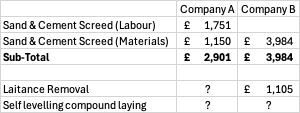
I'm getting quotes for both sand & cement and liquid screed floor layer over our UFH. The depth was going to be 75mm, but it turns out my principal designer failed to take into account that the screed needs a layer of self-levelling compound on top before we lay our LVT, so I've been advised by multiple screed companies to allow for at least 5mm as I can always add SL Compound. Therefore, working back from the FFL and 5mm LVT, with 150mm PIR, we'll be needing 70mm of screed. The initial costs I've had back aren't as different as I expected: Area = 130sqm If cost wasn't a deciding factor, what would you choose and why?
-
We saw some lithe audio bluetooth ceiling speaker at a homebuilding show. Looked very good, seem to get good reviews but I'm sure there must be some AV geeks in this forum who can provide comment. Purpose: Stream music (bluetooth or wifi) into the kitchen dining room area Ceiling height 3m Area = 50sqm Looking at two speakers that could be configured (I hope) to operate in stereo
-
Contract Administrator - cost queries
Great_scot_selfbuild replied to Jothetaxi's topic in Surveyors & Architects
Just to add to this, re-read the contract from both your position and then from the perspective of your architect and builder - have they followed the process as to their responsibilities. Knowing it inside out from all stakeholder perspectives is key to setting the conditions for you to be in a strong position to negotiate. (Don't assume they know the detail themselves, even if they behave as though they do) -
Contract Administrator - cost queries
Great_scot_selfbuild replied to Jothetaxi's topic in Surveyors & Architects
Sounds like it. I'd agree with this as a holding statement. Don't be pressured into making a decision, especially as you say they stopped work on your build some months ago - they clearly weren't in a rush. Just be calm and measured in your communication (may require a lot of self-control mind) and as long as you are in control of the discussion in a clear and reasonable way then you have a better chance of achieving an acceptable solution. Prepare yourself to have to compromise and not be totally happy (I say this from experience). If you have conversations then make sure you follow-up by email to confirm what was discussed (even if it wasn't for any formal agreement), as it will give you a written record if it's ever needed. -
@cjsparkey Thanks for this - I'm thinking about this on and off, weighing up if it's worth paying one of the VAT reclaim people or just DIY it. We're organised in our register of items that are VAT reclaim-able and copies of receipts. Any points to note in terms of lessons (good/bad/would do differently)?
-
I’m looking at an options of installing an instant water heater at the sink taps at the end of long runs. I have had more than one person suggest such an idea to me and I’m trying to understand the options out there. I’m not talking about instant boiling taps, but rather running only cold supply to the sinks, with an instant water heater at the sink to heat it at the point of use. Willis heater https://www.unventedcomponentseurope.com/willis-jacket-external-immersion-heater-complete-pre-wired-and-fully-assembled.html/ Stiebel Eltron Instant water heater https://www.stiebel-eltron.co.uk/en/products-solutions/Hotwater/instantaneous_waterheater.html We only have single phase, so are looking at the smallest options Has anyone done this, and what does the cost to the electricity bill look like? Noticeable?
-
Spray foam on cold bridge steels
Great_scot_selfbuild replied to NCXo82ike's topic in Heat Insulation
Why not? surely the same principle applies to it getting damp / soaked and needing to be able to dry out? both Board & batten and shingle involves overlapping timbers which I understood would need the airflow to avoid mould. I know the area is small (250 x 250) but they're at the corners of the house and will take all the weather. -
Spray foam on cold bridge steels
Great_scot_selfbuild replied to NCXo82ike's topic in Heat Insulation
Will definitely still be insulating to some degree - just with our board & batten or our timber shingle, but it'll still need an air gap behind it. The steel has already been zinc oxide coated and then bitumen painted on top prior to the windows being installed. Finish has come up well in terms of protecting the steel (these paint layers were specified by the SE to match the protection on the steel ring beam). -
Spray foam on cold bridge steels
Great_scot_selfbuild replied to NCXo82ike's topic in Heat Insulation
I’m likely to just cladding timber the same as the rest of the build. -
I had thought they were all of this type (push air to the sides as it leaves and follows the ceiling). Just did a search for those that advertise as ‘coanda effect vents’ - £100 per vent!?! https://www.epicair.co.uk/products/air-diffusers-gypsum-performance-circle?variant=48789368701213 @JohnMo all points received - I’ll add some extra columns to my spreadsheet where I’m pulling all this together 😁🙏🏻.
-
Ok, so I'm revisiting some of my MVHR design and I've found myself circling the following questions, without really finding the answers from any of the manufacturers sites (happy to be pointed in the direction of any reference material): Whilst I mention ender here, I'm not fixed on them as a brand - happy to take advice/ lived experience on performance / noise of other brands. 1. What is the largest number of 90mm ducts you can feed from a single manifold (single MVHR unit - looking at Zehnder Q600 sort of size)? 2. I'm interested in a quiet system; when suppliers were quoting for 75mm they were insisting on twin ducts per vent purely to meet the BR spec. I have now managed to confirm I can fit 90mm (through holes in beams - I had previously worried 90s wouldn't fit, but they do). If I fit twin 90 per vent, will this just make it even quieter by reducing the flow rate per duct even further but still achieving the BR requirement at the single vent? 3. My investigation into attenuators previously was because I was looking into a branch system and needed them to avoid cross-talk; would an attenuator on a 90mm duct as part of a radial system reduce the noise? 4. I have a limited number of holes through the glulam beam, and so it would be preferable to achieve quiet running using attenuator on a single duct rather than running twin ducts. 5. If I had twin ducts feeding into a single vent, is there a single attenuator that would receive two ducts and then go into a single vent? 6. Has there been any study (formal, or just based on experience) into the noise difference between attenuator and multiple ducts. For upstairs, almost all our vents will be wall vents. We have 90mm studs and the duct is 90mm (having offered up, it'll fit). Where we put the ducts in the stud wall, I plan to line the wall with 9mm OSB either side before plasterboard. The studs will have rock wool sound insulation. 7. How much space is needed for the 90degree wall vents? 8. Although the 90mm zehnder duct (off-cut) I have offered up looks like I could get it to work, I would also consider the flat cross-section ('Flat 51' as zehnder call theirs), but note that the actual cross-section is less than 90mm; if I use these, do I need to double up (not according to their spec sheet), but I'm concerned about space and the practicality of bending them into the space available. Thoughts?...