Hastings
-
Posts
284 -
Joined
-
Last visited
Everything posted by Hastings
-
Hello! - just starting out on a potential project
Hastings replied to TabWheeler's topic in Introduce Yourself
150L tank of water started at 41C and finished at 55C. Incoming air temp: 12C Outgoing air temp: 5C Here's the data from my Victron EasySolar 48V 4kVA for the last 30 days: Bear in mind that these figures are for an off-grid system in which power is only generated when there is demand. Very different numbers to a system connected to and feeding the grid (effectively 'maxed' out), which is probably 99.9% of systems posting to the pvoutput.org website (either way, you need to know which). Day 7: the system shutdown due to low voltage. Caused by me being too hasty with the newly installed air source water heater. Days with zero time in Absorb or Float denote that the batteries are not fully charged.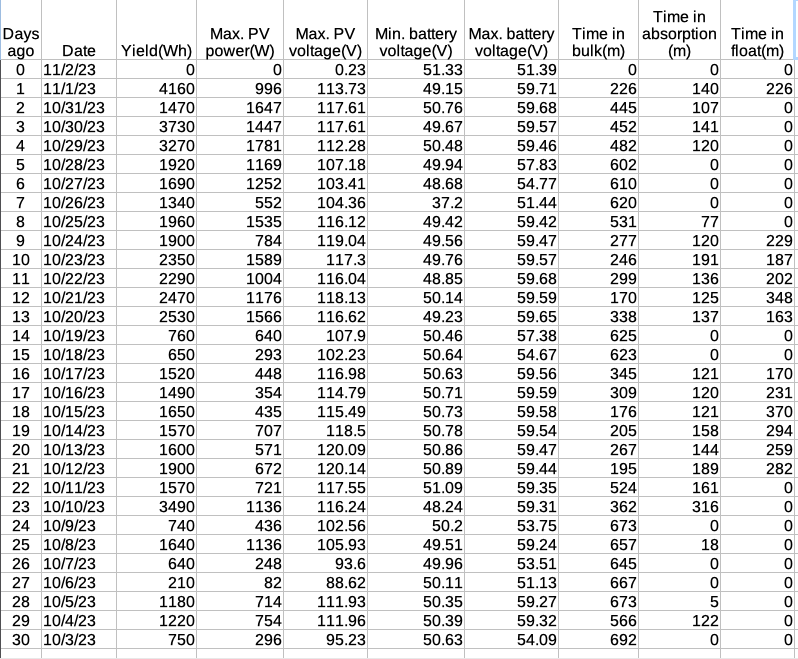
-
Hello! - just starting out on a potential project
Hastings replied to TabWheeler's topic in Introduce Yourself
Lovely calm sunny day today here in the southern Hebrides and my 1.9kW PV array powered my 350W air source water heater for 6 hours, with a little spare leftover to top up the 10kWh battery bank at the same time. There was a little high thin cloud so not optimal but the array was averaging around 500W across those 6 hours. 150L tank of water started at 41C and finished at 55C. -
Hello! - just starting out on a potential project
Hastings replied to TabWheeler's topic in Introduce Yourself
Now that's the way to go off-grid! -
Hello! - just starting out on a potential project
Hastings replied to TabWheeler's topic in Introduce Yourself
Presumably though this not all year round - you go over to mainly gas power in winter? -
I recommend you concentrate on your autumn/spring period. It's just about do-able, whereas winter isn't (in the UK). Then with the over production in summer connect up a hydrogen generating machine to store hydrogen for winter heating!
-
Single room MVHR
Hastings replied to Tony359's topic in Mechanical Ventilation with Heat Recovery (MVHR)
Not a gimmick I think although the efficiency of 75% seems low - might be because of the small size compared to normal ones that are for a whole house. BPCVentilation are popular with self-installers on this forum and offer single room units £300 and upwards. They would advise better than I can. -
Hello! - just starting out on a potential project
Hastings replied to TabWheeler's topic in Introduce Yourself
Sadly, off-grid is unlikely to be as eco as being on grid due to the embodied carbon emissions of all the kit you need if building new and therefore required to meet full building regs and planning that often includes eg. strict private water supply standards). If you can have a reasonably large wind/water turbine (most of us are not allowed) then it could be different. The UK grid has apparently reached the point of enough green-ness now that installing just solar panels on individual houses is borderline in terms of saving any carbon emissions, depending somewhat on which country makes the PV you buy. Info from an article on Circular Ecology (Dr Craig Jones the Life Cycle Assessment UK based specialist) I read a while back. -
Be very careful of performing calculations using average or mean weather data, which is what is mostly available. It is the minimums that you need to plan for. It is too many years ago that I used the PVGIS tool but I think it may use averages. A more useful resource is pvoutput.org where PV array owners upload their live and historical power production levels. It will show you that a 4kW array in Glasgow produces almost no significant power in Dec/Jan.
-
Unless you have acres of PV panels you will likely need a generator or wind/water turbine to get you through the winter months. The biggest issue and the one that 'gets' you in the winter is the total background demand ie. the total of all bits of gear that are on all the time. These can include water filters (40-80W for UV steriliser) which could be multiple (iron and manganese filters are common for borehole sources). The DC-240V AC inverter : even a smallish 4kVA Victron consumes 25-30W continuous. You can install an electric-free septic treatment unit or add on another 50-100?W for the normal (and much cheaper) air blower ones. So that takes you into the range of 70-200W. My 6x380W mono-crystaline (better in overcast conditions) PV array sometimes produces a total of 40W in the middle of a dull rainy day in November. Much harder to calculate is the demand from things turning on and off automatically. Heating systems, water pumps, fridge/freezer. Off-gridders with no turbines usually resort to simple wood burners.
-
Commissioning MVHR
Hastings replied to Ambaz79's topic in Mechanical Ventilation with Heat Recovery (MVHR)
Be aware that a UKAS calibration certificate (less than 12 months old) might be asked for if you are being inspected by building control. -
All that needless carbon pollution (concrete) - was it filmed 30 years ago?
-
I think it is very very unlikely to be a requirement. A wheelchair is not normally designed to be used in a shower and therefore a requirement for level access would not be logical. You transfer from a wheelchair onto a WC and I think the thinking is that you could put a seat in a shower to transfer onto. From memory I don't think a shower in a new build is a requirement at all. You can just provide a bath.
-
I still have not been signed off - aiming for submission before mid November now - so I can't definitively answer yet. The inspector has visited and didn't mention it as a problem but I am not sure that he was checking everything to the degree he will/might when he comes for the final sign off.
-
Limited height and ground floor Insulation Dilemma
Hastings replied to mickeych's topic in Underfloor Heating
We went airtight but weren't attempting PassivHaus level of insulation just current (2018) regs plus a bit more, where it was doable hence only 100mm underfloor insulation. The drawing shows roughly the average situation along 30m of existing 4 walls - but the sections where it was 'worse' were not long enough to worry about. It helped that the subsoil on which the old walls were built was gravel based (raised beach). The internal stud frame carries the weight of the new upper storey, hence the need for thickening of the slab at the perimeter. The engineer originally proposed that the new roof also rest on the new inner stud frame and that would have required even deeper digging and concrete. I vetoed that proposal in anticipation of the old walls being very shallow and I am very glad I did. The thickened reinforced concrete perimeter was wider than shown in my sketch. Sketch is not very to-scale. (Airtight and damp proof layers not shown, for clarity)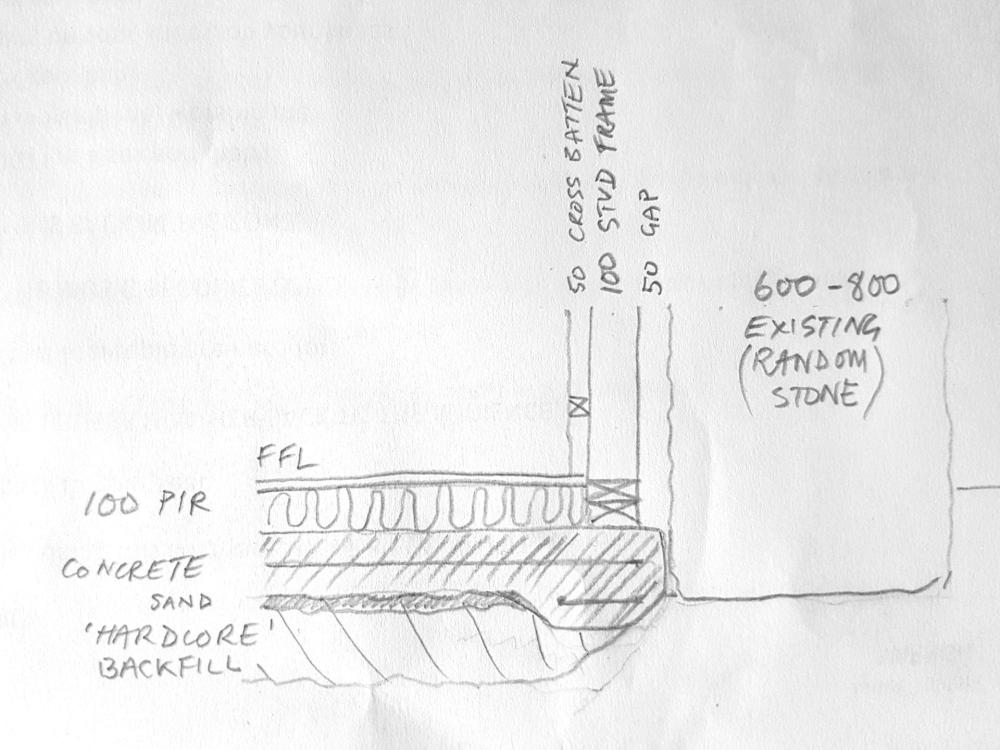
-
Limited height and ground floor Insulation Dilemma
Hastings replied to mickeych's topic in Underfloor Heating
I have twice now put new insulated concrete floors into old buildings that have no founds to the walls and both times we had to dig below the level of where the old walls 'stopped'. With agreement from the structural engineer (who was initially prescribing underpinning) we stayed away from disturbing the solum under the old walls mainly by feathering/rounding the lower outer edges of the new inner slab/foundation. At the same time we also raised the new FFL (relative to the original) a little, which we worried about at the time would spoil the space but in practice we don't notice it now. The finished ground floor ceiling height is slightly less than 2.4m. -
I am renovating and will get VAT refund because it's been unoccupied for more than 10 years. I decided to renovate, not demolish and rebuild, because I felt it my duty to reduce the carbon footprint.
-
Internal wall insulation questionable installation method
Hastings replied to Jonny pop rivet's topic in Heat Insulation
Be aware regarding manufacturers' installation guides - they don't always comply with building regulations. Eg. Medite 18mm OSB T&G flooring is more than strong enough for a domestic floor (given the correct support) as recommended and tested by the manufacturer but is not dense enough to comply with the regulation on prevention of sound transmission (in Scotland at least). -
Internal wall insulation questionable installation method
Hastings replied to Jonny pop rivet's topic in Heat Insulation
You are right that the PIR boards must be joined to each other or to something else in an airtight way, to make the thermal barrier continuous. Otherwise it won't do much good. You will get thermal bypass. PIR sheets should be at the very least taped together and where butting up to walls or timber studs. Something like Gapotape can be attached to the edges and is designed to ensure a perfect fit. Your contractor is very typical in my experience - it's very hard to find one that understands how insulation works. You might also need to check you won't create damp problems. I just spotted this, which looks useful: -
MHRV /HRV and no other heating
Hastings replied to Nic's topic in Mechanical Ventilation with Heat Recovery (MVHR)
Somewhere on this forum you will find folk who have very positive experience of simply heating a well insulated house directly with electricity using an inexpensive "Willis heater" heating water in the groundfloor slab briefly, overnight on economy rate electric. You can always add a heat pump to do it instead later. -
Sealing timber frame wall onto rendered wall
Hastings replied to Hastings's topic in General Construction Issues
All done now, no need to respond. -
What is the right way to weathertight a new timber frame shed wall, clad with horizontal boards, joining onto an existing rendered old stone wall? Should I install a lead flashing turned into a slot cut into the render, and turns 90 degrees to run behind the cladding? Or (easier for a DIY'er): Fold a PVC DPC into the corner, concealed behind a vertical batten fixed to the rendered side? As per this post The shed is a small 2mx1m lean-to to house a house water pump and water treatment kit. Soleplate will sit on single row of concrete blocks, so it is 200mm above ground level. The site is very exposed (Scotland) but the occasional minor leak won't harm anything inside so I'm thinking the 2nd option is the way to go (and I don't have a disc cutter to cut the slot in the rendered wall).
-
Internal door knobs/handles regulations Scotland
Hastings replied to Hastings's topic in Doors & Door Frames
Thanks @craig but there is nothing at all I can find referring to door handles in the tech guide apart from one instance relating to fire escape doors. For something that gets used more than light switches and sockets it seems odd to leave it out of the guidance. -
The 4 phases from Rainwater to flushing the loo
Hastings commented on Marvin's blog entry in Rainwater Harvesting
Your initial separating tank is using a vortex so this may not be relevant but the common way to design the inlet pipe going into a tank is it extend vertically down to near the bottom of the tank and terminate with a U-bend, forming a so-called 'calmed inlet'. This causes less stirring up and keeps the top surface layer, where bacteria and floaty things you don't want congregate most, as well as the bottom sediment from being disturbed. -
In a new build in Scotland are there regulations available to view online somewhere? I can only find reference to BS docs, and nothing on this forum. I want to put traditional round knobs on traditional (new) frame and panel softwood doors to bedrooms at height of 850 where the main door rail is.
-
Ours (Uponor) does not allow 3rd party timers. There's a control box unitiinvolved. Uponor technician I spoke to insisted it was more efficient never to have off periods, which is not true if you are running off a boiler rather than heat pump.