
jamiehamy
-
Posts
1204 -
Joined
-
Last visited
-
Days Won
4
Everything posted by jamiehamy
-
 Ah! So that might answer a question I've had for a while. I remember reading somewhere that a certain type of sailing vessel was said to almost 'create her own wind'. That will be this?
 -
Ah! I wasn't sure how fresh it was and just trying to cover bases!
-
Cut a patch of polythene in a square, say 300x300. Tape it on to a completely dry patch of concrete and leave for a day or two. You need to tape all 4 sides completely. Take it off after a day or two and see if it's damp - if so, the concrete is still curing (it always will but initially gives off lots of moisture). That could help narrow it down now to concrete giving off moisture or maybe tracking moisture from external?
-
@AliGIt's def coming through the cylinder, however there may be an element through the hole which I could sort when I replace the locks. It's this type handle. https://www.ironmongerydirect.co.uk/product/hoppe-tokyo-multipoint-handle-upvctimber-92mm-centres-60-70mm-door-thickness-silver-928001 @JSHarris good idea o the grease - if nothing it'll be a temporary solution for now. In terms of the thumblocks, I don't like the idea of these - I've heard various accounts of this being a method thieves liek to get in - smash a window, reach in and unlock the door properly with a thumblock. Friends had a Golf R and that was how they tried to get in according to the police. Whilst our doors having big glazing areas, I'd rather not add any 'easy method' to getting in. Appreciate your point @JSHarrisabout being able to exit - Craig is sick of me making a palava about keys going in the one place so we always know where they are in an emergency. That said, we can exit from most windows too if need be, Thanks @HerbJ - I'll check them out
-
Hi all, As Gareth approaches this reminds me to ask something I've meant to for a while. Our front doors face the prevailing wind - and right now that's a steady 30mph up to 50. The locks (Yale/Euro locks) let the wind through - I want to order new locks anyway and have them all Same Keyed, but do want one that has an inherently windproof design - the draught that comes through right now is unreal! I might not be seeing it for looking but not bene able to find a spec on this. Any suggestions gratefully received! Thanks, Jamie
-
Battening down the hatches onsite, how?
jamiehamy replied to epsilonGreedy's topic in General Self Build & DIY Discussion
Oh! I passed right by you in November when we went up to Harris! Had a week keek at the S1 Land Rover further up the road as well -
Most products I've seen come in at around £12m2 or less - the prep work is similar to most driveways - Hardcore, whin dust, teram, lay it down and fill with gravel. I was actually surprised at my cost coming in as it did, but seeing this has given me peace of mind. I know the contractor in this instance and they did a great job last time - albeit took their time - didn't cost me extra. My sister had this on a previous house and it worked well - was a steeply sloped driveway too.
-
A timely question. We're preparing to get our driveway done. It will be geo grid matting filled with gravel, 150mm hard core with membrane. 30m2 of setts at entrance and block paving in the layby. All in, just under £100 p m2.
-
Condensation or residual moisture being drawn out through the crack. It's interesting no change with the score. Does suggest moisture permeating through. Remember concrete will still be drying (it will for a long time) so maybe that's l this is? Might be no harm in leaving it for the time being and see if it dries up of its own accord? Its no flowing and rain fall doesnt seem to directly affect. You could probably do with a break from it now!
-
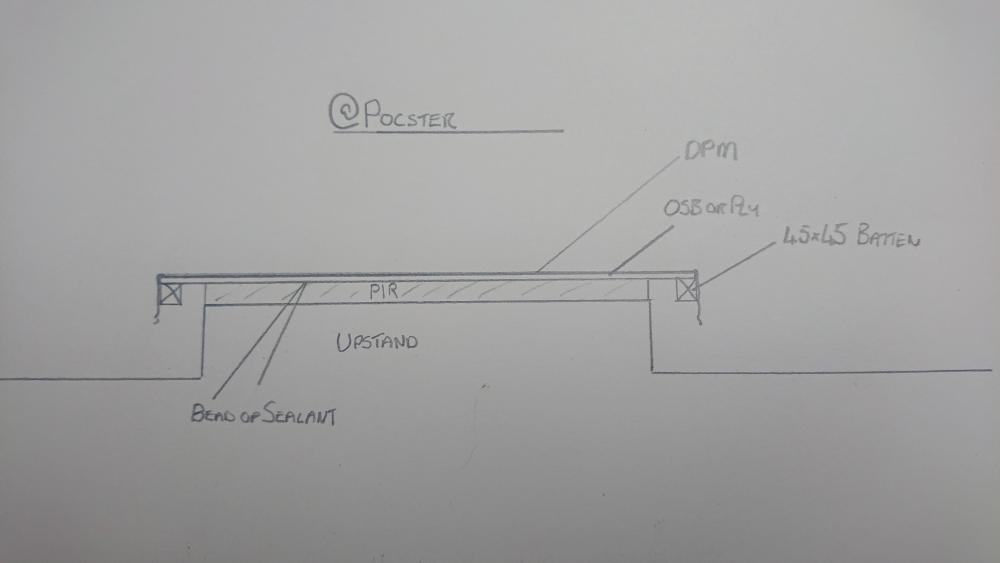
This is what I would do. Almost creating your skylight. This method will ensure no external ingress from the opening and minimise condensation formation.
-
Sorry - just seem that latest pic - you do have insulation in the slab yes? In which case that explains why no condensation on ceiling elsewhere which is good. You def need to get the covering of the opening right as it might be making things worse. I'll draw up what I mean.
-
So, if we go with the condensation theory, which is valid , then you need to put a sheet over PIR over the light on the outside - completely covering it. Then put the DPM OVER that and lap down the sides to the ground outside. You need to do two things here 1 - Stop ingress from outside. It's got to be done properly, hence why you need to make sure the light covering goes right over the edges and there is a clear lap downwards. 2 - Reduce condensation likelihood - in your case, the roofer if thinking it's condensing on the DPM and then tracking down - so you need the PIR over the whole of the opening. However, I would sound a note of caution - I have an underground garage made of concrete. I get terrible condensation on the ceiling(which isn't insulated yet) depending on what the weather does (it's fully enclosed inside). When condensation forms, it's uniform across the whole ceiling. In your case, if you can condensation you would see it everywhere across the ceiling. It would be seriously damp. However, you will sort that as thing progress, the PIR should hopefully stop condensation in that area to let you assess if it was gathering and running down the opening. Cut that slit across the crack - one side should then dry up and help you move - literally! - in the right direction.
-
Or the field/pipe has partially sunk in the middle and all the water pools in a small undulation and runs back/blocks?
-
It *could' be moisture being drawn out through some sort of capillary action - i.e retained moisture from the slab. Don't lose heart - you will get to the bottom of this, even if it takes time and a process of elimination. I think it you had a serious water ingress issue, it would be appearing much worse than this.
-
Why don't you get an angle grinder and put a score ACROSS the crack line (i.e at 90degrees) - say 5mm deep and 100mm long. See if that stops the moisture tracking? And see which side it's coming from that way? Just a thought? ANy tracking moisture should stop and drip down to the floor rather than permeat across the concrete and the line of the crack?
-
Which is lower - the corner of the light or the 'end' of the water track towards the wall? Even if it's only a mm or two, it might help indcate the 'source' of the moisture. My gut feel it that it's coming from the opening - which should be bone dry - doesn't look it in the picture? The covering of the light has to be much better than you had (I see you'd just commented) - a full sheet of OSB that is a clear 100mm overhang on each side, and then a 45x45 batten round the edges, then the DPM stapled down. This will ensure categorically there is no moisture getting in. I can't see it being condensation - it would be far more uniform over the whole ceiling. The source has to be that opening the more I think of it - the rest of the space looks nicely dry. You'll get there.
-
This will make you feel better about any problems with your house
jamiehamy replied to AliG's topic in Property TV Programmes
The grass is perfectly striped! On this area, no developer turfs the back grass. Sister just bought a 5 bed house. Mud out the back. Did some digging (pardon the pun) - it's the norm. -
This will make you feel better about any problems with your house
jamiehamy replied to AliG's topic in Property TV Programmes
"They also discovered architraves which are not level, cracking around the window boards, bubbled paintwork and say the turf in their garden was 'lumpy' and 'uneven'." End of days stuff that! ? Totally unheard of! -
Raft delivered, conrete poured and rocks in the road
jamiehamy commented on Simon R's blog entry in South coast ICF build
I really like the raft design and seamless interlock with the icf walls. That's one neat design! Good stuff and great read . -
ICF - Plastic ties vs Galv Steel
jamiehamy replied to Adam2's topic in Insulated Concrete Formwork (ICF)
I understand the concern however, when you pour, if through a line pump or boom, will likely be an over sanded mix. It should be fairly fluid and I doubt you'll have any real issues around the ties. On terms of fixing, we used Polarwall which had rails every 300mm vertically. We afixed no problem to that. In terms of fire, your protection is your plasterboard. If fire gets through that then you'll be way over by your 30mins anyway. I doubt there really is any definitive answer to your questions. Each will have pro and cons, neither make them decisively better. -
I would tend to agree with ProDave - I think now you have to game this a bit. The reason for my suggestion came from a chap down the road from us who built a small hydro station - he needed to run his pipeline under the road and the Council stated he would need a full road closure with everything that entailed (single track road). His solution? he went up late on a summers evening and dug up the road with a large steel plate should an emergency vehicle happen to come along. A local neighbour went bananas, called the police - who turned out and determined there was no criminal activity and they wouldn't do anything. A few hours later into the night, the pipeline was in and road reinstated as per what he'd have to have done.... I wouldn't engage any further with the council whatever you do. If you work entirely on the pavement (!), what can they do? That said, when we made our driveway, we applied for a Road opening permit - digger driver had the right qualification - and they issued it with no questions or followup. BUt you're in Edinburgh....!
-
Get your man to to do it either on a public holiday or after 1600. Will be done in peace and no-one will be any the wiser. Burden of proof would be on the council if anyone there was actually minded to pursue you fixing the road without a permit.... And tell no-one on your street of your intentions.
-
Noggin ', nogging, dwang, nog: be gentle with me....
jamiehamy replied to ToughButterCup's topic in General Flooring
No dwangs needed then. But unless the room and ALL the joists are exactly 400 or 600 centres, then you'll always have joins mid span (starting at the end of the first run). So don't worry about it, once the next run goes in, that first join will be firm. I agree with gluing and screwing. Glue the join, glue the joist. And would strongly recommend Spax for this job. If you can. You are running the boards at right angles to the joists? Just checking, no harm. -
Noggin ', nogging, dwang, nog: be gentle with me....
jamiehamy replied to ToughButterCup's topic in General Flooring
Are the boards tongue and groove? If they are, nothing needed for most. We fitted 22mm T&G and was no need to support. -
Very odd coincidence yesterday, was walking a friends dog and came across a new build in progress. Founds were in and lo, it was an icf build! I asked the chap what product and he said it was Logix. We didn't chat long but he knew the crew I had for our build. We talked briefly about tanking since it was being built into a hill and he said I should come back one afternoon but he had to get in and install the water bar before it rained... What's the chances?!