


TerryE
-
Posts
3826 -
Joined
-
Last visited
-
Days Won
30
Everything posted by TerryE
-
@Steptoe, the main reason for the absolute ban on no smoking in the house is that our new-build is a timber-framed one, and by far the greatest risk to a house before boarding out and plastering is smoking and flame gun work. We didn't need the latter and the former was an obvious thing to ban. Ian and my house are / were construction sites pre inhabitation. I feel that different rules would apply for using tradesmen and workers in an occupied family home.
-
If you do want to fill the internal box sections, then the trick is to use the foam gun with extension piece and start be squirting in a small amount in the middle ,say about 1/10th of the length. This will then expand and harden over the next 6-12 hours to fill the middle third. Then repeat on each side in one or two more goes. Practice on one, then do all of the other cills in batch. Cut of the excess when full hardened. Doing it in multiple fills like this will avoid undue internal pressure build up and the risk of distorting the exteriors.
-
We have AluClad PVC KF200 range. Absolutely no complaints. Zero maintenance, and the outside is sun-proof. As to the cornered mitres, my immediate reaction was Eh? I am not in the house at the mo, and so I checked some of our internal photos for a blow-up of the detail. Yes, you can see a very slight line at 45° in the window corners, but it is extremely subtle. @MikeSharp01, Mike do your picture frames have mitred or square corner joints in your house? A mitred corner is just a different approach. It doesn't make rational sense for one to be fine and the other offensive; this is purely cultural. Having inward opening windows is another thing that some people hate the idea of, but once you see them in practice they are brilliant.
-
When it comes to anyone other than you and the better half, IMO if you even hint at a "boots off" or "clean boots" policy, then they just won't bother coming near the house; just too much hassle for them. Except our slater who liked to come and have chat occasionally (and who was good company and as it he was slating in Feb, having his lunch with us was a good way to warm up), all of our builders or guys on site didn't want to come into the kitchen, except on an occasional basis, but we did make the loo next in the hall next to the back-door available (in lieu of a portaloo) and they did regularly use it for 1s and 2s, but: we never used this downstairs loo when the guys were on-site so they knew that they had it to themselves and, we put down heavy dust sheets between the external door and the loo, so they were comfortable with the idea of using it. One advantage of a timber framed house is that it goes up and is water proof within a week or so, so our workmen tended to use the house hall as canteen area when it was raining, but we did have an absolute smoking ban inside the house. A good alternative is a shed or even a gazebo in the milder months, but again it has to be reserved for their space if you want them to be comfortable to use it. As far as teas etc., we simply asked each team when their preferred break times were (and most preferred a set routine), say 10:00, 12:30, 15:00 and we took tea and biscuit out to them. To us it's just a matter of treating the people that work for you with respect and consideration, they will invariably reflect this back on us. In our case Jan and I had different rules: boots off or ear ache. But easy slip-on boots and a separate set of cloggies for working inside the new-build once weather tight helped a lot. So did a conscious effort to maintain and enforce clean access paths. You'll rapidly collect lots of pallets and they make excellent duck-boards.
-
End feed (don't use PF copper), but I was being a dozo. I missed the 1 off items hidden in the bulk buy lists
-
One issue with JTM is that they only sell standard parts like 22 x 22 x 22 in bulk , and I don't think I'll ever use 50× those, but I an always get them at Screwfix.
-
Jeremy, I use Screwfix a lot for many reasons: It's cheap compared to classic Builders Merchants (BMs) such as Travis Perkins. I live between a couple of branches within 15mins drive and service is quick, and their opening hours are excellent. I can buy online and know that the items will have been picked and waiting by the time that I get there. IMO, they very rarely score below 5/5 for the quality and functionality at that price-point. My only caveat is that for some things they've slowly been jacking up their margins over last few years for some lines. For example in plumbing. their bulk 10×90° elbows are competitive but some of the other slow turnover items are maybe 30% more expensive than Internet plumbing specialist such as the one that Peter mentioned -- if you can afford to wait the extra 2-3 days for delivery.
-
I am just going through the list of bits and pieces that I need. Whilst for the common stuff like end-feed Ts and Elbows it makes sense and is just easier to buy in 10, there's some stuff lie the 3/4" BSP male to 22mm compression elbow that I need 4 off. Just 4, and I am unlikely to need more or less, so if I go to Plumb Centre, say, which does a Pegler branded one at £10.58 inc VAT. I can get generic ones online for about half this price (e.g. here on eBay at £5.50). Both are brass components. I really can't see what the problems are with going the one for half the price. Both are brass co1mponents; passive fittings, and as far as I concerned if the the connect the bits that I need connected and don't leak then what's the difference? Any thought as to why I might be wrong here, or is there agreement on this approach?
-
We've made the policy and design decision for no mains gas in our new build. This has four tiers of saving: No Gas connection fees and these are typically ~£3K No need for Gas certified subcontract labour No daily connection charge No gas appliance annual maintenance charge This is a saving of ~£4K up front for the first 2. The last two cost us over £400 p.a. in our existing house (we could buy nearly 7,000 kWh for the same at E7 low tariff). We have got a 2-ring gas hob in the new kitchen, but that's run off a propane bottle outside. No PV because the planners said no, but we've got a wind farm and 3 solar farms within a 5km radius of our village and we will be buying green tariff electricity, so you could say that we've out-sourced the PV
-
Addressing backflow risks in Wet/Bathroom design
TerryE replied to TerryE's topic in Bathrooms, Ensuites & Wetrooms
A friend of mine was walking one of the coast-paths during the vacation when we were at uni. A big fizzzt and that was him done for. A surprising % of people who get hit by lightening survive. The main reason for death is that their heart stops or goes into fibrillation. If there's no-one on hand to perform CPR, then that's them gone. But we'd better stop this diversion otherwise Nick will tell us off -
Addressing backflow risks in Wet/Bathroom design
TerryE replied to TerryE's topic in Bathrooms, Ensuites & Wetrooms
I think that you mean that your house has been hit by lightening and you yourself not once and not fatally -- unless you are the forum ghost -
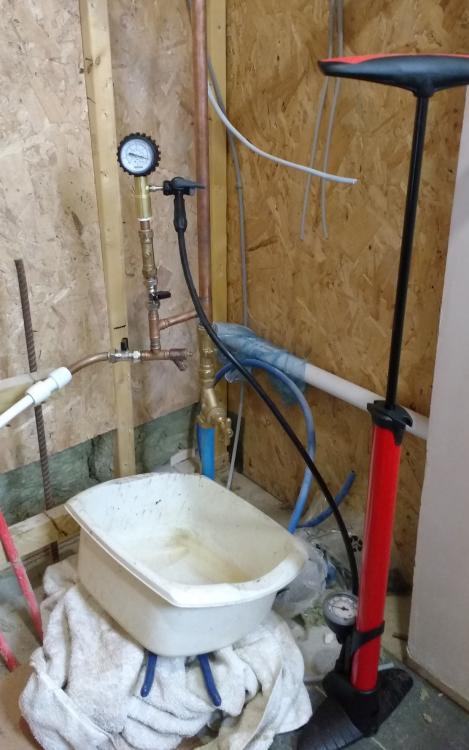
OK, One of the benefits of a manifold system is that we can do all of the pressure testing centrally. So is the T&J setup as per various feedback from Nick et al. I don't use the mains supply at the moment for anything other than testing. So coming from the mains I have: MDPE - Cu 25/22 stopcock : 22 Cu Double check valve : 22/15/22 T to (2) and finally a length of 22mm with an elbow and draincock at the top to act as a sort of air catcher / mini expansion Short 15 to 15/15/15 up to (3) and down to (4) 15 isolation valve, 15 double check valve and a Monument Dry Pressure Test Kit (£30) pumped by a Halfords Metal Trackside Pump (£18) 15 T to draincock and (5) 15 isolation valve and tail with Hep2O straight to hep2o flying lead which connects to whatever pipe or assembly that I wish to test. Most of these bits were old spares apart from the two price listed items so the setup was cheap and easy to make. The main disadvantage is that this Munson gauge only measures to 4 bar. But the set-up works well and the trackside pump is good for flushing out the test water so you don't leave drippy pipes after testing. Thanks guys
-
@Barney12 I am more than happy to go through all this, but it doesn't really belong in a topic about Alu cill depths. It's really about all the issues to do with adding a stone / blockwork skin to an MBC-style frame. I'll do a blog post over the weekend. Did you check your private mail?
-
Addressing backflow risks in Wet/Bathroom design
TerryE replied to TerryE's topic in Bathrooms, Ensuites & Wetrooms
IMHO. Can be both, but it's just that drop the H after someone got really arsey with me. Doesn't pee feels colder than the bath water? This is true for most actions that you do if they beach some regulation. However poluting the public water supply is a fairly sure one. IMO, if I had double check valves on the appliance and on the supply line then the risk of getting killed by lightning is far greater. -
Dual Hobs in Worktop, design vs structural engineering
TerryE replied to TerryE's topic in Kitchen Units & Worktops
Yup, ours is similar. Why the hell he designers don't put the touch controls at the bottom of the panel escapes me. -
Dual Hobs in Worktop, design vs structural engineering
TerryE replied to TerryE's topic in Kitchen Units & Worktops
Oops sounds like you need a stool or a stick with a rubber hand on the end in your kitchen -
@Barney12, no, MBC weren't proactive here. It was an issue that I picked up on eBuild chit-chat before we spec'ed the frame so we added 12mm on all sides to our frame window openings to give us room to insert the "shims", that is the framing. I've you haven't done this and the window openings are already agreed, then there is an alternative approach that either @ProDave or @Stones described (sorry, can't remember which; it was nearly 2 years ago) and this was to use something like the 38×44 tanalised construction timber to make up box frames which you screw to the outside of the frame openings once the frame is erected (depending on your detailing, then you might need to have an inverted U instead of a box) -- then you mount your frames in this. Most high-spec window frame profiles are 80mm+, so positioning them like this is fine. We got this right more by luck than by judgement. It's a pity that MBC (and other framing companies) don't go through this as part of their design check list. If you want to talk it through then PM me your voice details and we can do. That's if one of the other guy doesn't get there first.
-
Addressing backflow risks in Wet/Bathroom design
TerryE replied to TerryE's topic in Bathrooms, Ensuites & Wetrooms
Two comments: Repeating what some once said to me: "when have you ever been f**king humble in expressing your opinions?"; stick to IMO That's what I do. IMO, this debate isn't about real risks, it's about passing the inspection. -
Barney we have a similar profile except that our outer skin is stone ~125mm thick. What we did was to mount our windows in a narrow mounting frame (marine ply is typically used) so that the face of the windows sit some 45mm in front of the frame and largely close the cavity. This overhang is insulated by the cavity closers that surround each window. This makes finishing off the windows in term of weatherproofing, cills, etc a lot easier. If you look at the thermals is makes bugger all difference to heat losses and the slightly increased psi effect is still far above the thresholds where condensation might become a problem.
-
Addressing backflow risks in Wet/Bathroom design
TerryE replied to TerryE's topic in Bathrooms, Ensuites & Wetrooms
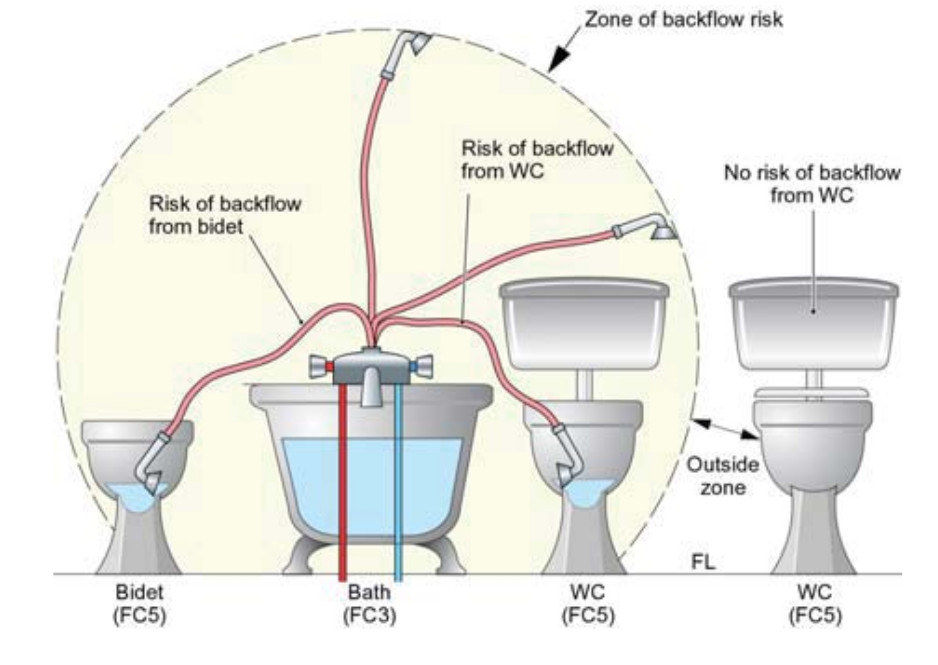
If you read that brief that I linked to FC1-5 is about protecting the public supply, and not necessarily about protecting the household. The difference between FC3 and FC5 as I read it is that for FC5, mandates a suitable air gap; a double check value (or even 2 in series) isn't good enough. In older non-pressurised systems this could be achieved by feeding the shower from indirect H/W and C/W primed from a cistern, with the cistern filled from a ball-valve -- and thus creating the airgap between the shower tap supply and the public supply. (This would not protect other indirect-fed basins fed fro the same indirect supply in the scenario that Nick discussed, BTW.) The problem is that this type of gap doesn't exist with modern pressured systems, so the Building Inspector should therefore fail any configuration which breeches this guideline. The easiest way to avoid any issues during inspection would be to comply with it by fixing short hoses or adding "permanent" restraining rings on the hose lines so that any shower hose passes the "can't reach the pan" test. Whether you remove it or not after the inspection is your affair. You might feel that a decent double check valve in the shower feeds should be perfectly adequate, but if you do and this does fail then you would be legally liable for the contamination that occurs. -
That's why it is in the Boffin's sub-forum but when JSH, ST and anyone else with informed views and I have reached a broad agreement to all the geeky shit and agree on conclusions, then I'll do a blog post summarising the "how to" in a blog post or mainstream topic.
-
This issue is one that you could come a cropper with your BInsp if you aren't careful. Here is a good paper written for WRAS which explains the issue and figure 2 is the nub of this issue You have to prevent the risk of backflow at two separate risk levels: (FC3) For basins and baths you can use double check valves, a self cancelling diverter (one of those button ones where the button pops if the flow stops), or a guaranteed airgap (FC5) For anything where liquids containing shit or its micro-orgamisms can pool, and in particular for toilets and bidets, these must be air-gapped with no exceptions. An airgap means just that. In old indirect systems that were fed from a ballcock, using the indirect hot and cold on the shower feeds would meet this requirement but on pressured systems there is no such airgap internal to the pipework. What this means is that the hose nozzle must be physically prevented from being able to be dropped into an adjacent loo or bidet. This means that you have to ensure that the hose is either too short for the nozzle to reach or that there is some restriction that effectively limits the hose length to achieve the same, such as a fixed shower screen between the pair or a permanent restraining clip around the hose. If the geometry / layout of your room means that this is a risk then using a very short hose or a permanent restraining clip to prevent this is the minimum that you should anticipate needing to get sign-off. How permanent this constraint is after the sign-off is up to you and your conscience, but this is a real risk to the water supply.
-
Peter, what gets me is that I often can't find what I am looking for or I am spoilt for choice, and both do my head in. So take two examples: The draincocks. I know when and where to use them. I've end-fed soldered them in the past so technique isn't the issue. However I was searching Screwfx to buy a few and could find them: drain, too many hits; drain valve, too few and the wrong ones. I had to know to call the bloody thing a draincock. Durrrhh! PRV. Again we are spoilt for choice so it would be good to know which actual model people have used. Putting the bits together once you've bought everything is the easy bit, IMO.
-
Effectively no, mains quality what is a pretty poor conductor: good enough to electrocute you but not good enough to use for earth continuity. On this main thread of DIY plumbing, this is a mix of design knowledge, techniques and skills and quality. As Jeremy commented the building industry in the UK is dogged by poor quality. I've worked in IT all my life and for three years my title was IT Operations Director for Rolls-Royce (the aero-engine one not the car one). Now that is a company that has quality as part of its DNA and culture, and IMO pretty much at the opposite extreme of current practice in the building industry. In IT whether application development or IT services where I worked for the last 10 years of my career, there is still a good quality culture. Processes and procedures were documented; testing and review were build in; essentially everyone was subject to independent scrutiny and accountable for there outputs. Lessons learnt where aggregated up and fed back into improving the processes. This was just part of the culture, and on the IT services side of my company I was at the top of that review and assessment pyramid in Europe. It wasn't perfect but it was a different world away from what we see in the building industry today where individual tradesmen work largely unchecked and in isolation. Now the average self builder will definitely not do as good a job as the top tradesmen, but IMO a best Q is to ask: with a small amount of advice and support (and sometimes testing / certification), will he or she do better than the average tradesman working to a rate that they can afford? And I think that the answer is "yes, definitely" for most knowledgeable self builders.
-
As far as I can see you need the SAP rating for Building Approval and some people need a A rating for some BSoc funding approvals, but after that it's either an ego thing, or a sales gimmick. We're not planning to sell our new house, so I don't really care about the SAP rating, just the true operating parameters such as performance, operating and maintenance costs. Jan's residual concern is about the summer peak and whether we will need the ASHP to provide active cooling.


