


TerryE
-
Posts
3826 -
Joined
-
Last visited
-
Days Won
30
Everything posted by TerryE
-
The height is a trade-off: bending the back all of the time or lifting wood. I personally prefer using my legs to lift and keeping my back straight when I cut. As to the notch, IMO you should engage the dog teeth and then let the saw's own weight and its own pull rotate it into the log. No need to push, pull or force the blade down; if you are doing this then your technique is wrong. This being the case, the notch only needs to be half (maybe up to the full) maximum width that you want to cut. And keep your blade sharp. As I said before the files are cheap and YouTube gives you lessons on technique. If you do start hitting nails then it's probably eaiser just to order a new chain. They only cost ~£15, IIRC
-
Just make sure that you've got a full hot tank so you can have a good steep and top-up in the bath when you are done!
-
@Steptoe, the cock crows twice. Please leave it. You seem to be one vs the world on a typo. Have you never made one yourself?
-
@Declan52same chainsaw as me The maul set seems a bargain. Rob, the maul takes a bit of getting used to. Momentum and accuracy. Also the C of G is slightly off the axis of the shaft so the head naturally turns to split the wood on impact. I recommend making up your own bench out of offcuts. Then you won't cry when you accidentally saw it in half!!
-
Where you live, I think that we can give you a bye on going woodstove (And we do the same in our current farmhouse). Wood burning is high labour. There's no denying. If you want efficient burn then you need to cut and stack your wood for a couple of years to get the moisture content down (otherwise a large % of the heat energy goes into boiling off sap water up the chimney). If your logs need cut to length then you'll need a chainsaw, plus making up a logging cradle and PPE such as kelvar trousers, ear defenders and gloves. I can't remember how old you are but IIRC you are a couple of decades behind me. Even so, doing a 3-4 tonne load of logs is back-breaking work so you will need to be reasonably fit and do your yoga ( ... ) exercises to strengthen those muscles. IMO, your don't need a hydraulic splitter for green wood, though a couple of splitting wedges, a sledge hammer and a splitting axe are pretty essential. BTW, if you have electricity on-site then I'd recommend an electric chainsaw. I always had problems starting my bloody Stihl, so I swapped it with a friend and bought myself one of these. Bloody useless for wandering around a forest, but perfectly adequate for working in the garden at a saw bench, but buy yourself a set of sharpening files and watch the usual "how to sharpen a chainsaw" videos on YouTube.
-
I could reply or just to make it more fun you could read my blog and a few others such as Jeremy Harris. There's about have a dozen of the frequent posters who have used the same supplier without any material complaints or even reservations, but others have used other TF suppliers and different construction techniques. What we chose worked for us. It might work for you. What others have chosen might also work for you. But at the end of the day, you have to make your choice as to what is best for you. If you ask here then you'll invariably get at least 2 or 3 perspectives. What I really like about this site, is that I often get out of my comfort zone, so I can research what others have done or just ask the Q. In return I give back where I do have the knowledge to contribute.
-
One other thing, and it's a personal view: we chose a frame+slab bundle tailored to our custom design from a specialist manufacturer that targets the passive-class market. I know of example builds where the scope of supply is stripped down and therefore a lot less. But you have to compare like-for-like. In our case we had three major subs: the slab and frame; the ground works and exterior, done by a local builder; and the windows . All of the other trades we either did ourselves or used the builder's subbies. The net result is a cosy warm house that looks really nice, costs bugger-all to maintain or to run -- for roughly the same price as a run-of- the-mill one-off development.
-
PM + Architect + QS between them can add over 20% to a self-build. A self-build is invariably a one-off so will cost more than a like-for-like mass-built estate house, simply because the developer can amortise a lot of costs over N builds. This being said, with a self-build you and your partner have the opportunity to take on activities (if you can spare the time) that you might otherwise be paying £250-500 per day for. In our case, I've done a lot of PM in the IT world before I retired early; I also have a good 3D visualisation sense, and we wanted a fairly standard house in terms of layout, though passive-class in performance. So between Jan and I, we've done all of the design, PM, bureaucracy, and a lot of the internal trades, such as the carpentry, plumbing, etc. The end result is that we've probably saved ourselves maybe £60-80K on the cost of our build. There's a lot of other members here that have done likewise. Moreover, I suspect that there are less than a 100 commercially-build houses with comparable energy specification to ours coming on the market in UK annually. It's a long road and can be very stressful, but the payback can also be huge. And there are people here willing to help you on the journey .
-
-
Maybe, but the general tone detracts from the underlying points. If you upset people, then they tend to stop listening, and if they don't listen, then they won't learn and this kind of defeats the point of the debate.
-
Gotcha!!! Not paying attention! http://www.tonyshouse.readinguk.org/tony.htm Not sure Tony invented it, because this sort of wrap is pretty standard on timber constructions, though most block-built houses are just allowed to leak from what I see
-
Ask your Brown Owl.
-
AND its got a schrader valve included. My hero!
-
Thanks guys. The end stop idea seems to be simpler to do than trying to make a T. I'll give it a go tomorrow.
-
I am trying to work out the easiest way to procure / fix a Schrader valve to the kit. My current thinking is to buy / butcher a bike tyre and lots of CT1 and wipping onto a piece of 15 pipe. Any better suggestions?
-
Jan's gone all coy -- mainly because she's got her head in a book, but her aside was "but I did the plumbing, so I'll rest easier once I've seen it pressure tested!"
-
Clive, thanks for the kind offer, but I am going to need this on and off (forgive the pun) over the next month or so, so it would probably be simpler to borrow the design and do my own. For others' benefit, can you give a quick parts list.
-
My sink is in the kitchen centrally against an outside wall under a window. I've got 2×Hep2O 15mm coming down the wall to the right of the window with 2×15 mm copper running along behind the units, each with a slow bend into the unit under sink. I've simple cut a slot hole in the plasterboard to bring the Hep2O pipe out clear of the wall behind the corner unit and I've 2 × Hep2O 90° elbows joining the copper to the Hep2O and turning the 90° at the same time. I would have used end-feed copper 90s and done a straight Hep2O to copper, but Jan's argument was: what's the difference between a copper - Hep2O straight vs. elbow. I couldn't come up with a valid counter-argument, so I lost this debate. I'll leave you two to discuss this while I go and hide
-
OK, another go around the merry-go-round on this one. Where we live is flat and the mains is pumped to around 3 bar IIRC. I have one particular pair of elbows that are behind a corner cupboard in our kitchen and the new worktop is going in on the 30th, so I want to pressure test these to at least 5 bar before then, because if either fails after the worktop is in then it's going to be a total PITA. As far as I can see, the Rothenburger RP 30s are the standard entry piece of kit for doing this, but they cost about £140-180 new. Has anyone used any of the cheap Chinese clones that you can pick up for down to £40? OK, I accept that the main risk is that the gauge is crap and I end up over-pressuring the system, but I thought that the simplest way of preventing this is to add a second pressure gauge at £15 or so. Any comments or suggestions? @Nickfromwales @Onoff or anyone got pearls of wisdom?
-
I left some 75mm wide sycamore saplings on my boundary when clearing it just over thirty year ago. About 5 years ago I had the last one felled and the root ground out. It was about 400mm wide by then and the root ball was even bigger!
-
What and where to use air tight tapes on block built house
TerryE replied to JamieM's topic in Ventilation
Yup,Tony also mentioned the alternative of using hangers plus sealant, but be aware that you can get air leaks particularly in the risers between blocks if not fully filled; that's why the render suggestion is made. Alternatively is you haven't hung the joists just hang a strip of air tightness membrane around the wall at floor void level and punch the hangers through it and seal each one. -
What and where to use air tight tapes on block built house
TerryE replied to JamieM's topic in Ventilation
To be honest, I not the expert here. I was just relating of detailed conversations with a couple of crews who worked on my timberframe house (both of which had a lot of experience of erecting passive house class both blockwork and timberframe constructions, and these crews essentially gave the same message that Tony described in his blog here, and this was that trying to achieve airtightness in the floor void zone was a real PITA if you didn't do something to actively address this (such as the sock method that Tony used). Whether you sit your joists in the block skin or use hangers the material interface invariably causes separation of the mortar at opens many cracks through the blockwork. These are structurally insignificant, but can really impact the overall airtightness. Essentially the house will leak like a sieve. As JSH once mentioned, if either of our houses was totally airtight except a 1" diameter hole somewhere, then it would fail a 0.6 ACH airtightness test. Just out of interest, here is how they did it on our TF build: the floor was decked out to the external perimeter and the airtighness membrane looped back onto it before the next storey cassettes where craned into position. I am not saying that everyone wants or needs to achieve an 0.6 ACH figure, but more that some though about how you seal the internal floor void surface of the exterior walls will have a major impact on the actual airtightness achieved.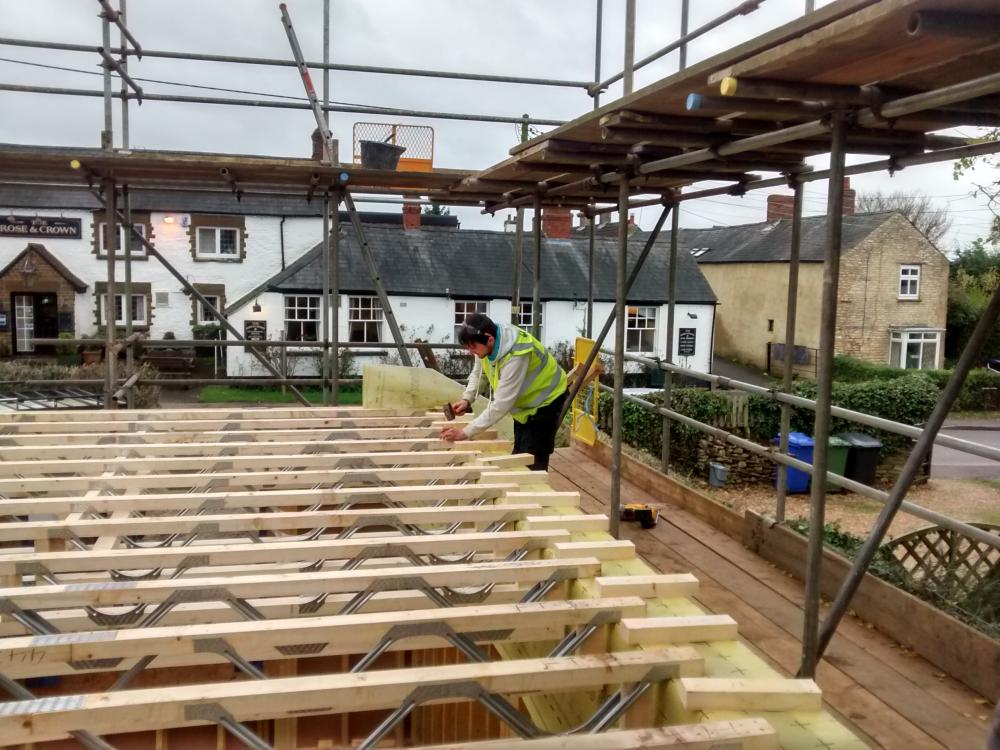
-
@hmpmarketing, this also has the advantage that the neighbour did this from the planners PoV so its outside your control Check with your BInsp that the neighbour has offered to remove the tree and grind out the stump and see if he will give you a concession on this in this light.
-
What and where to use air tight tapes on block built house
TerryE replied to JamieM's topic in Ventilation
@tonyshouse is one guy that posts here and been through this though there maybe others. If you want high levels of airtightness with a block wall then you are going to have to use the inner face of the blockwork as the VCL / airtightness layer. It is very easy in the laying of blockwork to leave or to create fine air paths between blocks. A direct inner render coat or plaster coat will help to minimise these, but the danger zones are the floor voids and joist hangers which tend to be omitted when planning plastering, as well as the window, door and services openings discussed in previous posts. The best time to address airtightness in the floor voids is during construction, but you are now past this, so the next best time is before boarding out. If you don't bother then at best you will get very modest airtightness by sealing around skirting, etc. -
Have you not just thought about finding out what a reasonable cost of the extra foundation work is, knock off the price of felling it and grinding out the root ball and offering your neighbour that as a lump sum plus you carrying the cost of removal for his agreement to let you remove it? There's nothing like a bit a cash to encourage cooperation.

