

TerryE
-
Posts
3806 -
Joined
-
Last visited
-
Days Won
30
Everything posted by TerryE
-
@Nick, for sure. It's just that I've had to get my head around the design stuff and dumping it out Jeremy-style will be helpful for others.
-
OK, we aren't having the exchange that I wanted, so I think that the way that I will approach this is to write up my pipe sizing design as a blog post, and I can always revise this in the light of comments. Hopefully you guys and others like @Alphonsox who also have a SunAmp setup and the others that are tracking my plumbing thread will give me feedback to help improve it.
-
@SteamyTea Nick, I assumed that you know how to use Google and have a base level of experience here on configuring the device that you want to use. However, I will expand on these for other readers and rather than go into great detail, I've just linked to the relevant Wikipedia article. HDMI and VGA. These are two hardware display interfaces. You plug old-style monitors (and some TVs) into VGA; and modern TVS into HDMI. The RPi has an HDMI interface on board so you need a little converter like this if you want to use VGA. Raspberry Pi ESP. Sorry I assumed that you'd read / not ignored / not forgotten my earlier post on this page where I explained all this. NOOBS, the RaspberryPi.org recommended and supported (and easiest) way to setup a Pi. If you haven't heard of this then no wonder you are struggling to setup you Pi. RTFM Server vs Workstation. In simple terms you have a display / mouse / keyboard and graphics interface on a workstation. You typically access a server using one of more encrypted SSH links, either for backup, console sessions (think of DOS box), and file browsing. This doesn't mean that you don't use a graphics interface to develop / maintain the server; you just use your PC/Laptops and open as many windows / SSH connections onto server as you need. The main advantage of doing it this way is that you don't need to install the OS desktop components or desktop applications on your server. Less footprint both in term of HDD and memory; less security vulnerabilities. SSH LAMP. The standard user interface for servers these days is either a web application or your mobile phone using RESTful API. To do this you need to configure your Pi as a webserver. The LAMP stack is the de facto free open-source stack. Installing it on the Pi is a check-box on the configuration menu. Nearly all automation application assume that you have this installed. Google, YouTube (and your brain) are your best friends here.
-
? apt-get purge is just short hand for a apt-get remove followed by apt-get clean. I'll just be doing this again in a few days, so if you want, I will update my notes, but IIRC, I just edit my NOOBS config.txt to set the HDMI screen to text mode only -- or you can buy a HDMI to VGA convertor for about £5 on eBay (but watch out, some come from China) and use an old monitor instead. You can also do this through rasp-confg. As well localisation, enable SSH. As far as using the RPi, I don't enable GPIOs or anything since I do this with my ESPs. I just configure it as a bog standard LAMP server plus SSH, then just do an autoclean / autopurge. Just search for raspberry pi raspbian lamp server in YouTube if you want an online video on how to do this. There are euvalent vidoes for using RPis for embedded use.
-
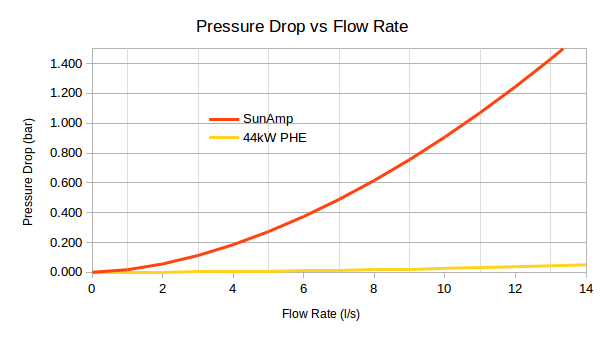
BTW, guys, if you have a maths or physics A level, then I really suggest that you read those two articles that I linked to or I can email you a copy that I reformatted to make it readable in printable layout. I don't want to put this up as a link as this is technically a breech of copyright. @JSHarris, this is all great stuff for me and I need to think / stew about some of the implications, and I am still getting to grips with some of the non-intuitive implications of my design, like I wasn't going to bother with a water softener, until I realised that (after a postcode search from Anglian) that we are at ~275ppm which is way above the recommended maximum for the SunAmps (150 ppm). I really can't see the benefit of putting a softener on the DCW, unless I do Jeremy's trick of wiring in a direct feed to the sink, but I will need one on the DHW side. There are also some pretty non-intuitive things like the impact of adding the PHE in front of the SunAmps. Adding an extra PHE is bound to increase the pressure drop (PD) isn't it? Well no it doesn't, and you can see why here. The PD through the PHE is tiny compared to that through the SunAmps. If the DCW supply is 8°C, to O/P of the SunAmps is 65°C and the PHE output is 18°C and the final mix is 48°C then a high flow, say 25 l/min through two SunAmps is 12½ l/min per SunAmp: The mix without the PHE is 30:70 cold : SA output so the PD of the SunAmp is 0.72 bar The mix without the PHE is 36:64 cold : SA output so the PD of the SunAmp is 0.61 bar The serial impact of the PHE is ~ 0.02 bar so the second has a higher maximum throughput as well as a more efficient use of the SunAmps. But all this exchange is helping me. My original post was more about how we collate all of this for the others who are just following down this same track and need to get up to speed.
-
I suspect that we're going to do this as two passes, the first is some heavy and at times geekish discussions. Hopefully the outcome is something that one of us can summarise There's no point in trying to go through the theory and practicalities of the flow calcs, because a guy called John Heartfield has done a good job of this on his articles: Part 1 -- The Theory, and Part 2 -- Real Systems. However, it would be good to have a structured discussion on the pros and cons / ins and outs of pipework sizing and radial vs loop or branching designs. I've been doing the calculations on my system and there is little clear benefit in going to 28mm, as 22mm will carry the heaviest flow rates and as manifold, supply and all central pipework are within a 2.4 × 0.65 × 1.4 m cuboid service area, all of my copper runs are really short. In our system the 2 × SunAmp PVs are the main limiting constraint as these will bottle out at @14 ltrs / sec at 3 bar so 2 in parallel mixing 2:1 with a cool stream will be unlikely to deliver more than 35 ltr/min in practice, but that's enough to have a shower and fill the bath at the same time. Two things that Hearfield doesn't discuss are: Dead carrying capacity. This only applies to DHW connected appliances, but it an efficiency issue. Small is good. Noise. Flow against a pressure gradient is doing work. This is shed as temperature rise or as noise, and goes up on a square law. And if you get the design wrong then pipe (and appliance) noise can be a real pain. An example of the latter is the header tank cold fill in my current house. This runs up a stud wall between our ensuite and the family bathroom in our current house. Our washing machine is an indirect feed cold-fill job and we usually run a washing cycle overnight kicking off at ~4am to take advantage of E7 plus be ready for the morning and every night from 4:00, the ballcock fill on the indirect tank sets up a pssshhhhttt on the fill riser. So laminar flow in pipes is also good = don't use devices which create a lot of noise or tight elbows etc. which cause a lot of energetic turbulent flow at high pipe velocities. So we have got our service area inthe new house on the ground floor, well away from bedrooms, and the pipe runs are short, etc. The room has acoustic insulation on all internal sides. Any other comments / views / advice that we should consider / reflect in an overview? PS. John Harvey does go into a lot of detail on noise issues, manly in Part 1 so I did him an injustice.
-
@Steptoe, I am not sure of the scientific basis of your assertion, or perhaps it's just an old street tale? As Onoff says, many of the foams include this as one of their purposes. I've got very few penetrations through the TF fabric; mainly exterior lights, etc. All extremely low current in 1.5mm cable or bigger.
-
@PeterW, it's an ARM chip so this shouldn't really be necessary if you are using it as a server, since the overall CPU utilisation will be well under 100% and the on-chip Graphics Processors (GPUs) will be idle. If you are concerned, then you can buy a passive component like this. I really don't think that you will need an active heat-sink unless you are making heavy use of the OpenGL libraries. (These are a standard API libraries used to access the functions provided in the hardware GPUs in a portable fashion; most 2D and 3D applications and OS functions will use these standard interfaces rather than get into proprietary Broadcom hardware internals).
-
I use ESP8266 devices for my sensors. And I program them in a language called Lua using the NodeMCU firmware. However, in the interests of full disclosure, I am a little biased since I am one of the core developers of the NodeMCU firmware. I use these to communicate to a central full RPi3 for logging and home automation. The ESP modules do the data collection and relay control, etc., but the RPi does all of the complex stuff. If you don't want to ESP programming at all and essentially use it as a fairly dumb Wifi connected chip, then an alternative that my son-in-law uses and recommends is ESPeasy. This project by default recommends Nodo Domotica as the Home Automation (HA) system, but I would suggest that you stick to either Pimatic or OpenHAB. I run my RPi3s with the SD cards pretty much RO and attach a small USB-powered HDD as the main storage device. You can buy these for £50 up or you can buy SSD ones such as this for £60. I run a standard Rasbian Server installed through NOOBS. It is basically a bog standard Debian build so there is little point in doing anything else. The only frill that you might consider is a Li/LiPo battery hat if you want a battery backup (UPS). As far was the ESP kit is concerned, have a look at the WeMos range. These use a standard form factor and edge pin-out so that you can stack them. You can get a whole range of hats for relay and sensors, and if you want to have multiple DS18B20s, then use the prototyping hat to put the headers for the DS18B20s, resistor and cap on. You can make up a complete battery-backed 6 temperature sensor with WiFi for about £20 if you are willing for delivery from China and buying the stuff from AliExpress. BTW the Wemos ESP boards which cost about £3 already have Arduino-style USB serial + power onboard + FlashRAM which is used for both firmware load and as a pseudo HDD -- as well as Wifi connectivity of course. PS. I've just ordered a USB 120Gb SSD from AliExpress: £39.74 free shipping. PPS. I've decided to SikaFlex my RPi3 box that I use for my house server to the wall of the cupboard under the stairs. That way there is no bloody chance of Jan covering it crap so that it over-heats this time!
-
The only Radius that I've come across is this: Wikipedia RADIUS and if so then I am not sure how anyone here would know how to answer this. Wrong forum
-
Another thing that stuck me here was that I would be seriously lagging my DHW copper pipework to keep the heat contained, and I will also lightly lag the DCW pipework to avoid condensation. So by the time the BInp sees it not of the pipework will be directly visible and I will have photos of course. BTW, what is the best tape to use for the joints in the lagging? The stuff that I used on our current house all fell off over the first 10 years or so.
-
In this case the output will never get above about 25°C so there isn't a lot of point. On a different tack, the two SunAmp PVs have internal PRelVs and the UFH will also have one so am I correct saying that the easiest way to deal with all three is just to have a row of 3 tundishes all draining off into a HepVO and back into the stack?
-
One issue is that these Willis heaters are spec'ed for a vented system. I'll be running my UFH at roughly 1-bar with pressure relief valve and ½ ltr expansion but technically this isn't unvented. Needs more thought.
-
How do you buggers know this stuff? You do know that you are going to get a man-hug when we meet.
-
OK, guys. It's manifold time, and this Q is addressed to those who are wizards and / or have been through this with an MBC frame, such as @Nickfromwales, @JSHarris, @jack, @Calvinmiddle, though PeterW always seems to be very informed on this stuff.. I'll be putting in a basic 3-port system such as this 3 Port Complete Manifold Assembly from the The Floor Heating Warehouse (and this looks very like the one that Jeremy used, BTW). I'll need a pump, but I will probably get a Gunfoss Temperature Controller and Pump Assembly. OK, in my case using an inline heater or as with Jeff using his ASHP unbuffered, the mixer regulator is probably redundant. Even so, part of me says that if something does go totally ape-shit with the heating system then I'd rather keep the problems / damage above the slab where the repair costs are relatively minor, so having the built-in TMV to limit the slab temp to 35 °C is probably a sensible safety back-stop. Finding the water heater that I want hasn't been going well. What I want is essentially a 3 kW immersion element in a tube. I'll be pumping water through it pretty fast, say 20 ltr/min, so it's only going to raise the flow by a few degrees and the water will never be hotter than 30 °C. About the best that I've found so far is something like the Stiebel-Eltron Mini Instantaneous Water Heaters, but these are really designed to lift very low flow rates by ~30°C. If anyone has any suggestions here, I'd be very grateful. Thanks.
-
In fact Wiltec also sell these through Amazon. Incidentally the Wiltec datasheet gives the pressure drop at 15ltr/min as ~1.5kPa or 0.015 bar which is two shades of bugger all. My only dilemma is whether to defer fitting this until after the BInsp visit since it isn't WRAS approved. So I can get this for 47.29 € + 13€ shipping from Wiltec direct and the exchange rate is 1.17 or £49.24 + £11.00 UK delivery via Amazon. Go figure that one. As far as the water treatment goes, Janny and I had a long discussion about that one and we decided that our local water supply isn't really hard enough to bother. (We descale the kettle about 4 times a year but we could get away with less).
-
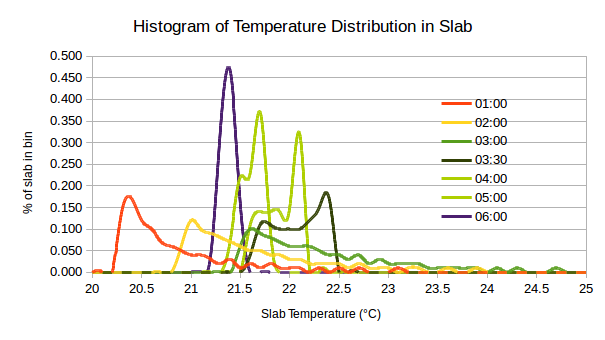
One last post and I think that I've done this to death. I will summarise my conclusions and observations in plainer non-boffin language as a blog post, because the general observations and behaviour of the slab are worth understanding if you are designing a low temperature UFH system. The previous post shows that as you heat the slab through the UFH pipework at this 3kW rate that I've used as a baseline, that the temperature in the pipe gets up to maybe 5°C hotter than room temp immediately around the pipe and this temperature rapidly drops back as you move away from the pipe. As soon as the heating is turned off then the UFH pipe fairly rapidly acts to start spreading the heat uniformly around the slab. So I decided to add a bit of analysis to histogram the heat in the slab over time. There is a slight complication in that the simulation uses an evenly spaced mesh at radial intervals from the centre core, but as I am collecting heat distributions then I need to do this at even volume steps, so that each sample represent the same volume of slab. I did this the simplest way, which was to resample the heat curves (using a simple linear interpolation) so that each sample histogrammed represented the same volume of concrete. A bit of a bodge, but good enough to see what's going on, and here is the result: The first three histograms show the effect as the slab is heated. The main bulk of the slab slowly rises in temperature and there is this very thin long tail (of hotter concrete very near the pipe), so for example by 3 hrs into heating the slab only 3% of the slab is over 24°C. The next four show what happens when the heat is turned off and the UFH pipe is now just circulating water. As can be seen in the previous plots with hot core is quickly cooled as the heat is redistributed along the length of the pipe. This in effect squashes the this tong hot tail back into the main peak . Over the next three hours or so (that is by 6hrs into the simulation) the temperature in the slab is already so uniform that the 80% of the slab is within ±0.1°C of the average temperature. And the reason that the average temperature is slowly falling is that the slab is slowly radiating heat back into the room-space. @JSHarris, @SteamyTea, @jack, does this make sense to you?
-
One subtle tweak: maybe you put a plug/socket break at the boundary and slip the meter in at that point. Put it in a heavy duty polythene sleeve and ducktape it up to keep it weather-tight. That way both you and the neighbour can read it. The neighbour can be confident that all of your electricity is being metered and you can be confident that only your electricity is being metered. You can pay him 2× or even 3× the standard electricity tariff. It will still work out a lot cheaper than buying a genny.
-
Back to the flow regulation issue, I've been checking our taps and they all use a standard diameter aerator / flow limiter and increased flow restriction versions are cheaply available, so for any that fail the flow tests, I can swap them out for the test. They all seem to have a preferred 1-5 bar rating and our 3 bar pressure is bang in the middle of this, so the whole "need to do flow restriction" is pretty much a non-issue if done at the appliance end. Phew. Another panic over. However, with all of these restrictors around the place, having a decent clean filtered water seems a really good idea, so I want to find a decent limescale inhibitor and a filter that I can clean without having to do any major disassembly. However, having looked into this there are no WRAS approved chemical filters for potable water, since these work by swapping out the calcium and magnesium ions in the water for sodium ions, and this effects both the taste and wholesomeness of the water. The magnetic descalers seem to be based purely on pseudo-science and there is no real evidence that they do anything at all. As to filters, the magic search term to use is strainer (thanks Jeremy) which yielded the business on the JTM site: Brass Strainer 22 mm. Another step forward. Where is your Welshman when you need him!
-
Jan prefers to do all of the driving and since I used to have to do a lot for my job before I retired, I am quite happy for her to let her -- a win,win. The main time that she wants me to drive is when we go to friends for a meal and she doesn't want me to drink too much, so she plays the "it's your turn to be the designated driver" card. So if we ever got a digger (and I am thinking of hiring one like Ed had went we do the back garden), then I suspect that she'd want to do the the driving!!
-
?? Our build is in a plot split off from the rest of our current house. I didn't want to get into all of the Part P crap for a temporary supply so I just ran a 13 Amp socket on an extension from our shed to a small garage MCU which I had in the TF shell as soon as the ground floor was in place to a couple of 13A socket strips and bought a dozen extension cable so we ran one to each floor and daisy chained any others to rooms as needed. We also bought ~10 cheap LED strip lights and work lights. The only reason for the chaining extensions was convenience. The builders mainly used the power for lighting, recharging their power tools and (unfortunately) the mandatory site radios blasting out Radio 2. We also ran a small dehumidifier at times. Our consumption never went up by more than 5 kWh per day. And if there were any Qs about the temporary supply (which there weren't) we could always unplug it in the shed and say: what temporary supply? And in fact we did unplug it a few times over the course of the build when doing outside groundworks. We powered our house like this for 10 months without any issues, as we only switched over to the plot supply and internal power after the electrics had been configured during second fix. So my suggestion is have a word with the neighbour. Buy a long extension and one of these plug-in battery backed socket power meters, and offer to pay him say 25p or even 50p per kWh for power drawn over the extension. This will be a lot quieter ran running a genny all day on the site and lot cheaper. So his life will be better without the genny at the bottom of the garden, and he'll also have a modest pocket money earner. As to the space heating: use propane heaters and electric fans to circulate. Anyway that's what I would do (did do) -- well not quite because we had our windows in on day 8 of the TF erection and once our frame was insulated you couldn't put more than ½-1 kW into any room without it getting too hot, so we never bothered with propane heaters: just no need.
-
+1, MM do a range of simple propane garage heaters from £100-£200, even a couple of Clarke MGH1 Mobile Gas Heaters at ~£80 for room heating, and then you'd only need a 3kVA generator for excess power needs.
-
@Barney12, I know that Nick has added few extras to our acronyms list, but I've also gone through this thread expanding any acronyms on my first use, so that if you read this start to end and don't forget any on the way, then all of the acronyms should be explained.
-
@joe90, there are two issues here: one for you and one for the BInsp. You might some taps, etc. where you want full flow (e.g. bath, showers, kitchen sink) where you want a decent flow rate, and the remaining ones where it makes absolutely no sense to have unlimited flow (e.g. toilet cisterns and hand basins). This is what our master here, @Nickfromwales, classes as "high flow" and "low flow". It makes a lot of sense throttling back the low flow so you don't get a cold dip in the shower when someone flushes the loo, or you don't get blasted from the bounce if you flick the basin tap to full. The second is the tick-in-box exercise to pass the Part G provision.
-
Guys, I'll have to go around with the likes, but I go to bed with a problem and wake up to a solution. Isn't this forum and its members brilliant! Thanks guys.
