
TerryE
-
Posts
3806 -
Joined
-
Last visited
-
Days Won
30
Everything posted by TerryE
-
Drying Towels in an MVHR fitted bathroom
TerryE replied to TerryE's topic in Mechanical Ventilation with Heat Recovery (MVHR)
My main gripe is that it would have been no problem at all if Jan had thought of this 3 months ago before we plastered. And I am still waiting for other entrants in the "how wet do I get my towel" competition. -
Drying Towels in an MVHR fitted bathroom
TerryE replied to TerryE's topic in Mechanical Ventilation with Heat Recovery (MVHR)
@readiescards, fancy doing the towel weighing test? -
This is one where I am asking the views of those members that already have MVHR-fitted houses. Jan has decided that she wants out electrician to provision a wall-plate in our bathroom so that we can have the option of fitting a heated towel rail in our master en suite. Her rationale is that she wants a backstop for drying damp towels. We differ on how wet we get our towels. Jan get out of the shower and immediately wraps herself in a towel whilst still dripping wet. I don't like drying myself with a damp towel, so over the years I've got into the habit of first rubbing myself down with a flannel or simply using my hand span between my thumb and forefinger as a blade to wipe off all the excess water on my body and then I towel myself dry. I did a quick experiment by weighing a towel in a bin liner using out kitchen scales, I then had a shower and dried myself Jan-style before weighing the towel again. It had increased its weight by 40gm. (I guess that with my technique the increase would be nearer 10gm.) I then hung the towel on a peg on the back of a door in our current farmhouse en-suite and weight it again 2 hrs later. 30 out of the 40gms of water had evaporated by this point. To evaporate 40gm of water (plugging in the latent heat of evaporation for water) takes 2,260,000×0.04/3,600,000 = 0.025 kWh of heat out of the shower room. Note that this the cooling on the house is mitigated since in winter most of this vapour will condense out again in the MVHR returning 90% of this latent heat to warm the incoming air. Given the extract rates / airflow through the shower room and ambient temperature, I wouldn't have thought that you wouldn't really need a heated towel rail. However I would be interested in the experiences of those already living in an MVHR house. (And also any other data points for towel weight gain, so volunteers welcome ).
-
Controlling underfloor heating in passive house
TerryE replied to dogman's topic in Underfloor Heating
The Willis has its own 60°C cut-out and I've also got a high level one. Even so -- yes, you are right. If the Wills and cut-out and my high level control logic all fail, then at least the TMV ensures that any consequences are above the slab and repairable. -
Controlling underfloor heating in passive house
TerryE replied to dogman's topic in Underfloor Heating
And just adding to what Nick says, in this case I will be circulating the water from the heater in the 23-28°C range and the blender TMV will be set at over 30, so the water will always be "too cold" and so the TMV will always be open. -
Controlling underfloor heating in passive house
TerryE replied to dogman's topic in Underfloor Heating
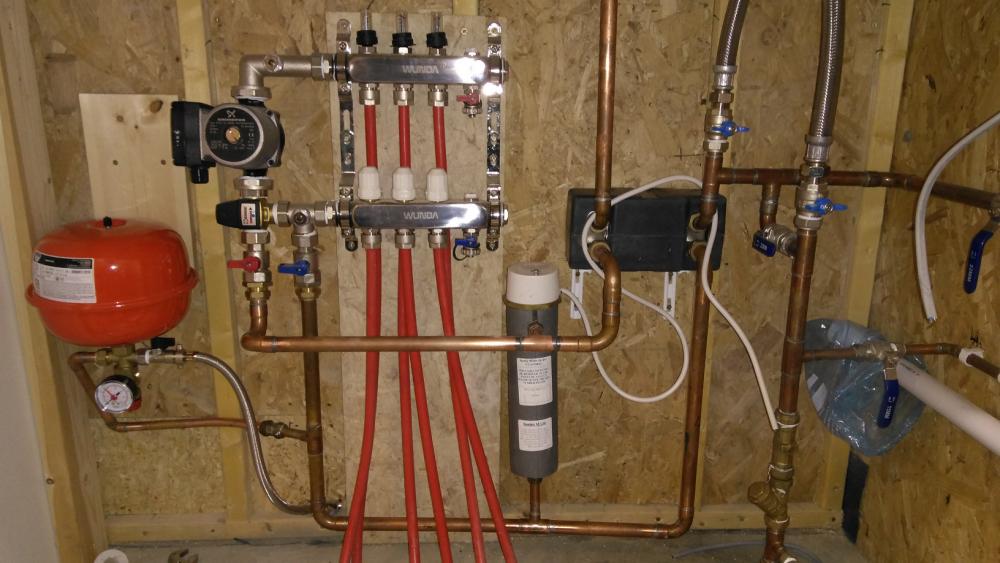
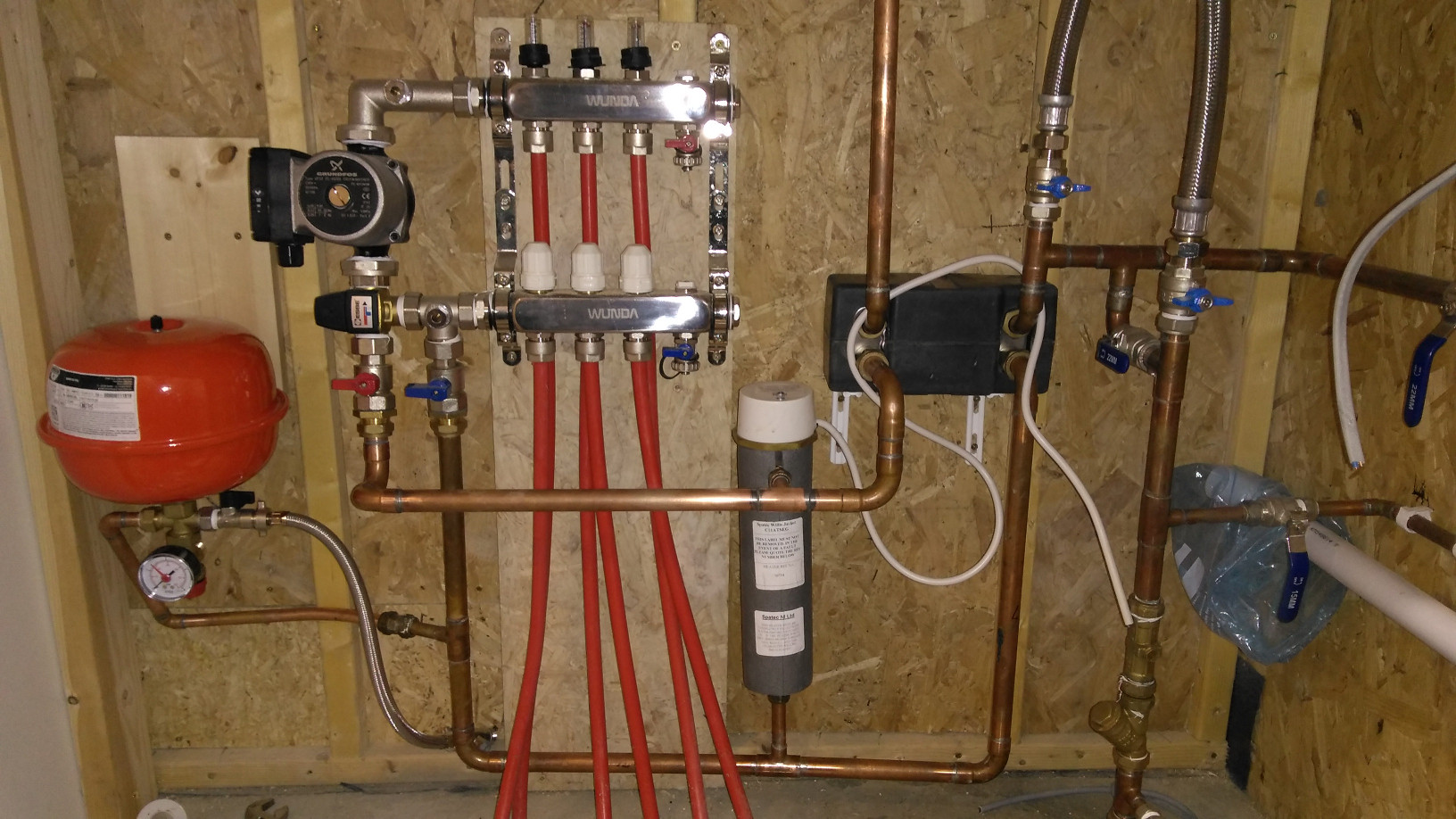
Here is the latest post with a picture. Not a lot to it for the heating system to heat a reasonably large four bedroom house. I've since completed the PRelV line plumbing and pressure tested the entire potable + UFH system. I need to put in the electrics so I can commission this, and I plan to do this in the next few weeks. At this stage, I will be able to do some commissioning runs to validate the modelling. -
Controlling underfloor heating in passive house
TerryE replied to dogman's topic in Underfloor Heating
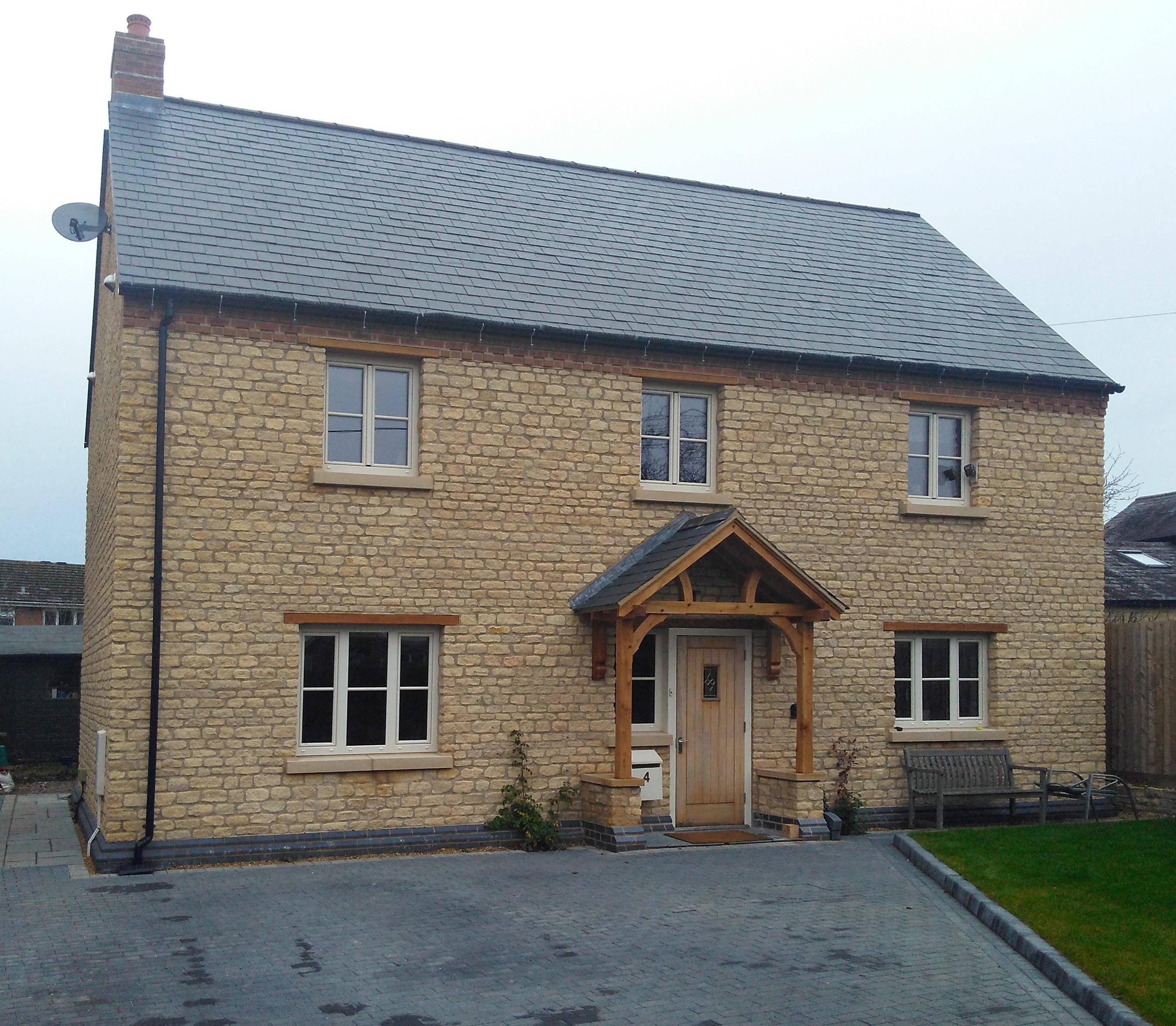
@ragg987, I understand your point about varying demand as a general issue, but in my case I have an MBC class passive twinwall frame with blown cellulosic filler and an outer 125mm stone skin. So the decrement delay from the external environment is a couple of days. Another point is that we aren't in love with acres of glass. Our windows on the front elevation were limited by planning restrictions. We have no side windows for the same reason. To the rear we overlook a 1970s estate. Our windows aligned on an ESE and WNW facing, so we catch the sun morning through midday on one side and late afternoon on the other, so my average solar gain varies from ½kWh/day in the winter to 2½Wh/day midsummer To keep our house warm in the coldest months, I only need about 1kW averaged over the day which only requires the slab at a couple of degrees warmer than room temp (on average) to achieve, and solar gain isn't a large percentage. Topping up the heat in a single 6 hour burst is only going to give a ~1°C ripple on room temp and I am quite happy for our house to swing from 21-22°C for example. The rate of change (of the order of 0.1°C per hour) is really too slow to be noticeable. At the moment we are planning to use off-peak electricity to do our bulk heating. Detailed modelling supports that this will work fine in our house, but until I've collected a year's had data, I won't know for sure and whether my modelling has missed something. At the moment I can't make the payback vs investment case for installing an ASHP, but if the data indicates otherwise or summer cooling becomes an issue, then I will add an ASHP. But still no buffer tank. But all-in-all your template seems well optimised for your use and house design. Ours is a more compact cottage-style (70m2 × 2 floors + 35m2 warm loft rooms). -
A little knowledge too late Still the only ones who might hear the pump will be sitting in the ground-floor toilet. (h is optional).
-
Controlling underfloor heating in passive house
TerryE replied to dogman's topic in Underfloor Heating
Jeremy, I understand that you have a system that works beautifully for you and given that you've already bought it, installed it and tuned it to meet your needs then there is absolutely no valid reason for you to consider changing it. However my position is that using a buffer tank is not to only method of controlling the heating of an MBC-style slab and passive build. There is an alternative approach and by adopting it, this considerably simplifies my potable water + UFH heating design and implementation. At the moment my entire UFH system is under a shelf in an area some 0.8 × 0.3 × 1.4 m³ in volume. The only mechanical component is my Gunfos pump. I can add an ASHP simply within this envelope if I have to. The only place I could put a buffer tank would be on the second floor in my storage room so if I went this route then I would need to house it and add pipework from the ground to the second floor. We both have partners that lack our technical background, and so share the "what if I drop dead tomorrow" risk. In my case my son-in-law is equally into RPis and ESP8266s and IoT hacking, so I have to implement my system in a way that he can understand and maintain it should this happen. However I also suggest that your wife would also struggle to maintain or repair or find someone to do this for your system. Yes it might comprise off-the-shelf components, but the system as a whole is configured in a way that is very different to typical UFH systems. We are both pioneers / evangelists of this type of system. We are adopting variant approaches, that's all. Your design works. I have designed and built mine largely informed by your blogs and experience, but with slightly different design goals. And I am extremely grateful to you for this knowledge. I will soon find out whether mine works as I've modelled it. As far as a "complex, multi-sensor control system" goes, I think that we need to separate out the extensive logging and analysis (that I might need to do to validate and tune my concept) from its final stripped down implementation. For example, I don't think replacing the analogue temperature gauges in the Wunda manifolds with a couple of DS18B20 temperature probes and linking them into Node Red, OpenHAB or Pimatic with a 3 line control rule to turn off the heating when the accumulated ΔT has reached some preset threshold is that complex an implementation. Others that follow are free to pick and choose and quite possibly either or both could end up as a standard template for future self-builders. -
Controlling underfloor heating in passive house
TerryE replied to dogman's topic in Underfloor Heating
This is why your ASHP is cycling. In essence there are two broad strategies for heating the slab. If you want to put a chunk of ΔQ joules of heat into the slab in a controlled fashion you can either: limit the power going into the slab, and you do this by limiting the ΔT of the heating water and hence you can allow the heat to be added over an extended period. If you do this and run your ASHP at a higher power output, then this heat has to go somewhere and that's the buffer tank. You heat up the buffer tank at a quicker rate and then trickle flow this heat into the slab. limit the energy going into the slab, and you do this by allowing the dynamics of the heat transfer dictate the ΔT as I explained in my modelling topic. You don't actively control the ΔT at all, except that you might want to set the maximum blend temperature as a safety stop. If you aren't controlling the ΔT then instead you need to control the Δt for which this power is applied. You compute this and apply the heat as single "chunk" (or possibly two chunks) per day. In the case of my electric heater, putting in a known ΔQ is easy since the power output of the heating element is known and fixed. In the case of an ASHP, even if I don't know the exact power response of the ASHP, it doesn't really matter since where ΔT is the temperature difference across the manifolds, cpthe specific heat of water and s the flow rate through the UFH. In other words since s and cp are fixed, the only thing that you need to control on is the integral of ΔT. For example measure the ΔT once per minute and add these up. Turn off the ASHP once this total exceeds some preset N Ks (degree seconds). This is easy if you are willing to use one of these instead of one of these . But even if you don't want to use an embedded server to carry out control, then simple alternative asynchronous control strategies could be used for example: Simply run the ASHP for a fixed but settable time period. This will heat the slab by some overall temperature increment. Keep the pump running but then have a dead window to allow the slab temperature to even out. Say 4 hours. Trigger the next heating cycle when the water return temperature from the slab drops below some fixed but settable temperature threshold. Say 21.5°C By a process of trimming set the ASHP on-period (as per the first bullet) so that the heat pump only cycles one or twice a day. I realise that my whole approach has been documented as a set of evolving discussions on various topics, some of which includes maths which will lose some readers. But my core approach is that it seems sensible avoiding having to buy and install a 100 ltr buffer tank when I already have a 10 tonne slab that I can use for this purpose. Let me do a summary write up as a blog post.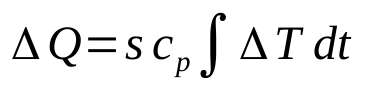
-
Controlling underfloor heating in passive house
TerryE replied to dogman's topic in Underfloor Heating
But did you open your blender to 30°C for this test and have you pump at the minimum setting? If the ASHP isn't being throttled by the blender then the delta should be at least 3°C and the higher the flow rate the lower the temperature delta. -
IMO No. I wouldn't expect to fill it with the pump running anyway.
-
Controlling underfloor heating in passive house
TerryE replied to dogman's topic in Underfloor Heating
I may still decide to install an ASHP, especially if we need to cool the slab during the peak summer months. I would still stick with my configuration of using the slab itself as my buffer store, but do as @jack does and set the ASHP to a target temperature of 27°C say and my blender valve set at 30°C so that the ASHP will not be slab limited, and run it in chunk mode as I describe in the Boffin's thread, rather than use a room thermostat. The lags and time constants are such that you can't do this stably without a buffer tank. So all my Home Automation system will be doing is to turn the ASHP on for N hours overnight with a possible top up during the day. -
Controlling underfloor heating in passive house
TerryE replied to dogman's topic in Underfloor Heating
Jeremy, I feel that these two statements are mutually contradictory. As I think that I explained on the Boffin's thread, you will get this sort of behaviour if you set your blender target temperature too low. Our slab will take 3 kW at 21°C with the input at around 27°C and return at around 24°C, with the 3°C representing the delta temperature of heating our UFH circuits at a 1m/s flow rate which is what the Gunfos pump will do at setting I with our 3×100m loop configuration. Have a play with the analytic steady state solution to the radial 1D heat equation. You need the UFH circulation to be at least 3-4°C hotter than the baseline slab temperature to pump 10W/m into the slab, and you've got the 3°C ramp over the length of the loop. If you limit your rercirc temperature to 25°C then you will be hard pressed to put a 1Kw into the slab. Try to push any more at this blender setting, and your heater is going to have to cycle. @jack feed his ASHP directly into the slab; no buffer tank. IRC, he just runs his ASHP on a timer. Anyway, I'll be doing heating trials in a month and I will be able to characterise and compare our real slab and compare this to model predictions. -
Controlling underfloor heating in passive house
TerryE replied to dogman's topic in Underfloor Heating
@dogman, I used a Wunda pumpset simply because it was the cheapest way to buy the pump and connectors. If you look at my setup then you will see that I have a TMV blender but since my circulation is always cooler than its minimum setting, it will always be open. I have a PHE for a different reason, but this could just a easily be used to link in an ASHP. Also read my blog post on heating the slab and the linked Boffin's corner article. I currently use an immersion heater in a Willis jacket for heating my slab. IMO, if you aren't using the buffer to preheat the DHW, then you don't need one unless you have a gas boiler. You can modulate the output temp of the ASHP down to room temp + 7°C say and at this temperature you can pump the headt directly into the slab and use the slab as the buffer. -
Controlling underfloor heating in passive house
TerryE replied to dogman's topic in Underfloor Heating
@dogman, you've got an MBC frame and slab. You will need to put maybe 1kW of heat on average into the slab in the coldest and darkest months. By all means use 3 or 5 pumps but why? Likewise you can pump heat from zone to zone or you can take the simple path of running all loops in one zone at a comfortable temperature. Yes, you can make you heating design complex, or you can make it very simple. Your choice. @PeterW did you follow my Boffin's corner topic? I can see why a buffer tank will work, but I don't understand why you need one. -
You'll have to get used to that one! They'll pay you back by turning up at 07:00.
-
If Mick, Danny or Pete are in the crew, then say hello from Jan and Terry in Hartwell. ? And in terms of foul drainage and access pipes, they dug them in after the site had been levelled. It was the easiest way to do it. I took the XY measurements from the nearest wall line / corners of the CAD drawings for them. This way we could place them to within 25mm or so relative to the outer ring beam. Our builder later dug the drains to meet up with the now buried tails poking out from the slab area.
-
This sort of cladding is a quite common in Ireland. Watched some YouTube videos on it in the past.
-
You've my email. I think that we're free, but I better double-check with the boss I will ping you a confirmation.
-
Why don't come over one w/e and we can chat about this? Or I visit Roade.
-
Vijay, one thing to be aware of is the height of the water table and the soil type. 200mm hardcore on its own won't take heavy lorries if the underlying soil liquifies. This will a spread the top load and help to minimise wheel damage but you need something solid underneath. We have a firm clay 2 miles down the road. This will take really heavy loads if it is drained and free from surface water, but once wet, it looks like the brick clay in Ed's barrow. You might need to put in land drainage either side of the line that the lorries will use, and drain / pump this. OR used a lot more temporary subbase.
-
@joe90, I used the ESBE valve because in my system I don't generate enough power to need a valve, so I chose the simplest. But it's the Gunfos pump.
-
When did you buy your manifold. I've got the "premium manifold" which is the one that they are selling now on the Wunda website. This uses one of the port pairs for the two filler / drains. Is your manifold the previous generation? If looks as if the filler / drains on your are for left hand mounting and isn't listed on the website. Which pumpset have you got? Is it the one which can be mounted on either side? If so then one option would be to reverse the flow direction, that is have the pumpset on the right. Mine is designed for left hand mounting only.
-
So here is the UFH setup. There's one fill line missing; I was just about to fit it but Jan ordered me in for dinner. The Wllis heater is in between the UFH and the PHE.