


-rick-
-
Posts
1367 -
Joined
-
Last visited
-
Days Won
6
Everything posted by -rick-
-
Ideally UVC should be optimally placed for short pipe runs to the bathrooms/kitchen. Wherever that is (up or downstairs doesn't matter). I'm sure others will disagree with me but UFH manifold should be central and if that's not where the plant room is so be it. Can be built into a cupboard/bump-out/etc. Does need to be accessible but can be remote from other plant (unless you want to do lots of zoning or other complexity which this forum advocates against).
-
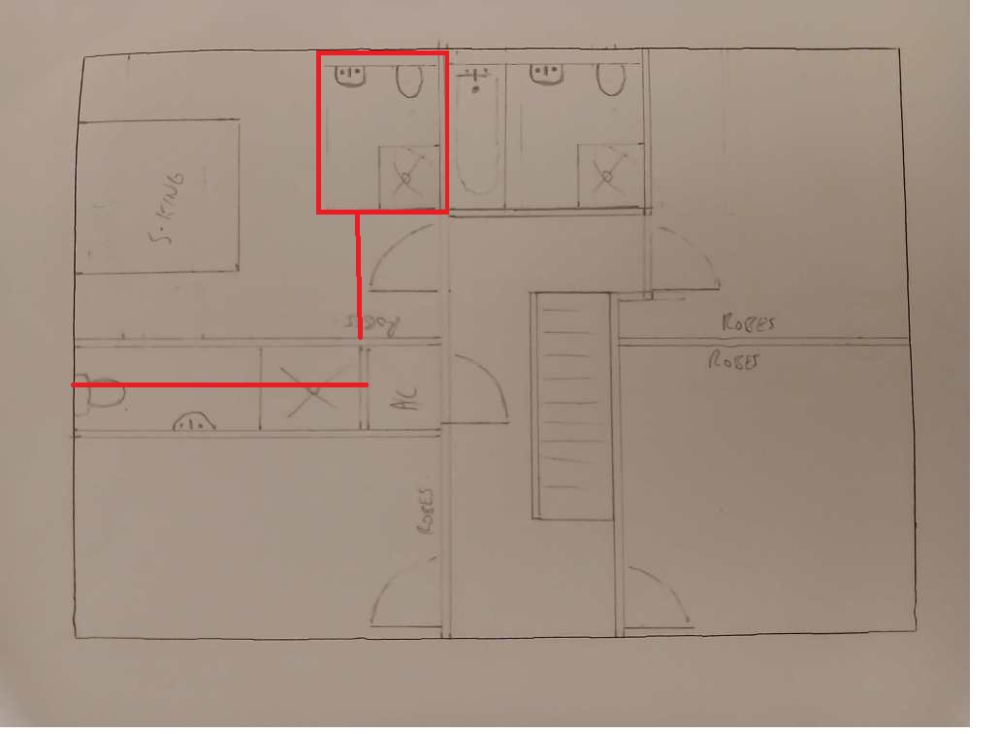
Yeh it's not perfect but my thought was not to steal space from the room, just reorient the space. I'm not doing this with a ruler so very handwavy. There is likely room to optimise space use between the two bathrooms if they back onto each other, etc.
-
The cupboards are on your plan to the right which might make this area pretty awkward. Personally I would go for larger doors if you want to market the property. Some people would be put off by small seeming ones.
-
Along these lines. Putting the stairs on the other side of the corridor might open up some flexibility as well. Edit: Personally, I'm quite keen on clustering bathrooms for ease of service routing, but even if that isn't a concern an arrangement similar to this provides the master with a buffer from noises from the shared bathroom and removes all bathroom noise from the bedroom adjoining the master. Btw, it's not entirely clear which room is which, the measurements didn't make sense to me.
-
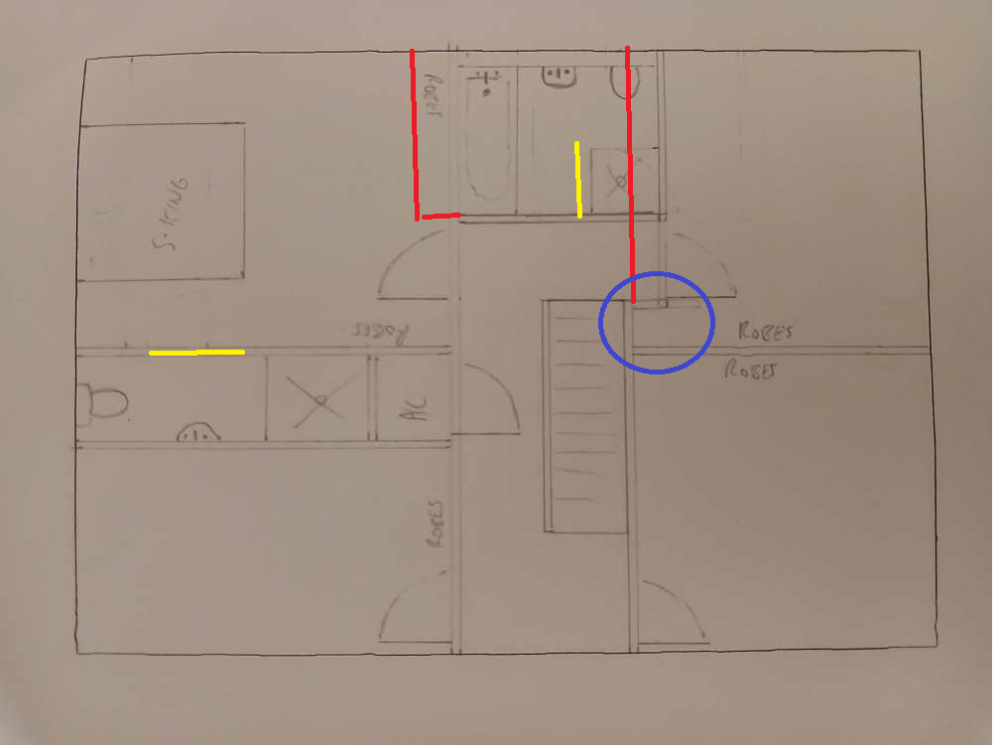
Some initial thoughts: 1. I don't like the blue area. Was thinking you could move the bathroom over a bit to avoid it but then realised you might have regs problems with the door directly at the top of the stairs. Not actually sure pushing the door back as you've done is good enough for regs. 2. Doors to the bathrooms seem awkward, especially the en-suite. Guess a pocket door makes it work but maybe better layout options available. 3. Feel like there might be some better layout options overall but still thinking.
-
Yes, your bills will be higher than in a well insulated house. That's a fact. But as Nick, my mum and many others can prove uninsulated houses can be heated. Right now you don't think your house is capable of being heated and I think it's important to firstly prove this wrong. Then once your house is up to temp you can work out what the bills would be do keep it warm. Once you know what it costs to heat you can work out whether it will cost less money to make improvements to lower bills vs just paying higher bills. You could do this, but it's going to create a huge mess, cost a lot of money and quite possibly not save any money on running costs (make you feel warm). Better to prove the house can be heated first. My guess is that the most cost effective improvements are in the upstairs rooms, but only if you run the house with minimal setback. With 2ft thick walls if you let the house go cold it will take ages and a lot of energy to warm back up again. I think you might be getting things mixed up here. As long as you keep the upstairs at approximately the same temp as downstairs you don't need insulation in the floor. The earlier discussion was about stopping loft air getting behind the plasterboard. I did mention the possibility of putting fluffy insulation in the floor void if it was accessible but it wasn't the main point. Why do you say this? A setback is very standard. But it should only be a few degrees. The bigger the difference between daytime and nighttime the less effective the heating system will be.
-
Please pause for a minute and reconsider this. I'm not convinced your system will work well if you set such a low set back. If you want your bedroom to be cold at night thats fine, but the rest of the house needs to be kept warmer. Try to think about your bedroom seperately from the rest of the house. You can turn the radiator off in your bedroom before you go to sleep and turn it back on in the morning. At least to start with. If that works out we can improve things. As to noise, now that you have replaced the previous system you shouldn't really be hearing any noise inside when the system is on. Do you? If the room it's in is cold then it's better than I thought when it sounded like it was inside the cupboard with a cylinder. However, it's still not great. As your house warms up the upstairs will inevitably warm first. Yes you could set the thermostat to say 20 with the aim of getting the downstairs to 18 but I suspect given your thick walls that still won't work well. You've said you don't want the controller in the sitting room. Why not? it sounds like the perfect place for it? If you don't like the screen being on then I suspect theres a way to turn it off when you aren't pressing buttons. If you don't like the way it looks there's likely a way to disguise it (though it needs good airflow around it).
-
Ah sorry, that may have lead to some confusing conversation then. Good, There's too many things going on here. To repeat my view, lets keep things as simple as possible until you have the temperature of your place under control. After that we can tune things if needed.
-
Would have thought that would depend on both what you put in it and also what type of machine it is. ie, does it vent air to the room or not. AFAIK heatpump dryers don't cycle the air in the drum outside the machine. If the clothes are cotton, I'm not sure where the plastic comes from. If you wash a lot of nylon/polyester then sure.
-
And if you try to insulate these pipes the cooling effect in the room would reduce which might be a negative... ... because I'd expect the heat sources to vary over the year. Winter will be the heating system, summer will be the solar electronics working flat out.
-
Sounds like a really successful build if this is the main worry after moving in! Not an expert but the little plant room that I have (boiler, cylinder, consumer unit with a few electrical bits) is similar, gets a lot hotter in summer. 27C isn't really going to worry electronics etc. I'd monitor over summer and if you find the room getting about 35C or causing other problems then may be worth doing something but 27C doesn't warrant much concern in my book.
-
I thought you had previously told us the flow temperature was set to 46. I'm not suggesting you change it. If it's something else tell us what it is. In reality the best flow temp is one that varies depending on the outside temperature. It's higher when its colder and lower when its warmer outside. But that's all to complicated to worry about right now. I'm trying to get you to focus on just the most important things. Everything else can be looked at in future.
-
@zoothorn Don't go changing settings you don't need to. 46 is fine. @marshian and I may debate what is best, but what you have is plenty to get your place warm. 46 is a perfectly normal temperature for someone with radiators. 'Medium' if you like. If it was over 50 it might be an issue. Long term lower may be better but it really doesn't matter right now when you are cold. Just focus on adjusting the timer. Maybe as a learning exercise set yourself the task of changing the evening heat period from 2 hours to 3 hours. Change nothing else. Just extend that time from 2 to 3 hours. Once you've done that we can talk about other changes. I've been busy today so will reply to the other stuff tomorrow.
-
Exploring the ratios and losses between building elements
-rick- commented on SteamyTea's blog entry in Energy Ideas
A developer actually drilled through into the Northern City line near me (site is close to Old Street). They were piling foundations. Could have been very nasty. -
I'd very strongly advise not touching it at all right now. Zoot has mentioned that this new system is the first time he has felt as if the system is working and outputting some warmth. Once the other issues we've talked about have been solved and the building is warm then we can talk about lowering this. But I think it's a really bad idea to lower it now before we have got the building warm. Zoot, in my view, you could increase the hot water temp to 55 rather than 46 if you want but don't touch the flow temp for the rads. Focus on figuring out how to adjust the timer and locating the thermostat in the right location.
-
Why not in the sitting room? What about at the bottom of the stairs? You can set up whatever periods you like in the timer. Lower temp at night higher temp during the day is about the simpliest way to do it. As we have said repeatedly, setting it that low overnight means your system will be overwhelmed by the cold. To maintain a comfortable temperature during the day you will need to maintain a higher temp at night. Having the temperature set a bit lower overnight is fine, but more than a few degrees will cause the heatpump too much work and the house will become too cold to heat. I know this sounds wrong to you and you don't like the idea, but all we are asking is you give it a go. We can work with you to find a solution for your bedroom so you can sleep comfortably, but the rest of the house should be kept relatively stable temperature (+/- 2-3 degrees).
-
But equally, your heatpump will produce more heat output per unit of energy input the lower the temperature. So if your set the output temp to 55C it might take 1kw input to produce 2.5kw output. But if you set the output temp to 35C it might take 0.5kw to produce 2.5kw output. So double the amount of heat for the same money. Zoot said his current flow temp is set at 46C. That sounds fine for now to me. I would leave that as is. The aim is to set it as low as possible while still outputting enough heat to be warm. Right now there are other issues stopping zoot from warming up.
-
Brexit hasn't helped either. A lot of the high paying finance jobs have dispersed and the young Europeans who used to flood london also.
-
If you do this the advice I've seen which seems like a good idea is to put the sensor inside a pipe/conduit with the end sealed to stop concrete getting in. That way if something goes wrong with the sensor you can pull it out and push in a new one. Can use either an extra length of PEX or flexible electrical conduit. PEX might be the better option as long as your sensor fits inside.
-
Thinking about this some more, I'm not sure this is a good idea. Zoot had this convo with Octopus a while ago. We are still in Winter and bills lag, so the surplus may be lower now. Zoot also has a new heatpump with a different setup and at this point it's unclear if it's drawing more or less energy. So leaving the Octopus surplus there gives a bit of buffer against surprises. As @sharpener has said this may be a little tricker on this model heatpump and there are some advantages to using the Valliant controller. So if what Zoot has can be made to work then it's worth trying that first. But if that is too difficult for whatever reason then switching makes sense.
-
Not entirely sure I get you. When I've thought through sequencing on this, to get this style I think you need to install the custom door frames in before plasterboard (definitely before skimming). This would the require protecting these frames so if I did that I'd build temporary protection frames around those frames. Those frames in turn should provide a standoff from the metal trim and therefore protection. Still, a lot of work. Edit: Read your post again, clearly you said corner beads and I was thinking about beads around doorways. Still a little confused as the bulk of the corner beads is the same as a normal wall. Guess you are talking that the area where the bead is mitred into the shadowgap beads at the bottom? If so, seems like an easy way to avoid that problem is to put some temporary rough skirting in the corners to avoid bumps?
-
The other option with porcelain/ceramic tile is to have mitred edges with a sliver of face tile on top resin bound. Load of extra labour in it though.
-
Exploring the ratios and losses between building elements
-rick- commented on SteamyTea's blog entry in Energy Ideas
My slightly more nuanced take: It's an interesting idea that I have considered. Not for GSHP though as I suspect it's not a big enough area for that. My thought was to use the water direct for either cooling in summer (would also warm/recharge the soil for winter) or as pre-warmer for MHVR in winter. With no heatpump in the loop freezing would be a low probability. In a PassiveHaus class building then maybe a tiny water to water heatpump would be possible to top up heat but wasn't where my thoughts were leading and I think all the GSHPs available are way too big. Main concern was if it would cause problems with drying out under the slab and potential movement/insurance issues and I think for this reason it's worth ruling out even if the maths add up. (Not that I did the maths) -
Haha, wondered if you'd say something like this. You can have fun or efficient not both
-
Yes. Another way I've seen this explained is which of the following is the more efficient way to drive 100 miles: 1. Drive at 70mph constantly (maybe occasionally slowing down a little for traffic but basically staying at 70) 2. Everytime you see a gap in traffic you floor it accelerate as fast as possible until you hit traffic then you stop the car, wait for another gap to open up then floor it again.



